

What if the best destination isn’t the one with the most “favorable” planetary line, but the one that fits the experience you want? If you’re asking, “where should I travel based on my birth chart,” it’s natural to want a clear answer. Yet a map full of lines can be hard to translate into an itinerary, especially if you’re unsure what the planets and chart angles mean.
Astrocartography maps birth-chart themes across locations around the world. It offers a symbolic way to reflect on how different places relate to your intentions, not a guaranteed answer about where to go. Your budget, travel dates, interests, accessibility needs, and preferred pace still matter.
This guide shows you how to compare destinations based on your travel intention, read planetary lines alongside their chart angles, and turn the interpretation into a grounded shortlist. You’ll also learn why birth-time precision matters and how to use astrological themes as prompts for reflection, not predictions. Treat the map as a framework for asking better questions about a place, then decide what belongs in your journey.
Key Takeaways
- Start with the travel experience you want, then use astrocartography to explore locations through your birth-chart themes.
- Read planetary lines and chart angles together: the planet suggests a theme, while the angle gives it context.
- To answer “where should I travel based on my birth chart,” compare destinations by intention, chart symbolism, and practical fit.
- Build a shortlist by weighing chart insights alongside travel dates, accessibility, companions, and personal comfort.
- Use 12th House astrocartography mapping to explore location themes, and Lala to ask follow-up questions and reflect on interpretations.
Where should you travel based on your birth chart? Start with the location question
Where should I travel based on my birth chart? Start by defining what you want from the trip, rather than searching for one universally “best” place. Astrocartography maps birth-chart themes across locations. Its lines can offer prompts for reflection, but they can’t guarantee a particular experience or outcome. A place may feel meaningful in the symbolism and still not suit your dates, budget, or travel style.
Use the map to shape a question, not make the decision for you. For example: “I want a restful trip with room to reflect. Which destinations might be interesting to explore through that lens?” This approach gives you a consistent frame for interpreting the map. For broader foundations, the astrocartography pillar guide explains how to read the map’s structure. Locational Astrology on Wikipedia also surveys astrocartography alongside other location-based astrology techniques.
What information connects a birth chart to a place?
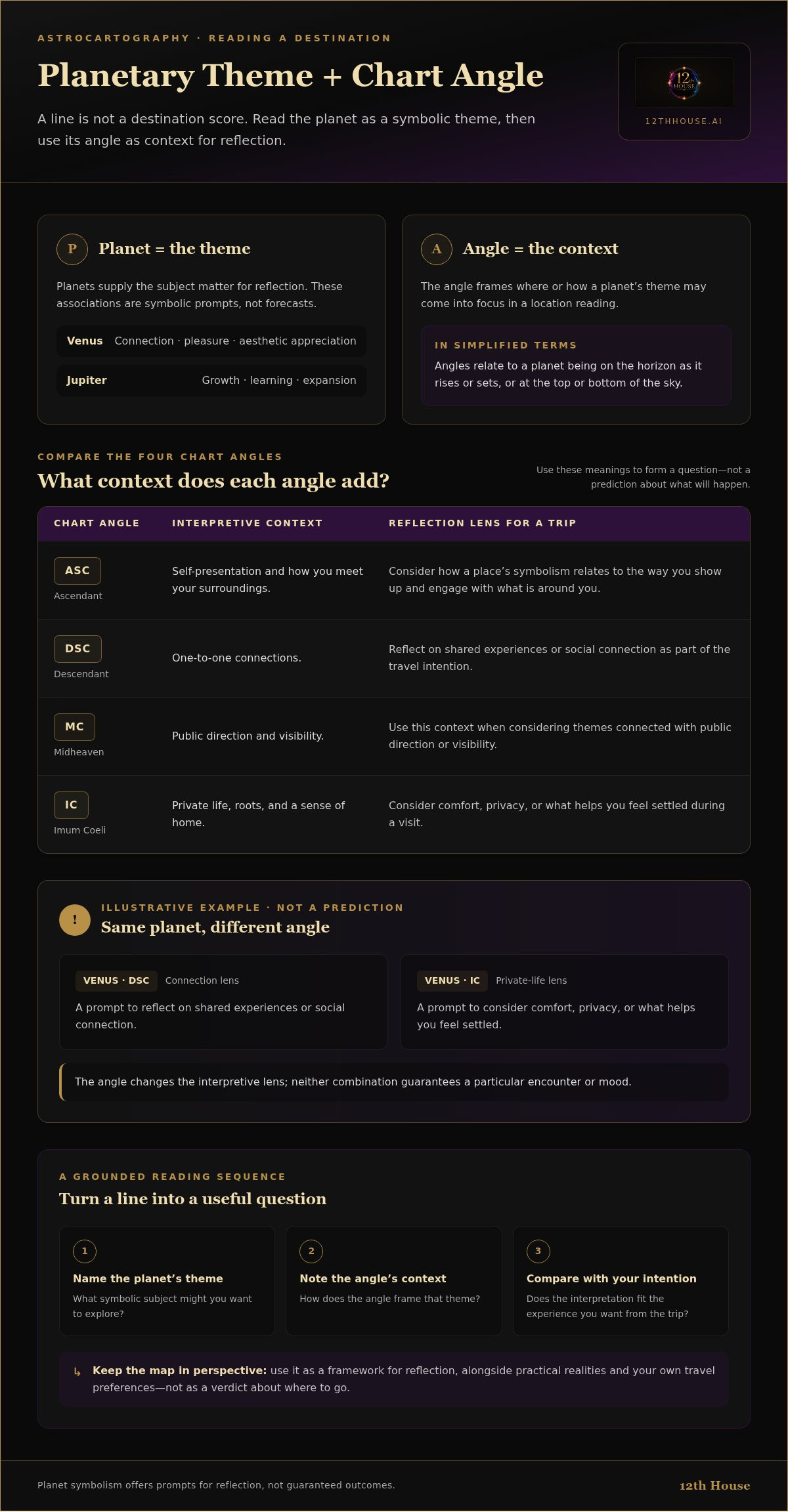
A natal chart is calculated from your birth date, birth time, and birth location. Astrocartography uses that chart to map where planets align with key chart angles around the world. In simplified terms, those angles relate to a planet being on the horizon as it rises or sets, or at the top or bottom of the sky.
Birth time matters because it helps determine those angles. Even a small difference can shift where a mapped line falls, so an uncertain birth time makes location interpretations less precise. If your birth details are incomplete or approximate, treat the map as a broad symbolic framework rather than a fine-grained way to distinguish between nearby destinations. Precision can support interpretation, but it doesn’t make that interpretation certain.
How is a travel question different from a relocation question?
A travel question is temporary and specific. You might be looking for rest, discovery, creative inspiration, or connection during a visit. A relocation question has a longer horizon: it involves considering a place as a home and weighing the demands of daily life over time. The same map can inform both kinds of inquiry, but your intention changes what you’re trying to understand.
Imagine comparing two destinations. For a short creative retreat, you might ask which location’s chart symbolism feels aligned with experimentation or inspiration. If you were considering a move, the question would widen to include routines, work, relationships, and whether the place suits your longer-term needs. Neither question has to produce a single astrological verdict.
The same destination may hold different meaning for different travelers, and its symbolism is only one part of the choice. Let your trip purpose set the frame. Then consider the chart alongside practical realities, keeping the final decision in your hands.
How planetary lines and chart angles describe a destination
A planetary line isn’t a score that tells you whether a destination is objectively good or bad. In astrocartography, it marks a place where a planet’s symbolism is emphasized in relation to one of the chart’s angles. Instead of asking, “Which line is best?” ask, “What theme might I want to explore here, and does it fit this trip?”
A planetary line suggests which symbolic theme to consider, while its chart angle frames where or how that theme may come into focus.
This is a symbolic framework, not a promise that a place will produce a specific event. National Geographic on Astrocartography offers a mainstream look at how travelers are using the practice to think about destinations. Keep that distinction in view as you ask, “where should I travel based on my birth chart?”
What do the planets contribute to a location reading?
Planets supply the subject matter. In common astrological symbolism, Venus is associated with connection, pleasure, and aesthetic appreciation, while Jupiter is associated with growth, learning, and expansion. These associations offer a vocabulary for reflection, not a forecast. A Venus line doesn’t guarantee romance, and a Jupiter line doesn’t promise an effortless or successful trip.
A theme may feel supportive, challenging, or simply more noticeable, depending on your chart and your own experience. Ask what it might invite you to notice. Connection could mean time with a companion or a deeper appreciation of art and culture. Expansion could mean studying something new, not necessarily pursuing a grand adventure. No planet is automatically the right choice for every traveler.
What do the Ascendant, Descendant, Midheaven, and Imum Coeli add?
The chart angle gives the planetary theme context. The Ascendant (ASC) relates to self-presentation and how you meet your surroundings. The Descendant (DSC) relates to one-to-one connections. The Midheaven (MC) concerns public direction and visibility, while the Imum Coeli (IC) points toward private life, roots, and a sense of home.
Illustrative example, not a prediction: Imagine comparing a Venus line near the DSC with a Venus line near the IC. You might use the first as a prompt to reflect on shared experiences or social connection, and the second to consider comfort, privacy, or what helps you feel settled. Neither guarantees a particular encounter or mood. The angle changes the interpretive lens.
Read the combination before drawing a conclusion. Name the planet’s theme, note the angle’s context, then compare that interpretation with your trip intention and practical preferences. To explore these symbols on your own map, 12th House astrocartography mapping offers a way to examine location themes through your birth chart.
How to compare birth-chart travel destinations without treating a line as a verdict
A map becomes more useful when you compare places against the same travel intention. Before weighing lines, name what you want from the trip: rest, cultural discovery, creative focus, or time with people you care about. Then consider how each destination’s planetary and angle symbolism relates to that purpose. If a place has mixed themes, treat them as questions to explore, not automatic reasons to rule it out.
Chart symbolism is one input alongside budget, access, safety, and personal preference. A map can suggest themes to reflect on, but it can’t guarantee a trip’s quality or predict what will happen. Practical fit deserves equal attention: a compelling chart pattern won’t make inconvenient dates, difficult transport, or an unsuitable pace right for you.
Match the destination’s chart themes to your reason for traveling
Choose one primary intention first. For a trip centered on connection, you might consider whether Venus symbolism resonates; for learning or a sense of expansion, Jupiter might be relevant. These are starting points, not fixed rules. A quiet retreat could also involve social discovery, and a cultural trip might include time to rest. Keep your intention clear enough to compare places, but flexible enough to reflect what you value in practice.
Use a simple comparison table. The examples below are illustrative only; they don’t describe actual planetary placements for these destinations.
| Destination | Intended experience | Planet and angle to explore | Practical fit |
|---|---|---|---|
| Candidate A | Creative exploration | Venus on the MC, as a prompt to consider visibility, art, or public-facing experiences | Works with your travel dates and has activities that interest you |
| Candidate B | Rest and inward focus | Moon on the IC, as a prompt to reflect on comfort, privacy, and a sense of settling in | Offers a pace and setting that feel comfortable to you |
What should you do with crossings, distance, and mixed signals?
A crossing may bring two planetary themes into the same map area. Rather than label it “good” or “bad,” ask how those themes might relate to your intention. Do they suggest a useful tension to reflect on, or a combination that doesn’t feel relevant to this trip? The answer is personal, and the map alone can’t settle it.
Distance from a line is another interpretive consideration, not a universal cutoff. How you read a line’s relevance can depend on the map and interpretive approach, so don’t treat one mileage figure as the boundary between “active” and “inactive.” Compare the broader context: the relevant planet and angle, your reason for traveling, other nearby map features, and what the destination actually offers.
Then make a grounded comparison. If one place aligns symbolically but conflicts with your budget or access needs, it may not be right for this trip. If another has subtler chart themes and suits your preferences, it may deserve a place on your shortlist. The question “where should I travel based on my birth chart” can focus your exploration, but the map can’t issue a verdict for you.
A practical process for turning your birth chart into a travel shortlist
A map can show many possible themes. A shortlist gives them a purpose. Use this process to move from an open-ended question to a few destinations worth researching, without letting chart interpretation replace ordinary travel planning.
Create a shortlist around one clear travel intention
Write one sentence about what you want from this trip, such as “I want a restful week with time outdoors” or “I want to explore art and local culture.” Then choose a manageable set of places you’re genuinely interested in. You don’t need to scan the entire world. For each place, record the relevant planetary and angle themes so you can compare them against the same intention.
- Name your intention. Be specific enough to guide a choice. “A change of scene” could mean quiet, novelty, creative focus, or connection. Decide which matters most for this trip.
- Select candidate destinations. Start with places you’re curious about or that could work logistically. Keep the list small enough to assess carefully instead of chasing every line on the map.
- Record the chart themes. For each destination, note the planet and angle you’re considering, plus what that combination brings up for you. Treat the interpretation as a question to explore, not a description of what must happen.
- Compare the practical fit. Review the dates, journey demands, accessibility, budget, and available activities. If you’re traveling with others, include their needs and preferences in the decision.
- Choose, then stay curious. Weigh the symbolic and practical notes together. Pick the destination that best fits the whole picture, and let the trip show you what the place is actually like.
Test the shortlist against the realities of the trip
Give each option three brief notes: what feels compelling, what remains uncertain, and what may be impractical. A destination might have chart symbolism that resonates, yet require a pace or type of journey that doesn’t suit you. Another might feel less striking on the map but offer the access, comfort, or shared activities that make the trip workable. Keep both kinds of information visible.
Separate research from interpretation. Use practical sources to review travel dates, transport, accessibility, and the realities of traveling with your companions. Then return to the chart as a reflection layer: does its symbolism deepen your interest, raise a useful question, or feel unrelated to this trip? Any of those responses can help clarify your priorities.
A short visit is an opportunity to experience a place, not proof that it’s destined to suit you. Your mood, plans, company, and circumstances all shape a trip. Keep the decision yours. To apply this process to your own birth data, explore your astrocartography map as one more lens for building your shortlist.
Explore travel themes with 12th House astrocartography and Lala
You’ve defined what you want from a trip and how you’ll compare chart symbolism with practical fit. Now use a map to bring those ideas into focus. 12th House astrocartography mapping lets you explore location themes through your birth-chart lens. It doesn’t identify a guaranteed ideal destination. Instead, it gives you a structure for examining places you care about and considering what their chart themes might mean to you.
Use an astrocartography map to explore places that interest you
Begin with a destination on your shortlist or a clear intention, such as cultural discovery or creative focus. Look at the relevant planetary and angle themes, then ask how they connect with your purpose for traveling. A map can help you compare places through a consistent lens, but it can’t tell you whether you’ll enjoy the food, feel comfortable getting around, or prefer the pace of the trip. Those questions belong in your practical research.
Keep your notes specific: record the location, the chart theme you’re exploring, and why it seems relevant to your intention. If an interpretation feels compelling, consider what you hope to experience there. If it feels unclear, leave room for uncertainty instead of forcing a meaning. The digital astrocartography map guide offers a deeper overview of the map’s structure and how to approach its themes.
Bring focused questions to Lala as you reflect
Lala is an AI spiritual guidance assistant for personalized follow-up questions about chart interpretations. Focus your question on the relationship between a theme and your stated intention. For example: “How might I reflect on this planetary theme in relation to a trip focused on rest?” Or: “What questions could I consider about this angle and my interest in cultural discovery?” A focused prompt keeps the conversation connected to your shortlist.
Use the response to generate reflection, not a final ruling. Compare any interpretation with your preferences and the realities of your plans. Does the theme help you clarify what you want? Does it bring up a concern worth considering, or does it simply not resonate? You’re free to accept, question, or set aside an interpretation. AI guidance can support your thinking, but it doesn’t replace your judgment, travel research, or the needs of your companions.
If you’re still asking “where should I travel based on my birth chart,” let the question open a thoughtful comparison instead of demanding one certain answer. Explore the map, bring clear questions to Lala, and keep your shortlist grounded in both symbolism and real-world fit. Explore 12th House to continue examining your travel themes through your birth chart.
Let your next journey begin with a better question
Your shortlist doesn’t need to produce a perfect answer. Let it help you notice what you’re seeking, which places spark genuine curiosity, and what practical conditions will make a trip feel right. The question “where should I travel based on my birth chart” can be a starting point for intentional exploration, not a rule you have to follow.
Choose one destination that interests you. Consider its chart themes, then look beyond the map: imagine the pace of the visit, the experiences you’d make room for, and how you want to feel while you’re there. Your plans can evolve as you learn more. Astrology can add perspective, while your judgment remains central.
Ready to explore your own location themes? Explore your astrocartography map with 12th House and use what you discover to shape a shortlist that feels both meaningful and workable. Let curiosity guide the first step, then make the journey your own.
Frequently Asked Questions
Do I need my exact birth time to use astrocartography for travel?
An accurate birth time helps you interpret angle-based map details because chart angles depend on the time and place of birth. If your time is approximate, note that uncertainty beside the locations you’re comparing rather than treating a line placement as exact. You might look for a family record or birth documentation before interpreting the map. Use uncertain data as a reflective starting point, not the sole basis for a major trip.
Can my birth chart tell me one exact city to visit?
No. A birth chart can’t reliably identify one required city or promise what you’ll experience there. If you’re asking “where should I travel based on my birth chart,” use the map to generate possibilities, then compare them with concrete interests such as museums, hiking, food, or visiting friends. A destination that fits your priorities may be a stronger choice than one that seems symbolically compelling but doesn’t suit your plans.
What if there are no planetary lines near the place I want to visit?
You can still visit and enjoy a destination even if no prominent line appears nearby. The map’s lack of a close line isn’t a warning, and it doesn’t erase your reasons for wanting to go. Consider what draws you there, what you’d like to experience, and whether the trip works logistically. For instance, a family visit or long-awaited event can matter more to your plans than a particular map feature.
Are astrocartography lines good or bad for travel?
Astrocartography lines are better treated as symbolic themes than as a simple good-or-bad rating. A theme that feels relevant to a social trip may not help you decide about a quiet retreat, and a challenging association doesn’t predict a failed journey. Consider what the planet and angle suggest together, then ask whether that interpretation is useful for your specific plans. Don’t let a label override your experience or priorities.
Can I use astrocartography for a weekend trip as well as relocation?
Yes. You can use astrocartography to reflect on a short visit, keeping your question proportionate to the trip. For a weekend away, consider what kind of experience you’re seeking and whether a location’s symbolism gives you a useful perspective. That’s different from deciding where to establish a home, which raises longer-term questions about work, routines, and relationships. A brief visit offers an experience, not proof of long-term fit.
Is astrocartography scientifically proven to predict travel experiences?
No. Astrocartography is an astrological interpretive system, not a scientifically established way to predict what will happen on a trip. You may find it useful as a symbolic prompt for examining your hopes or assumptions about a destination, but that’s different from evidence-based prediction. For decisions, use practical travel research to assess transport, accessibility, conditions, and other logistics. Keep the map’s role clear, and don’t treat an interpretation as a guarantee.
What is the difference between astrocartography and a relocation chart?
Astrocartography maps planetary relationships to locations around the world, while a relocation chart recalculates a birth chart for a particular place. They’re related approaches within location astrology, but offer different ways to examine place. For example, you might use a map to compare several potential trip destinations, while a relocation chart focuses on one location. This guide uses astrocartography for travel exploration rather than providing a full relocation-chart reading.


