

What if the Tower isn’t predicting disaster, but asking you to look closely at what no longer feels stable? It’s understandable to feel unsettled when this dramatic card appears, especially if you’re unsure what to do when you pull the tower card. But a tarot draw isn’t a guarantee that something terrible will happen. The Tower points to disruption, revelation, and structures under pressure. Its meaning depends on the question, the surrounding cards, and what’s happening in your life.
Start by pausing rather than reacting. This guide will help you read the Tower without catastrophizing, steady yourself after the draw, and use its symbolism as a prompt for grounded reflection. You’ll explore what the card can suggest in different contexts, how to separate a useful insight from a fear-driven prediction, and how to choose a considered next step. The aim isn’t to force a dramatic interpretation. It’s to examine what the card brings into view, then decide what deserves your attention.
Key Takeaways
- Read the Tower as a symbol of upheaval and revelation, not a fixed forecast of disaster.
- To decide what to do when you pull the tower card, note its position and your first reaction before looking up standard meanings.
- Interpret the card through the spread’s topic and position, using different reflective questions for work, relationships, and personal beliefs.
- Separate observable facts from assumptions and emotions before considering any response; the card alone isn’t an instruction to make a major change.
- Summarize the card’s relevance in one sentence, then revisit your notes later and compare your interpretation with what actually unfolds.
What the Tower tarot card means, and why it is not a guaranteed disaster
The Tower’s lightning, flames, and falling figures can feel alarming, especially if you’re new to tarot. The image is designed to command attention. But a striking picture is not a forecast. The Tower is a Major Arcana card traditionally associated with upheaval, revelation, and structures being disrupted. In a reading, those themes can invite you to examine what feels unstable, what is coming to light, or which assumptions may need closer scrutiny.
The Tower signals symbolic disruption, not a guaranteed real-world disaster. Tarot offers a language for reflection, not a verified or inevitable prediction of future events. Treat the card as a prompt to investigate a question, rather than proof that illness, loss, or catastrophe is coming. That distinction gives the symbol room to be meaningful without turning it into a source of fear.
What the Tower’s imagery can suggest
In many traditional decks, lightning strikes a tall tower, its crown is dislodged, and figures fall from the structure. The image can suggest a sudden interruption: something hidden is exposed, a fixed view is shaken, or a framework that seemed secure is challenged. The falling figures may represent the disorientation of that moment, not a literal event awaiting you. A familiar belief about work, intimacy, or your own identity might suddenly feel less convincing.
Artwork varies, and so does emphasis. One deck may make the lightning the central force; another may draw attention to the people, flames, or damaged architecture. The The Tower (tarot card) entry surveys the card’s history and varied symbolism, offering useful context for why interpretations aren’t identical across every tradition. Look closely at your own deck, then consider what its particular image brings to mind.
Why pulling the Tower does not mean disaster is certain
Traditional themes are not literal forecasts. If the question concerns a relationship, the Tower might prompt reflection on honesty or an assumption that needs testing. In a career spread, it could raise questions about change, pressure, or a work structure that no longer fits. Neither interpretation proves that a breakup or job loss will occur. The card’s meaning depends on the question, its position in the spread, and the surrounding cards.
Context is the interpretive framework. A Tower in a position about an obstacle may point toward a belief or pattern worth examining; in a position about a resource, it could invite you to question what truth or flexibility might help. Don’t isolate one dramatic card and let it overrule the rest of the spread. For broader foundations in reading cards together, explore this Tarot Mastery guide.
If you’re asking what to do when you pull the tower card, begin by separating the image’s intensity from the evidence in your life. Note what the card evokes, then return to the actual question and spread. A symbol can open a line of inquiry; it cannot, by itself, establish what will happen.
Pulling the Tower Card: A Calm, Practical Sequence
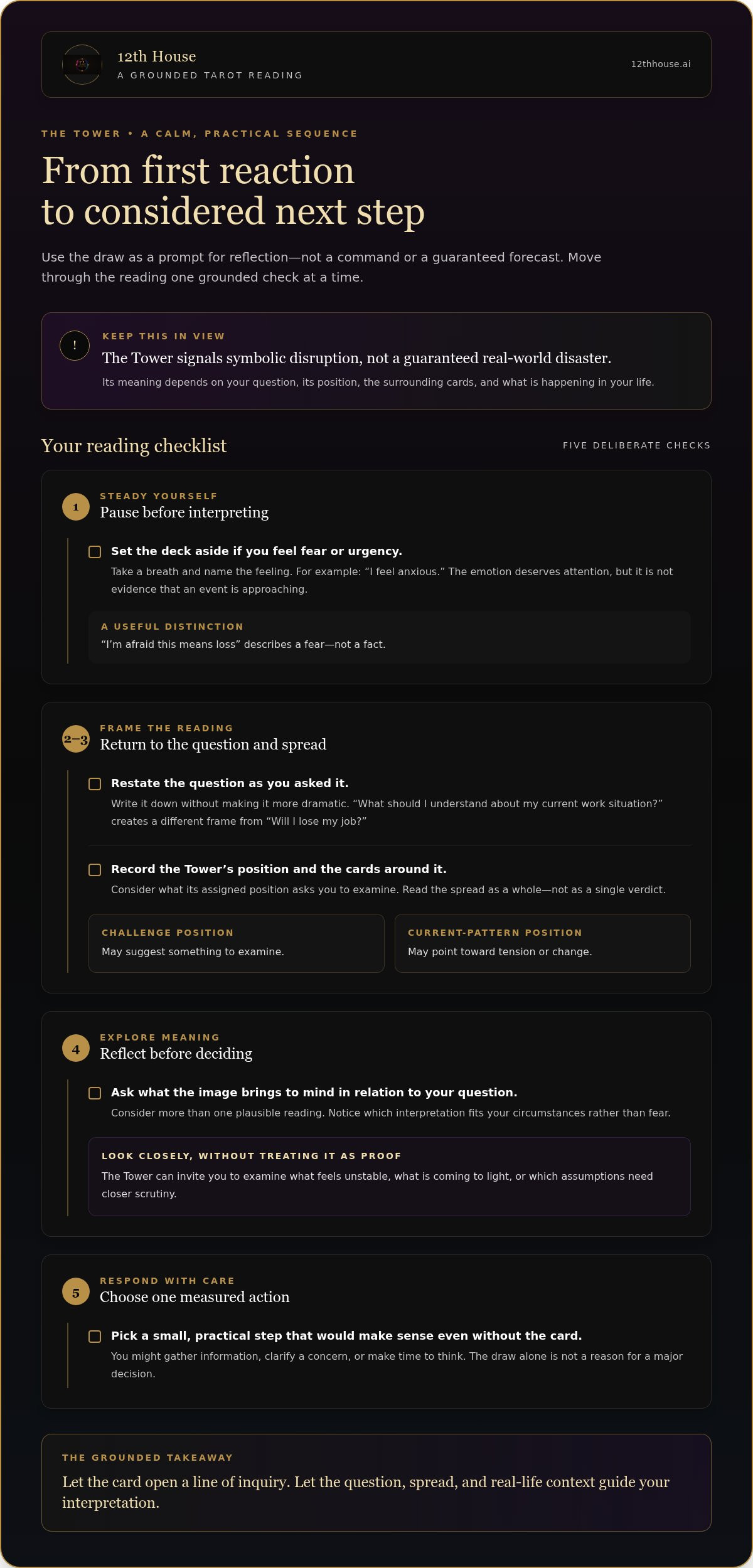
If the image has stirred fear, don’t rush to decode it. A clear process can help you move from first reaction to considered interpretation. Pause, record the draw, reconnect it to your question, examine the spread, reflect on what resonates, and choose one measured next step. The card can guide inquiry without issuing a command.
Before looking up meanings, write down the Tower’s position in the spread and your immediate response. Note the question you asked, too. This preserves the reading’s original context and helps you distinguish what you actually noticed from ideas you picked up afterward. If you’re wondering what to do when you pull the tower card, use this sequence as a way to slow the moment down:
- Pause. Set the deck aside briefly if the image triggers fear or urgency. Take a breath and name the feeling: “I feel anxious,” for example. That emotion deserves attention, but it isn’t evidence that an event is approaching.
- Restate the question. Write it as you asked it, without making it more dramatic. “What should I understand about my current work situation?” gives you a different interpretive frame from “Will I lose my job?”
- Inspect the context. Record the Tower’s position and the cards around it. A card in a challenge position may suggest something to examine; in a position about a current pattern, it may point toward an area of tension or change. Treat the spread as a whole, not as a single verdict.
- Reflect before deciding. Ask what the image brings to mind in relation to your question. Consider more than one plausible reading, and notice which is grounded in your circumstances rather than in fear.
- Choose one measured action. Select a small, practical step that would make sense even without the card. You might gather information, clarify a concern, or make time to think. Avoid treating the draw alone as a reason for a major decision.
Pause before interpreting the draw
There’s no need to force an interpretation while you feel activated. Put the deck away, step back, and return when you can consider the image with some distance. Naming your reaction can help: “I’m afraid this means loss” describes a fear, not a fact. When you’re ready, ask what the card could suggest besides the most alarming possibility.
Reconnect the card to the question and spread
The original question narrows the reading, but it doesn’t make the Tower an instruction. Look at its assigned position, then ask what interpretation fits that role and the surrounding cards. If several possibilities remain, keep them open. You don’t have to turn uncertainty into a definitive answer before the card can be useful.
For another structured perspective, Ask Lala AI Spiritual Guidance can offer personalized reflection questions to help you explore your question and its context. Use the prompts to deepen your own consideration, not as guaranteed predictions or a substitute for observable facts.
How to interpret the Tower in a spread without overreading it
The Tower’s role changes with the reading around it. A card in a position about a challenge asks a different question than one placed as a strength, influence, or outcome. Start with the spread’s structure, then connect the card to the topic you asked about. This keeps interpretation specific without turning one symbol into a complete story.
Use prompts as openings, not verdicts. The questions below translate the Tower’s themes into areas you can examine. Choose the one that fits your reading and circumstances; don’t force a connection just because the card looks dramatic.
| Reading topic | Reflective prompt |
|---|---|
| Work | Does a plan or expectation need review before I make a major change? |
| Relationships | Which assumption or communication pattern needs honest attention? |
| Personal beliefs | Which belief feels unstable, and what evidence supports that feeling? |
Questions to ask about relationships, work, and personal patterns
In a relationship reading, consider whether tension comes from a specific conversation, an unspoken expectation, or a recurring way of communicating. The card can help you notice a subject worth discussing, but it doesn’t tell you to end a relationship or confront someone. For work, pause over the difference between a plan that needs adjustment and a situation that truly calls for a major decision. In personal growth, ask what belief feels shaken and what you know, rather than fear, that supports this impression.
How surrounding cards and reversals affect interpretation
Nearby cards contribute context. They may suggest what part of the situation deserves attention or what response could help, but they don’t prove that a dramatic outcome will occur. Read each card in relation to its position and the question; don’t let a neighboring card cancel the Tower or dictate a fixed ending.
A reversed Tower has no single universal meaning. Some readers treat reversals as inward or delayed expression; others read them through the deck’s own system, the spread, or their established practice. These are interpretive approaches, not rules that apply to every reading. If your deck’s guidebook offers a reversal meaning, consider it alongside your own framework rather than treating it as authoritative. If reversals aren’t part of your practice, you can read the card upright and focus on the question and spread.
To decide what to do when you pull the tower card, test an interpretation against the reading’s actual structure. Ask: does this prompt fit the topic and position, or am I assigning it because I’m alarmed? You can hold more than one plausible reading at once. That disciplined uncertainty is useful: it keeps the card open to reflection while leaving real-world decisions anchored in evidence, values, and circumstances.
Turn the Tower’s message into grounded reflection, not a rushed decision
A powerful symbol can bring a concern into focus, but it shouldn’t make a consequential choice for you. The Tower doesn’t instruct you to end a relationship, quit a job, or confront someone. Instead, use its themes to form questions: What feels unstable? What information am I missing? Is there a real issue to address, or am I reacting to the card’s intensity?
A card can prompt inquiry, but it can’t decide what you must do. Treat its message as one perspective for reflection. Choices with serious effects deserve real-world information, consideration of your values and circumstances, and support suited to the situation.
A short journaling practice after a Tower draw
Give yourself a page and separate what you know from what you fear. Keeping these categories distinct helps prevent an interpretation from becoming evidence in your mind.
- Observed facts: What has actually happened? Record specific events or words, without adding a prediction.
- Assumptions: What are you imagining might happen, or taking for granted? Mark these as possibilities, not established facts.
- Emotions: What are you feeling, and how strongly? Naming fear, anger, or uncertainty acknowledges the response without treating it as proof.
- Possible responses: What options are available? Include waiting, gathering information, or asking for a conversation, not only dramatic changes.
Then write one open-ended question about a structure or assumption you want to examine. For example: “What would help me understand why this plan feels secure?” Close with one small, reversible step, such as reviewing a document, noting what you want to clarify, or setting a time to revisit the question. The aim is movement without pressure.
When the reading feels too intense
If each new pull makes you more anxious or confused, stop drawing for now. Repeating the question may keep you cycling through interpretations instead of gaining clarity. Set the deck aside and return your attention to present facts: what you can see, what has been said, and what you can verify. A frightening possibility isn’t confirmed just because a card brings it to mind.
If the reading connects to a serious concern, talk it through with someone you trust or seek appropriate professional support. Tarot can be a reflective practice, but it isn’t a substitute for practical advice about health, safety, work, or legal and financial decisions. Let the real circumstances guide those choices.
If you’re considering what to do when you pull the tower card, use reflection to clarify your own question rather than search for certainty. Explore personalized reflection questions with Ask Lala as one optional way to examine the situation from another angle, not as a source of guaranteed predictions.
Integrate the Tower card’s insight with a clear next step
Bring the reading to a useful close by summarizing what the Tower may represent for you in one sentence. Keep the wording reflective, not predictive. For example: “This card invites me to examine an assumption I’ve treated as certain.” That statement identifies an area to consider without claiming that a specific event is destined to happen.
Then choose a response that fits what you actually know. If the card raised questions about a plan, your next step might be to review the facts or identify what you still need to learn. If it brought a belief into focus, you might write down what supports it and what challenges it. A measured step turns interpretation into practical inquiry.
Build a personal record of tarot interpretations
Use a journal to create a record you can revisit, rather than relying on the most alarming meaning you find in the moment. For each reading, note:
- The date and the question you asked
- The spread position where the Tower appeared
- Your first reaction and chosen reflection prompt
- The interpretation you settled on and any next step
Return to the entry later. Compare your interpretation with observable developments, not with a prediction you may have come to expect. Over time, notice which prompts consistently help you reflect and which meanings feel driven mainly by fear. This record can refine your personal reading practice while keeping each draw connected to its original context.
Personalized digital reflection can also help you generate questions tailored to the issue you’re considering. For a broader look at that approach, the AI astrology assistant guide explores the idea of using a digital tool as a prompt for your own inquiry.
Use guided questions to continue the reflection
Ask yourself: What feels unstable? What do I know from direct experience? What needs a closer look before I respond? These questions keep the focus on discernment. Ask Lala can offer personalized tarot reflection questions to help you explore the question and its context. Treat it as a reflective aid, not an oracle or substitute for your judgment.
If you’re considering what to do when you pull the tower card, let the answer begin with a question, then choose a next step grounded in what you can observe. Explore 12th House’s tarot and spiritual guidance tools for another way to continue your reflection. The Tower can feel intense, but your response can remain steady, considered, and your own.
Let the next step be yours to choose
The Tower can make a reading feel urgent. You don’t have to answer that urgency with an immediate decision. Let the card open a question, then give yourself room to observe, reflect, and decide what matters in your actual circumstances. If you’re still asking what to do when you pull the tower card, begin with one small step that brings more clarity, not a prediction that demands a dramatic response.
When you want a structured space to continue, 12th House brings together tarot readings, Ask Lala AI spiritual guidance, and a metaphysical content library. Use them to explore your question and develop reflection, while keeping your judgment at the center. Explore 12th House tarot and spiritual guidance, and let your next move come from steadiness rather than fear.
Frequently Asked Questions
Is the Tower card always a bad sign?
No. The Tower can bring attention to disruption or a challenge to an existing structure, but it doesn’t guarantee a harmful event. For example, in a reading about a new project, it might prompt you to check whether your expectations are realistic before committing. Let the question, card position, surrounding cards, and your reading tradition shape the interpretation. Don’t treat the card as proof that trouble is on its way.
Does the Tower card mean a breakup?
No, the Tower alone doesn’t establish that a breakup will happen. In a relationship reading, use it to identify a subject for reflection, such as a misunderstanding that keeps recurring or an expectation neither person has discussed. Consider what you actually asked and how the rest of the spread relates. If there’s a real concern, base any conversation or decision on the relationship itself, not on a single card.
Can the Tower card predict death or illness?
No. A tarot draw can’t establish that someone will die or become ill, and it isn’t medical evidence or a diagnosis. If you have a concrete health concern, rely on appropriate medical care and information rather than trying to interpret a card as a clinical sign. For reflection, you might instead ask what uncertainty or change the image brings to mind, while keeping that symbolic question separate from health decisions.
Should I pull another card after drawing the Tower?
You can draw a clarifying card if you have a focused question and feel calm enough to consider the answer. For example, ask, “What perspective would help me understand this situation?” rather than repeatedly asking whether something bad will happen. Read the extra card as part of the original spread; it doesn’t erase the Tower. If each pull leaves you more unsettled, stop and return to the reading later.
What does the Tower reversed mean in a tarot reading?
There isn’t one universal meaning for the Tower reversed. A reader might interpret it as inner disruption or resistance, while another may follow a different system. Start with the guidebook or interpretive method you already use, then consider whether that meaning fits the question and position. For instance, a reversed card in a position about an obstacle might invite you to examine what you’re reluctant to acknowledge, not assume a fixed outcome.
What does it mean if I keep pulling the Tower card?
Repeated draws don’t prove that an event is destined. Check whether you’re repeating the same question, changing the wording, or drawing again because you want reassurance. Those details can help explain why the card remains central to your attention. Record each question and spread position; then look for a recurring concern you can investigate in ordinary life. If the process is increasing distress, put the deck away for now.
How should I read the Tower card in a yes-or-no question?
The Tower isn’t a dependable yes-or-no verdict. Instead of forcing a binary answer, use the draw to refine what you need to know. If you asked whether to accept a new role, for example, consider what information about responsibilities, expectations, or stability you still need before deciding. The card can frame a question for further thought, but your choice should rest on the facts and priorities relevant to the decision.


