

What if a yes-or-no tarot reading is less like checking an answer key and more like reading a map? If you’ve searched which tarot cards indicate a yes or no, you’ve likely found conflicting lists that assign the same card different verdicts. That doesn’t mean tarot is arbitrary. It means readers use different interpretive frameworks.
This guide covers cards commonly read as yes, no, or maybe, and explains why their associations can shift between decks and traditions. You’ll also learn how to choose an approach to reversals and interpret a card that doesn’t give a simple answer.
Start with a focused question, choose a consistent method, then read the card in context. A “maybe” can point to conditions, uncertainty, or a choice still in your hands. Treat the cards as prompts for reflection, not a fixed code or verdict on your future. The goal is to understand the symbols while keeping your judgment and agency at the centre.
Key Takeaways
- Use common yes-or-no tarot associations as conventions, not rules.
- Choose whether to read reversals and apply that approach consistently.
- Use a focused question and a clear method to make an ambiguous draw more useful.
- Record recurring symbols and interpretations to develop a personal framework without treating the cards as commands.
Which tarot cards indicate yes or no? Start with the limits of a simple answer
A yes-or-no tarot reading focuses on a specific question. It isn’t a guaranteed prediction. You might draw a card to reflect on whether to pursue an opportunity, clarify a concern, or notice what is shaping a decision. The value comes from examining the symbol and your situation, not handing your agency to a verdict.
So, which tarot cards indicate a yes or no? There’s no universal answer key. Associations vary with the deck, reading tradition, question, and method. A common card association is a useful convention, not a universal rule. Keep that distinction in mind before treating any list as definitive.
What does a yes-or-no tarot card mean?
“Yes,” “no,” and “maybe” are labels readers apply to cards, not meanings printed into them. The label gives a quick orientation, but the card’s imagery and traditional meanings provide the substance. Tarot has a layered history and more than one form; the overview of Tarot cards places divinatory readings within that broader context.
For example, a reader might associate the Six of Wands with “yes” because its imagery often suggests recognition, progress, or a visible win. The Ten of Swords might lean toward “no” when themes of painful endings or exhaustion fit the question. Context still matters. If you’re asking whether to continue a draining situation, the Ten of Swords could prompt you to acknowledge that something has reached its limit, rather than act as a simple prohibition. These are examples, not fixed laws.
Why do tarot readers disagree about the same card?
Readers draw on several sources when interpreting cards: personal associations, a deck’s imagery, established traditions, and the wording of the question. One reader may treat difficult imagery as a clear “no”; another may see it as a warning about an obstacle that can be addressed. Either interpretation needs to be considered alongside the question and the reader’s method.
A consistent framework matters more than copying someone else’s list. If your system treats the Six of Wands as a likely yes, decide what supports that leaning and apply the same reasoning in later readings. Another deck may show details that change your response. That’s a reason to examine the image, define the question’s scope, and explain how you reached your interpretation.
For broader foundations in reading symbols and developing a grounded practice, explore Tarot Mastery: A Professional Guide to Spiritual Clarity. A quick answer works best as one layer of a reading, not a substitute for interpretation.
Common yes, no, and maybe tarot cards across the 78-card deck
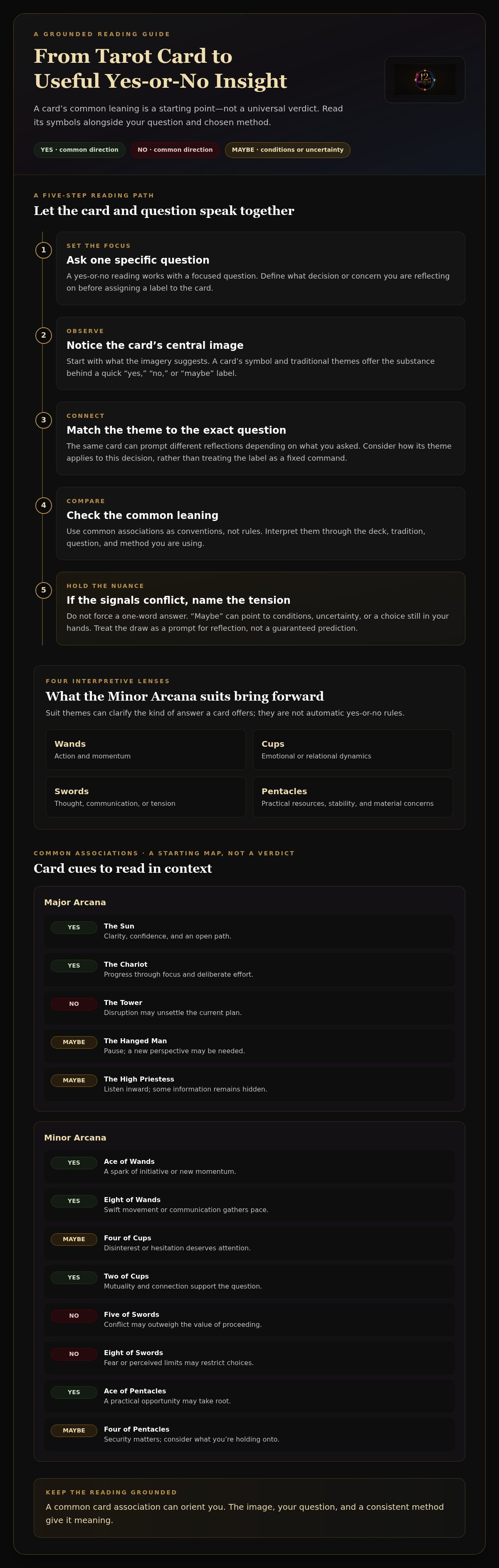
If you’re asking which tarot cards indicate a yes or no, treat card lists as a starting map, not a verdict. The table summarizes common conventions and pairs each leaning with a symbolic cue. It isn’t a universal code: the same card can read differently depending on the question, deck, and method you’ve chosen.
Try this sequence: notice the card’s central image, connect its traditional theme to the exact question, then consider whether its conventional leaning fits. If those signals conflict, describe the tension rather than forcing a one-word answer.
Major Arcana cards that often suggest yes, no, or maybe
Major Arcana cards often point to broader forces or turning points. The Sun commonly leans yes through clarity and vitality; the Tower may lean no when disruption challenges the plan; the High Priestess often suggests maybe, inviting patience or attention to information not yet visible. A question about inner readiness may shift these conventional leanings from an outcome toward reflection.
| Card | Common leaning | Interpretive cue |
|---|---|---|
| The Sun | Yes | Clarity, confidence, and an open path. |
| The Chariot | Yes | Progress through focus and deliberate effort. |
| The Tower | No | Disruption may unsettle the current plan. |
| The Hanged Man | Maybe | Pause; a new perspective may be needed. |
| The High Priestess | Maybe | Listen inward; some information remains hidden. |
| Ace of Wands | Yes | A spark of initiative or new momentum. |
| Eight of Wands | Yes | Swift movement or communication gathers pace. |
| Four of Cups | Maybe | Disinterest or hesitation deserves attention. |
| Two of Cups | Yes | Mutuality and connection support the question. |
| Five of Swords | No | Conflict may outweigh the value of proceeding. |
| Eight of Swords | No | Fear or perceived limits may restrict choices. |
| Ace of Pentacles | Yes | A practical opportunity may take root. |
| Four of Pentacles | Maybe | Security matters; consider what you’re holding onto. |
How the four Minor Arcana suits shape a yes-or-no reading
Suit themes can help specify the kind of answer a card offers. Wands point to action and momentum, while Cups bring emotional or relational dynamics forward. Swords focus on thought, communication, or tension. Pentacles draw attention to practical resources, stability, and material concerns. These are interpretive lenses, not automatic yes-or-no rules for an entire suit.
For instance, the Ace of Pentacles may conventionally lean yes for a question about a workable opportunity, but its cue is grounded potential, not guaranteed success. The Five of Swords may lean no when the question is about resolving conflict, while prompting a different reflection if you’re asking whether to stand up for yourself. Consider what the card’s theme means for the decision at hand.
Let “yes,” “no,” and “maybe” label a card’s common direction, then let its symbolism and your question define the meaning. To develop a consistent practice, compare your card notes with a structured tarot reading experience and notice which interpretations help you make sense of the draw.
Do reversals change a tarot card's yes-or-no meaning?
They can, but reversals are optional in a yes-or-no reading. Some readers use only upright cards; others include reversals and interpret them as altered, obstructed, or differently directed energy. Neither approach is automatically more accurate. Decide how orientation works in your system before drawing, so you don’t change the rules to fit the answer you want.
A reversed card doesn’t automatically mean “no.” That shortcut can erase the card’s specific message and turn a flexible practice into a mechanical code. Ask what the reversal adds: is the card’s theme delayed, turned inward, intensified, or expressed in a less balanced way? Base your interpretation on the card and the question, not just the fact that it landed upside down.
Reading reversals without turning the answer into a rigid rule
Consider the Three of Cups, often associated with friendship, shared enjoyment, and community. Reversed, it might suggest social strain, feeling out of step with a group, or a celebration that needs more care. If the question is whether to attend a gathering, that could indicate hesitation or complicated dynamics, not necessarily a flat refusal. The upright theme still matters; the reversal changes how clearly or easily it may be expressed.
Before a reading, choose whether reversals mean changed energy, blocked expression, or a separate yes-or-no leaning. Then apply your choice consistently. Afterward, record the card, question, orientation, interpretation, and what you noticed in the situation. Reviewing those notes can show whether your convention produces coherent readings or whether you’re treating every reversed card as a negative by default.
When a maybe card is more useful than forcing yes or no
A “maybe” can describe incomplete information, mixed influences, or a situation that hasn’t settled. It doesn’t mean the reading failed. Sometimes the card’s clearest contribution is to show what needs attention before a decision becomes easier.
Take the Two of Swords as a conventional example of a pause, stalemate, or difficulty choosing. If you ask whether to accept a job offer, the card may point to an unresolved factor: perhaps you haven’t weighed the role against your priorities, or a key detail still needs consideration. It doesn’t have to mean “no.” Connect its themes to the question and identify what could make the next step clearer.
This is also why readers may disagree about which tarot cards indicate a yes or no. Their reversal conventions can differ, just as their reading methods do. To keep your practice grounded, write down your chosen framework and use it for several readings before changing it. Let uncertainty prompt a better question or a thoughtful pause, not a forced verdict. The aim is to interpret the symbol clearly while leaving the decision in your hands.
How to interpret a yes-or-no tarot draw without losing the context
A useful reading begins before you turn over a card. Define the decision, choose a method, and decide how you’ll use the result. That structure helps you interpret the symbol instead of reshaping its meaning around a hoped-for answer. Knowing which tarot cards indicate a yes or no is only one part of the process; the question gives the card a meaningful frame.
Prepare a clear question and a consistent reading method
Focus on one decision and a timeframe you can assess. “Should I apply for this role this month?” has a defined scope. “Will my career and relationships improve?” combines separate concerns and makes the draw difficult to interpret. Before shuffling, decide whether you’ll read reversals and what they mean in your system.
- Define the decision. Name one choice or concern. Avoid questions that ask the cards to decide several things at once.
- Set a timeframe. Include a period that makes the question specific, such as “this week” or “before the end of the month.”
- Choose your convention. Decide whether you’ll use upright cards only or include reversals. Set how you’ll interpret yes, no, and maybe before drawing.
- Draw with intention. A single-card draw can offer a concise reflection, but it’s one option, not the only valid spread. Use your chosen method rather than adding cards just because the first feels unclear.
- Pause before concluding. Notice the image and its emotional tone. Then connect the card’s themes to the decision and consider what action, if any, they suggest.
Consistent card conventions make interpretations clearer because they let you compare readings without changing the rules to suit each answer. Consistency doesn’t make a reading infallible; it makes your reasoning easier to examine and refine.
Interpret the card, then decide what to do with the answer
Start with the card’s conventional leaning, but don’t stop there. Ask how its imagery and themes relate to the question’s actual subject. A card associated with momentum might encourage a first step in a creative project, while pointing to a need for caution if you’re asking whether to move too quickly. The symbol provides a lens, not an instruction.
If the draw feels like a maybe, turn that uncertainty into a useful next move. Clarify what you need to know, gather relevant information, or revisit the question when circumstances change. A brief journal entry can preserve the details: record the wording, card, orientation, interpretation, and a later reflection on what proved useful. Over time, those notes can help you see whether your method is coherent.
Keep the reading in its proper role. Tarot can support reflection, but it shouldn’t replace professional advice or sound judgment in medical, legal, financial, or other high-stakes decisions. For a structured space to continue exploring tarot readings and spiritual guidance, explore 12th House.
Use a yes-or-no tarot reading as a starting point for deeper reflection
A yes-or-no draw can offer a clear point of entry without closing the inquiry. Treat the card’s leaning as a prompt, not a command. Ask what its symbolism brings into focus: a resource you can draw on, a hesitation worth examining, or a condition that could change the outcome. The reading becomes more useful when it helps you see the situation with greater precision.
Turn a quick answer into a more useful tarot reflection
After interpreting the card, pause before drawing again. Repeatedly asking the same question can make it harder to distinguish insight from a search for reassurance. Instead, try a follow-up that opens reflection, such as “What should I consider before deciding?” or “What part of this situation needs my attention?” Keep the new question distinct from the original, and let it guide you toward something you can observe or act on.
Build a record of your readings. Note the question, card, orientation, common association, and meaning you drew from its imagery. Add a later reflection on what felt relevant. Over time, recurring symbols and patterns can help you develop a personal framework for which tarot cards indicate a yes or no, without assuming every card means the same thing in every context. For broader study of tarot interpretation and practice, explore Tarot Mastery: A Professional Guide to Spiritual Clarity.
Look for useful questions in your notes: Do certain symbols consistently point you toward action, patience, or a need for more information? Does your interpretation change depending on whether the question concerns relationships, work, or a practical choice? Reviewing your notes helps you refine your method through observation rather than forcing a fixed answer onto each new draw.
Explore tarot readings within a structured digital practice
If you’d like to explore beyond quick-answer draws, tarot can become part of a broader reflective practice. 12th House offers tarot readings alongside Lala AI spiritual guidance and access to a metaphysical learning library. These tools offer different ways to engage with spiritual ideas; they don’t turn a card’s interpretation into a guaranteed prediction.
Choose a next step that suits the question you’re carrying. You might return to your journal, study a symbol in more depth, or explore a tarot reading as another way to reflect. Explore 12th House as a space for continued spiritual exploration, while keeping your own discernment at the centre of the process.
Let your next reading open a better question
The most useful answer may be the question you carry forward. After a draw, notice what you feel ready to act on, what still needs attention, and what information could help you choose with greater clarity. Over time, your notes can reveal how your own symbolic language develops. Let that personal understanding guide your practice, rather than searching for a final authority on which tarot cards indicate a yes or no.
12th House offers tarot readings alongside Lala AI spiritual guidance and a metaphysical library for continued learning. These resources can support reflection without presenting tarot as a source of fixed predictions.
Explore tarot readings and spiritual guidance with 12th House, and take your next step with curiosity and confidence.
Frequently Asked Questions
Can tarot cards really give a yes-or-no answer?
Tarot can support a focused yes, no, or maybe interpretation, but it can’t guarantee an outcome. If you’re wondering which tarot cards indicate a yes or no, remember that readers may interpret the same card differently because of deck imagery, tradition, and personal method. For a consequential choice, use a draw to examine your assumptions or feelings, then weigh practical evidence and your own judgment before deciding.
How many cards should you draw for a yes-or-no tarot question?
One card is a common, simple choice because it keeps attention on a single question. Some readers draw another card to explore a specific point, such as what could support the situation, but extra cards can muddy the reading if you keep drawing until you like the result. Decide on your spread before shuffling and use that approach consistently. No single spread is mandatory.
Should you use the guidebook when reading yes-or-no tarot?
Yes, a guidebook can help you understand an unfamiliar card or notice a meaning you might otherwise miss. For example, compare the book’s description of a card’s central theme with a detail in the artwork, such as a figure’s posture or direction of gaze. Then relate those observations to your question and chosen method. Treat the guidebook as a learning aid, since decks can emphasize different symbols.
What should you do if you draw a card you do not recognize?
Identify the card first, then look at its suit, figures, objects, and overall mood. Consult the deck’s guidebook or a trusted tarot reference to understand its themes before assigning an answer. If the symbolism still feels unfamiliar, mark the result as uncertain in your notes rather than guessing. Returning to the question after learning more about the card can give you a steadier basis for interpretation.
Is it okay to ask tarot the same yes-or-no question more than once?
You can revisit a question, but drawing repeatedly in the same moment may create noise rather than insight. If a first answer disappoints you, pause and consider whether you’re seeking clarity or reassurance. Revisit the original card, check whether your wording was precise, and ask what information is missing. A later draw may be more relevant if circumstances have genuinely changed, such as receiving new information or facing a different choice.
Can you use any tarot deck for a yes-or-no reading?
Many readers adapt a tarot deck for yes-or-no readings. Choose one whose imagery you can study comfortably, then notice how its illustrations express movement, tension, connection, or stability. A guidebook can help establish context, while your notes show which interpretations remain useful over time. Your deck doesn’t need a universal yes-or-no chart; build a consistent approach that makes sense within its symbolism.


