

Your birth chart isn’t a list of separate personality traits. It’s a system whose parts work together. If you’ve wondered what the planets in my birth chart mean, you may already know that a Sun sign can’t explain the whole picture. Planet descriptions can also feel disconnected when signs, houses, and aspects add unfamiliar layers of meaning.
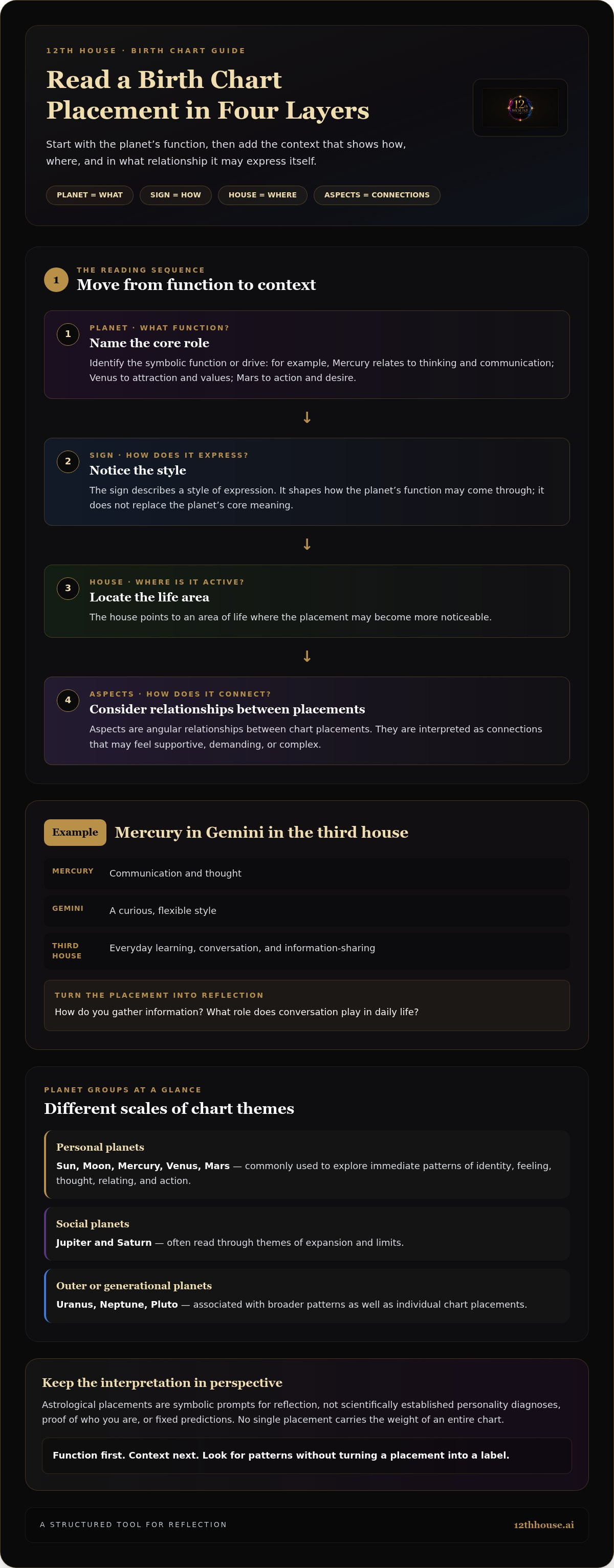
Start with a simple framework: planets describe functions, signs show how those functions express themselves, houses point to where they’re most active, and aspects reveal how they interact. Together, these placements form a symbolic map you can use to reflect on your tendencies, needs, and recurring patterns.
This guide explains what each planet symbolizes, from the Sun and Moon to the outer planets, then shows how to read those meanings in context. You’ll learn how to connect planetary roles with signs, houses, and aspects without getting lost in terminology. Use the chart as a structured tool for reflection, not a fixed verdict about who you are.
Key Takeaways
- Read planets as symbolic functions or drives, not as fixed labels or scientifically established personality diagnoses.
- To understand what the planets in my birth chart mean, start with each planet’s core role, then consider how its sign and house shape its expression.
- Compare Jupiter’s themes of growth with Saturn’s themes of structure, and use reflective questions to explore the outer planets’ wider patterns.
- Interpret a placement in four steps: identify the planet, note its sign, locate its house, and examine its aspects.
- Look for repeated themes and tensions across your chart, then use personalized birth chart and transit analysis to explore how they connect.
What the planets in your birth chart mean: the chart’s basic grammar
In astrology, planets symbolize functions or drives within a chart, such as communication, desire, growth, and discipline. They form the chart’s basic grammar, but no placement works alone. A useful starting formula is planet means what, sign means how, and house means where. Aspects add another layer by describing relationships between placements.
This is a symbolic framework for reflection, not a scientifically established personality diagnosis. Treat an interpretation as a prompt for noticing patterns, not proof of who you are or a fixed prediction of what you’ll do. The Planets in astrology overview traces how planetary meanings appear across classical and modern traditions, which helps explain why astrologers may use different interpretive frameworks.
What a planet represents in astrology
Think of each planet as naming a function, rather than assigning you a complete personality. Mercury is associated with thinking and communication; Venus with attraction and values; Mars with action and desire. Jupiter and Saturn are often read through themes of expansion and limits. These are interpretive symbols, not measurements of ability or character.
Astrologers often group the Sun, Moon, Mercury, Venus, and Mars as personal planets because they’re commonly used to explore immediate patterns of identity, feeling, thought, relating, and action. Jupiter and Saturn are often called social planets, while Uranus, Neptune, and Pluto are outer or generational planets, associated with broader patterns as well as individual chart placements. These categories help organize a reading, but they aren’t rigid personality boxes.
Meanings also depend on astrological school and historical context. A traditional approach may emphasize a planet’s condition and classical rulerships; a modern psychological approach may focus more on inner drives and self-reflection. Neither is the only possible way to read a chart.
How signs, houses, and aspects change the reading
A sign describes a style of expression; a house points to an area of life where a placement may become more noticeable. An aspect is an angular relationship between chart placements, interpreted as a connection that may feel supportive, demanding, or complex. The planet’s core function remains the starting point, while these other factors provide context.
For example, imagine Mercury in Gemini in the third house. Mercury points to communication and thought; Gemini suggests a curious, flexible style; and the third house directs attention toward everyday learning, conversation, and information-sharing. This doesn’t predict that someone will become a writer or excel in school. Instead, it gives you useful questions to explore: How do they gather information? What role does conversation play in daily life?
A planet names the function; its sign shapes the style, its house locates the arena, and its aspects show how it connects with other functions. Keep that distinction in view when asking what the planets in my birth chart mean. It prevents one placement from carrying the weight of an entire chart and gives you a clear structure for interpretation.
The Sun, Moon, Mercury, Venus, and Mars: your personal planet meanings
These five placements bring the chart’s symbolic language close to everyday experience. In astrology, each planet represents a distinct function: the Sun relates to identity and direction, the Moon to emotional needs, Mercury to thought, Venus to relating, and Mars to action. A sign and house modify how and where a function may show up; they don’t replace its core meaning. Read each placement as a question to explore, not a verdict.
Sun and Moon: identity, vitality, needs, and emotional responses
The Sun symbolizes identity, vitality, and conscious direction: what you’re developing a sense of purpose around. The Moon points to emotional needs, familiar habits, and instinctive responses, including what helps you feel secure. In astrology, the Sun and Moon are often called the luminaries. Astronomically, they aren’t both planets, as NASA Science: Planets makes clear; astrology uses “planet” in a broader symbolic sense that includes them.
Consider the Sun a prompt to ask what energizes your choices, and the Moon a prompt to notice what you seek when you need comfort. Neither placement alone defines a whole person or predicts behavior. Their signs and houses add context, while other chart placements may reinforce or complicate the picture.
Mercury, Venus, and Mars: thought, connection, and action
- Mercury represents communication, learning, and information processing in astrological tradition. Its placement can prompt reflection on how you gather details, explain ideas, or respond to new information. Ask: Do I prefer to think aloud, observe first, or sort ideas by writing them down?
- Venus symbolizes attraction, values, pleasure, and relational preferences. It can offer a lens on what you appreciate, what feels harmonious, and how you approach connection. Ask: What qualities or experiences do I value, and how do I express appreciation?
- Mars is associated with drive, assertion, initiative, and approaches to conflict. Its placement can prompt you to examine how you pursue a goal, set a boundary, or handle frustration. Ask: What helps me take action, and how do I respond when something gets in my way?
Keep the core function steady as you interpret. If Mercury is in a direct, expressive sign, that sign may describe a more outward style of communication; it doesn’t turn Mercury into a different planet. A house placement can bring that communication theme into a particular area of life. These are interpretive possibilities, not universal descriptions of everyone with the same placement.
Together, the personal planets map identity, needs, thought, relating, and action. This sequence helps connect placements instead of treating them as five unrelated labels. To explore questions about how these symbols fit your own chart, you can use Ask Lala for personalized chart questions.
Jupiter, Saturn, Uranus, Neptune, and Pluto: growth and wider patterns
These planets add a longer-range layer to chart interpretation. Jupiter and Saturn are often read through themes of expansion and structure. Uranus, Neptune, and Pluto are known as outer planets in modern astrology; their slow movement means people born around the same period may share their sign placements. That shared backdrop doesn’t make their charts identical. House placements and relationships to other planets provide more individual context.
| Planet | Central theme | Reflective question |
|---|---|---|
| Jupiter | Meaning, growth, opportunity, and beliefs | Where do I seek possibility or a wider perspective? |
| Saturn | Boundaries, responsibility, discipline, and development | What am I willing to build through steady effort? |
| Uranus | Disruption, innovation, and independence | Where do I question convention or need room to experiment? |
| Neptune | Imagination, ideals, spirituality, and blurred boundaries | Where do I feel inspired, and where might I need clarity? |
| Pluto | Power, intensity, and transformation | What patterns invite deeper examination or change? |
Jupiter and Saturn: expansion, responsibility, and structure
Jupiter symbolizes the search for meaning, growth, opportunity, and beliefs. Saturn represents limits, responsibility, discipline, and development over time. Together, they raise contrasting but complementary questions: Where might you reach further, and what structure could help you sustain that effort? Neither guarantees success or hardship. Read each planet’s sign and house to consider its style and life context. For example, Jupiter in a house may invite reflection on where learning or possibility feels important.
Uranus, Neptune, and Pluto: change, imagination, and transformation
Uranus is associated with innovation, disruption, and independence; Neptune with imagination, ideals, spirituality, and boundaries that may feel less defined; Pluto with power, intensity, and transformation. These are symbolic themes, not universal outcomes or dramatic predictions. Since outer planets can remain in one sign for years, a sign placement may describe a generational backdrop. Its house and connections to other chart placements can make the symbolism more personally relevant.
Use the table as a set of prompts, not a scorecard. For instance, Saturn’s symbolism might lead you to consider how responsibility shapes a goal, while Jupiter’s could raise questions about the beliefs guiding it. If a placement doesn’t immediately resonate, hold the interpretation lightly and examine its chart context before drawing conclusions. This measured approach helps clarify what the planets in my birth chart mean without turning broad symbols into fixed labels.
Combine planetary meanings without reducing chart to a list
A birth chart is more useful as a set of relationships than as a catalogue of traits. To explore what the planets in my birth chart mean, read one placement in layers, then compare it with the rest of the chart. This keeps each symbol distinct while giving you a way to notice patterns.
A practical sequence for reading any planetary placement
Move through these steps in order. Keep the planet’s core function in view before adding context, and resist letting one placement speak for the whole chart.
- Identify the planet. Name the function you’re examining, such as communication, desire, growth, or responsibility. Begin with the question, “What part of experience does this planet symbolize?”
- Note the sign. Consider the sign as a style of expression. Ask how its qualities might shape the planet’s function, without treating the sign as a replacement for that function.
- Locate the house. Identify the area of life the house represents in the chart. This adds context about where the placement may become meaningful, not a guarantee of what will happen there.
- Examine aspects. Look at the planet’s angular relationships with other placements. Consider whether these connections seem to reinforce, challenge, or complicate the theme, then interpret the placement alongside the broader chart.
Hypothetical example: Imagine Venus in an expressive sign and a house associated with learning and communication, with an aspect to Saturn. Symbolically, you might explore how values and relationships connect with exchanging ideas, while Saturn’s connection raises questions about caution, commitment, or boundaries. This doesn’t show that a person will meet a partner through study, struggle in relationships, or follow any specific path. It’s a framework for reflection, not a factual prediction.
How to work with mixed signals and recurring themes
Charts can hold apparent tensions. One placement may suggest a preference for independence, while another points toward security or cooperation. Don’t force these symbols into a single verdict or assume one cancels out the other. They may describe different needs, contexts, or responses that a person can notice and work with in varied ways.
Look for motifs that recur across several parts of the chart. If multiple placements emphasize communication, for instance, ask where that theme appears: in a planet’s function, a sign’s style, a house’s life area, or connections between placements. Repetition can give a theme weight, but it still doesn’t prove a particular outcome.
Bring the symbols back to lived experience with open questions: Does this theme feel familiar? Where does it show up, and where doesn’t it? What might change when the context changes? Your observations matter more than making every placement fit a tidy story. For personalized questions that arise as you read, explore your chart with Ask Lala, an AI assistant for chart-related guidance.
Explore what your birth chart’s planets mean for you
General planet meanings give you a starting framework. Your own chart adds the coordinates: a planet’s function, its sign’s style, its house context, and its aspects to other placements. That sequence helps you ask more precise questions about what the planets in my birth chart mean without treating any one symbol as a complete definition of you.
Move from general meanings to your own placements
Choose one placement that interests you. Begin with the planet’s symbolic role, then trace its sign, house, and aspects in that order. Keep the layers distinct: a sign doesn’t replace the planet’s function, and a house doesn’t predict a specific event. This gives you a repeatable method for studying your chart rather than relying on a single keyword or isolated interpretation.
Record what you notice as questions and observations. For example, if Mercury’s placement draws your attention, note where communication or learning seems relevant in your life. Then ask what supports that interpretation and what doesn’t fit. Your notes can change as you reflect; they don’t need to resolve into one final answer.
For a broader foundation in natal chart structure, continue your study with Mastering the Natal Chart: Your Cosmic Blueprint. Return to a specific planet afterward and consider how its placement connects to the chart as a whole.
Use guided tools to continue your chart exploration
Some questions need more than a general definition. Why does a placement feel prominent? How might a planet’s house and aspects add context? Ask Lala is an AI assistant for personalized questions about astrology charts, offering an interactive way to explore questions that arise as you examine your placements.
Personalized birth chart and transit analysis can extend basic planet meanings by relating them to your chart and its timing. A birth chart offers a map of placements to interpret; transit analysis considers current planetary movements in relation to that map. Use these perspectives as tools for inquiry, not as fixed instructions about what must happen.
Keep your approach grounded: identify the planet, consider its sign, locate its house, and examine its aspects. Then compare the symbolism with your own observations. If you’re ready to explore your personal chart questions, Explore your birth chart with 12th House.
Keep your chart exploration open
Your chart can become a continuing record of questions, patterns, and changing perspectives. Rather than searching for one definitive interpretation, notice which themes remain meaningful as your circumstances shift. Return to your notes with curiosity: What feels clearer now? What still invites reflection?
12th House membership includes access to a metaphysical library for self-guided study. You can also bring personal chart questions to Ask Lala and explore how they relate to your placements. The aim isn’t to outsource your judgment, but to deepen the questions you ask yourself.
Understanding what the planets in my birth chart mean is less about finding a final label and more about building a thoughtful relationship with the symbols. Let each insight be a starting point, then decide what resonates with your lived experience. Explore your birth chart with 12th House.
Frequently Asked Questions
What does each planet represent in a birth chart?
In astrological tradition, the Sun symbolizes identity, the Moon emotional needs, Mercury thought, Venus relating, and Mars action. Jupiter and Saturn, often grouped as social planets, are associated with growth and structure. Uranus, Neptune, and Pluto are outer planets linked symbolically with wider patterns of change, imagination, and transformation. To understand what the planets in my birth chart mean, consider each placement with its sign, house, and aspects. These are traditional interpretations, not scientific diagnoses.
Do retrograde planets mean something different in a birth chart?
Astrologers may interpret a retrograde planet as carrying an additional symbolic condition, though the meaning varies by tradition and planet. Retrograde motion is an apparent backward movement from Earth’s perspective. It doesn’t automatically make a placement bad, blocked, or destined to cause problems. For example, consider a retrograde Mercury alongside its sign, house, and aspects before drawing conclusions, rather than treating the retrograde label as a complete interpretation.
Does an empty house in my birth chart mean that area of life is unimportant?
No. An empty house doesn’t mean its related area of life is absent, irrelevant, or unavailable to you. Astrologers may look at the sign on the house and the planet traditionally associated with that sign, often called its ruler, to explore the house’s chart context. For instance, an empty house associated with work can still be considered through its ruler’s placement. This symbolism doesn’t guarantee a particular career outcome.
Can I understand my birth chart if I do not know my exact birth time?
You can explore some chart information, but missing birth-time details limit interpretation. The Ascendant and house placements depend strongly on the time of birth, so they may be unreliable without it. Planetary signs may be identifiable from the birth date, but don’t assume every placement is precise. Check the Moon especially if it changed signs near your birth date, since the time can affect which sign it occupied.
Are the meanings of planets in astrology scientifically proven?
Astrological planetary meanings are symbolic interpretations, not evidence-based scientific conclusions about personality or future events. You can use them as a reflective or cultural framework to consider habits, values, and questions about your life. They shouldn’t be treated as validated psychological diagnoses or guaranteed predictions. For example, a chart can prompt you to reflect on how you approach responsibility, but it can’t establish a clinical fact about your character.
Do planets in my birth chart change over time?
Your natal chart represents planetary positions associated with your birth moment, so astrologers don’t rewrite it as planets move. They distinguish those birth placements from transits, the current positions of planets interpreted in relation to your natal chart. A transit reading may offer a symbolic lens on a period or theme, but it isn’t a certain forecast. You can compare a transit interpretation with your circumstances without assuming it dictates what will happen.


