

What if the Death card isn’t warning you about disaster, but asking you to notice what has reached its natural end? Its imagery can feel alarming, especially when a reading touches love, work, or someone you care about. If you’re wondering what to do when you pull the death card, pause before treating it as a literal prediction. In tarot, Death points to endings, transition, and the possibility of change.
That first jolt of fear is understandable. But the card’s meaning isn’t fixed by its name or image. The question you asked, the card’s position in the spread, and the cards around it all shape the interpretation. Pulling another card isn’t automatically wrong, but a clear question matters more than drawing more cards.
This guide will help you read Death in context and respond with a simple, grounded process. You’ll explore its symbolism, consider what it may mean in different kinds of readings, and decide whether a clarifying card would add focus or confusion. The aim isn’t to force a positive message. It’s to turn the pull into a useful reflection and one practical next step.
Key Takeaways
- Learn what to do when you pull the death card by using a calm, structured reflection instead of reacting from fear.
- Consider whether the card points to a habit, role, expectation, or life phase that may be changing.
- Use your question and the card’s position in the spread to explore possible meanings without treating them as predictions.
- Follow a beginner-friendly five-step practice to turn the pull into one grounded response, no special spread or ritual required.
- Explore tarot further when you want more symbolic context, using study and reflection rather than seeking a fixed forecast.
What to Do First When You Pull the Death Card
The name can be unsettling, especially if you’re new to tarot or asked a question about someone you love. Take a breath before letting the image decide what the reading means. The Death card is read as symbolic guidance, not evidence that a literal death is approaching. In tarot traditions, its imagery is commonly associated with endings and change; The Death card in Tarot outlines these interpretations and variations across decks. A card pull is not a certain prediction. Tarot offers symbols for interpretation, not verified knowledge of future events.
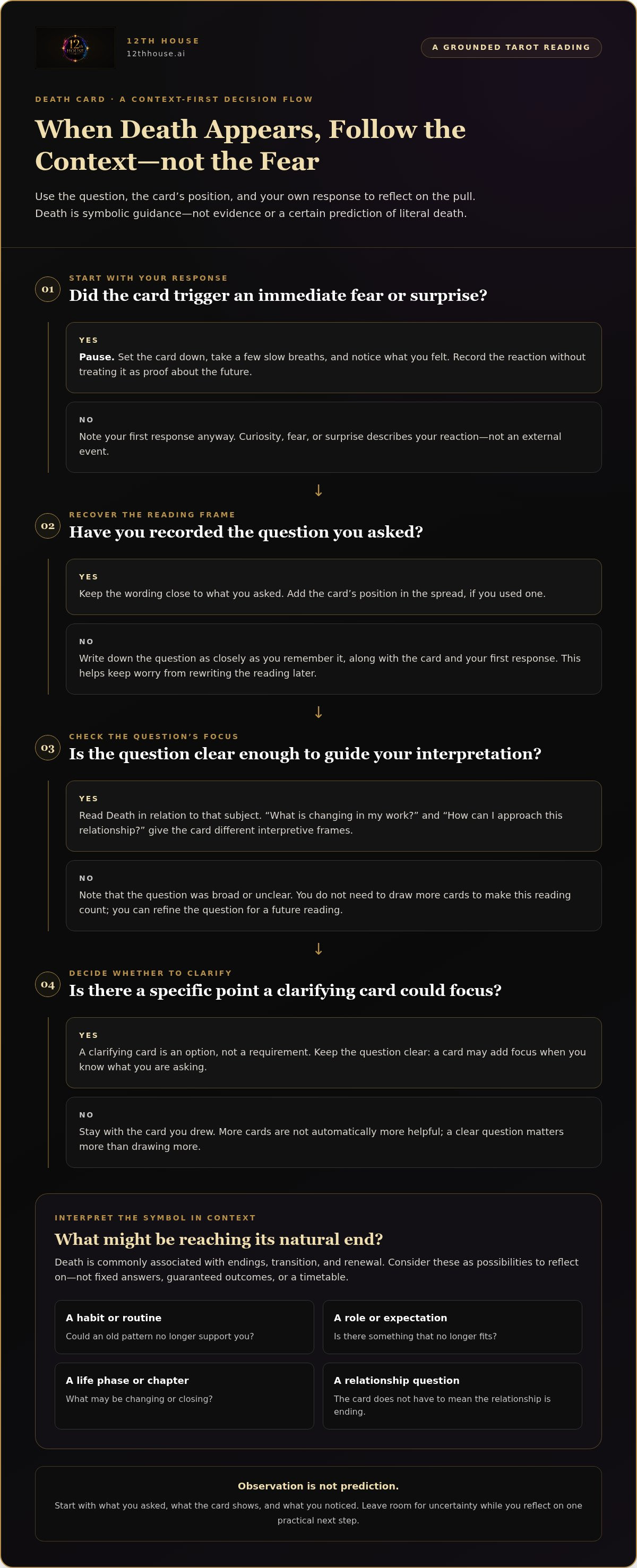
If you’re asking what to do when you pull the death card, start with a short sequence that steadies your attention and preserves the reading’s context:
- Pause. Set the card down and give yourself a moment before interpreting it.
- Breathe. Take a few slow breaths and notice whether your first reaction is fear, surprise, or something else.
- Note the question. Write down the wording you used, as closely as you remember it.
- Observe. Record your first response without deciding that the feeling proves anything about the future.
Pause before assigning a meaning
Give yourself a short interval before searching online for interpretations. When a card’s name carries a strong association, it’s easy to treat that association as the answer before considering the imagery, spread, or question. Separate what you saw from what you assumed: “I drew the Death card” is an observation; “something terrible will happen” is a fear-driven conclusion.
Write down your first feeling in plain language. Perhaps your shoulders tightened, or you felt curious rather than frightened. Both reactions tell you about your response to the card, not about an external event. You don’t have to suppress the feeling or make it meaningful immediately. Let it be present while you look at the reading with a little more distance.
Return to the question you asked
Restate the exact question behind the pull. “What is changing in my work?” gives the card a different interpretive frame from “How can I approach this relationship?” The card’s possible relevance shifts with the subject. A reading about a routine might invite reflection on an old habit, while a question about a decision may focus attention on what you’re ready to leave behind. These are possibilities to examine, not fixed answers.
Record the question and the card together, along with the card’s position in the spread if you used one. That simple note keeps your interpretation anchored to the original inquiry instead of letting worry rewrite it later. If the question was broad or unclear, note that too. You can refine it for future readings, but you don’t need to draw more cards to make this one count.
For now, aim for clarity rather than certainty. You’re gathering the elements of the reading: the question, the card, and your response. With those recorded, you can consider what the symbol might illuminate without allowing its name to become a prediction.
What the Death Card Symbolizes in Tarot
In tarot, Death is a Major Arcana card commonly associated with endings, transition, and renewal. Its central theme is a threshold: one form, pattern, or chapter may be closing, making change possible. That ending can involve a habit, a role you’ve outgrown, an expectation that no longer fits, or a phase of life. It doesn’t have to mean a relationship is ending.
Death is a symbol of closure and transformation in a reading, not a literal forecast of someone’s physical death. This distinction matters: a symbolic ending can be uncomfortable, incomplete, or gradual. The card doesn’t guarantee that a difficult change will quickly resolve into something better. It offers an image to consider, not a timetable or a promised outcome.
Why the card’s name is not its whole meaning
Tarot communicates through images, positions, and relationships between symbols rather than straightforward forecasts. The word “Death” can point toward closure, a significant change, or the need to acknowledge that something has run its course. Think of a familiar routine that no longer supports you: the card may prompt you to examine its role without declaring exactly what will happen next. Meaning develops through interpretation and context.
That’s why the first meaning that comes to mind isn’t automatically the most useful one. Ask what may be ending or changing, but leave room for uncertainty. A reading can help you frame a question; it can’t establish that every ending is chosen, easy, or immediately followed by renewal.
How imagery shapes a card interpretation
Before reaching for a guidebook, look closely at the card in your own deck. Describe what’s visible: figures, colors, gestures, movement, distance, and contrast. Is the scene still or in motion? Does a figure appear to be leaving, approaching, or watching? Start with observation, then consider what those details suggest in relation to your question.
The Rider-Waite-Smith deck is a familiar example, not a universal visual standard. Its Death card shows a skeleton in armor riding a white horse, with figures and a rising sun in the scene. Another deck may emphasize different symbols or use a less literal image. Those choices can shift the card’s emotional texture while keeping its broader association with endings and transition.
Try separating your notes into two layers: first, what the illustration plainly shows; second, what you think those details might mean. This distinction helps you avoid treating a memorized definition as the only valid reading. If you’re exploring what to do when you pull the death card, let the image generate a focused question: what part of my current situation feels complete, unsettled, or ready for change?
For a personalized space to explore that question through reflection, use Lala’s tarot guidance. Keep the card as a prompt for inquiry, then weigh any interpretation against the question and details of your reading.
How the Death Card’s Meaning Changes with Reading Context
The Death card doesn’t carry one fixed message into every reading. Interpret it through three layers: the question you asked, the cards around it, and the circumstances you’re navigating. The question sets the subject. Nearby cards may add emphasis or tension. Your lived situation helps you assess which symbolic possibilities are relevant, without turning them into predictions.
Use the examples below as prompts for reflection, not definitive answers. A card can suggest a line of inquiry; it can’t confirm that a particular event will happen.
| Question area | Possible reflective direction | Question to consider |
|---|---|---|
| Work | A changing role, routine, or professional priority | What part of my current work pattern may no longer fit? |
| Personal growth | An old habit, self-image, or expectation ready for review | What am I holding onto out of familiarity? |
| Relationships | A shift in expectations or a relational pattern that needs attention | What dynamic might need to change, whatever happens to the relationship? |
Read the card through the question’s subject
Start by returning to the actual wording of your question. If you asked about work, don’t jump straight to “I’ll lose my job.” The card might instead prompt you to examine a responsibility, routine, or ambition that has run its course. For personal growth, consider whether an old coping habit or self-description still serves you. In a relationship reading, ask whether a pattern or expectation is changing. None of these possibilities guarantees a job loss, breakup, or other specific event.
Keep the interpretation proportionate to what you know. For example, if you’re already considering a career change, the card may give you a symbolic frame for examining that choice. It doesn’t independently verify that a change is necessary or tell you when to make it.
Use surrounding cards without losing the central question
Adjacent cards can add nuance. Notice whether their images echo, contrast with, or complicate the Death card, then describe that connection before deciding what it means. A card suggesting pause beside Death might lead you to consider the pace of a transition; it doesn’t cancel the original question or dictate a result. Reading systems vary, so no single spread method is required.
Keep the layers separate in your notes: write the question first, record the cards’ positions and visible connections next, then add how your present circumstances inform your reading. This structure helps distinguish what the spread shows from what you bring to it. For broader foundations on reading symbols and building interpretive confidence, explore the Tarot Mastery guide.
When considering what to do when you pull the death card, treat context as a framework, not a decoding machine. Choose the interpretation that raises a useful question about the subject you asked about, and leave room for more than one answer.
A Grounded Five-Step Practice for Reflecting on the Pull
You don’t need a specialist spread, a ritual, or another card to work with this pull. Use a notebook and move through five steps: record, observe, connect, question, and choose one grounded response. The structure keeps the card in view without letting fear turn it into a verdict. If you’re deciding what to do when you pull the death card, focus on what you can examine in your actual situation.
- Record the reading. Write the question as you asked it, the date, the Death card’s orientation, and your immediate reaction. Include the spread position if you used one. Keep the record factual at first: “I asked about a change at work and drew Death upright” is more useful than “The card says I’ll lose my job.”
- Observe the image. Note one detail you can see, such as a figure moving forward, a strong color, or a contrast between light and dark. Then separate observation from fear: “The image feels stark” describes your response; “something terrible will happen” is a prediction the image cannot establish.
- Connect it to the question. Consider what the card’s themes of closure or transition might bring into focus about the subject you asked about. Keep the link specific. If your question concerned a daily routine, for instance, explore whether a habit or expectation feels ready for review rather than leaping to an unrelated life event.
- Question your first interpretation. Ask, “What do I know from my circumstances, and what am I assuming because of the card’s name?” Add an open-ended prompt, such as “What part of this situation feels complete?” You don’t need to force an answer. The purpose is to create room for reflection, not certainty.
- Choose one grounded response. Select a small action that fits the original question: list what you want from a work decision, make time to reflect on a changing personal pattern, or have a thoughtful conversation if it feels appropriate. Base consequential choices on real-world information and your circumstances, not on a card alone.
Journal the pull without turning it into a verdict
Keep the entry brief enough to revisit. Alongside the question, card orientation, date, and reaction, write one visible detail and one open-ended question. Later, read the notes again and mark what still feels relevant. A pause between the initial reaction and your review can help distinguish a lasting insight from the alarm of the moment.
Choose one small action that supports reflection
Your next step should be practical, modest, and connected to what you asked. You might gather information, write down options, or notice a recurring habit for a few days. A personal ritual, such as quiet journaling, can support reflection if it’s meaningful to you, but it isn’t a required fix. Avoid repeated pulls in search of a preferred answer; they can add noise instead of clarity.
If you want to explore your tarot question through personalized reflection, ask Lala about your tarot reading. Treat any interpretation as a prompt to consider, then choose a next step that makes sense in your life.
Where to Go Next After Pulling the Death Card
Return to the question you asked and the reflection you chose. The card doesn’t need to settle the matter for you. Its value may be in helping you identify what you want to examine, whether that’s a changing expectation, a decision, or a pattern you’ve noticed. Keep your written notes, then compare them with what you learn about the card’s symbolism. Look for context that helps you think more clearly, not a fixed forecast that replaces your judgment.
When a second perspective may help
Sometimes another perspective helps you organize a question, especially if your first interpretation feels tangled with fear. It shouldn’t decide for you or turn a symbolic reading into certainty. Lala is an AI assistant for personalized questions about tarot and other metaphysical topics. Use it to explore what the card might prompt you to consider, then weigh that reflection against your own circumstances and judgment.
For a wider view of personalized AI spiritual guidance, explore the AI astrology assistant guide. Treat a second perspective as another way to frame your inquiry, not as an authority that can confirm what will happen. You remain responsible for deciding what, if anything, to do with the reflection.
Continue learning at your own pace
If you want more context, return to foundational tarot meanings before searching for dramatic interpretations. Study how symbols, card positions, and the wording of a question shape a reading. Then compare those ideas with what you observed in your own deck. Learning this way builds a vocabulary for interpretation without requiring every pull to produce a definitive answer.
A self-guided approach can be simple: revisit your notes, read about the card’s traditional themes, and record which ideas connect to your original question. You might also explore structured tarot learning through books, videos, or reflective frameworks. Take what helps you examine the question more thoughtfully, and set aside interpretations that create alarm without adding useful context.
Ultimately, what to do when you pull the death card is return to the question, keep the interpretation open, and choose your next step based on both reflection and real circumstances. If you’d like a space to continue exploring tarot questions and metaphysical topics at your own pace, 12th House offers tarot and spiritual guidance tools.
Carry Your Reflection Forward
Let the reading become a starting point for thoughtful attention, not a demand for an immediate decision. Ask yourself what you want to understand more clearly, then give that question space to develop. The most useful answer may come from observing your circumstances over time, gathering practical information, or revisiting your notes with a steadier perspective.
If you’re still considering what to do when you pull the death card, you can keep exploring without looking for a fixed forecast. Lala answers personalized questions about tarot and other metaphysical topics, while 12th House membership includes a metaphysical library of books, videos, and ritual frameworks for self-guided study.
Continue your inquiry with tarot readings and spiritual guidance with 12th House. Explore your question with Lala and the metaphysical library, then take the next step at your own pace, with curiosity and confidence in your ability to reflect.
Frequently Asked Questions
Is the Death card a bad omen?
No, the Death card isn’t inherently a bad omen. Its presence doesn’t label an event as good or bad; it brings a symbol into the reading that you can interpret alongside the question and your circumstances. If it unsettles you, note what the image brings up before making a decision. You might ask whether a current situation is changing, rather than treating the card as a warning of misfortune.
Can the Death card predict an actual death?
No tarot card can establish that someone will die, and drawing Death isn’t evidence of a real-world death. If you’re worried about someone’s safety, respond to concrete information and contact them or appropriate support as the situation requires, rather than relying on a reading. Tarot can offer a symbolic lens for reflection, but it can’t verify someone’s health or forecast a specific event.
Should I pull another tarot card after drawing the Death card?
You can draw a clarifying card if you have a specific question about the first card, such as, “What part of this situation should I examine?” Decide what you want the extra card to clarify before drawing it. If you’re pulling repeatedly because the first answer feels frightening or unsatisfying, pause instead. More cards can add possibilities without resolving uncertainty, especially when the original question is unclear.
What does it mean if the Death card appears reversed?
A reversed Death card is often read as resistance to change, delay, or a sense of being stuck, though interpretations vary by tarot tradition and spread. Consider whether you’re postponing a transition or holding onto a familiar pattern, but don’t assume that resistance is automatically wrong. The card’s position offers a prompt for reflection, not a diagnosis. Compare the interpretation with the question and the other cards before settling on a reading.
Is the Death card a yes-or-no card?
The Death card doesn’t have one universal yes-or-no answer. Some readers use assigned meanings for yes-or-no pulls, while others consider tarot better suited to exploring a decision’s dynamics. If you need a practical answer, define what “yes” would mean and what information would help you decide. For example, a career question may need research into responsibilities or options, not a card-based prediction about what will happen.
What tarot cards commonly appear with the Death card?
Death can appear beside any card, and no combination guarantees a particular outcome. Some readers might interpret it with the Tower as a prompt to examine major disruption, with the Star as a question about hope after change, or with the Fool as an opening to consider a new direction. These are interpretive possibilities, not fixed pairings. Read each card’s position and relationship to the question before building a combined meaning.


