

What if a recurring dream isn’t a fixed message waiting to be decoded, but a pattern shaped by your experiences and emotions? If you’ve wondered what is the meaning of a recurring dream, it makes sense to look for answers, especially when unsettling images linger after waking. A symbol that means one thing to someone else may carry a different meaning in your life.
This article offers a grounded way to explore why a dream may return without treating any interpretation as universal. You’ll learn how psychological perspectives connect dreams with waking concerns, stress, memory, and emotion, and how symbolic approaches can prompt reflection without claiming certainty. You’ll also find practical ways to track details and feelings, notice shifts over time, and recognize when repeated distress may call for support.
Begin with curiosity, not a dream dictionary. The aim isn’t to force a single answer, but to build a clearer map of your own patterns. A Dream Interpretation Tool can offer an additional reflective lens, not a diagnosis or guaranteed explanation.
Key Takeaways
- Explore what is the meaning of a recurring dream by looking at its returning themes and your personal context, not assuming it has one fixed or prophetic message.
- Consider how waking concerns, emotions, memory, and sleep may shape a dream without treating any single explanation as universal.
- Use a simple journal to record the dream, its emotional tone, changes over time, and what’s happening in your waking life.
- Prioritize your own associations over generic symbol dictionaries, and treat patterns as invitations to reflect rather than conclusions.
- If recurring dreams cause significant distress, recognize when reflection may not be enough and support could be helpful.
What Is the Meaning of a Recurring Dream?
A recurring dream is a dream whose central scene, theme, setting, or emotional pattern returns over time. Sometimes the same sequence seems to replay. In other cases, details shift: you may be in a different building or with different people, yet the same sense of being trapped, pursued, or unprepared remains. There’s no universal number of repetitions required before a dream counts as recurring. What matters is whether you recognize a pattern.
A returning dream can feel significant because it’s familiar, emotionally vivid, or connected to questions that still feel open in waking life. You might wake unsettled and wonder whether the dream is warning you, reflecting a concern, or simply repeating a memorable image. Asking what is the meaning of a recurring dream is a natural way to seek orientation, but repetition alone doesn’t establish a single explanation.
A one-time dream is a single scene; a recurring dream is a pattern whose return invites attention, not automatic certainty. That distinction makes room for careful reflection. A recurring dream can be explored through different psychological and symbolic frameworks, but none makes every repeated image a universal code or guaranteed prediction.
What makes a dream recurring?
Look beyond an exact replay. A recurring dream may repeat a complete scene, such as arriving late to an important event, or return through a theme, place, person, or feeling. The setting may change while the emotional structure stays recognizable. One version might involve searching an unfamiliar house; another might take place at a school or workplace, with the same underlying confusion.
Timing and detail can vary, too. A dream might return after a long interval, then reappear during a different period of life. Track what stays constant and what changes rather than dismissing variations as evidence that the dreams are unrelated. The repeating element could be the plot, the atmosphere, or your response inside the dream.
Does a recurring dream have one universal meaning?
No single symbol has the same personal meaning for everyone. A house might suggest safety to one dreamer, family history to another, or simply a familiar setting. Even a common image such as falling can connect to different experiences and associations. A symbol guide may offer possibilities, but it can’t establish what an image means in your particular life.
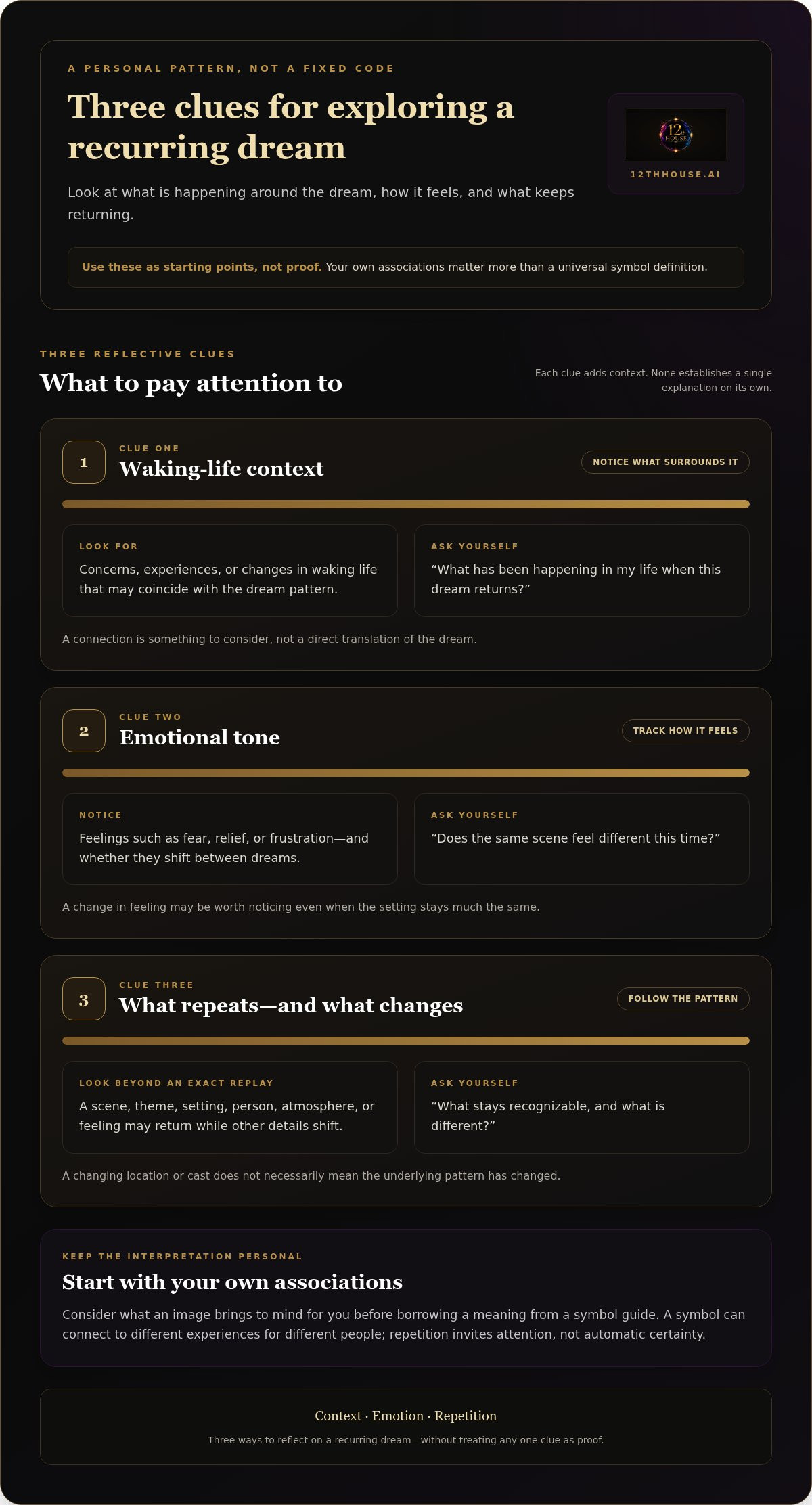
Use three clues as starting points, not proof: context, including what’s happening in waking life; emotion, such as fear, relief, or frustration; and repetition, including which features return or shift. Ask what each image brings to mind for you before borrowing an interpretation from elsewhere. This keeps reflection personal and open to revision.
A recurring dream can be meaningful as a prompt for self-inquiry without being prophetic, diagnostic, or evidence of one hidden truth. Let your own associations guide the exploration, and leave room for uncertainty. The next step is to consider why a dream pattern may return.
Why Do Recurring Dreams Happen? Memory, Emotion, and Sleep
There may not be one cause behind every repeating dream. A useful starting point is the continuity hypothesis: dreams can incorporate concerns, feelings, and experiences from waking life, often in altered or heightened form. A difficult conversation might return as a dream about being unable to speak; pressure at work might take the shape of a missed deadline. These are possibilities to consider, not direct translations.
Other perspectives focus on how the sleeping brain processes emotion, organizes memories, or simulates threatening situations. Each offers a different lens, but none can establish what a particular dream means for you without your context. Psychological explanations can suggest how a dream pattern might form; symbolic interpretations explore what its images mean to the dreamer.
How stress, change, and emotion may shape dream themes
Emotionally charged experiences can leave strong impressions, making them possible material for dreams. A new responsibility, family tension, or period of uncertainty may coincide with a dream about being lost or unprepared. That doesn’t mean the dream is a coded report about one event, or that every recurring nightmare points to unresolved trauma. Notice the timing instead: does the pattern appear during a transition or alongside a concern that keeps returning during the day?
Track the feeling as carefully as the plot. The same dream scene might carry panic one night and determination another. That shift can be informative: it may reflect a change in how you’re experiencing the theme, even if the setting stays much the same. Treat it as a question to investigate, not a conclusion.
What sleep and memory research can, and can’t, tell us
Memory consolidation is one proposed context for dreaming. During sleep, the brain processes and reorganizes information; dream content may draw on fragments of recent experiences, older memories, and emotion. This perspective can help explain why ordinary events sometimes appear in unexpected combinations. It doesn’t prove that every dream performs a specific function or that a repeated scene reveals a precise hidden message.
Research into sleep and dreaming examines patterns across people and brain processes. Interpreting an individual dream is different: a general theory can’t determine what a particular image means in your life. The Sleep Foundation’s overview of recurring dreams offers background on common themes and possible explanations, but your own associations remain essential to personal reflection.
Use these perspectives to form better questions. What was happening around the time the dream returned? Which emotion stayed with you after waking? Did the dream change as your circumstances changed? You can explore those observations with a Dream Interpretation Tool as reflective support, not a clinical assessment or guaranteed explanation.
How to Interpret a Recurring Dream Without Assuming a Fixed Symbol
Interpretation works best as an inquiry, not a codebook. Rather than asking what an image “always” means, begin with what you experienced and what the image brings to mind for you. If you’re asking what is the meaning of a recurring dream, use a sequence that keeps your observations at the center: record the dream, name its emotional tone, compare versions, and consider waking-life context.
Start with the emotion and the details that change
Capture what you remember before the details fade. Note the strongest feeling during the dream and immediately after waking, then separate recurring elements from those that shift. Which people, places, or actions return? What changes? Ask what those details personally remind you of without assuming they carry a universal meaning.
- Record the scene. Write a brief account of what happened, including the setting, people, and any detail that felt unusually vivid. Don’t edit it into a coherent story if it arrived in fragments.
- Name the emotion. Choose your own words, such as dread, embarrassment, relief, or curiosity. Ask what the feeling was like in the dream and whether it lingered after waking.
- Compare versions. Identify what stays stable and what changes. Does the setting shift while the same obstacle remains? Does your response become more active, or does the same emotion return?
- Explore your associations. Ask, “What does this person or place bring to mind for me?” and “Where else have I felt this way?” Let more than one answer remain possible.
Consider a recurring image of a locked door. For one person, it might bring to mind a current decision they feel unable to make. For another, it may connect to a childhood memory, a need for privacy, or simply a detail from the day. The image alone can’t settle which association fits. Your feelings and personal history help shape the inquiry.
Connect the dream to waking life carefully
Look for possible connections, not hidden verdicts. Did the dream return during a transition, alongside recurring pressure, or while you were weighing an unresolved question? You might ask, “What was taking up my attention this week?” or “Does this dream echo a feeling I recognize?” These questions open reflection without steering you toward a predetermined answer.
A possible connection remains a hypothesis. A dream can’t establish what another person intends or predict what will happen next. If one interpretation feels compelling, hold it lightly and see whether it continues to fit as you notice more details. If it doesn’t, revise it. The aim is not to force certainty, but to build a more considered understanding of your own pattern.
What to Do When a Recurring Dream Returns
A familiar dream can leave you unsettled, but its return doesn’t automatically mean something is wrong. Start with a calm record rather than rushing to decode it. A short journal can help you notice patterns in the dream and your waking life while keeping interpretation open. If you’re still asking what is the meaning of a recurring dream, use your notes to gather clues, not to force a definitive answer.
Keep a recurring-dream journal that reveals patterns
Write down what you remember soon after waking. Capture only the details that are present; don’t fill gaps or pressure yourself to recall a complete story. A few lines are enough to create a useful record.
- Date: Note when the dream occurred.
- Brief summary: Record the central scene, setting, people, or action.
- Emotion: Name how you felt in the dream and after waking.
- Waking context: Note any change, pressure, or question occupying your thoughts.
As entries accumulate, compare what returns with what shifts. Does the setting change? Does the emotional tone soften or intensify? Review your notes periodically, but not every morning if that starts to make sleep feel like a test. Write possible connections as questions, such as, “Could this relate to a decision I’m facing?” A journal supports reflection; it isn’t a diagnostic tool or proof of a hidden cause.
When is it worth seeking professional support?
Occasional repetition can be explored without alarm. Consider seeking support from a qualified mental-health professional if distress persists, sleep is significantly affected, or the dreams interfere with daily life. The dream’s content alone can’t establish a diagnosis. You don’t need to solve its meaning before describing how it affects you.
Approach support as care for the distress or disruption you’re experiencing, not as confirmation that a particular symbol has a fixed meaning. Reflective practices may help you organize your observations, but they don’t replace appropriate mental-health care. If writing about a dream increases your distress, pause the exercise and focus on what helps you feel grounded.
For a symbolic perspective alongside your notes, the Dream Interpretation Tool can help you explore personal dream themes as reflection, not as a clinical assessment or guaranteed explanation.
Explore Your Recurring Dream as a Personal Pattern
A recurring dream can be approached as a pattern to explore, not a message that dictates one answer. Bring together what repeats, how you feel, and what’s happening in your life. This gives you a grounded way to ask what is the meaning of a recurring dream for you, while leaving room to revise your understanding as you notice more.
Turn observations into questions worth exploring
Choose one detail that feels central, then turn it into an open question. If you keep dreaming about missing a train, for example, ask, “What does being unable to move forward bring to mind right now?” rather than deciding the dream must predict a missed opportunity. Compare any interpretation with your lived context. Does it fit your emotions and circumstances, or does it rely on assumptions you haven’t examined?
- Notice the pattern: What scene, feeling, or situation keeps returning?
- Identify your response: What do you do in the dream, and how does that response change?
- Check the context: Is there a current concern or transition that may connect, or does another association feel more relevant?
- Keep alternatives open: What else could the image or feeling mean to you?
Some people also use other symbolic frameworks to reflect on personal questions. Tarot, for example, offers a different structure for considering perspective and choice. The guide to Tarot Mastery and spiritual clarity introduces that separate reflective framework. It can sit alongside dream journaling without replacing your own judgment or turning a symbol into a fixed verdict.
Use digital interpretation as a reflective aid
The 12th House Dream Interpretation Tool is one way to explore personal dream themes. Treat its interpretations as prompts for thought, not authoritative conclusions. You remain the best judge of whether an idea resonates with your memories, emotions, and present circumstances. Digital guidance can offer another perspective, but it isn’t a clinical assessment, diagnosis, or guaranteed explanation.
For broader context on AI-guided metaphysical exploration, read The Digital Sage: Why an AI Astrology Assistant is Your New Metaphysical Architect. The central practice remains the same: observe carefully, consider more than one possibility, and keep your interpretation connected to your own experience.
Explore your dream themes with the 12th House Dream Interpretation Tool.
Carry Your Curiosity Into the Next Dream
The next time a dream returns, give yourself permission to observe before deciding what it means. A useful interpretation doesn’t have to arrive all at once. Let your questions evolve as you notice what resonates, what doesn’t, and what your own experience adds. You’re not searching for a verdict. You’re building a more attentive relationship with your inner life.
If you’re still wondering what is the meaning of a recurring dream, use reflection as a starting point rather than a demand for certainty. 12th House offers a Dream Interpretation Tool and Ask Lala AI Spiritual Guidance within its digital metaphysical platform. These resources can offer additional perspectives to consider while keeping your judgment and personal context at the center.
Explore your dreams with 12th House, and meet each returning image with curiosity, care, and room for your own insight.
Frequently Asked Questions
What does it mean when you have the same dream repeatedly?
Repeated dreams can reflect a theme or emotional concern that remains active in your mind, but they don’t have one guaranteed meaning. Ask what stands out in this version: did you make a different choice, reach a new place, or wake with a different feeling? Those shifts may offer fresh context. The question “what is the meaning of a recurring dream” is best explored through your own associations, not a universal symbol chart.
Can recurring dreams predict the future?
There’s no reliable basis for treating a recurring dream as a definite forecast. A dream about failing an exam, for example, might reflect anticipation or pressure rather than predict an actual failure. If a dream seems to match a later event, consider how memory and attention can make similarities feel especially significant. Use the dream to reflect on what’s concerning you, not as evidence that an event must happen.
Is a recurring dream a sign of unresolved trauma?
No. A recurring dream by itself can’t show that someone has experienced trauma or has a particular mental-health condition. Dreams may draw on stress, ordinary worries, memories, or other emotional material, and their content varies between people. If the dream connects to a painful experience or causes ongoing distress, you can discuss its impact with a qualified mental-health professional. You don’t need to identify a cause before asking for support.
Why do I keep dreaming about the same person?
Dreaming about someone repeatedly doesn’t prove that they’re thinking about you or reveal their intentions. The person might represent your memories of them, a quality you associate with them, or a relationship question on your mind. They may also appear because you saw or spoke about them recently. Consider what you feel toward the person in the dream and how that differs from your waking relationship.
How can I stop having a recurring nightmare?
There’s no single self-guided method that works for everyone, but you can start by protecting a steady wind-down routine and noticing whether particular stressors or sleep disruptions coincide with the nightmares. If they continue, cause fear around sleep, or affect your daytime life, speak with a qualified health professional. They can help assess what’s happening and discuss suitable options. Don’t treat a dream interpretation as a substitute for care.
What should I write down after a recurring dream?
Jot down the date, a short description, the strongest feeling, and anything notable about the previous day or current circumstances. Add one detail you’re unsure about rather than filling in the gap. For example, write “I remember a hallway, but not where it led.” This preserves uncertainty instead of turning a partial memory into a fixed account. Later, compare entries to see which elements and emotions actually recur.
When should I seek help for recurring dreams?
Consider professional support if recurring dreams persistently upset you, disrupt sleep, make you dread going to bed, or interfere with work, relationships, or daily activities. A qualified mental-health professional can help you focus on the distress and its effects without assuming the dream alone proves a diagnosis. If you feel unsafe or in immediate crisis, seek urgent help through local emergency or crisis services. You deserve support even without a clear explanation.


