

What if the number that describes how others first see you isn’t a complete portrait of who you are? If you’ve wondered, “what is my personality number,” numerology offers a clear place to begin: the consonants in your name map to a number associated with your outward presence and first impressions. It’s a symbolic lens, not a fixed judgment of your character.
The calculation can feel less clear when you’re choosing which version of your name to use, deciding how to treat Y, or wondering whether to reduce a Master Number. This guide walks through a transparent method using Pythagorean letter values, explains common choices around reduction, and shows how to interpret your result without mistaking it for a full personality profile. You’ll also see how the Personality Number differs from other core numerology numbers, so you can choose what to explore next with more context.
Key Takeaways
- Wondering “what is my personality number”? Learn what this name-based number traditionally suggests about the impression you convey.
- Follow a clear calculation method, from choosing a name to assigning consonant values and reducing the total.
- Explore traditional themes linked to numbers 1-9, including a possible strength and tension for each.
- See how the Personality Number differs from the Soul Urge and Expression numbers, and why none can define your whole character.
- Use your result to reflect on first impressions, self-presentation, and what resonates with your experience.
What Is My Personality Number in Numerology?
If you’re asking, “what is my personality number,” you’re looking for a numerological value associated with the impression your name may convey. In the common method, it’s calculated from the consonants in your birth name. Numerology interprets the result as a symbol of outward presentation, not an objective measure of your character or a guarantee of how other people will respond to you.
That distinction matters. A number can provide a structured prompt for noticing how you introduce yourself, communicate, or act in new situations. It can’t capture every part of your identity, and it shouldn’t be treated as a verdict. Numerology includes different traditions and systems; the Personality Number is one interpretive element within that broader practice.
What does the Personality Number describe?
Traditionally, the Personality Number is linked to qualities others may notice first. Think of it as a symbolic lens on your public-facing manner: the tone you set, the energy you project, or the impression that may form before someone knows you well. It suggests a possibility within a numerological framework, not a rule that everyone with the same number behaves alike.
For example, someone might come across as composed and decisive in a meeting because they speak carefully and keep the discussion focused. Inwardly, they may feel uncertain and be motivated by a wish to avoid confusion. An outward impression and an inner motivation can differ. A Personality Number reading can help you reflect on that gap, but your own experience is a better guide than treating a description as fact.
Where does it fit in a numerology chart?
The Personality Number is one of several name-based numbers used to build a broader numerological portrait. Each method draws attention to a different symbolic layer, so one number shouldn’t be expected to explain your whole nature. The distinction starts with which letters of the name are counted.
The Personality Number calculation focuses on consonants in the birth name. Other name-number methods use different parts of the name, creating separate interpretations rather than alternate versions of the same result. Identifying the method before calculating helps: using all the letters, or selecting vowels instead, answers a different numerological question.
Keep the framework clear as you explore. The Personality Number offers one way to examine outward presentation; it doesn’t define your inner life, account for every context, or determine how others see you. Treat its meaning as a hypothesis to compare with real experiences. Start by working through the consonant calculation so you can see how the number is formed before considering its traditional interpretation.
How to Calculate Your Personality Number from Your Name
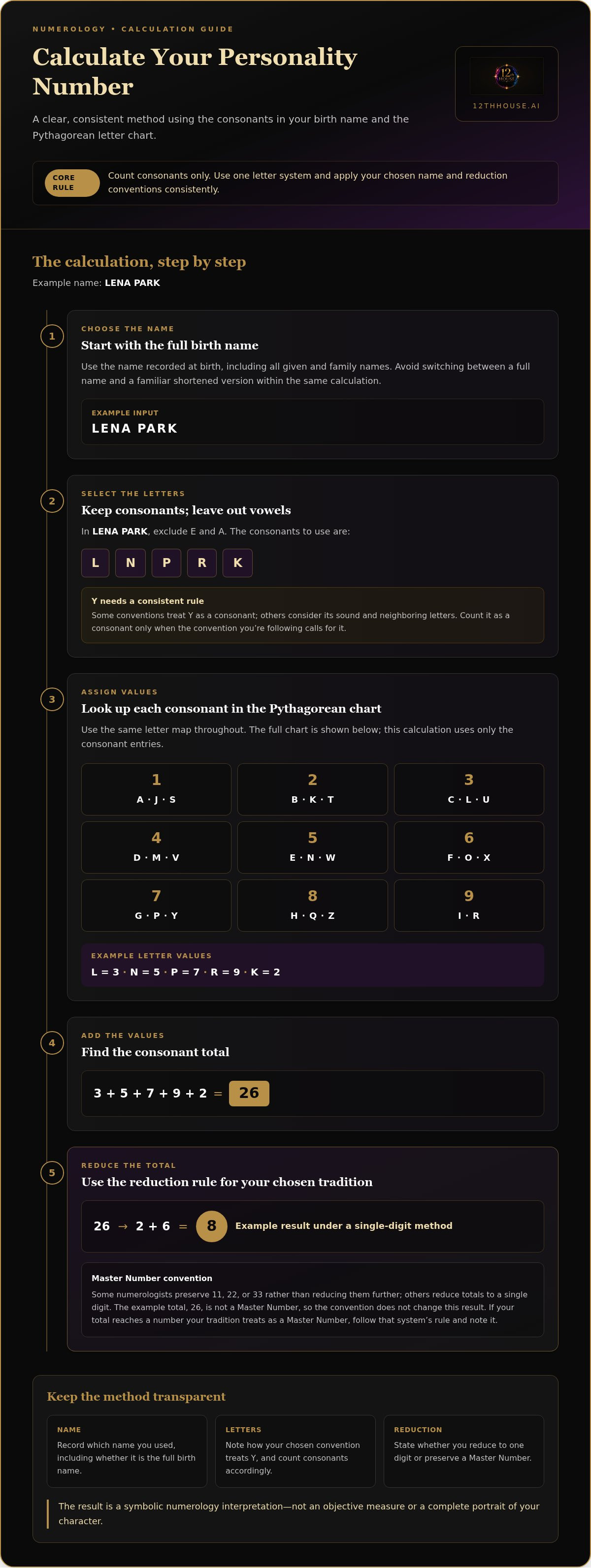
To answer “what is my personality number,” follow one letter system from beginning to end. The method below uses the Pythagorean chart and the full name recorded at birth. Numerology traditions may handle name forms, the letter Y, or Master Numbers differently, so note the convention you choose and apply it consistently.
Which name and letters should you use?
Start with your birth name as it appears on your birth record, including all given and family names. Use each name in the calculation rather than switching between a full name and a familiar shortened version. If you compare results from different approaches, record the name and letter rules used for each. Otherwise, a change in the input can produce a different total without making the reason clear.
For this consonant-based method, leave out vowels. Y needs care: some conventions treat it as a consonant, while others consider its sound and neighboring letters. Follow the rule associated with the method you’re using, and count Y as a consonant only when that convention calls for it.
How do you add and reduce the letter values?
Use this Pythagorean letter map. The Personality Number calculation selects consonants, but the full chart shows where every letter belongs:
- 1: A, J, S
- 2: B, K, T
- 3: C, L, U
- 4: D, M, V
- 5: E, N, W
- 6: F, O, X
- 7: G, P, Y
- 8: H, Q, Z
- 9: I, R
- Write the birth name. For this example, use LENA PARK.
- Select the consonants. Leave out E and A, the vowels. The remaining letters are L, N, P, R, and K.
- Assign each value. From the chart, L = 3, N = 5, P = 7, R = 9, and K = 2.
- Add the values. Calculate 3 + 5 + 7 + 9 + 2 = 26.
- Reduce the total. Add the digits: 2 + 6 = 8. Under a single-digit method, the example Personality Number is 8.
Reduction conventions vary. Some numerologists preserve Master Numbers such as 11, 22, or 33 rather than reducing them further; others reduce totals to a single digit. The example total, 26, isn’t a Master Number, so that difference doesn’t change its result. If your total reaches a number your chosen tradition treats as a Master Number, follow that system’s rule and note it rather than mixing conventions.
Once you’ve calculated your number, explore its traditional interpretation alongside the method that produced it. 12th House offers numerology reports that can help you consider the result in a broader context.
Personality Number Meanings: What Numbers 1-9 May Suggest
If you’re asking “what is my personality number” because you want a clear description of yourself, keep the interpretation in proportion. These meanings come from traditional numerology, not proven personality findings. Read each as a symbolic theme to test against your experience. A strength can become a tension when it’s overused or when a situation calls for a different response.
What themes are associated with Personality Numbers 1-4?
Numbers 1 to 4 are often linked with initiative, cooperation, expression, and structure. Their themes can suggest how someone might come across, but they aren’t rules about how that person must act.
- 1, initiative: May project independence and decisiveness. A possible blind spot is seeming too forceful or self-reliant to invite collaboration.
- 2, cooperation: Can give an impression of tact and attentiveness. The tension may be overaccommodating or holding back a view to keep the peace.
- 3, expression: Is traditionally associated with warmth, creativity, and lively communication. Spontaneity may sometimes come across as scattered or distract from follow-through.
- 4, structure: May suggest a practical, steady, organized presence. Reliability can be a strength, while strictness or resistance to change may become a blind spot.
What themes are associated with Personality Numbers 5-9 and master numbers?
For these numbers, pair the symbolic theme with a question rather than treating it as a label. Notice what fits in particular settings and what changes when you feel more at ease.
- 5, adaptability: May suggest curiosity and flexibility; frequent shifts could be read as restlessness. Do people experience you as open to change, or hard to pin down?
- 6, care: Is associated with responsibility and support, though helping can become taking on too much. Do you offer care while still respecting your own limits?
- 7, inquiry: Can point to an observant, thoughtful presentation; privacy may be mistaken for distance. How does your communication change when you trust the room?
- 8, responsibility: May convey capability and authority, with a risk of seeming controlling or overly focused on results. How do you balance direction with listening?
- 9, breadth: Is traditionally linked to compassion and broad perspective; idealism can sometimes blur personal boundaries. Where do you give generously, and where do you need clearer limits?
Some numerology systems also preserve 11, 22, and 33 as Master Numbers instead of reducing them to single digits. They’re commonly associated with heightened intuition or inspiration, building and responsibility, and compassion or service, respectively. Interpretations and reduction practices vary. If your method keeps a Master Number, explore that reading as an additional symbolic layer, not as a stronger or more definitive judgment of your character.
What Your Personality Number Does Not Tell You
A Personality Number can suggest a theme for reflection, but it can’t define you, diagnose you, or guarantee how another person will perceive you. If you’re asking “what is my personality number,” keep the answer within its proper frame: it’s a symbolic interpretation within numerology, not an objective personality assessment.
Numerology isn’t a scientifically validated personality test. Its value here is as a reflective framework that can help you ask questions about self-presentation without treating a symbolic reading as measurable evidence. Your behavior can change across situations, and other people interpret what they see through their own experiences and expectations.
How is the Personality Number different from other core numbers?
These name-based numbers use different inputs and traditionally point toward different areas of interpretation. Their descriptions can complement one another, but they aren’t interchangeable or a complete account of a person.
- Personality Number: Uses consonants in the birth name; traditionally associated with outward presentation and first impressions.
- Soul Urge Number: Uses vowels in the name; traditionally associated with inner desires and motivations.
- Expression Number: Uses the full name; traditionally associated with talents and potential.
This comparison maps traditional meanings, not proven psychological categories. A useful way to read the numbers is to notice the distinct questions each invites: What might I express outwardly? What may matter to me inwardly? What possibilities might I want to develop? Let the questions guide reflection rather than turning the numbers into competing claims about who you are.
Can one number define how others see you?
No single number can account for every impression you make. Context matters: you may communicate differently with close friends than in a job interview, and culture, behavior, mood, and individual perception all shape how others interpret you. Someone may read quietness as thoughtfulness; another may read the same quietness as reserve. A numerological interpretation can’t settle which impression is correct.
Different systems may also produce different readings because they can use different name forms, letter rules, or reduction conventions. That variation is a reason to treat the result as one symbolic lens, not a universal verdict. If an interpretation resonates, ask what experience supports it and whether it helps you understand a pattern. If it doesn’t fit, you can set it aside.
Keep what opens a useful line of inquiry. Leave behind anything that makes you feel fixed, diminished, or boxed in. 12th House offers numerology reports for exploring your result alongside broader themes.
How to Use Your Personality Number for Self-Reflection
A number becomes useful when you test its meaning against your own life. Treat the interpretation as a prompt, not a script. You don’t need to change your behavior to match a description; the aim is to notice whether its themes help you see your habits and choices more clearly.
- Calculate. Use one name and letter convention consistently, and note the method you chose. That gives you a clear reference point if you explore other numerology systems later.
- Read the interpretation. Notice the suggested strengths as well as possible tensions. Avoid selecting only the flattering parts or treating a challenging theme as a flaw.
- Compare it with experience. Look for a specific moment when the theme seemed relevant, and another when it didn’t. Consider whether the setting, relationship, or mood changed how you presented yourself.
- Decide what resonates. Keep ideas that lead to a useful observation. Set aside claims that feel inaccurate or limiting, and let your lived experience remain the stronger evidence.
Which questions can help you reflect on your result?
Ask yourself: What impression do I hope to communicate in unfamiliar settings? What might people notice about my manner before they know me well? Where does this interpretation fit, and where does it miss the mark? Think of one conversation, meeting, or introduction that offers a concrete example. Journal what happened without turning one moment into a broad conclusion about your identity.
Then look for variation. Do you present yourself differently with trusted friends than with new people? What changes when you feel relaxed, rushed, or uncertain? These questions help distinguish a recurring pattern from a response shaped by a particular context. If the reading suggests confidence, for instance, note when you felt confident and what was happening rather than assuming you always appear that way.
Where can a personalized numerology reading fit?
Once you’ve formed your own observations, a personalized reading can help organize questions about a numerology result or a broader chart. Keep your notes beside the interpretation: they give you a grounded way to consider which themes connect with your experience and which don’t. 12th House offers numerology reports, and Lala, its AI spiritual guidance assistant, can answer personalized questions about charts and related topics.
If your reflection turns toward relationship patterns, explore Numerology compatibility as another symbolic lens, not a verdict on how two people will relate. A number can open a question; it can’t answer for you.
To continue exploring, explore personalized numerology guidance at your own pace.
Let Your Result Open a Better Question
Now that you know what is my personality number, let the result start a conversation with yourself, not close one. What do you want people to understand about you, and what parts of your presence feel natural rather than performed? Those questions can lead to more meaningful insight than trying to fit neatly into a number’s description.
Use what resonates as a starting point for curiosity. Notice how your impression shifts across different relationships and situations, and give yourself room to change. A symbolic framework can help you examine a pattern, but you remain the authority on your own experience.
Explore personalized numerology guidance with 12th House to reflect on your result in a broader context.
Frequently Asked Questions
Is a Personality Number the same as a Life Path Number?
No. A Personality Number is based on a name, while a Life Path Number is based on a birth date, so they represent separate numerological perspectives. If you’re comparing both in a chart, keep track of which interpretation belongs to which number rather than blending them into one description. Traditions can differ in how they interpret each result, so treat the comparison as symbolic context, not a definitive account of your character.
Can I calculate my Personality Number without my full birth name?
Yes, you can calculate a result from a partial or current name, but it may not match one based on your full birth name. For instance, using only your first name leaves out letters that would contribute to the full-name total. Label the name used alongside your result. That makes it easier to understand why two calculations differ and avoids treating results from different name forms as directly equivalent.
What happens if my Personality Number calculation gives 11, 22, or 33?
Some numerology traditions keep 11, 22, or 33 as Master Numbers, while others reduce them to a single digit or follow another convention. Note the rule you used beside your result, especially if you’re comparing readings from different sources. These numbers are symbolic categories within numerology. A Master Number doesn’t establish that someone has a special ability, destined role, or guaranteed outcome.
Does my Personality Number change if I change my name?
A calculation using a different name can produce a different number because the letters in the input have changed. Some numerology approaches distinguish a birth name from a name adopted later, but their interpretations may not align. If you explore both, label each result with the name and method used. Compare them as prompts for reflecting on how you present yourself, not as proof that your underlying identity has changed.
Is numerology a scientifically proven way to describe personality?
No. Numerology is a symbolic interpretive practice, not a scientifically validated personality assessment. If you’re asking “what is my personality number” to understand yourself, use the result as a question prompt rather than a measurement of your character. For example, reflect on whether a suggested theme fits a specific interaction instead of assuming it applies everywhere. Numerology shouldn’t replace evidence-based psychological assessment or support when those are needed.
Can two people have the same Personality Number but different personalities?
Yes. Sharing a number doesn’t mean two people share the same identity, history, or behavior. One person might use a traditional interpretation as a prompt to think about communication, while another may focus on how they approach unfamiliar settings. The useful comparison is not whether both people fit the same label, but how each interprets the theme in light of their own experiences and choices.
Do I use vowels or consonants to calculate my Personality Number?
In the common Pythagorean method, the Personality Number uses consonants in the chosen name, while vowels are associated with the Soul Urge Number. A practical detail to watch is the letter Y, which different conventions may classify differently. If a result seems inconsistent with another calculator, compare which letters each method counted before assuming there’s an arithmetic error. Consistent inputs make your result easier to interpret.


