

What if an eighth-house stellium points not to a life of crisis, but to a recurring invitation to understand trust, intimacy, and change more deeply? If you’re asking what does a stellium in the 8th house mean, the answer isn’t a fixed prediction. Several planets gathered in this house can bring its themes into focus, but intensity alone doesn’t determine how they’ll unfold.
It’s understandable to wonder whether this placement signals loss, trauma, or upheaval. The eighth house is also associated with shared resources, emotional vulnerability, psychological insight, and renewal. Even the definition of a stellium varies: some astrologers count three planets, while others require four. The planets involved, their aspects, and the rest of your chart all shape the interpretation.
This guide explains what may qualify as a stellium and how an eighth-house concentration can be read without treating astrology as fate. You’ll learn which planets and chart relationships to examine, why birth-time accuracy matters for house placements, and how to place this signature within your full birth chart.
Key Takeaways
- Learn what astrologers may count as a stellium and why the definition varies.
- Understand what does a stellium in the 8th house mean by tracing how its planets concentrate eighth-house themes.
- Separate symbolic associations with intensity and transformation from literal predictions of crisis or loss.
- Use an ordered chart-reading process: check planets and signs, examine aspects, then locate the house ruler.
- Confirm your birth details and house system before interpreting the placement, then consider it alongside the full chart.
What Does a Stellium in the 8th House Mean in Astrology?
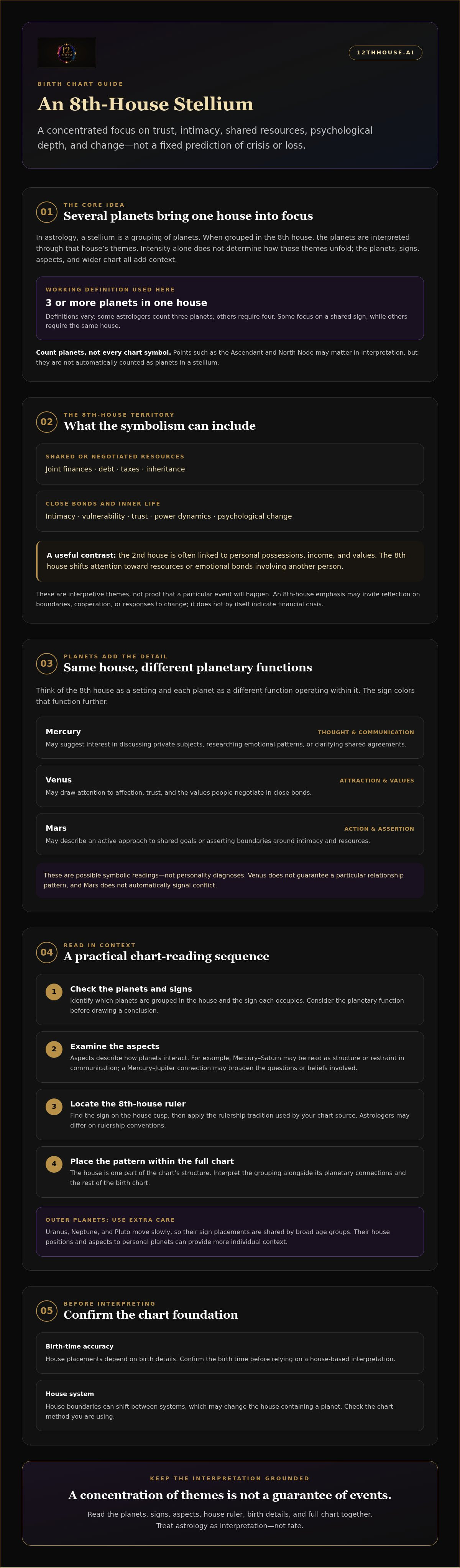
A stellium in the 8th house is a grouping of several planets in the birth-chart area associated with shared resources, intimacy, trust, psychological depth, and transformation. In astrology, this concentration is interpreted as an emphasis on those themes, not as a guaranteed event or fixed outcome. So, what does a stellium in the 8th house mean? It suggests a concentrated symbolic focus whose expression depends on the planets involved and the rest of the chart.
What counts as a stellium in a birth chart?
Astrologers don’t use one universal counting rule. Some define a stellium as three or more planets grouped in one sign or house; others reserve the term for four or more. Some focus on a shared sign, while others require the planets to occupy the same house. For clarity, this guide uses three or more planets in one house as its working definition.
Count planets, not every symbol shown on a chart. Points such as the Ascendant and North Node can matter in interpretation, but they aren’t automatically counted as planets in a stellium. Before drawing conclusions, check the chart method and house system you’re using, and confirm that your birth time is accurate. House boundaries can shift between systems, changing which house contains a planet.
What does the 8th house represent?
The eighth house is commonly associated with what is shared, merged, or negotiated with others. Its symbolic territory includes joint finances, debt, taxes, and inheritance, as well as intimacy, vulnerability, trust, power dynamics, and psychological change. These are interpretive themes, not proof that someone will experience a particular event.
Compare this with the second house, often linked to personal possessions, income, and values. The eighth house shifts attention toward resources or emotional bonds involving another person, such as managing shared expenses or deciding how much to disclose in a close relationship. That contrast doesn’t mean every eighth-house chart points to financial crisis. A planet grouping here may instead prompt reflection on boundaries, cooperation, or how a person responds to change.
Astrology is an interpretive system, so context matters more than a dramatic label. The planets describe different functions, and their astrological aspects show how those functions may interact. Read the house as one part of the chart’s structure, not as a standalone prediction.
How the Planets Shape an 8th-House Stellium
Think of the eighth house as a setting and each planet as a different function operating within it. Mercury brings thought and communication; Venus relates to attraction and values; Mars acts, pursues, and asserts. The sign each planet occupies further colors that function. This is why the question what does a stellium in the 8th house mean has no single answer based on the house alone.
How personal planets color eighth-house themes
Personal planets can make the symbolism feel more immediate in everyday choices and relationships. For example, Mercury in the group may suggest an interest in discussing private subjects, researching emotional patterns, or clarifying shared agreements. Venus may draw attention to affection, trust, and the values people negotiate in close bonds. Mars might describe a more active approach to pursuing shared goals or asserting boundaries around intimacy and resources.
These are possible symbolic readings, not personality diagnoses. A Venus placement doesn’t guarantee a particular relationship pattern, and Mars doesn’t automatically signal conflict. Read each planet alongside its sign, condition, and connections to other chart factors. For instance, note whether the planet’s aspects reinforce or complicate the way you’re interpreting its role.
How aspects and the house ruler add context
Aspects describe how planets interact through their positions in the chart. For instance, an aspect between Mercury and Saturn could be read as bringing structure or restraint to communication, while a connection with Jupiter might be interpreted as broadening the questions or beliefs involved. Neither aspect is inherently good or bad. Consider which planetary functions meet, then check whether that pattern connects to other parts of the chart.
Outer planets require extra care. Uranus, Neptune, and Pluto move slowly, so their sign placements are shared by broad age groups and aren’t automatically personal markers. Their house positions and aspects to personal planets can provide more individual context. To explore astrology as a structured interpretive practice, Kepler College offers educational resources for further study.
Also identify the ruler of the eighth house: find the sign on the house cusp, then apply the rulership tradition used by your chart source. Astrologers may differ on rulership conventions, so keep the method consistent. The ruler’s sign, house, and aspects can help show how eighth-house matters connect to other areas of life.
A stellium’s meaning depends on its planets, their aspects, and the context of the full chart. To move beyond a generic placement description, explore your chart with personalized birth-chart analysis as one way to examine those connections.
Does an 8th-House Stellium Mean Crisis, Loss, or Intense Relationships?
No. An 8th-house stellium doesn’t guarantee death, betrayal, debt, trauma, or a turbulent relationship. The house has traditional symbolic associations with endings, vulnerability, shared resources, and transformation. Those symbols can sound severe when reduced to a list of dramatic keywords, but they aren’t a forecast of specific events.
In astrology, intensity can describe where attention or recurring questions may gather, not inevitable hardship. A person might reflect often on trust, learn to communicate about shared responsibilities, or be drawn to psychological self-inquiry. These are possible ways to work with the symbolism, not outcomes dictated by a natal placement.
Why online interpretations can sound alarming
Short interpretations often emphasize the eighth house’s most dramatic associations and leave out the surrounding chart. That can turn symbolic language into an absolute-sounding claim. Shared resources, for example, may refer to cooperation, planning, or mutual responsibility, not necessarily debt or financial trouble. Treat alarming statements as prompts to examine, not conclusions to accept. Look for interpretations that explain their reasoning and acknowledge uncertainty.
What this placement cannot tell you by itself
A natal placement alone can’t confirm a particular relationship outcome, financial event, or psychological condition. It can’t establish that someone will be betrayed, inherit money, experience loss, or develop trauma. These are consequential matters, and a symbolic chart reading should never be treated as proof or as a substitute for appropriate practical support.
Context changes the reading. Consider the planets in the stellium, their signs and aspects, the eighth-house ruler, and how these factors connect with the full natal chart. Life circumstances matter too. An identical placement may be understood differently in two charts because the surrounding configurations and lived experiences differ.
If an interpretation has frightened you, pause before treating it as a prediction. Ask what specific chart factors support the claim. Does the explanation distinguish symbolism from certainty, and does it consider more than one possible expression? If it presents a single difficult outcome as unavoidable, it’s making a stronger claim than a natal placement can support.
So, what does a stellium in the 8th house mean in a grounded reading? It marks a concentration of symbolic emphasis, not a script. Use it to frame thoughtful questions about closeness, trust, and shared responsibilities, then interpret those questions through the wider chart rather than fear.
How to Read Your 8th-House Stellium in the Full Birth Chart
A useful interpretation comes from reading the stellium as part of a connected chart, not as a stack of separate keywords. Before you begin, confirm your birth date, time, and place, then check the house system used to calculate the chart. An uncertain birth time or a different house system can change house placements, so verify that foundation first.
A practical sequence for interpreting the placement
Move through these steps in order. Keep the first pass simple, then add nuance as patterns emerge.
- List the planets. Note each planet placed in the eighth house, along with its sign and degree.
- Consider each planet’s function. Ask what that planet represents before connecting it to the house’s themes.
- Review major aspects. Notice which other planets connect with the stellium and how those relationships may modify its expression.
- Locate the house ruler. Identify the sign on the eighth-house cusp, then find its ruling planet. Astrological traditions vary, so use the rulership system applied by your chart source.
Now look for repetition across the factors you’ve noted. If several point toward communication, for example, you might frame the placement as an invitation to examine how you discuss private matters or shared responsibilities. Keep the conclusion proportional to the chart: describe an area of focus or reflection, not a forecast.
Questions that make the interpretation personal
Bring the chart into conversation with your own experience, without assuming the symbols must fit. Which eighth-house topics feel relevant, if any? Do questions of trust, boundaries, collaboration, or shared responsibilities recur in your life? What practical circumstances might shape how you approach them? Write down observations as questions, not verdicts, and revisit them as your understanding develops.
If your question concerns a relationship, distinguish your individual birth chart from a comparison of two charts. A birth chart compatibility guide can offer a framework for relationship-chart context, but no single placement determines whether a relationship will succeed or fail.
For a reading that connects the planets, aspects, and house ruler rather than treating them in isolation, explore your personalized birth-chart analysis.
What to Explore Next After Finding an 8th-House Stellium
A stellium concentrates attention, but its interpretation depends on the planets involved and the rest of the chart. Treat it as a starting point for inquiry, not a complete explanation of your life. Review your chart factors, write down questions that arise, and return to your notes over time. Your understanding may shift as you notice connections or gain new perspective.
Turn a broad placement into a focused chart question
Instead of asking only, “What does a stellium in the 8th house mean?”, make the question specific to your chart. For example: Which planet in the group forms the most relevant aspects? What sign colors that planet’s expression? Where is the eighth-house ruler, and does its placement connect these themes to another area of life?
Look for patterns that repeat across the chart rather than building a conclusion from one placement. If your question concerns a relationship, separate your own natal chart from the dynamics between two charts. You can also explore the ideas in The Digital Sage: Why an AI Astrology Assistant is Your New Metaphysical Architect as a broader introduction to using an AI assistant for chart questions.
Continue your chart exploration with 12th House
Keep your interpretation open. Note which themes resonate, which don’t, and what questions remain. You might ask how a planet’s aspects modify its expression or how the house ruler links the stellium with another chart area. These prompts support reflection without turning astrological symbolism into certainty about future events.
Lala is an AI assistant that answers personalized questions about birth charts and other metaphysical topics. It can be an optional resource for exploring how a placement fits within your chart, but its responses aren’t definitive predictions. If you’d like to continue your exploration, Explore 12th House astrology tools.
Keep Exploring Your Chart with Curiosity
So, what does a stellium in the 8th house mean? It marks a concentration of astrological themes, not a fixed forecast. The planets in the grouping shape its expression, while their signs, aspects, and the wider chart provide essential context. Before interpreting it, confirm your birth details and chart method, then look for patterns rather than treating one placement as a complete story.
Use the symbolism as a framework for thoughtful questions about trust, intimacy, or shared responsibilities. Record what stands out, and revisit your notes as your understanding grows. Astrology birth-chart and transit analysis can help you explore placements in context, while Lala can answer personalized questions about your chart without turning interpretation into certainty.
Explore 12th House astrology tools to continue examining your chart at your own pace. Let curiosity guide the next step, and give your interpretation room to become more nuanced over time.
Frequently Asked Questions
What qualifies as a stellium in astrology?
A stellium is a grouping of planets in one zodiac sign or house, though astrologers differ on the exact rules. Some count three or more planets; others require four, and approaches vary on whether the grouping must share a sign, a house, or both. Points such as the Ascendant or North Node aren’t automatically counted as planets. Check the chart method behind the interpretation before applying the label.
How many planets make a stellium in the 8th house?
There’s no single standard count. Some astrologers use three or more planets in the eighth house, while others require four. In this guide, three or more planets in the same house is the working definition, not a universal rule. Count the planets shown in your chart, and confirm the house system and birth-time accuracy, since those factors can affect which house a planet occupies.
Is an 8th-house stellium bad or dangerous?
No. An eighth-house stellium doesn’t establish that you’ll experience danger, loss, betrayal, debt, or trauma. In astrology, the house is associated with topics such as trust, intimacy, shared resources, and transformation, but those symbols aren’t guarantees of life events. Astrology is an interpretive system, not a scientifically established method for predicting what will happen. Treat alarming, absolute claims with caution.
What does an 8th-house stellium mean for relationships?
In astrological interpretation, this grouping may bring attention to intimacy, trust, vulnerability, boundaries, or shared responsibilities in close relationships. The planets involved help shape the symbolism: Venus, for example, is associated with affection and values, while Mars relates to assertion and action. These placements don’t determine compatibility or relationship outcomes. Consider the signs, aspects, and wider chart before drawing conclusions about a bond.
Can an 8th-house stellium indicate wealth or inheritance?
No placement alone can confirm wealth, inheritance, debt, or another financial event. The eighth house is traditionally associated with shared resources, which can include joint finances, taxes, debts, and inheritances. Those are symbolic topics for interpretation, not promises or predictions. For practical financial decisions, rely on relevant financial information and professional advice rather than treating an astrology chart as evidence of what will happen.
Which planets matter most in an 8th-house stellium?
No one planet is always the most important. Each contributes a different function, and its sign, aspects, and relationship to the rest of the chart affect how astrologers interpret it. Personal planets such as Mercury, Venus, and Mars may describe more immediate themes around communication, relating, or action. Also examine the house ruler and connections among the planets instead of reading one placement in isolation.
How do I interpret an 8th-house stellium in my birth chart?
Start by confirming your birth details and chart’s house system. Then list the planets in the eighth house, note their signs, examine their aspects, and locate the house ruler. Look for themes that repeat across these factors rather than stacking separate keywords into a prediction. Asking what does a stellium in the 8th house mean is a useful starting point, but the full chart shapes any interpretation.


