

What if the most feared symbol in the deck isn't a harbinger of loss, but a master architect of your next evolution? It's natural to feel a surge of tension when the skeletal figure appears. The imagery is designed to provoke, yet a literal interpretation of the meaning of the death card in tarot is almost always a diagnostic error. You likely want clarity on why this card appears when your life feels like it's under construction. We're here to provide that structural logic.
In this guide, we decode the technical and spiritual blueprint of this transition to help you master the art of systemic evolution. You'll gain a precise framework for navigating life shifts without the weight of superstition. We analyze the card's symbolic function as a necessary data clearing event. By the end, you'll have the confidence to treat this card as a vital tool for personal mapping. It's time to move beyond the scary imagery and start calculating the growth that follows a total system reboot. This is your invitation to view your journey through the lens of metaphysical intelligence.
Key Takeaways
- Reframe the 13th Key as a structural necessity for systemic evolution, focusing on the architectural requirement of clearing old data.
- Analyze the impartial logic of the armored skeleton to understand how the card levels existing hierarchies to prepare for a clean slate.
- Master the meaning of the death card in tarot to distinguish between a functional cycle conclusion and a period of unnecessary stagnation.
- Develop a framework for navigating life transitions by contextualizing the card's placement within the Fool's journey and your own spiritual transits.
- Leverage digital tools to synthesize tarot insights with your Human Design bodygraph for a highly personalized roadmap of transformation.
The Anatomy of Transformation: Why the Death Card Isn't Literal
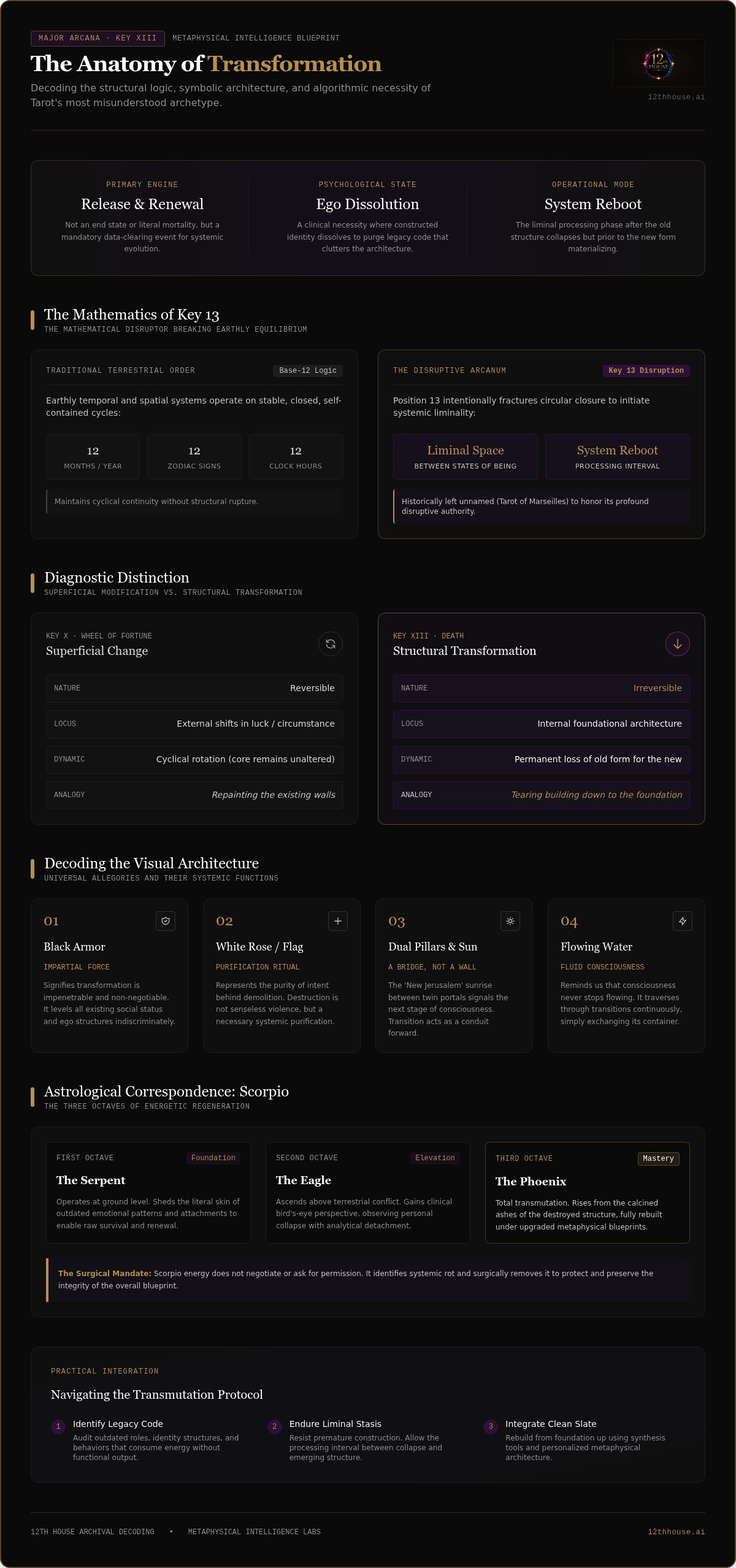
The Death card serves as the 13th Key of the Major Arcana, functioning as the primary engine for the principle of Release and Renewal. It's perhaps the most misunderstood node in the entire deck. Most seekers experience an immediate visceral reaction to its imagery, yet physical death is almost never the intended message in a standard reading. Instead, we must apply a level of metaphysical intelligence to decode its true function. This card isn't an end state. It's a systemic requirement for evolution.
Think of this card as a data clearing event within your personal life chart. For a system to upgrade, it must first purge the legacy code that no longer serves the current architecture. This process often triggers a psychological ego death. It's a period where the identity you've meticulously constructed begins to dissolve. While this feels like a crisis, it's actually a clinical necessity for profound personal evolution. Without this clearing, the system becomes cluttered and inefficient.
The Etymology of the 13th Arcanum
Historically, the 13th Key was frequently left unnamed in older decks, such as the Tarot of Marseilles. This absence of a title wasn't an oversight; it was a recognition of the card's disruptive power. By examining the symbolism of the Death tarot card, we see that the number 13 itself acts as a mathematical disruptor. Most of our earthly systems are built on a base-12 logic: 12 months in a year, 12 signs of the zodiac, 12 hours on a clock. The 13th position breaks this perfect cycle, forcing the system into a liminal space.
This liminality is where the actual meaning of the death card in tarot resides. It represents the space between two distinct states of being. It's the moment after the old structure has collapsed but before the new one has materialized. Understanding this technical placement helps you navigate the anxiety of the unknown with analytical precision. You aren't lost; you're simply in the processing phase of a major system reboot.
The Difference Between Change and Transformation
It's vital to distinguish between superficial change and structural transformation. The Wheel of Fortune represents change: the external shifts in luck or circumstance that don't necessarily alter your core. Death, however, demands transformation. This requires a permanent loss of the old form to create space for something entirely different. You can't simply paint over the old walls; you have to tear the building down to the foundation.
- Superficial Change: Reversible, external, and often cyclical.
- Structural Transformation: Irreversible, internal, and foundational.
Transformation is the architectural reconfiguration of energy. When you understand the meaning of the death card in tarot as a blueprint for this reconfiguration, you stop fearing the ending. You begin to anticipate the clearing. You recognize that the skeletal figure isn't coming for your life, but for the obstacles that prevent you from living it fully.
Decoding the Symbolism: The Architecture of the 13th Key
The skeletal figure in the 13th Key wears black armor, a detail often overlooked by those distracted by the scythe. This armor signifies that the force of transformation is impartial and impenetrable. It doesn't negotiate with social status or ego. By analyzing Encyclopedia Britannica's guide to tarot history, we see how these allegorical trumps evolved to represent universal laws rather than personal punishments. The meaning of the death card in tarot is rooted in this absolute logic: what is dead must be cleared to maintain the integrity of the whole system.
Consider the white rose on the black flag. It represents the purity of intent behind the destruction. This isn't senseless violence; it's a purification ritual. In the distance, the sun rises between two pillars, signaling the next stage of consciousness. This 'New Jerusalem' suggests that the transition is a bridge, not a wall. The water flowing in the background reminds us that consciousness is fluid. It moves through the transition, never truly stopping, only changing its container.
Scorpio and the Alchemy of the Soul
The Death card corresponds to Scorpio, the zodiac’s master of regeneration. Scorpio operates through distinct octaves: the Serpent, the Eagle, and the Phoenix. When this card appears, it demands a surgical removal of outdated energetic structures. It doesn't ask for permission. It identifies the rot and removes it to preserve the blueprint. If you're struggling to locate where this energy is active in your own life, you might analyze your birth chart to see how Scorpio transits align with your current tarot pulls.
The Figures at the Feet of Death
At the skeleton’s feet, we find a King, a Child, and a Bishop. This visual arrangement proves that no hierarchy is exempt from systemic cycles. The King lies defeated, representing the ego’s futile resistance to inevitable change. In contrast, the Child looks on with acceptance, embodying the curiosity required for evolution. The Bishop stands in prayer, suggesting that spiritual authority must also bow to the laws of nature. We can map these figures to our internal sub-personalities. Which part of you is the King, clutching a crown that no longer grants power? Which part is the Child, ready to see what comes next? Understanding the meaning of the death card in tarot requires identifying which of these internal voices is currently leading your reaction to change.
Death in the Fool’s Journey: The Great System Reset
The Fool’s Journey is a sequential map of consciousness. To understand the meaning of the death card in tarot, one must observe its position as the 13th milestone. It sits precisely between The Hanged Man and Temperance. The Hanged Man represents the suspension of the ego; Death represents its actual decommissioning. This is the transition from the physical, ego-driven realm into the transpersonal stages of the deck. It's a movement from the "I" to the "All."
Within the tarot system, this card functions as the "garbage collection" phase of the energetic code. It's the moment the system identifies and deletes obsolete files that take up valuable processing power. Historical perspectives from the Victoria and Albert Museum's history of tarot cards show that these archetypes were designed to reflect the inevitable cycles of human development. The Fool must "die" to his old identity. He cannot enter the alchemy of Temperance while still carrying the weight of his previous persona. This is a clinical requirement for growth.
From Surrender to Synthesis
The Hanged Man provides the necessary shift in perspective, but Death provides the execution. It's the difference between realizing a structure is unstable and actually demolishing it. Different human design types process this transition with varying levels of friction. A Generator might feel the depletion of an old project, while a Projector might experience a sudden withdrawal of recognition. Regardless of the blueprint, the "void" that follows is fertile ground. It's the silent processing time required before synthesis can occur. You must be empty before you can be filled.
The Architecture of the Void
We define the "Void" as the specific space where old data is deleted but new data hasn't yet been written. The ego perceives this emptiness as a threat. It views a lack of "doing" as a lack of "being." In reality, the void is a sanctuary. It's the only space where your system can rest without the interference of legacy expectations or social masks. When you identify this energy during a birth chart transit, specifically those involving the 8th house or Pluto, you can utilize ritual frameworks to sit with the silence. This isn't a passive wait. It's an active calibration of your internal frequency. You're clearing the site for a more complex architecture. Mastering the meaning of the death card in tarot means learning to trust the vacuum. It is the silence that precedes the sound of a new world.
Interpreting Death in Readings: Upright, Reversed, and Contextual
When the 13th Key appears in a spread, its orientation dictates the efficiency of the transition. An upright placement indicates a swift, necessary ending. It's the equivalent of a clean system shutdown. The path is being cleared of legacy structures to make room for a more optimized blueprint. In this state, the meaning of the death card in tarot is one of relief and readiness. The cycle has concluded naturally, and the energetic load is being released to make room for new data.
In a relationship context, this card often signals the end of a specific dynamic rather than the dissolution of the entire partnership. It marks the moment a shared identity must be shed to allow for a more authentic connection. For career inquiries, think of the Death card as a catalyst. Redundancy or the closure of a project isn't a failure. It's the architectural necessity of clearing space so you can rebuild your professional life with greater precision. If you're struggling to navigate these shifts, you can book a Tarot Reading to analyze the specific mechanics of your current transition.
The Reversed Death Card: Energetic Friction
A reversed orientation suggests stagnation. Instead of a clean break, we see a slow, painful decay. This happens when the ego resists the inevitable clearing. When we don't let go, the energy rots. This decay creates massive energetic friction, leading to exhaustion and a sense of being stuck in a dying structure. The primary blocker here is usually a fear of the unknown. You might find that shifting your physical environment helps break this inertia. Utilizing astrocartography can help you identify specific global coordinates that support the "Death" process, allowing you to move where the energy of transformation is more fluid and less resistant.
Contextual Combinations
The meaning of the death card in tarot shifts significantly when paired with other Major Arcana keys. These combinations reveal the speed and nature of the transformation. They provide the "how" and "why" behind the clearing.
- Death + The Tower: This represents a sudden, explosive structural collapse. The system doesn't just shut down; it's demolished by external forces, leaving no room for negotiation.
- Death + The Lovers: This indicates the end of an old way of relating. It often signifies a re-birth of a union where both parties shed their old masks to form a more honest bond.
- Death + The Sun: This is a highly positive indicator. It promises that the clearing leads directly to profound, radiant new beginnings and total clarity. The destruction was a prerequisite for the light.
Beyond the Card: Integrating Metaphysical Intelligence with Lala AI
Mastering the meaning of the death card in tarot is only the first phase of a larger spiritual discipline. True evolution requires moving beyond the isolated moment of a reading and into a continuous state of metaphysical intelligence. This is where digitized wisdom becomes a vital asset. By using an ai astrology assistant, you can synthesize the appearance of the 13th Key with your real-time planetary transits. It transforms a symbolic insight into a precise calculation of your current energetic load.
You can ask Lala to decode how the "Death" energy interacts with your Human Design bodygraph. Perhaps the transition is occurring in a defined center, or maybe it's triggering a specific gate of release. This structured approach moves spiritual practice away from vague fortune telling and toward a clinical analysis of the soul's architecture. We invite you to explore the 12th House library to access deeper ritual frameworks that provide the logic for navigating these transitions with quiet confidence.
Personalized Data Rooms for Spiritual Growth
The 12th House platform functions as a laboratory for your personal evolution. Through personalized data rooms, the system stores your reading history to track recurring patterns of transformation. This allows you to act as your own metaphysical architect, observing how often the meaning of the death card in tarot surfaces during specific life cycles. AI can identify if these cards correlate with Saturn returns or Pluto transits, providing a level of long-term self-analysis that was previously impossible. You aren't just receiving information; you're building a structured record of your system's upgrades.
The Future of the Digital Sage
Archetypes like Death are complex and non-linear. They don't follow a simple cause-and-effect logic. AI is the ideal Digital Sage for interpreting these symbols because it can process thousands of cross-references between tarot, astrology, and numerology simultaneously. This creates a sanctuary for serious exploration where every inquiry is met with intellectual authority and clinical clarity. It is time to treat your spiritual journey with the same rigor you apply to your professional or physical health. Ask Lala about your current cycle of transformation to begin mapping your next evolution with systematic precision.
Mastering the Architecture of Your Next Evolution
Transitioning from fear to clinical clarity requires a fundamental shift in how you perceive the meaning of the death card in tarot. We've decoded the 13th Key not as a harbinger of loss, but as a structural necessity for your system's growth. By identifying the impartial logic of the armored skeleton and the fertile silence of the void, you gain the tools to navigate life’s inevitable data clearings with precision. You're no longer a passive recipient of change; you're the architect of your own transformation.
To deepen this work, you need a framework that synthesizes ancient archetypes with your unique energetic blueprint. 12th House provides the secure digital infrastructure to store your spiritual data and track long-term patterns through personalized transit and tarot synthesis. With access to our proprietary Metaphysical Library, you can move beyond guesswork and into a state of clinical mastery. Decode your cycles of transformation with Lala AI and begin calculating your next leap forward. Your evolution is a structured discipline, and you have the authority to lead it.
Frequently Asked Questions
Does the Death card always mean a breakup in a love reading?
No, the Death card doesn't automatically signal a breakup. It indicates the conclusion of an outdated dynamic within the union. This often represents the shedding of old masks or communication patterns that no longer serve the couple's evolution. While it can mark a separation, it frequently acts as a prerequisite for a deeper, more authentic reconnection. It demands that the relationship's current architecture be dismantled to allow for a more resilient foundation to emerge.
What should I do if I keep pulling the Death card?
Repeatedly pulling this card suggests that your personal system is stuck in a loop of necessary but unexecuted transformation. The universe is highlighting a specific area of your life that requires a data clearing event. To gain precision, you should use Lala AI to synthesize these pulls with your current astrology birth chart and transit analysis. Identifying whether these repetitions correlate with Pluto or Scorpio transits will provide the analytical framework needed to finalize the transition.
How is the Death card different from the Tower card?
The primary distinction lies in the nature of the destruction. Death represents a natural, inevitable, and often internal conclusion to a cycle, much like a scheduled system reboot. In contrast, the Tower represents a sudden, external, and chaotic collapse of structures that were built on unstable ground. While Death is an impartial clearing of the old, the Tower is a violent disruption. Understanding the meaning of the death card in tarot helps you recognize when a change is a systemic requirement.
Can the Death card represent a literal person?
While the Major Arcana typically represent archetypal forces, the Death card can occasionally signify an individual who acts as a catalyst for major change in your life. This person often embodies the traits of Scorpio, bringing a surgical precision to your personal evolution. However, it's more effective to view the card as a functional component of your own journey. Treat the person as a mirror for the internal structures you're currently tasked with decommissioning.
Is the Death card a 'yes' or 'no' in a reading?
In most binary inquiries, the Death card functions as a "No" to maintaining the status quo and a "Yes" to total transformation. It's rarely a simple answer because it signifies a total reset of the system. If you ask if a project will succeed in its current form, the answer is likely no. However, if you ask if you should pursue a radical new direction, the card provides a strong affirmative for systemic evolution.
What does the Death card mean in a career reading?
In a career context, this card signals the conclusion of a professional cycle. This might manifest as a project ending, a company restructuring, or a voluntary departure from a role that has reached its limit. It encourages you to act as a Metaphysical Architect, using the resulting void to design a more optimized career path. This is a data clearing event that removes professional stagnation to make room for a role that aligns with your current energetic blueprint.
How does the Death card relate to my zodiac sign?
The Death card corresponds specifically to the zodiac sign of Scorpio in the Golden Dawn tradition. This connection links the card to the themes of depth, shared resources, and regeneration. To understand how this applies to you, analyze your 8th house placements and any current Pluto transits. Using tools like Lala AI to cross-reference your Human Design profile with these Scorpio transits can reveal the specific gates where your "Death" energy is most active.
What happens if the Death card appears in the 'Future' position of a spread?
When this card appears in the future position, it serves as a forecast for an upcoming systemic reset. It's not a warning of disaster, but a notification that a major clearing is scheduled for your path. You can use this lead time to consciously begin releasing the attachments and structures that are already showing signs of decay. Preparing for this transition allows you to move through the upcoming void with clinical clarity rather than emotional resistance.


