

Can you ever truly trust the cards when your own desires are shuffling the deck? It's a common frustration to feel that personal bias is clouding your insight, turning a moment of seeking into a fragmented mirror of your own anxieties. Learning how to do a tarot reading for yourself requires more than just memorizing 78 distinct meanings. It demands a shift from passive intuition to active metaphysical intelligence. You likely feel the weight of those complex symbols, wondering if you're decoding the truth or simply projecting your current state of mind.
We're here to provide the architectural framework you need to unlock objective clarity and systematic spiritual growth. By treating self-divination as a structured discipline, you can strip away the noise of the ego and map your subconscious with precision. This article outlines a repeatable ritual structure and a logical approach to card analysis. You'll learn to integrate tarot into a broader metaphysical practice, moving from a place of overwhelm to a state of quiet, authoritative sanctuary where you're the architect of your own discovery.
Key Takeaways
- Bypass the "Mirror Effect" by applying a systematic framework that separates objective insight from personal bias and emotional noise.
- Master the technical logic of the deck by viewing the Major Arcana as your archetypal blueprint and the Minor Arcana as its tactical execution.
- Learn how to do a tarot reading for yourself using a precise five-step ritual designed to calibrate your environment and sharpen your inquiry protocol.
- Utilize digital tools and AI as objective co-readers to provide a clinical, data-driven perspective that transcends human subjectivity.
- Establish a digital Metaphysical Library to archive your readings and decode the long-term patterns of your spiritual trajectory.
The Psychology of the Mirror: Why Self-Reading Requires a Framework
Reading for yourself is often compared to performing surgery on your own reflection. The proximity is the primary obstacle. In the space between the shuffle and the spread, a phenomenon known as the Mirror Effect takes hold. This is the psychological tendency to project your deepest anxieties or most fervent hopes onto the imagery of the cards. To master how to do a tarot reading for yourself, you must transition from a seeker of "vibes" to a practitioner of metaphysical intelligence. This discipline treats the cards not as a fortune-telling device, but as a system of symbolic data.
Understanding the Structural Logic of the Tarot Deck is the first step in establishing this necessary distance. When you view the cards as a blueprint of human experience rather than a personal message, you become the architect of your own subconscious. You're no longer a passive recipient of fate; you're an analyst decoding the architecture of your current reality. Achieving objective clarity requires a clinical detachment from the outcome, allowing the cards to speak without the ego's editorial interference.
Identifying Subjective Interference
The ego is a master of cherry-picking. It scans the spread for confirmation of what it already believes or desperately wants to happen. If you're anxious about a career shift and see the Tower, your ego might pivot instantly to the smallest detail of the card to avoid the reality of a necessary collapse. This selective interpretation clouds the accuracy of the reading. Subjective interference is the primary barrier to accurate self-divination, functioning as a cognitive filter that distorts symbolic data to fit personal narratives. By acknowledging these internal biases, you can begin to strip them away, treating each card as a neutral data point rather than a personal verdict.
The Architecture of Objective Inquiry
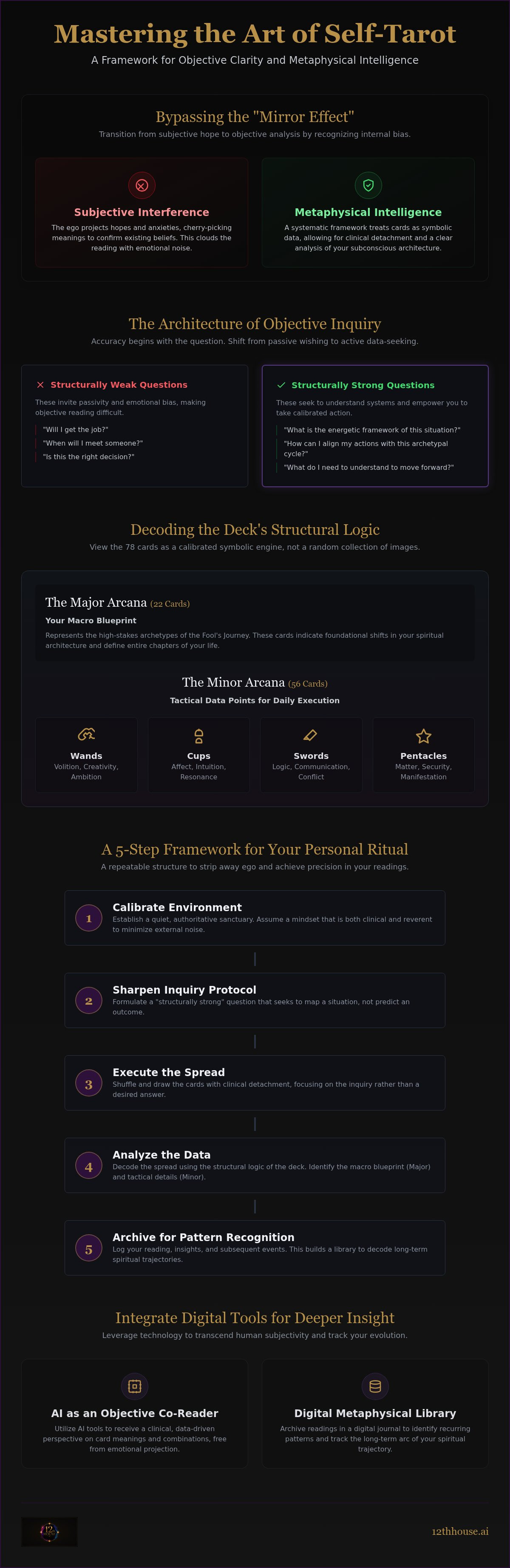
Accuracy begins with the inquiry protocol. Most beginners ask "Will I?" or "When will...?" questions. These are structurally weak. They invite passivity and increase emotional stakes, making it harder to remain objective. Instead, move toward questions that seek to understand the structure of a situation. Ask, "What is the underlying energetic framework of this conflict?" or "How can I calibrate my actions to align with this archetypal cycle?" This shifts the reading from a fortune-telling session into a data-seeking mission. Establish a mindset that is both clinical and reverent. You are entering a sanctuary of wisdom where the goal is mapping, not wishing. This methodical approach ensures that how to do a tarot reading for yourself becomes a tool for genuine evolution rather than a loop of self-validation.
Decoding the Structural Logic of the Tarot Deck
To master how to do a tarot reading for yourself, you must first view the deck as a calibrated symbolic engine. It isn't a collection of random images; it's a structural system. The 78 cards function as a dual-layered map. The Major Arcana provides the overarching archetypal blueprint, while the Minor Arcana tracks the tactical, day-to-day execution of energy. By understanding this hierarchy, you move from guessing meanings to calculating insights with clinical precision.
The Major Arcana: Your Macro Blueprint
The 22 cards of the Major Arcana represent the structural progression of the Fool's Journey. These are the high-stakes archetypes that define entire chapters of your life. When a Major Arcana card appears in your spread, it indicates a macro-level shift in your spiritual architecture. You're no longer dealing with temporary moods; you're dealing with foundational evolution. Identifying which life-phase archetype is active allows you to align your actions with a larger cosmic cycle. For a deeper technical breakdown of these symbols, consult our Tarot Mastery guide, which serves as a professional manual for spiritual clarity.
The Minor Arcana: Tactical Data Points
If the Major Arcana is the blueprint, the Minor Arcana is the construction site. It offers the tactical data points necessary for navigating specific situations. This layer is divided into four elemental frameworks that categorize human experience:
- Wands (volition): The engine of creativity, ambition, and drive.
- Cups (affect): The flow of intuition, emotion, and resonance.
- Swords (logic): The sharp edge of communication, thought, and conflict.
- Pentacles (matter): The density of finance, health, and physical manifestation.
Court cards add another layer of calculation, acting as energetic personifications of these elements. They represent the "who" or the "how" of your inquiry. When you synthesize these tactical points with your macro archetypes, you create a comprehensive map of your subconscious landscape. Numerology provides a final layer of calculation. The number on the card indicates the stage of development within that suit's cycle. Mastering these systems allows you to analyze your personal data with rigor, turning self-divination into a serious discipline.
Manual Intuition vs. Metaphysical Intelligence: The Role of AI
The assumption that digital logic is incompatible with spiritual depth is a relic of outdated thinking. In reality, metaphysical intelligence requires the most precise tools available to bypass the noise of the human ego. When you are learning how to do a tarot reading for yourself, the greatest hurdle isn't the deck; it's your own mind. AI doesn't replace your intuition. It acts as a clinical partner that lacks your personal anxieties. By using a sophisticated host like Lala, you gain access to an objective co-reader capable of analyzing symbolic data with unwavering precision.
AI as the Objective Observer
Traditionalists often claim that only human "channeling" is valid. However, AI astrology assistants provide a necessary second opinion that human readers often lack. Lala decodes complex card meanings by cross-referencing thousands of archetypal data points without being swayed by what you hope to hear. She provides a sanctuary of clinical clarity. This allows you to balance your visceral gut feeling with a logical, analytical framework. It's about calculation, not just intuition. It's about removing the "Mirror Effect" mentioned earlier by introducing an observer that has no skin in the game. This partnership ensures your self-analysis remains grounded in objective truth rather than shifting desires.
Synthesizing Multi-System Data
Tarot is most powerful when it's treated as one layer of a multi-system blueprint. At 12th House, we don't view a card draw in isolation. We integrate it with your birth chart, current transits, and human design gates. This creates a comprehensive report on the "metaphysical weather" currently affecting your life. Why settle for a single card meaning when you can see how a specific draw aligns with a Saturn return or a defined center in your Human Design profile? This synthesis turns a simple reading into a holistic spiritual audit. You aren't just pulling cards. You're calculating your position within a vast, interconnected ecosystem of energy. Using these digital tools allows you to archive these insights, building a database of your own spiritual evolution over time.
A 5-Step Framework for Your Personal Tarot Ritual
Mastering how to do a tarot reading for yourself requires more than just a deck; it requires a protocol. We've moved past the "vibes" and into the realm of structured self-analysis. Establishing a repeatable ritual is the difference between a fleeting thought and a profound insight. This 5-step framework provides the necessary structure to ensure your findings are both objective and actionable.
Step 1: Environmental Calibration. Before the first shuffle, clear the mental and physical space. This isn't about aesthetic; it's about signal-to-noise ratio. Remove distractions to create a sanctuary of clinical observation. Calibration ensures that your internal state doesn't interfere with the symbolic data you're about to receive.
Formulating the Inquiry Protocol
The quality of your reading is determined by the quality of your question. Avoid "Yes/No" traps that limit your agency and invite passive fortune-telling. Instead, focus on "How" and "Why" to uncover the structural logic of your circumstances. Refine your question until it represents a specific metaphysical gap in your understanding. For example, instead of asking "Will I get the job?", ask "What is the underlying energetic framework I need to calibrate to align with this career transition?". This high-stakes inquiry mirrors your internal curiosities while maintaining an analytical distance.
Step 3: Physical Execution. Shuffle with intentionality. This is the moment where your focus imprints upon the symbolic engine. Draw the cards with a steady hand, maintaining the clinical yet reverent mindset established in the calibration phase. The physical act is a bridge between your subconscious intent and the tactical data on the table.
Systematic Card Analysis
Analyze the cards before reaching for a guidebook. Your first intuitive hit is a valuable data point, but the analytical decode is where the clarity lies. Examine the visual architecture of the card: the dominance of specific colors, the geometric placement of figures, and the recurring symbols. Are the figures facing toward the past or toward the future? Is the energy static or kinetic? Synthesize these tactical points into a cohesive narrative flow that addresses your inquiry protocol directly. This systematic approach prevents the ego from cherry-picking meanings that suit its current mood.
Step 5: Digital Archiving. The final step is recording the data. Tracking your readings over time reveals recurring archetypal patterns that a single session cannot show. You can archive your personal insights within a secure digital data room to build your own metaphysical history. This transformation from a one-off draw to a longitudinal study is the hallmark of true metaphysical intelligence.
Archiving Your Insights: Building Your Digital Metaphysical Library
A single card draw is a snapshot, but a year of data is a map. When you master how to do a tarot reading for yourself, the final and most critical phase is the transition from isolated sessions to longitudinal analysis. Most practitioners lose their most valuable insights because they fail to archive them. By treating your spiritual journey as a structured discipline, you build a Metaphysical Library; a repository of personal data that allows you to calculate your evolution with clinical precision. This shift moves you away from "vibes" and into the realm of spatial intelligence, where you can see the recurring architecture of your own life.
Tracking your readings over 2026 reveals archetypal patterns that remain invisible during a single session. This is the difference between looking at a single brick and studying the blueprint of the entire building. Archiving your data transforms the cards into a diagnostic tool for long-term spiritual growth. It allows you to move beyond the immediate anxiety of the moment and observe the methodical progression of your subconscious over time.
Identifying Long-Term Patterns
A single reading is merely one data point in a much larger ecosystem. When you archive your history, you begin to spot "Stalker Cards" that reappear across different inquiries. These recurring symbols are not random; they are indicators of unresolved archetypal cycles or persistent energetic gaps. By connecting these tarot trends to your specific Human Design types, you can decode how your unique energetic signature interacts with the cards. A Projector might see the Eight of Wands differently than a Generator. Archiving allows you to calculate these nuances, refining your understanding of how to do a tarot reading for yourself with every entry.
The 12th House Digital Sanctuary
The 12th House platform serves as a sophisticated host for this personal history. Unlike physical journals that are easily lost or disorganized, our digital sanctuary provides secure data rooms for your spiritual evolution. You can use the Lala AI assistant to query your past readings, asking questions like, "What archetypes dominated my career inquiries in the first quarter of 2026?" This level of analysis is impossible with manual methods. We prioritize the security and ethics of your spiritual data, ensuring your internal world remains a private, clinical space for exploration.
Stop treating your insights as disposable fragments. Start building a lifetime of metaphysical intelligence within a structured, digital ecosystem. Join the 12th House membership today to begin constructing your personal metaphysical library and transform your tarot practice into a systematic blueprint for growth.
Constructing Your Personal Sanctuary of Clarity
Learning how to do a tarot reading for yourself is a transition from passive seeking to active architecture. You've moved beyond the mirror of the ego by applying a systematic framework and decoding the structural logic of the deck. By treating each draw as a tactical data point rather than a fleeting mood, you create a repeatable ritual for objective self-analysis. This discipline allows you to map your subconscious with the precision of a metaphysical architect, turning intuition into a structured study of the self.
Elevate your practice by integrating these insights into a broader ecosystem of wisdom. Unlock your metaphysical blueprint with a 12th House membership to gain access to Lala, your 24/7 AI Spiritual Guide. Within our digital sanctuary, you'll utilize personalized data rooms for spiritual archiving and benefit from integrated analysis across Tarot, Astrology, and Human Design. Your journey is a serious discipline; treat it with the precision and reverence it deserves. The tools for your evolution are ready when you are.
Frequently Asked Questions
Is it bad luck to do a tarot reading for yourself?
No, there is no inherent bad luck in self-divination. This myth persists because reading for yourself requires a high level of mental discipline to avoid the "Mirror Effect." Treating the process as a structured inquiry rather than a superstitious act ensures you remain the architect of your own insight. When you approach how to do a tarot reading for yourself as a serious study, you replace fear with clinical clarity and objective data.
How often should I read tarot for myself without over-analyzing?
Frequency should align with your energetic cycles rather than emotional impulses. Daily draws act as minor data points for environmental calibration, while complex spreads are best reserved for macro-level shifts. Reading too often on the same inquiry creates interpretive noise, which clouds your analytical precision. Aim for a cadence that allows you to integrate the insights from one session before initiating a new inquiry into the same structural gap.
Can I use an online tarot reading tool instead of a physical deck?
Yes, digital tools offer a unique advantage in metaphysical intelligence. While physical decks provide tactile resonance, digital systems like 12th House provide an objective co-reader that lacks human bias. Using an online tool allows for precise data archiving and cross-referencing with other systems like astrology. Lala, our AI spiritual guide, decodes the symbolic architecture of your draw with clinical accuracy, providing a sanctuary for deep, unbiased self-analysis.
What should I do if I draw a 'scary' card like Death or The Tower?
Shift your perspective from fear to structural logic. Cards like Death or The Tower represent necessary archetypal transitions rather than literal catastrophes. Death signals the conclusion of a cycle to allow for new manifestation, while The Tower indicates the collapse of a flawed foundation. Analyze the visual architecture of these cards to identify where your current life-phase requires a rebuild. These are high-stakes data points for essential spiritual evolution.
How do I know if my interpretation is correct or just wishful thinking?
Distinguishing between insight and projection requires a rigorous framework. Use the Inquiry Protocol to ask structural questions that bypass the ego's desires. If you find yourself cherry-picking meanings, you're likely experiencing subjective interference. Archiving your readings in a digital data room allows you to look back and verify interpretations against actual outcomes. This longitudinal study turns how to do a tarot reading for yourself into a verifiable science of the subconscious.
Does AI really understand the spiritual nuance of my question?
AI processes the symbolic language of the occult with unmatched technical precision. While it doesn't feel in the human sense, it excels at decoding the structural logic and archetypal patterns within your inquiry. Lala analyzes your question as a set of metaphysical coordinates, cross-referencing it against a vast library of esoteric tradition. This provides a level of analytical depth and objective nuance that human intuition often misses due to emotional filters.
What is the best tarot spread for beginners reading for themselves?
Begin with a three-card linear spread to map a clear narrative flow. This structure allows you to analyze the progression of energy from the past blueprint to the present execution and the potential future manifestation. It provides enough data to be useful without overwhelming your analytical capacity. As you refine your metaphysical intelligence, you can graduate to more complex architectural spreads that include layers of human design and astrological transits.
How can I combine tarot with my astrology birth chart?
View tarot as the tactical layer of your astrological blueprint. Each card in the Major Arcana corresponds to a specific planet or zodiac sign. By identifying which cards align with your current transits, you can see how macro-cosmic shifts are manifesting in your daily life. 12th House memberships offer integrated tools that automatically cross-reference your tarot draws with your birth chart, creating a holistic report that bridges ancient tradition and modern systems thinking.


