
The right tarot app is defined by the reading tools it offers, not its mystical aesthetic. A useful Golden Thread tarot app alternative provides digital readings and spreads that suit your practice, while offline access varies by app. Compare these features before choosing a digital deck.
You may want a quick card pull one moment and a more structured spread the next. An app can make both easy to explore, but the experience depends on how clearly it explains card meanings, organizes readings, and supports your routine when you’re away from an internet connection.
This guide helps you compare tarot apps by reading formats, spread options, and offline functionality. Learn what makes each feature useful, how to match an app to your practice, and when digital readings can support deeper reflection. Use these criteria to choose a tool that feels intuitive and substantial enough to return to.
Key Takeaways
- Match an app’s reading formats and spread selection to the kind of reflection you want to practice.
- Check whether offline access fits your routine, and distinguish it from features that require an internet connection.
- Use journaling, reading history, and customizable layouts to build a more consistent tarot practice.
- Compare Labyrinthos, Fool's Dog, and Golden Thread by the tools and reading experience that matter most to you.
- When you want guidance beyond an app-based reading, explore 12th House Ask Lala AI Spiritual Guidance.
Digital tarot readings and spreads
A digital tarot reading follows the same symbolic structure as a tabletop draw. Choose a question, select a spread, then interpret each card through its position. For example, a three-card layout can map a situation, its tension, and a possible response. The app provides the framework; your attention brings the inquiry.
Tarot’s history connects card play and divination. Cartomancy became popular in Europe after playing cards arrived there in the 14th century. The standard 78-card tarot deck emerged in Paris in the late 1700s. Digital readings translate that structure onto a screen, where a card’s image and position can be reviewed together.
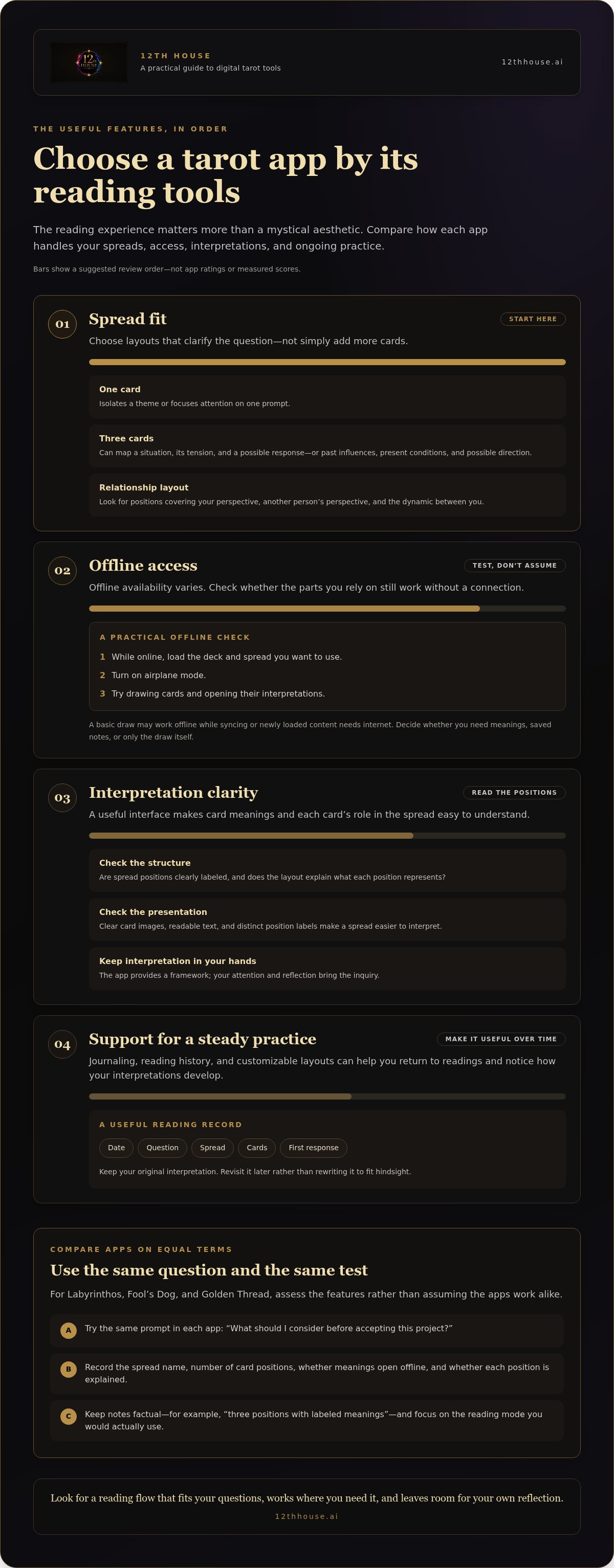
Choose a spread that matches your question. A single-card draw can focus attention on one theme. A three-card spread can compare past influences, present conditions, and possible direction. A relationship question might use positions for your perspective, another person’s perspective, and the dynamic between you. Read each position before applying a card meaning.
Saving readings helps you trace how your interpretations change. After a draw, record the date, question, spread, cards, and first response. For example, note whether the Eight of Pentacles suggests practice, patience, or a work pattern in your situation. Later, compare that entry with what actually became relevant. Keep your original interpretation rather than rewriting it to fit hindsight.
A daily card can become a brief observation practice. Draw one card in the morning, write down its central image, then revisit it at day’s end. If the Hermit appears, notice where you sought quiet or independent thought. Treat the card as a prompt, not a fixed forecast. That distinction keeps the practice reflective.
Guided readings can also support meditation. Choose a spread with a clear focus, such as what needs attention today. Study one card’s figures, colors, and direction before reading its description. Breathe steadily, then write one observation. This sequence turns a quick draw into a focused contemplative exercise without requiring a long session.
Conversational tarot uses follow-up prompts. Begin with a focused question, then ask what a particular card adds to the reading. For example, if a spread points toward a choice, ask which assumption deserves closer examination. Avoid repeating the same question until you receive a preferred answer. Use each prompt to clarify the pattern, not force certainty.
To build reading skills, separate observation from interpretation. First, name visible details, such as a figure facing left. Next, connect those details to the card’s position. Then write your personal association alongside the traditional meaning. This method helps distinguish intuition from memorized definitions. Over time, saved entries reveal which symbols consistently speak to you.
When comparing a Golden Thread tarot app alternative, assess its reading flow rather than its artwork alone. Look for spreads that fit your questions, a way to save useful notes, and guidance that supports interpretation. A well-designed digital reading makes the cards easier to examine while leaving the final reflection in your hands.
Tarot apps with spreads and offline access
Spread choice shapes a reading’s structure, while offline access determines when you can use it. Compare both with the same practical test: choose a layout, then see what remains available without an internet connection.
Spread Selection and Offline Access
Look for layouts that suit distinct questions. A one-card draw isolates a theme; a decision spread separates options and influences. A relationship layout can assign positions to each person and their shared dynamic. These examples provide a useful comparison framework, even when apps use different names for similar arrangements.
Offline access varies by app, so don’t assume it’s available. Before relying on a reading away from an internet connection, open the app online and load its deck and spread, then enable airplane mode. Try drawing cards and opening interpretations. This reveals whether the essential reading materials remain accessible on your device.
Decide what “offline” needs to mean for your practice. A basic draw may work without internet, while account syncing or newly loaded content may require a connection. Separate the reading itself from optional functions. For example, decide whether you need card meanings, saved notes, or only the ability to draw.
Use one question to compare layouts across apps. Try “What should I consider before accepting this project?” Then note whether each spread includes positions for context, challenge, and next step. A layout is useful when its positions clarify the question rather than simply adding more cards.
Comparing Tarot Apps
Labyrinthos, Fool's Dog, and Golden Thread are names readers may encounter when comparing digital tarot tools. Don’t assume they offer identical features just because they’re in the same category. Assess each app’s spread range, offline behavior, and interpretation format using the same question and device conditions.
Keep a simple comparison record. For each app, note the spread name, number of card positions, whether meanings open offline, and whether the layout explains each position. Keep your observations factual. For instance, “three positions with labeled meanings” is more useful than “easy to use.”
Compare how each tool presents the cards. Clear card images, readable text, and distinct position labels make a spread easier to interpret. If an app offers several decks or reading modes, focus on the one you would actually use. More options matter only when they support your practice.
Choose a consistent test. Use the same prompt, draw once in each app, and compare how the interface frames the cards. Then repeat the offline test after loading relevant content. This helps you identify a Golden Thread tarot app alternative based on practical fit, not the name alone.
For deeper study alongside digital practice, explore structured tarot learning as a way to develop your interpretation framework.
Which tarot apps include journaling, reading history, and customizable spreads?
These features vary by app, so compare them separately. An app includes journaling when you can attach personal notes to a reading. Reading history means you can revisit earlier draws. Customizable spreads let you adjust positions or layout. Look for each function in the app’s menus and descriptions before choosing.
Test journaling with a sample reading. Record the question, cards, and first interpretation. For example, note whether the Two of Swords reflects indecision or a need for space. Then leave the entry and return to it. A useful journal keeps your words connected to that specific draw, rather than providing only a blank notes field.
Reading history serves a different purpose: it lets you compare earlier interpretations with your present perspective. Open a saved reading and check whether its date, question, spread, and cards appear together. If you drew the Hermit during a work decision, those details can help you recall the original context. A card list without its question offers a thinner record.
Customizable spreads change a reading’s structure. Check whether an app lets you rename positions, add or remove them, or reorder their sequence. Try adapting a decision layout with one position for the current situation, another for a concern, and another for a possible next step. These controls matter when fixed layouts don’t match your inquiry.
Use this practical comparison during an app trial:
- Journal: Can you add notes to an individual draw?
- History: Can you find a past reading by its details?
- Customization: Can you alter a spread’s positions?
Record what each app actually allows. Feature labels can conceal meaningful differences. “Journal” might describe a separate writing space, while a reading log may store only cards and dates. For a work question, test whether your interpretation stays attached to the spread. That connection makes later reflection more precise.
Choose according to your practice. If you study recurring symbols, prioritize searchable or clearly organized reading history. If you develop personal layouts, prioritize editable spread positions. If you reflect through writing, test how easily you can save notes after drawing. One app may suit all three needs; another may serve one particularly well.
Judge a Golden Thread tarot app alternative by these tasks, not feature names alone. Run the same test question in each candidate, then inspect its saved record. Can you reconstruct the draw later? Can you shape the spread around the question? The answers reveal whether its tools support your method.
How do Labyrinthos, Fool's Dog, and Golden Thread compare?
Compare Labyrinthos, Fool's Dog, and Golden Thread through the same reading task. Their names alone don’t tell you which app suits your practice. Examine each app’s current description and interface, then test how it handles a question, card selection, and interpretation. This keeps your comparison grounded in observable features.
Start with Labyrinthos. Open its available reading options and choose a layout that matches your question. Check how clearly the app identifies each card position and presents its meaning. Then consider whether the wording leaves room for your own interpretation. A reading is more useful when card symbolism and spread position remain distinct.
Apply the same method to Fool's Dog. Select a reading option and inspect how the cards appear together. Does the interface help you see the spread as a connected pattern, or focus on individual card meanings? Note how easily you can move between those views. Your answer matters if you prefer interpreting relationships between cards.
For Golden Thread, examine the same points rather than relying on familiarity with its name. Choose a question about a concrete decision, such as whether to accept a new responsibility. Follow the app’s reading sequence and note where it explains the card, the position, and the relationship between them. These observations show whether its presentation supports your thinking style.
Use a comparison grid after trying all three:
- Reading flow: Record how many steps separate your question from the card interpretation.
- Position clarity: Note whether each card’s role in the spread is easy to understand.
- Interpretive depth: Compare card descriptions with the context of your question.
- Personal response: Decide which interface helps you notice your own associations.
Keep the test consistent. Use one prompt across Labyrinthos, Fool's Dog, and Golden Thread, but don’t treat different draws as controlled predictions. Instead, assess the structure each app provides. For example, note whether a card meaning addresses its spread position or reads like a general definition. That distinction can shape how much interpretation you do yourself.
Finally, match the result to your practice. A reader who values clear card explanations may prioritize readable meanings. Someone who studies symbolic patterns may prefer a layout that keeps every position visible. If you want a Golden Thread tarot app alternative, choose the app whose actual reading sequence fits your method rather than assuming one is universally best.
Best tarot
The best tarot app is the one that supports your actual practice. Labyrinthos, Fool's Dog, and Golden Thread offer useful points of comparison, but your decision should rest on direct experience. Start with a question you genuinely want to consider, then assess how clearly each app guides you through its reading process.
Define your main use before comparing options. For a quick daily reflection, prioritize a concise draw and clear card explanations. For deeper study, look for room to examine symbolism and record your interpretation. If you read while travelling, test the process without an internet connection. Each purpose points to different criteria.
- For beginners: Choose an interface that explains card meanings in context.
- For regular practice: Look for a simple way to return to past readings.
- For personal layouts: Check whether spread positions can match your question.
- For offline use: Test the app after loading the relevant reading materials.
Compare apps with the same prompt, such as “What deserves my attention at work?” Notice how each interface frames the draw. Does it distinguish the card’s traditional meaning from its position? Can you pause and form your own reading? These details show whether the app supports reflection or mainly supplies a ready-made interpretation.
Consider the language, too. A card description should give you something specific to examine. For example, the Eight of Pentacles might prompt reflection on practice, effort, or repetition. The key is whether the app connects that symbolism to your spread, rather than offering a detached definition. Read one interpretation, then write your own response.
Keep your final choice practical. If you rely on saved notes, test how easily you can find a past draw. If you value flexible layouts, check the spread options directly. If quiet contemplation matters most, notice whether the screen encourages focused reading. A Golden Thread tarot app alternative should fit these habits, not simply resemble another app.
Try a short routine before settling on an app. Open it, complete a reading, and record what felt clear or cumbersome. Repeat the process with another candidate and compare your notes. To find a Golden Thread tarot app alternative, judge the actual reading sequence against your method. Another option may suit someone with different priorities, so let your observed needs guide the choice.
If you want a guided interpretation beyond app-based tools, explore a tarot reading as another way to work with your question.
12Th House: Ask Lala AI Spiritual Guidance
12th House: Ask Lala AI Spiritual Guidance offers a next step when an app-based spread leaves you with questions to explore. Bring the theme from your reading into a focused reflection, then consider whether another symbolic framework better suits your inquiry. Astrology Birth Chart & Transit Analysis and Numerology Reports offer different lenses for examining personal patterns. Tarot Readings provide another way to work with card symbolism beyond a self-guided app. Choose the format that matches the question you’re holding, rather than seeking one tool to answer everything. Visit 12th House to explore guidance for your next reflection.
Carry Your Practice Beyond the Screen
A digital reading can open a line of inquiry, but your next step is deciding what to do with it. Treat each card as a prompt for observation, not a substitute for your own judgment. If you're seeking a Golden Thread tarot app alternative, let the questions your readings raise guide your next reflection.
When you want to explore a question with more support, 12th House offers Ask Lala AI Spiritual Guidance and Tarot Readings. Astrology Birth Chart & Transit Analysis can provide another framework for examining personal patterns. The best Golden Thread tarot app alternative may support your daily practice, while these offerings can help you explore a question through a different lens.
Take your time with the choice. A clear question and thoughtful reflection can make your next reading more meaningful. Contact 12th House to explore a next step for your spiritual practice.


