
AI astrology can calculate chart factors with mathematical precision, but that does not make its interpretations or predictions more accurate than a traditional Vedic astrologer’s. So, is AI astrology accurate? It can apply a defined method consistently, but the meaning drawn from a birth chart still depends on interpretation, context, and the astrological system used.
AI’s speed and repeatability can be useful, especially when you want a clear, structured reading. But a polished answer is not necessarily a perceptive one, and consistency alone cannot resolve conflicting chart factors.
This comparison explains how AI birth-chart calculations work, where interpretations can miss nuance, and how human astrologers bring experience and judgment to a reading. It also looks at how bias can shape either approach, helping you decide when an AI reading is a useful starting point and when a more considered interpretation matters.
Key Takeaways
- Separate chart calculation from chart interpretation: precision in planetary positions doesn’t automatically produce a meaningful reading.
- Compare AI and human readings by consistency, method, and ability to weigh context, not by confidence of tone alone.
- Give an AI clear context and a defined astrological approach to make its responses more relevant and easier to assess.
- Use a reading as a framework for reflection, and bring careful judgment to major personal decisions.
- Explore Ask Lala AI Spiritual Guidance when you want to ask personalized questions about spiritual themes and chart insights.
Birth-chart calculations and planetary analysis
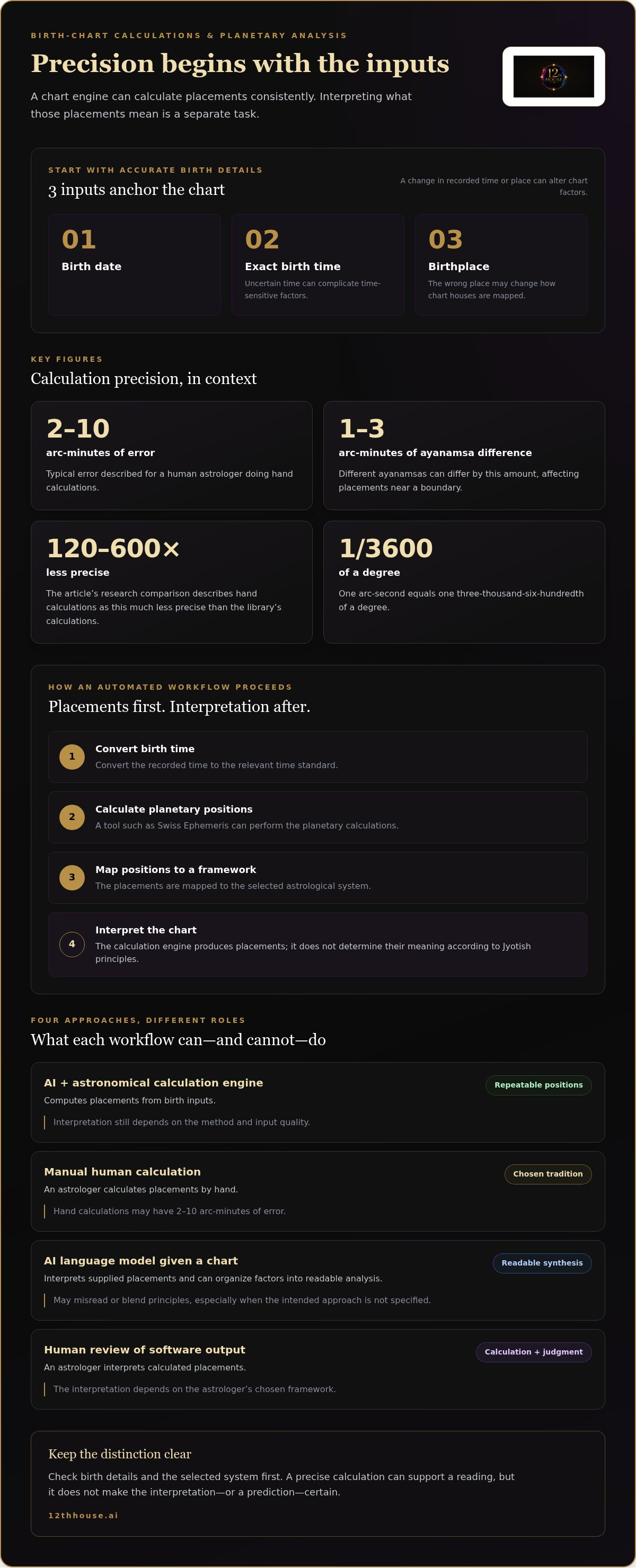
A Vedic birth chart starts with three inputs: birth date, exact birth time, and birthplace. These details anchor planetary positions and chart houses to a specific moment and location. A change in the recorded time or place can alter chart factors, so calculation quality depends first on accurate birth details.
Most automated workflows follow a sequence. They convert the birth time to the relevant time standard, calculate planetary positions for that moment, then map those positions to a selected astrological framework. Swiss Ephemeris is one example of software used for planetary calculations. The calculation engine produces placements; it does not determine what those placements mean according to jyotish principles.
Precision and interpretation are separate questions. A human astrologer doing hand calculations typically has an error of 2-10 arc-minutes. Different ayanamsas can differ by 1-3 arc-minutes, which can affect placements near a boundary. The research comparison describes hand calculations as 120-600 times less precise than the library’s calculations. One arc-second is 1/3600th of a degree.
AI astrology systems may be trained on thousands of birth charts and use pattern recognition to link repeated combinations with interpretive themes. This can quickly surface planetary relationships or recurring chart factors, but it does not prove that a theme applies to a person’s life. AI can produce a fluent explanation from inaccurate input or combine principles from different systems if the prompt does not specify the intended approach.
Birth details also affect personalization. For example, using the wrong birthplace may change how a chart maps its houses, while an uncertain birth time can complicate time-sensitive factors. Before interpreting a reading, compare the birth details and selected system with the chart being analyzed.
Sharing your birth date, exact time, and birthplace can create a detailed personal profile that may be identifying when combined with other information. Before entering those details, review what an app collects, stores, and uses. Avoid adding unrelated personal identifiers.
| Option | Calculation process | Strength | Key limitation |
|---|---|---|---|
| AI with an astronomical calculation engine | Computes placements from birth inputs | Repeatable planetary positions | Interpretation still depends on method and input quality |
| Manual human calculation | Astrologer calculates placements by hand | Can follow a chosen tradition directly | Hand calculations may have 2-10 arc-minutes of error |
| AI language model given a chart | Interprets supplied placements | Can organize chart factors into readable analysis | May misread or blend principles |
| Human review of software output | Astrologer interprets calculated placements | Joins computational consistency with judgment | Depends on the astrologer’s chosen framework |
Choose a workflow that clearly distinguishes accurate planetary calculations from the human or AI interpretation built on them.
Is AI astrology as accurate as a traditional Vedic astrologer?
AI can apply a defined interpretive pattern consistently, while a traditional Vedic astrologer can weigh context and competing chart factors. Neither consistency nor intuition alone establishes whether a prediction will match actual events.
AI Astrology and Human Astrologers
An AI system can return similar interpretations when given the same chart and prompt. A human astrologer can ask about your circumstances, explain why one factor matters more, and adapt the reading. That difference can matter when a relationship question involves conflicting indications or when you want a reasoned interpretation rather than repeated chart keywords.
Popular AI astrology apps in the United States use different pricing models. Costs vary depending on whether an app offers one-time chart analysis, ongoing access, or compatibility features. Compare what each plan includes before choosing.
For love compatibility, Ashtakoot matching assesses eight koots for a total score of 36 points. That score gives a structured comparison, but it doesn’t describe the full relationship: communication, shared expectations, and lived experience aren’t reducible to a single match result.
Compare apps by their methods, not just their tone. Check whether a reading names its astrological system, uses your birth details consistently, and explains how it reached its compatibility themes. Different answers from two polished apps may reflect different prompts, chart inputs, or interpretive rules.
Prediction Accuracy and Supporting Evidence
A chart reading can be treated as a way to explore possibilities rather than as proof of a fixed outcome. Mathematical accuracy in calculating transits or dasha periods doesn’t establish that a prediction will occur. Claims of 100% astrology accuracy should be treated as marketing language, not as evidence of predictive certainty.
Scientific accuracy is a separate question from whether a reading feels meaningful. You can assess whether astrological calculations are consistent within a chosen system, while claims about predictions require evidence that outcomes can be reliably tested. A precise chart, by itself, does not show that its interpretation predicts future events.
For example, the Vimshottari Dasha timeline uses a 120-year cycle calculated from the Moon’s nakshatra. AI can describe the resulting periods, and a Vedic astrologer can interpret them through Jyotish principles. The comparison is about how each explains those periods, not proof that either method can forecast a person’s actual future with certainty.
Use AI for a repeatable first reading, then examine the reasoning behind important relationship or timing claims. For decisions with lasting consequences, treat the reading as one perspective, not the sole basis for action.
Consistency and bias in astrology readings
An AI system can repeat a reading when the birth details and prompt stay the same. Its response may still change if you alter the question, add personal context, or request a different astrological approach. Consistency shows repeatability, not that every interpretation is correct.
Specific questions matter. “What does my chart say?” invites a broad answer that may sound like a generic horoscope. “How do current transits relate to the career change I’m considering?” gives the system a clear topic and relevant context. Sharing life events may make an AI reading more relevant, but added context can also steer the response toward those details.
Bias can shape the tone of a reading. AI astrology may lean positive, emphasizing opportunities while giving less attention to difficult possibilities. Ask for both supportive and challenging interpretations, then identify the chart factors behind each. A balanced analysis explains its reasoning instead of presenting optimism as a prediction.
Evaluate an AI reading critically with a simple review:
- Confirm that it used your intended birth details and astrological system.
- Separate chart placements from the interpretation attached to them.
- Ask which factors support a claim and what could point another way.
- Compare the answer with relevant life events without treating a match as proof.
These steps can reveal when a response is generic, inconsistent, or shaped mainly by your prompt. If two AI chats explain the same chart factor differently, compare their reasoning rather than choosing the answer that sounds more confident.
Tarot readings raise a related question about decision-making. A card interpretation can offer a symbolic lens on a choice, while an AI-generated response can organize possible themes. For a career decision, use the reading to clarify what matters to you, then weigh practical factors such as responsibilities and timing separately.
Health-related timing needs particular care. One reported AI reading identified Mars aspecting the 6th house and advised caution about stress during that period. Treat that as an astrological interpretation, not a diagnosis or a substitute for medical judgment.
Career timing illustrates why context matters. In one anecdote, an AI predicted March would be challenging and April more favorable for a job change; the writer later described work improving in April. A single story can illustrate how someone assesses a reading, but it cannot establish a reliable predictive pattern.
AI interpretation quality and chart-factor synthesis
AI can identify several chart factors and arrange them into a coherent narrative. The harder task is deciding which factor should lead. A career question, for example, may involve planetary placements, house themes, and timing indicators that point in different directions. A smooth explanation can hide that conflict instead of resolving it.
Charts are systems of relationships, not isolated symbols. If an interpretation mentions the 10th house for work, it should explain how that theme interacts with other relevant placements. A response that lists keywords for houses may sound specific while leaving the actual synthesis undone. Look for a clear connection between each cited factor and the prediction or reflection that follows.
Emotional themes reveal another difference. AI might describe a placement as “sensitive” or “independent,” then offer a broad statement that fits many lives. A useful interpretation links the theme to a specific chart combination and distinguishes a possible tendency from a fixed outcome. No single symbol should carry the entire reading.
Prioritization is where experience can matter. A senior astrologer with 30 years of chart reviews can outperform current AI at weighing conflicting factors. That advantage is not simply a larger vocabulary. It involves deciding which indications deserve emphasis, which need context, and which should not dominate the interpretation.
Use this short review to assess how AI has built its reading:
- Trace each claim: Identify the chart factor behind a statement about career, relationships, or emotional patterns.
- Find competing signals: Ask whether another house or placement changes the interpretation.
- Check the hierarchy: See whether the reading explains why one factor matters more than another.
- Separate insight from prediction: Note whether the text describes a theme or asserts a specific event.
For example, if AI predicts a career shift based on one placement, ask how other career-related chart factors affect that conclusion. A stronger analysis explains how the factors interact instead of treating one placement as decisive. This also helps distinguish chart interpretation from generic horoscopes, which usually do not explain personal chart factors.
Dream interpretation uses a different symbolic structure, but the same question applies: does the reading connect its conclusion to the details you provided? Compare a specific dream image and its emotional context with the interpretation. Whether you are considering charts, horoscopes, or dreams, assess the reasoning rather than just the confidence or fluency of the answer.
AI interpretation versus human astrologers
AI and a human astrologer bring different strengths to a spiritual reading. AI can organize planetary positions and provide quick answers in a repeatable format. A human astrologer can explore the question behind those answers, notice tensions in the chart, and explain why one interpretation may deserve more weight.
Speed is one clear distinction. A skilled human astrologer may spend 2-3 hours producing a comprehensive 40-page kundli report by hand. AI can assemble an interpretation faster, but speed doesn’t show whether its reasoning fits the person’s situation. Read for the connection between the chart factors and the conclusions, not the length of the report.
Human judgment also matters when information is incomplete. AI can narrow 100 candidate birth times down to 3 for a human to choose from. That makes it a useful tool in a rectification process, but choosing among the remaining possibilities calls for context about the person’s life. The calculation narrows the field; interpretation still requires judgment.
Consider a question about Saturn and career direction. AI may describe the placement you provide and suggest possible themes. A human astrologer can ask what kind of work you do, what prompted the question, and which chart factors support a particular interpretation. Those details can change the reading without changing Saturn’s position.
The point is not that AI has no value or that human insight guarantees a better outcome. AI can organize information and respond consistently to defined prompts. Human astrologers bring experience and intuition to ambiguous questions, competing indications, and personal context. Neither approach makes astrology a certainty machine, and AI cannot predict the future better than a classical astrologer.
- Choose AI when you want a quick explanation of supplied planetary positions or a structured first pass.
- Choose human interpretation when your question depends on life context or conflicting chart factors.
- Combine both by using AI to organize questions, then examining the astrologer’s reasoning and priorities.
If you want to explore a chart question through an AI-guided format, ask personalized astrology questions and use the response to clarify what you want to examine further.
12Th House: Ask Lala AI Spiritual Guidance
12th House’s Ask Lala AI Spiritual Guidance offers a place to explore personalized questions about charts, spells, and compatibility. Turn to it when you want to examine a chart theme or organize your thoughts before making a decision, while treating the reading as perspective rather than a final authority.
For a chart-focused exploration, Astrology Birth Chart & Transit Analysis connects birth-chart themes with transits. Tarot Readings and Numerology Reports offer other symbolic frameworks for reflection. Choose the approach that fits your question, and use its interpretation to guide further thought.
Explore Ask Lala AI Spiritual Guidance at 12thhouse.ai.
Choose the Next Step in Your Chart Exploration
The useful question is not only whether AI astrology is accurate. Consider what kind of reflection you need next: a clearer view of your chart, a prompt for self-inquiry, or another symbolic lens on a decision. Let that question guide how you use a reading, and keep your own judgment at the center.
12th House offers Ask Lala AI Spiritual Guidance for personalized spiritual questions, Astrology Birth Chart & Transit Analysis for chart and transit exploration, and Tarot Readings for reflection through card symbolism. Choose the format that fits the question you’re carrying, then use its insights to shape your next thoughtful step.
Contact 12th House about your chart and continue your exploration with curiosity and discernment.
Frequently Asked Questions
Why AI Astrology?
AI astrology can be a convenient way to explore astrological ideas and ask focused follow-up questions. For example, ask it to explain a chart term in plain language, then request a practical reflection prompt. Treat the exchange as a tool for organizing your curiosity, not as a source of unquestionable answers. Its value depends on how clearly you frame your question and assess the response.
Why do two different AI astrology apps sometimes give different answers?
Different apps may use different chart settings, interpretive traditions, data sources, or language models. The same question can also prompt different answers if one app receives more birth information or context. Compare the chart settings and stated astrological system first. Then ask each app the same focused question using identical details. Differences in the explanations can show whether a disagreement stems from calculation choices or interpretation.
How Accurate are the results?
Whether AI astrology is accurate depends on what you mean by “accurate.” A chart may have correctly calculated placements while its interpretation remains debatable, and a prediction is a separate claim. For a practical review, identify the placement or timing factor behind a statement, then see whether the app explains its reasoning. A confident tone or personal-sounding description alone does not demonstrate accuracy.
What factors determine the accuracy of astrological predictions?
Prediction quality depends on the birth information, astrological framework, calculation method, and interpretive reasoning. The question matters too: “What should I consider about this decision?” invites reflection, while asking for a fixed outcome seeks certainty that astrology cannot establish. Check whether the answer explains its assumptions and connects them to your question. A meaningful reading distinguishes symbolic interpretation from a guaranteed event.
What is AI actually doing when it generates a kundli?
An AI kundli workflow uses birth information to produce or interpret a Vedic chart. A calculation component can map planetary placements to chart structures, while a language model can turn supplied chart information into explanatory text. These functions may be combined or kept separate. To understand a result, look for the chart details it used and whether the explanation connects a stated placement to its interpretation.
How accurate are AI astrology readings compared with human astrologers?
There is no single accuracy score that ranks every AI reading against every human astrologer. AI can provide structured explanations quickly, while a human astrologer may ask clarifying questions and adapt an interpretation to personal context. Compare the reasoning: does the answer explain why a chart factor matters, acknowledge other relevant factors, and address your actual question? This is more useful than fluency alone.
How do AI astrology apps generate horoscopes and birth chart readings?
A generic horoscope usually draws on broad astrological themes, while a birth chart reading begins with an individual’s birth information. An app may calculate or receive chart placements, select interpretive material, and use AI to present it as conversational text. Ask whether the reading is based on your personal chart or a general sign-based forecast. That distinction shows how closely the answer relates to you.
What information does an AI astrology app need, such as birth date, time, and location?
A personalized birth chart generally requires your birth date, birth time, and birthplace. The date identifies the day’s planetary positions; time and location help map the chart to the moment and place of birth. Enter the location where you were born, not your current home. If your birth time is uncertain, note that rather than treating an estimate as exact.


