
Your best Labyrinthos tarot app alternative may use a different symbolic system. Tarot, Lenormand, oracle, I Ching, astrology, numerology, and psychic-reading apps offer distinct approaches to guidance, so the right choice depends on what you want to explore.
If you value accessible readings and learning tools, look for an option that fits your practice. You may also want a different framework, a broader view of personal patterns, or a reflective prompt rather than a card reading.
This comparison explains how each app category works and what kind of inquiry it suits. Use the side-by-side comparison and practical decision guide to narrow your options. An app can support learning or offer an on-the-go way to center yourself, but it does not have to define your entire tarot practice.
Key Takeaways
- Match the divination system to your question: tarot, Lenormand, oracle, I Ching, astrology, numerology, and psychic-reading apps offer different interpretive frameworks.
- Compare learning tools and reading formats to find an app that supports the way you want to study and reflect.
- Use the privacy section to identify what to look for in an app’s data practices before sharing personal details.
- Assess ads and subscription models alongside features so the app’s ongoing costs and interruptions fit your preferences.
- Explore a broader form of reflection through Ask Lala AI Spiritual Guidance, or choose tarot, astrology, or numerology offerings for a more focused inquiry.
What are the best alternatives to the Labyrinthos tarot app?
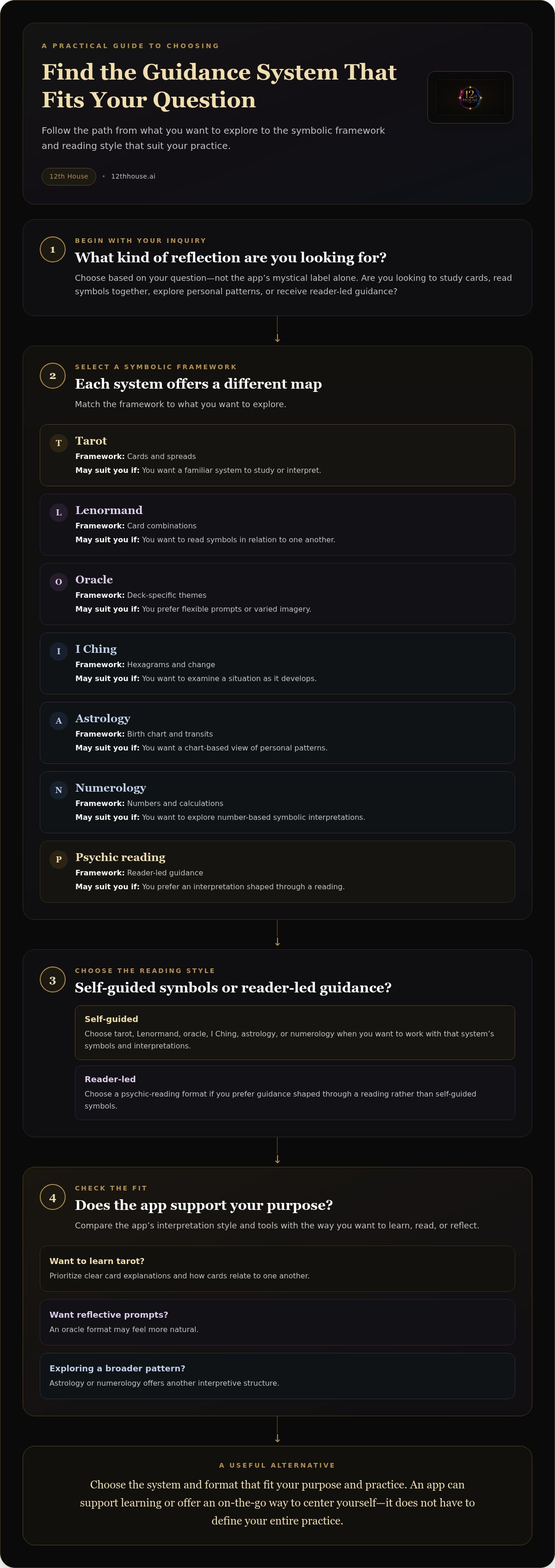
The best alternative depends on the symbolic system you want to explore. Tarot apps use familiar card draws and spreads, while Lenormand, oracle, I Ching, astrology, numerology, and psychic-reading apps follow different frameworks. Choose based on your question, not the app’s mystical label alone.
If you want to stay with tarot, compare apps by their interpretation style. Some focus on card meanings; others emphasize readings, journaling, or spread layouts. A simple three-card spread can frame a situation through its context, present tension, and possible direction. Look for an app that explains how the cards relate to one another.
For a different card language, consider Lenormand or oracle apps. Lenormand readings often rely on combinations between cards, so context is central to interpretation. Oracle decks vary in structure and theme, and each app’s deck shapes its symbolic vocabulary. A nature-focused oracle deck, for example, may invite reflection through images and themes rather than tarot’s established card archetypes.
| App category | Framework | May suit you if |
|---|---|---|
| Tarot | Cards and spreads | You want a familiar system to study or interpret |
| Lenormand | Card combinations | You want to read symbols in relation to one another |
| Oracle | Deck-specific themes | You prefer flexible prompts or varied imagery |
| I Ching | Hexagrams and change | You want to examine a situation as it develops |
| Astrology | Birth chart and transits | You want a chart-based view of personal patterns |
| Numerology | Numbers and calculations | You want to explore number-based symbolic interpretations |
| Psychic reading | Reader-led guidance | You prefer an interpretation shaped through a reading |
The I Ching offers a distinct alternative to card readings. Its hexagrams provide a structure for considering change, timing, and response. Astrology apps map planetary placements in a birth chart and may interpret transits against it. Numerology apps use values derived from names or dates to create a number-based profile. Each system offers a different symbolic map.
Use this decision sequence to narrow the field:
- Keep tarot if card meanings, spreads, or structured practice matter most.
- Switch systems if Lenormand, oracle, I Ching, astrology, or numerology better matches your question.
- Choose a reading format if you want reader-led psychic guidance rather than self-guided symbols.
A useful Labyrinthos tarot app alternative should fit your purpose and practice. If you want to learn tarot, prioritize clear card explanations. If you want reflective prompts, an oracle format may feel more natural. If your question concerns a broader pattern, astrology or numerology offers another interpretive structure. Use an app as a learning aid or an on-the-go way to center yourself, not necessarily as your only way to work with tarot.
Which tarot apps offer free readings and learning features?
Start by checking which features are available without payment, such as a sample reading, card meanings, or guided lessons. Free access to a card draw does not necessarily include free study material. An app might let you draw a card but put detailed explanations behind a paid plan. That distinction matters if your goal is learning, not simply receiving a prompt.
Compare each app’s reading and learning functions. A reading function gives you a spread, card positions, and an interpretation. A learning function explains symbolism and how to apply meanings in context. If you’re studying the Rider-Waite-Smith tradition, look for explanations that connect a card’s imagery to its interpretation. A keyword such as “change” offers less guidance than a lesson showing how the image supports that meaning.
Use this practical sequence to assess a free version:
- Open a sample reading. Note whether you can choose a question or spread, then see the complete interpretation.
- Inspect a card entry. Look for imagery, keywords, upright and reversed meanings, and explanations of symbolism.
- Test a lesson. Check whether it teaches a method, such as interpreting a card in relation to its position.
- Return to the same topic. See whether the app gives you a way to record your own interpretation for later reflection.
For example, draw the Hermit for a question about a stalled project. A learning-focused app should help you connect the card’s imagery with solitude or examination, then consider what that symbolism means in the spread. The interpretation should give you material to reflect on, rather than treating a single keyword as a complete answer.
Free readings and lessons serve different needs. A daily draw can prompt a brief check-in, while a guided lesson builds familiarity with card structure. If you already know the meanings, prioritize varied spreads and space to record personal observations. If you’re new to tarot, clear explanations and examples matter more than a long menu of reading formats.
Before choosing, compare what the free experience actually includes. Separate accessible features from paid lessons or readings, then assess whether the available material supports your practice. A Labyrinthos tarot app alternative may suit you better if it teaches interpretation in a way that matches your learning style, even if its reading format differs.
If you want an interpretation beyond an app’s built-in lesson, a reflective tarot reading offers another way to engage with the cards. Use app lessons to develop your own symbolic vocabulary, then bring a specific question to a reading when you want a more focused interpretation.
Look for apps that provide both a complete sample reading and learning tools, such as detailed card entries and guided lessons, without payment. A free card draw alone does not mean the explanations or lessons are free.
Choose an app with card entries that explain imagery and upright and reversed meanings, lessons on interpreting cards in context, and a place to record your interpretations. These features can support both study and journaling.
Which tarot apps offer daily readings, spreads, and personalized interpretations
Choose a tarot app by how it frames a reading, not by how many spreads it offers. A daily card provides a compact prompt, while a larger spread separates parts of a question. For example, a three-card layout might map a situation, its challenge, and a possible response. The interpretation should explain how each position shapes the card’s meaning.
Daily readings work best as a repeatable reflection practice. Draw a card, note its central image, and connect it to a specific event or decision. If you draw the Hermit, consider where focused attention or withdrawal might matter that day. A useful interpretation opens a line of inquiry rather than declaring what must happen.
For a deeper reading, compare spread variety and guidance on card positions. A relationship question may benefit from positions for each person’s perspective and the shared dynamic. A work decision might use positions for current conditions, available choices, and a next step. These examples show why a spread’s structure matters more than its size.
Personalization can take different forms. Some apps let you enter a question before drawing cards; others save reading history for later review. Saved entries help you compare an earlier interpretation with what you noticed afterward. Some divination apps also provide a numerology profile containing a life path number and birth chart, expanding the view beyond an individual card draw.
AI guidance offers another format. Some apps provide an AI guide without requiring a scheduled session. The guidance may be framed as reflective rather than predictive, so consider how you use it: examine your assumptions instead of treating a response as a fixed forecast. A specific question, such as “What am I overlooking in this decision?” gives the reading a clearer focus than a general request for certainty.
Assess an app’s interpretation with this short checklist:
- Daily draw: Can you connect the card to a concrete intention or observation?
- Spread positions: Does each position clarify a different part of your question?
- Personal context: Can you record a question or revisit saved readings?
- Interpretation style: Does the response invite reflection instead of presenting a prediction?
Choose the format that supports your routine. A daily card suits a brief check-in; a structured spread offers more angles on one question. A Labyrinthos tarot app alternative with saved history can help you trace how your interpretations develop. Treat a reading as a learning aid or an on-the-go way to center yourself, while keeping space for your own tarot practice.
Look for a repeatable daily card, spreads with positions that clarify different parts of a question, and options to enter questions or revisit saved readings. Some apps also offer an AI guide for reflective interpretations.
Seeker provides saved reading history that users can revisit. Returning to those entries can help you compare the question you asked, the card’s interpretation, and what you observed later. That record can support reflection without turning an earlier reading into a promise about what will happen.
How do Labyrinthos alternatives compare on privacy and data collection?
Privacy depends on an app’s data practices, not its divination system. A tarot app, astrology app, or AI reading tool may request different details for different features. A birth-chart tool, for example, may ask for birth information, while a basic card draw may require less personal context. Compare the privacy notice and device permissions before creating an account.
Start with the information you enter. A reading app might save questions or readings; an astrology feature may request birth details. Consider whether each item supports a feature you plan to use. If you only want a one-time card draw, decide whether creating a profile or saving personal notes serves your purpose.
| Data area | What to examine | Example question |
|---|---|---|
| Account details | Required fields and sign-in options | Can you use a reading without adding profile details? |
| Reading history | Saved questions, card draws, or notes | Can you remove an entry you no longer want stored? |
| Birth information | Details used for chart-based features | Does the feature explain why it needs your birth details? |
| Device permissions | Access requested by the app | Does a card-reading feature need the permission it requests? |
| AI prompts | Information included in submitted questions | Could you phrase the question without identifying details? |
Next, look for information about retention and deletion. Find instructions for removing saved readings, account details, and personal notes. A journal entry about a relationship, for instance, may reveal more than the card draw itself. Consider that before saving a reading or recording private reflections in an app.
Review each permission prompt individually. A tarot app used for card meanings may request access to device features unrelated to your reading. Pause when a permission seems unnecessary, then decide whether the additional function is useful enough to enable.
For AI readings, treat each prompt as information you choose to share. Ask, “What perspective might help me consider this decision?” instead of including names, addresses, or private messages. A focused question can support reflection while limiting identifying details in the text.
Use this quick review when comparing a Labyrinthos tarot app alternative:
- Read the policy: Find what information the app collects and why.
- Review settings: Locate controls for reading history, saved notes, and account details.
- Limit inputs: Share only what a feature needs for your reading.
- Reassess permissions: Allow access only when it supports a function you intend to use.
These steps help you compare privacy practices without assuming every tarot or divination app handles information the same way. Choose a Labyrinthos tarot app alternative whose collection, storage, and account controls fit your boundaries.
Are there tarot apps without ads or recurring subscriptions
Some tarot apps may offer an experience without ads or recurring subscriptions, but these are separate qualities. An app can avoid subscriptions and still display advertisements. Another may remove ads through a recurring plan while offering some readings for free. Compare payment models and advertising separately; neither tells you whether the readings suit your practice.
Start with the app’s purchase screens and listing. Distinguish free access, one-time purchases, optional in-app purchases, and recurring subscriptions. An app may let you draw a card for free, for example, then offer additional decks as separate purchases. Read the terms for each option to understand whether a payment happens once or repeats.
Ads also shape the reading experience. A banner beside a card meaning is different from an interruption between drawing a card and viewing its interpretation. Consider a daily draw used for a quiet check-in. An interruption during that brief practice may matter more than an advertisement elsewhere in the app.
Use this review before choosing:
- Identify the payment type: Separate free access, one-time purchases, and recurring subscriptions.
- Locate advertising: Note whether ads appear during readings or in other parts of the app.
- Compare core tools: Assess whether the card meanings, spreads, and learning features fit your practice.
- Review subscription settings: Find how recurring plans renew and where account settings manage them.
- Try a complete reading: Follow a card draw through to its interpretation and observe any interruptions.
Imagine comparing two apps with the same three-card spread. One may provide the spread without a recurring plan but display ads. Another may offer an ad-free experience through a subscription. The better fit depends on whether uninterrupted readings or avoiding repeat payments matters more to you. That trade-off is more useful than relying on a label such as “free.”
Keep app settings and payment settings separate if you stop using an app. Removing it from your device and managing a subscription are different actions. A Labyrinthos tarot app alternative should fit both your reading preferences and the payment structure you’re comfortable maintaining. Check whether its available access supports the features you use, rather than choosing based only on an ad-free claim.
Before selecting an app, write down your priorities. You might value uninterrupted readings, learning tools, or avoiding recurring billing. Then compare each option against that list. A Labyrinthos tarot app alternative is a better fit when its trade-offs align with your practice, not simply when it carries the right label.
If you want to continue your card practice with a focused interpretation, explore a guided tarot reflection.
Costs depend on whether an app offers free access, one-time purchases, optional in-app purchases, or a recurring subscription. Check each app’s purchase options and terms to understand which payments apply and whether they repeat.
12Th House: Ask Lala AI Spiritual Guidance
12th House’s Ask Lala AI Spiritual Guidance offers a reflective next step when an app’s card meanings leave you with more to consider. Bring a focused question and use the guidance to explore your perspective. For a card-based interpretation, 12th House also offers Tarot Readings. If your inquiry concerns birth-chart patterns or number symbolism, Astrology Birth Chart & Transit Analysis and Numerology Reports provide those distinct frameworks.
Choose the format that matches your question: tarot for card symbolism, astrology for chart analysis, or numerology for number-based reflection. Each approach offers a different structure for examining personal themes.
Visit 12th House to explore spiritual guidance and choose an approach that suits your inquiry.
Let your next question shape the practice
The most useful divination practice is one you can return to with attention and curiosity. Choosing a Labyrinthos tarot app alternative can be a chance to refine how you engage with symbols, not simply replace one interface with another. Let your questions evolve; a reading can open a new line of inquiry rather than settle it.
When you want a structured perspective beyond an app, 12th House offers Ask Lala AI Spiritual Guidance, Astrology Birth Chart & Transit Analysis, and Tarot Readings. Each offers a different way to examine a question, from card symbolism to chart-based interpretation and guided reflection.
Contact 12th House to explore your options and choose a path that feels aligned with the question you’re ready to explore. Your practice can begin with one clear inquiry.


