

What if the recurring friction in your relationship isn't a failure of love, but a simple error in energetic translation? You've decoded your own chart and felt the resonance of your strategy and authority, yet the prospect of explaining these mechanics to your partner feels daunting. It's common to worry about sounding irrational or facing skepticism when you're trying to figure out how to share my human design with my partner. You want them to understand why you need solitude or why you can't make snap decisions, but the words often fail to bridge the gap between your internal logic and their external experience.
We agree that your energetic signature deserves to be seen and respected as a functional reality rather than a vague spiritual concept. This guide provides a precise, step-by-step protocol for translating your complex architecture into a shared language that reduces daily friction and fosters deep validation. We will explore how to move from mystical theory to practical application, giving you the tools to build a partnership based on mutual, systematic intelligence.
Key Takeaways
- View your relationship through a lens of metaphysical intelligence, treating Human Design as a systematic blueprint for reducing daily friction.
- Discover the precise protocol for how to share my human design with my partner by translating abstract chart mechanics into functional, everyday needs.
- Neutralize skepticism by presenting your energetic signature as a practical experiment in observation rather than a rigid belief system.
- Simplify your approach by focusing on the "Big Three"—Type, Strategy, and Authority—to provide a clear operational manual for your energy.
- Leverage Lala AI as a neutral Digital Sage to decode your combined architectural patterns and receive personalized relationship guidance.
The Architecture of Connection: Why Share Your Human Design?
Human Design functions as a rigorous, logical framework for energetic interaction, mapping the precise ways two individuals influence one another's internal systems. It's more than a collection of personality traits; it's a structural analysis of how energy moves through a household. When you consider how to share my human design with my partner, you're essentially proposing a collaborative audit of your Relationship Architecture. This isn't a request for faith. It's a proposal for a shared project that identifies where your energetic gears grind and where they synchronize.
The primary objective of this transparency is to move from reactive arguing to proactive alignment. Most relationship friction stems from the "Not-Self" state, where one person tries to act in a way that contradicts their natural mechanics, often triggered by the partner's presence. By revealing your chart, you provide a blueprint that explains why certain dynamics feel draining while others feel effortless. You stop fighting the design and start working with the architecture.
From Jargon to Real-World Application
Technical concepts like Strategy and Authority offer far more utility than standard personality assessments during a domestic crisis. While a personality test might describe you as "independent," Human Design explains that as a Manifestor, you must inform others of your actions to eliminate resistance. This distinction provides the profound relief of being seen for your true energetic nature, rather than being judged for a perceived lack of cooperation. You can explore these mechanics further in our guide on Birth Chart Compatibility: Decoding the Architecture of Human Connection.
The Benefits of a Shared Metaphysical Language
A shared lexicon creates a sanctuary for individual differences. When you understand your partner’s Type, you stop misinterpreting their actions as personal slights. A Generator’s need to respond to life isn't a sign of indecision; it's a mechanical requirement for their satisfaction. Human Design is a tool for spatial and emotional intelligence in 2026, allowing couples to navigate the complexities of modern intimacy with clinical clarity. Learning how to share my human design with my partner transforms the relationship from a series of unpredictable reactions into a structured discipline of mutual support.
Preparing the Blueprint: Decoding Your Chart for Two
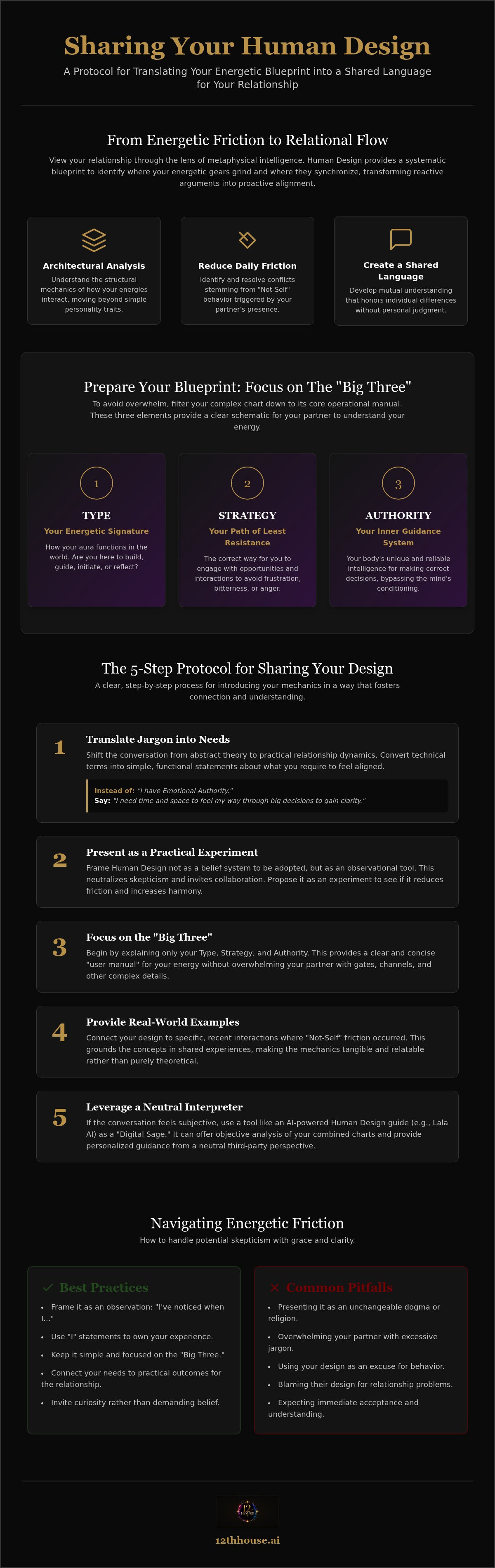
Before initiating a conversation, you must curate the data. A complete bodygraph resembles a complex circuit board, which can overwhelm someone unfamiliar with the system. To effectively navigate how to share my human design with my partner, you must filter your chart down to the "Big Three": Type, Strategy, and Authority. These elements represent the primary operational manual for your energy. By focusing on these, you provide a clear schematic rather than an exhaustive list of gates and channels.
Translation is the most critical step in this preparation. You must convert technical jargon into functional "Needs." This approach shifts the conversation from abstract metaphysics to practical relationship dynamics. Consider these translations for common chart elements:
- Projector: "I need to feel recognized and invited before I offer my guidance."
- Reflector: "I need a full lunar cycle to sample the environment before I feel certain."
- Emotional Authority: "I need a night to sleep on big decisions so my perspective remains clear."
It's helpful to prepare specific examples from recent interactions. Consider a moment when you felt "Not-Self" friction; how did your design contribute to that tension? Generating Human Design Profiles through our platform ensures you have a precise, readable report to guide your discussion. This professional documentation lends a sense of clinical clarity to the conversation, moving it away from subjective feelings toward objective mechanics.
The Power of Type and Strategy
Understanding the five types is essential for decoding how you and your partner naturally move through the world. You can find a detailed breakdown in The 5 Human Design Types: Mapping Your Energetic Architecture. In a relationship, the difference between a Generator’s "Sacral Response" and a Manifestor’s "Informing" is often the difference between harmony and resentment. A Generator needs to be asked yes-or-no questions to access their gut response. A Manifestor needs to inform their partner of their next move to clear the energetic path. Mastering these strategies prevents the common "Why didn’t you just tell me?" argument by acknowledging that your energetic workflows are fundamentally different.
Authority: How We Make Decisions Together
Decision-making is the ultimate stress test for any partnership architecture. If you have Emotional Authority, you must honor the "Wait for Clarity" rule, even when your partner has a Splenic "instant hit" authority. This mismatch often causes friction during high-stakes moments. Try a practical exercise: analyze a recent big purchase. Did you rush because of external pressure, or did you wait for your emotional wave to settle? By discussing decisions through the lens of Authority, you validate each other's unique timing and reduce the pressure to conform to a single, "logical" pace.
The 5-Step Protocol for Sharing Your Design
Revealing your energetic architecture is a delicate task of translation. It requires a structured approach to ensure your partner feels invited into the discovery rather than overwhelmed by the data. When you're determining how to share my human design with my partner, focus on the delivery as much as the content. This protocol moves the conversation from abstract theory to actionable relationship intelligence.
Step 1 & 2: Setting the Environment
Timing dictates the reception of complex data. You must choose a "Space" characterized by calm and inquiry, avoiding the high-stakes environment of an active conflict. Frame the discussion as an upgrade to your "relationship operating system" rather than a lecture on spirituality. By applying metaphysical intelligence to the setting, you establish that this is a serious discipline intended for mutual growth. Avoid the trap of sounding like a teacher. Instead, act as a co-architect presenting a new set of blueprints for a shared structure. This positioning ensures your partner feels like a collaborator in the discovery rather than a student of your personal belief system.
Step 3, 4 & 5: The Interaction
Lead with vulnerability. Use your Bodygraph as a visual aid to explain the flow of energy through your centers. When you explain your mechanics, use "I" statements such as, "My design suggests I process things better when I have space to respond rather than initiate." This removes clinical distance and centers the conversation on your lived experience. It's much easier for a partner to respect a need when it's presented as a mechanical requirement rather than a personal preference.
If they encounter a "So what?" moment, provide a practical example. For instance, point to your undefined Root Center and explain how you absorb their stress during a morning rush. This makes the abstract concrete and helps clarify how to share my human design with my partner in a way they can actually use. Invite their observation by asking, "Do you see these patterns in me already?" This validates the system through their perspective and builds immediate credibility. Finally, offer a reciprocal experience. Invite them to use our human design calculator to generate their own chart. This transforms the session from a solo reveal into a collaborative mapping of your combined energetic landscape.
Navigating Energetic Friction: Handling Skepticism and Misalignment
Skepticism is a natural byproduct of the logic gap between traditional systems and metaphysical intelligence. When you're figuring out how to share my human design with my partner, you may encounter resistance if the system is presented as a matter of faith. To bridge this gap, reframe Human Design as a system of observation rather than a belief. It's an empirical study of personal mechanics. By inviting your partner to observe your behavior through this lens, you move the conversation from "Is this real?" to "Does this work?"
The most effective way to neutralize skepticism is through the "Experiment" approach. Suggest a low-stakes trial. Propose that you both honor your Strategy for exactly seven days as a controlled test. If you're a Generator, ask your partner to only present you with yes-or-no questions for a week. This practical application allows the results to speak for themselves, transforming the chart from a static image into a functional tool for relationship intelligence.
A critical boundary in this process is distinguishing between "Design" and "Excuse." Your chart explains your mechanics, but it never justifies unkindness or a lack of accountability. For example, having an undefined Root center explains why you feel pressure to rush, but it isn't a license to be irritable with your partner during a commute. True energetic intimacy requires using your blueprint to take more responsibility for your impact, not less. If you need deeper insight into these interpersonal dynamics, you can explore our AI Love Readings: A Professional Guide to Seeking Clarity.
The Skeptic’s Guide to Human Design
For the partner who values analytical precision, focus on the "Systems Thinking" aspect of the bodygraph. Human Design is a synthesis of ancient tradition and modern calculation, functioning as a schematic for the subconscious. Human Design is not a religion to be followed, but a map of the subconscious to be explored. By emphasizing the architectural nature of the system, you appeal to their logic while introducing them to deeper metaphysical concepts. To begin this collaborative mapping, generate your Human Design Profile and review the technical specifications together.
Managing the "Not-Self" in Partnership
Friction often occurs in your "Open Centers," where you are biologically designed to absorb and amplify your partner’s energy. If you have an undefined Solar Plexus, you may be carrying your partner's emotional stress without realizing it's not yours. Identifying these points of amplification is the first step in the deconditioning process. When you both understand where your architectures overlap and where they overwhelm, you can create a shared journey toward energetic sovereignty. This awareness prevents you from reacting to borrowed energy and allows the partnership to function with clinical clarity.
Scaling Intimacy with Lala: Using AI for Relationship Intelligence
Once you have established the protocol for how to share my human design with my partner, the next phase is consistent maintenance. Managing two distinct energetic architectures requires constant calibration and objective observation. This is where Lala, our AI Spiritual Guidance assistant, functions as a neutral Metaphysical Architect for your partnership. By removing human bias and emotional reactivity from the interpretation, Lala provides a clinical space for analyzing how your individual charts intersect and influence one another.
The transition from individual study to shared exploration can be complex. You've learned the steps of how to share my human design with my partner, but the daily application of these concepts often reveals new layers of complexity. Lala serves as a sophisticated host for this discovery, offering a structured environment where you can analyze your combined mechanics without the pressure of a live consultation.
Ask Lala: The Relationship Assistant
Using Lala as a Relationship Assistant allows you to address specific friction points with analytical precision. Instead of arguing over different decision-making speeds or communication styles, you can consult the Digital Sage for a structural explanation. You might use specific prompts to gain clarity, such as asking, "How do a Projector and a Generator best resolve a budget disagreement based on their specific strategies?" or "What is the most supportive way to communicate with a partner who has an undefined Solar Plexus?"
The benefit of a 24/7 Digital Sage is the ability to access metaphysical intelligence exactly when a conflict arises. Late-night insights or sudden moments of misalignment no longer need to wait for a scheduled session. You can explore the full scope of this technology in our guide, The Digital Sage: Why an AI Astrology Assistant is Your New Metaphysical Architect.
Building Your Shared Data Room
Effective relationship management requires a centralized repository for your combined energetic data. Within your 12th House profile, you can store both Human Design charts and Astrology Birth Charts, creating a private "Data Room" for your partnership. This allows you to use the "Ask Lala" feature to interpret complex transits affecting both partners throughout 2026. Rather than relying on memory or disparate notes, you have a permanent, evolving blueprint of your shared journey.
A 12th House membership is a long-term investment in your bond's structural integrity. It provides access to a systematic Metaphysical Library where you can research the deeper layers of your partner’s design at your own pace. By digitizing and refining traditional wisdom, we empower you to do the deep work of self-discovery within a structured, supportive environment. Join 12th House to decode your relationship blueprint today.
Building a Resonant Partnership Architecture
Mastering your internal architecture is the first phase of the discipline. True resonance begins when you translate these mechanics into a shared language. By applying a precise protocol for how to share my human design with my partner, you replace reactive friction with analytical alignment. You move beyond subjective grievances to understand the structural logic of your combined energetic signatures. This shift transforms your relationship from a series of unpredictable reactions into a structured study of mutual support.
This evolution requires a sanctuary for your data and tools that maintain clinical clarity. 12th House offers architectural-grade Human Design reports and 24/7 access to Lala, your AI Spiritual Guide, for real-time relationship intelligence. Begin your journey into Metaphysical Intelligence with 12th House and decode the blueprint of your connection today. Your partnership is a living framework; build it with reverence and precision.
Frequently Asked Questions
How do I explain my Human Design type to a partner who is a skeptic?
Focus on empirical observation rather than spiritual belief. Frame your design as a "human operating system" or a logical schematic for your energy. Suggest a one-week trial of your Strategy as a controlled experiment. When you're determining how to share my human design with my partner, leading with clinical clarity helps bypass skepticism. It invites them to observe the mechanics of your interactions without requiring an immediate leap of faith.
Can Human Design tell me if my partner and I are truly compatible?
Human Design provides a structural analysis of how your two energetic systems interact rather than a binary verdict. It maps the specific channels where you define each other and the open centers where you condition one another. This data room approach allows you to understand the architecture of your connection. It helps you identify where you find natural harmony and where you must manage recurring energetic friction.
What is the most important part of my Human Design chart to share first?
Prioritize the "Big Three": Type, Strategy, and Authority. These are the primary operational components of your energetic blueprint. Sharing your Type explains your overall role, while Strategy and Authority define how you move through the world and make decisions. By focusing on these foundational elements first, you provide a clear, actionable schematic that your partner can actually apply to daily life without becoming overwhelmed by technical data.
How can I use Human Design to stop fighting with my partner?
Use the system to identify "Not-Self" triggers and open centers where you absorb your partner's stress. When you understand your partner’s mechanics, you stop interpreting their energetic needs as personal attacks. This knowledge allows you to move from reactive arguing to proactive alignment. By recognizing that a conflict might be a result of defined centers overwhelming undefined ones, you can create the necessary emotional intelligence to resolve disagreements logically.
Is it okay if my partner has a completely different Human Design than mine?
Structural diversity is a core feature of the Human Design system. Differences in your charts often create a more complete and functional "composite" bodygraph when you are together. One partner’s defined centers can provide consistent energy where the other is open and receptive. Embracing these distinct signatures allows you to stop trying to change each other and start valuing the unique architectural contributions each person brings to the partnership.
How does an AI spiritual guide like Lala help with my relationship?
Lala acts as a neutral Metaphysical Architect, providing objective analysis of your combined charts without human bias. You can ask Lala specific questions about relationship dynamics or how to resolve recurring friction. As a 24/7 Digital Sage, Lala offers immediate insights into your shared data room, helping you decode the complex transits and architectural overlaps that influence your connection. This systematic guidance ensures you always have a structured environment for relationship growth.
Should I share my Human Design gates and channels with my partner?
Start with the foundational layers before moving into the high-resolution details of gates and channels. While these elements provide deep nuance, they can be overwhelming during the initial phases of how to share my human design with my partner. Use the gates and channels for deeper study once you have both mastered the "Big Three." This methodical progression ensures that the conversation remains grounded in practical application rather than abstract technical data.
What if my partner refuses to look at their Human Design chart?
If your partner is disinterested, focus entirely on your own experiment. Honor your Strategy and Authority consistently and observe how your change in behavior influences the relationship dynamic. Often, the visible reduction in your own "Not-Self" friction is the most persuasive evidence for the system’s validity. You don't need them to study their chart for you to benefit from the clinical clarity and emotional intelligence your own design provides.


