

What if the sudden unraveling of your late twenties isn't an existential collapse, but an architectural stress test? Saturn does not destroy your life; it audits your foundation for structural load-bearing capacity. If you feel paralyzed by shifting relationships and acute career pressure, the challenge of navigating my first Saturn return often feels like managing an unscripted breakdown. You aren't imagining the weight. Between ages 27 and 30, personal gravity intensifies, demanding that you discard whatever cannot support your authentic evolution.
Generic horoscopes provide vague platitudes, but vague answers cannot steady a life in transition. This guide delivers the metaphysical intelligence and technical rigor needed to recalibrate your path. You will calculate the exact orbital timing of your transit passes, map the specific natal house governing your initiation, and execute a grounded protocol to rebuild your personal infrastructure sustainably.
Here is your structural blueprint for moving beyond reactive panic and stepping into the deliberate architecture of your adulthood.
Key Takeaways
- Decode the astronomical mechanics of Saturn's 29.5-year orbit to understand why this transit audits structural integrity rather than causing arbitrary collapse.
- Calculate your exact three-phase transit timeline across shadow periods and retrograde stations, establishing an objective blueprint for navigating my first Saturn return.
- Map the specific natal house governing your initiation to identify whether career, relationship, or identity frameworks face mandatory renovation.
- Apply a grounded five-step audit protocol to eliminate obsolete obligations and direct your energy toward durable life foundations.
- Synthesize multi-layered transit data with modern metaphysical intelligence to transform high-stakes planetary cycles into actionable life strategy.
What Is the First Saturn Return in Modern Astrology?
Astrology often treats planetary cycles as vague celestial moods, but Saturn operates like a structural engineer. In metaphysical architecture, Saturn represents load-bearing integrity, boundary enforcement, and material reality. The transit marks the exact astronomical conjunction where transiting Saturn completes its circuit through the zodiac and aligns with the precise degree, minute, and second it occupied at your birth. Approaching this planetary milestone with technical clarity makes navigating my first Saturn return a calculated process of self-governance rather than an emotional free fall.
This cycle isn't punitive; it's diagnostic. Saturn applies systematic pressure to your personal infrastructure, exposing hairline fractures in career choices, relationships, and unexamined habits. Whatever collapses under this transit wasn't built to hold the weight of your actual future. Whatever survives becomes the durable scaffolding of your adulthood.
The Astronomical Orbit of Saturn
Saturn requires approximately 29.46 solar years to complete its journey around the Sun. Because planetary orbits are elliptical rather than circular, Saturn's orbital velocity fluctuates, making this transit active across an extended chronological window between ages 27 and 30. Modern systems map the Saturn return astrological transit using precise ephemeris data that distinguishes between your permanent natal position and the dynamic body currently moving across the sky. The tension you register is the celestial closing of a three-decade loop.
The Psychological Rite of Passage
The astrological return mirrors a profound biological threshold. Between ages 25 and 29, the human prefrontal cortex completes its final myelination, solidifying executive functioning, risk assessment, and long-term consequence modeling. Neurologically and esoterically, psychological adolescence ends here.
Inherited beliefs, parental expectations, and borrowed ambitions lose their structural utility during this window. You can't outsource authority to institutions or family mandates anymore. The transit forces the systematic dismantling of performative identities, demanding total personal accountability. While navigating my first Saturn return, the core assignment is learning to inhabit your own sovereignty without relying on external scaffolding.
Calculating the Timeline: Stations, Degrees, and Retrograde Passes
Vague calendar estimates fail because they treat an exact orbital event like a blunt season. Effective transit management requires astronomical precision. Successfully navigating my first Saturn return begins with calculating the exact degree of your natal Saturn and tracking how transiting stations intersect that point over a multi-year arc.
Locating Your Natal Saturn Coordinates
To plot your return, generate a birth chart using your exact birth date, time, and location. Modern computational engines map your natal Saturn to a specific sign, house, and coordinate down to the arc-minute, such as 12°18′ Aries. This precise coordinate marks your ground zero. When transiting Saturn approaches within three degrees of this point, your active window officially opens.
Decoding the Three-Pass Retrograde Pattern
Because Earth moves faster along an inside orbit, Saturn appears to halt and reverse direction once a year. This apparent retrograde motion means most people experience a three-pass initiation rather than a single event:
- Pass One (Direct Motion): Transiting Saturn crosses your natal degree. An external catalyst or sudden boundary friction exposes hidden vulnerabilities in your foundation.
- Pass Two (Retrograde Station): Saturn tracks backward across your natal degree. External noise fades, forcing deep internal auditing, psychological restructuring, and the deconstruction of unviable agreements.
- Pass Three (Direct Resolution): Saturn stations direct and makes its final crossing. You execute permanent systemic solutions, cement boundaries, and build sustainable long-term commitments.
Shadow Periods and Orbital Orbs
Planetary pressure doesn't vanish overnight. While Saturn's 29.4-year solar orbit governs the macro timeline, your personal transit operates within distinct shadow zones. The pre-transit entry shadow begins when Saturn enters the degree where it will later station retrograde, generating subtle early warning tremors. The post-transit exit shadow lasts until Saturn clears the degree of its direct station, establishing your new operational baseline.
Instead of guessing your active dates, running an objective astrology birth chart and transit analysis lets you map every station and degree pass with mathematical certainty, turning an unpredictable crisis into a structured blueprint.
The Structural Pressure Points: Career, Identity, and Relationship Reality Checks
Saturn does not negotiate with illusions. When this celestial body returns to its natal coordinate, it strips away superficial lifestyle projections to test what can actually carry weight. If your late-twenties choices were built on external validation or unexamined conformity, the pressure will feel relentless. Successfully navigating my first Saturn return requires identifying which house domains are being actively interrogated so you can reinforce your structural integrity before unviable arrangements fracture completely.
Career Restructuring and Vocational Authenticity
Professional friction peaks when Saturn touches vocational sectors like the Tenth House of public standing or the Sixth House of daily routines. Jobs held purely for social status or parental approval become intolerable. Friction with corporate hierarchies often reveals that you have outgrown passive compliance. Saturn demands slow, disciplined mastery rather than overnight vanity metrics. Transitioning from reactive work to vocational authority means replacing shortcuts with deep, patient expertise.
Relational Pruning and Boundary Audits
Relationships built on proximity, trauma bonding, or reciprocal accommodation rarely survive this transit intact. Saturn functions as an uncompromising relational auditor, separating transient social ties from enduring evolutionary partners. Codependent patterns collapse when you begin enforcing non-negotiable boundaries around your time, mental bandwidth, and emotional energy. When assessing which unions possess genuine structural longevity, evaluating your shared foundational chemistry through birth chart compatibility clarifies whether a connection can support mutual maturation or if it has reached its natural architectural threshold.
Physical Energy and Energetic Architecture
Your physical vessel registers Saturnian gravity long before your cognitive mind formalizes the lesson. Chronic exhaustion, somatic tension, and adrenal fatigue signal that your previous operating model is unsustainable. You cannot navigate this cycle on sheer willpower. Aligning daily exertion with your natural blueprint across distinct human design types helps pinpoint where you are forcing output versus honoring your biological cadence. Establishing disciplined sleep protocols, restorative somatic rhythms, and non-negotiable downtime ensures your energetic architecture can shoulder the heavy demands of this foundational rebuild.
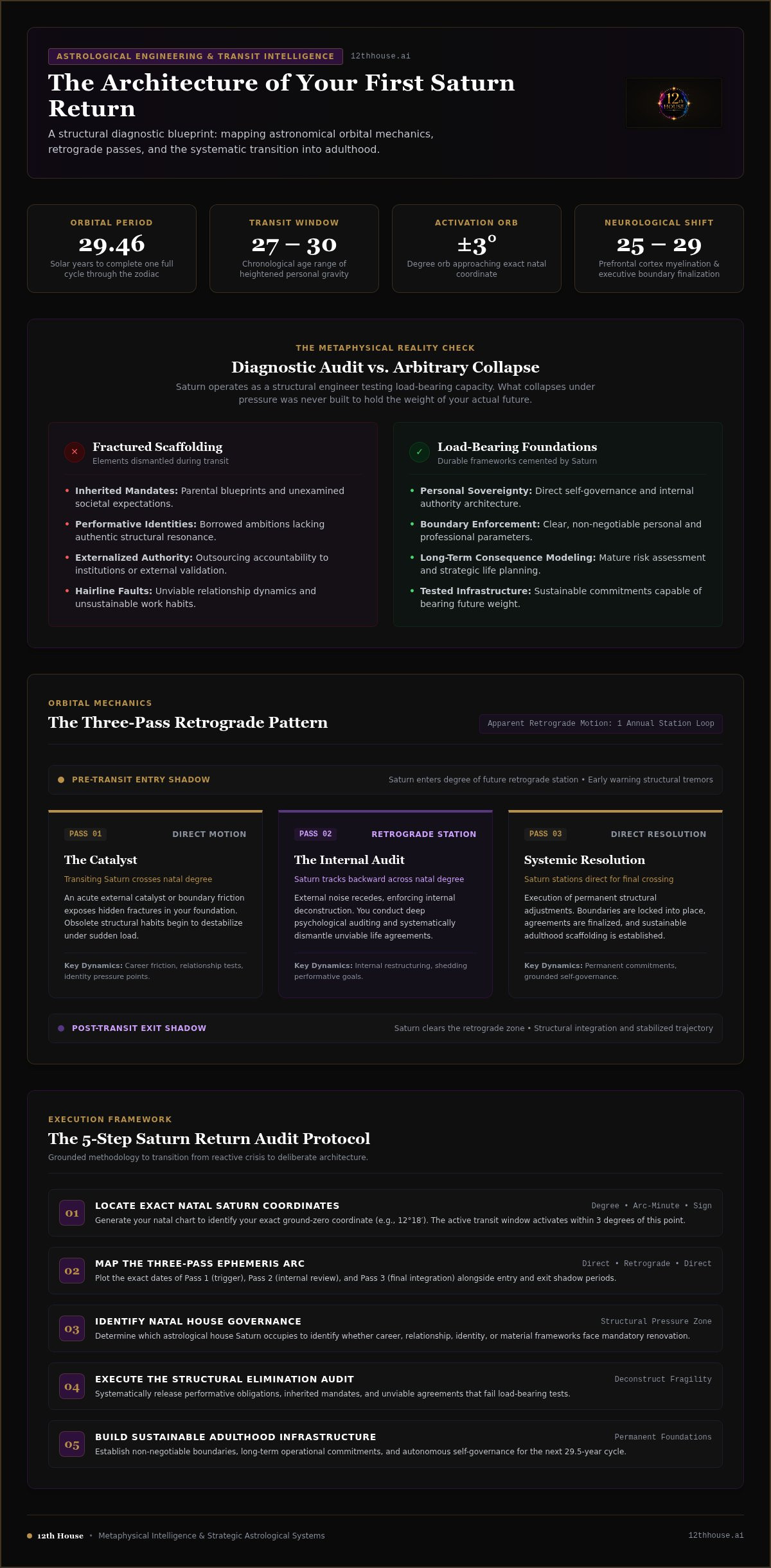
How to Navigate Your First Saturn Return: A 5-Step Protocol
Passive endurance is not a strategy. Surviving this transit requires methodical life engineering. Rather than waiting for external circumstances to force your hand, you must initiate the demolition of compromised structures yourself. Successfully navigating my first Saturn return comes down to treating your daily operational choices with architectural seriousness. Follow this five-step protocol to convert existential friction into lasting stability.
Step 1: Execute a Rigorous Life Foundation Audit
Audit every major domain of your existence with clinical detachment. Treat your life like a balance sheet: catalogue consumer debt, contractual obligations, physical health parameters, and emotional dependencies. Identify the load-bearing pillars that are currently hollow inside, such as high-effort friendships that provide zero reciprocal support or career tracks chosen to appease family expectations. Document persistent leaks where time and attention drain into unproductive escapism.
Step 2: Strip Away Non-Essential Commitments
Saturn rewards surgical subtraction. Terminate contracts, committee memberships, and dynamic agreements maintained purely out of lingering guilt. Prune peripheral distractions that dilute your core purpose. This step requires practicing strategic refusal; say no to low-yield social rituals and uncompensated professional favors. Safeguard your bandwidth ruthlessly so your remaining energy flows entirely toward structural repairs.
Step 3: Construct Sustainable Daily Systems
Ambition without logistical infrastructure breeds burnout. Replace chaotic routines with repeatable daily rituals:
- Systematize financial resources: Automate debt amortization and retirement contributions to eliminate perpetual cash-flow anxiety.
- Anchor somatic health: Lock down fixed sleep windows and scheduled physical movement to support nervous system regulation under pressure.
- Institutionalize deep work: Block out dedicated, non-negotiable windows to convert vague creative concepts into concrete, finished output.
Step 4: Assume Voluntary Structural Responsibility
In Saturnian logic, unchosen obligations feel like crushing burdens, but voluntary responsibilities build genuine authority. Step forward to own your financial autonomy, career direction, and emotional responses. Stop blaming parents, past partners, or economic conditions for current limitations. When you claim full stewardship over your circumstances, victimhood evaporates and personal sovereignty takes root.
Step 5: Institutionalize Long-Range Accountability
The final phase requires locking in permanent accountability mechanisms. Document your five-year operational milestones and review them quarterly. When navigating my first Saturn return, tracking how current planetary stations intersect your natal coordinates prevents unexpected life shocks. Access our curated metaphysical library access to explore self-guided frameworks, chart tracking methods, and rigorous systemic protocols that keep your foundational rebuild firmly on schedule.
Integrating Transit Data with Modern Metaphysical Intelligence
Static ephemeris tables offer isolated dates, while generic horoscopes trade in vague generalities. Neither provides an operational blueprint for navigating my first Saturn return. Metaphysical intelligence works differently; it treats your chart as an interactive system where transiting planetary bodies interface directly with your unique natal coordinates. Real stability comes from mapping these overlapping cycles as a unified whole.
Synthesizing Natal Houses with Transiting Pressure
Saturn never operates in isolation. While the ringed planet occupies your natal sign, its specific house placement establishes the physical theater of your structural renovation. A transit traversing your Fourth House destabilizes ancestral conditioning and domestic foundations, whereas an activation in your Eighth House demands a ruthless audit of joint financial liabilities and psychological entanglements.
At the same time, transiting Saturn casts mathematical aspects to your natal Moon, Venus, or Mercury, activating friction points between your duty and your emotional needs. Spatial context matters just as much as chronological timing. Mapping your planetary lines through astrocartography helps you evaluate whether your current geographic environment amplifies Saturnian constriction or provides the grounded stability needed to build long-term enterprise.
Engaging Metaphysical Intelligence for Strategic Clarity
Synthesizing multiple diagnostic systems manually can trigger analytical paralysis. Interfacing with an ai astrology assistant lets you cross-examine transit timelines against your natal blueprint and core energetic design instantaneously. Rather than sorting through detached data points, you get contextualized intelligence built for real-world application.
This systematic feedback translates complex astrological tensions into actionable operational moves. You can track when retrograde pressure begins to lift, pinpoint optimal windows for signing durable agreements, and establish precise personal boundaries before crises erupt. Approaching navigating my first Saturn return through modern metaphysical intelligence transforms an intimidating planetary threshold into a calculated blueprint for sovereign maturity.
Claiming Your Structural Authority
Saturn does not demand perfection; it demands reality. The friction of your late twenties isn't a sign that your life is unravelling, but proof that your foundation is being stress-tested for long-term load-bearing capacity. Successfully navigating my first Saturn return means swapping existential dread for architectural clarity. By calculating your exact orbital station windows, pruning hollow obligations, and committing to disciplined operational systems, you transform a period of acute pressure into an enduring baseline of self-governance.
You don't have to decipher these complex celestial mechanics in the dark. Blending transit calculations with holistic intelligence allows you to anticipate structural shifts before they blind-side your personal or professional life. Decode your planetary transits with 12th House to map your birth chart with technical precision and unlock real-time, contextual insights through the Lala AI spiritual assistant. Trust the weight of this initiation. When you commit to the work of building an authentic foundation, Saturn ensures what you create will stand.
Frequently Asked Questions
At what exact age does my first Saturn return occur?
Your first Saturn return occurs between the ages of 27.5 and 30, with peak intensity centering around age 29. Because Saturn requires approximately 29.46 Earth years to complete its orbit around the Sun, the exact onset depends on your precise birth date and planetary speed. The active window initiates when transiting Saturn enters the sign of your natal Saturn and concentrates when it reaches within three degrees of your exact natal position.
How do I find the astrological house where my Saturn return happens?
You find this sector by calculating your natal birth chart using your exact birth date, time, and birthplace. The house containing your natal Saturn identifies the specific life department undergoing structural reorganization. For example, a Seventh House Saturn restructures legal contracts and primary partnerships, while a Tenth House placement focuses pressure on your professional status and vocational direction. Knowing this house placement turns an abstract transit into a targeted renovation plan.
Can a Saturn return cause positive career and relationship breakthroughs?
Yes, Saturn rewards disciplined effort and deliberate responsibility with lasting professional milestones and durable relationships. While the transit exposes structural weakness, it also cements commitments that possess genuine load-bearing capacity. Many individuals secure career promotions, establish independent businesses, or formalize long-term marriages during this cycle. The key to navigating my first Saturn return constructively is voluntary ownership; whatever is built on authenticity and hard work receives enduring planetary backing.
What happens if I resist the lessons of my first Saturn return?
Resisting Saturnian restructuring typically amplifies external friction, converting necessary course corrections into acute crises. If you cling to hollow jobs, codependent relationships, or escapist habits, the planetary pressure intensifies until unviable arrangements shatter under structural fatigue. Avoidance doesn't delay maturation; it merely compounds the difficulty of the eventual rebuild. Confronting the necessary dismantling voluntarily preserves your agency and establishes a solid foundation for the subsequent thirty-year cycle.
What is the difference between a direct transit and a retrograde Saturn return?
A direct transit involves Saturn crossing your natal degree in forward motion, triggering tangible events, logistical reality checks, or external environmental shifts. A retrograde pass occurs when Saturn appears to move backward over that same coordinate, shifting the pressure inward. The direct pass exposes structural flaws in the physical world, whereas the retrograde pass demands internal reflection, psychological inventory, and deep behavioral recalibration before you can execute sustainable solutions.
How long does the entire Saturn return transition typically last?
The entire transit arc spans roughly two and a half to three years, reflecting Saturn's passage through your natal zodiac sign. When navigating my first Saturn return, the most acute psychological and circumstantial events concentrate into the retrograde stations within a tight three-degree orb of your natal placement. This peak activation phase usually lasts between 10 and 18 months, concluding once transiting Saturn makes its final direct pass and clears the exit shadow.
Does the Saturn return impact mental health and energy levels?
Yes, the transit frequently registers as somatic fatigue, mental gravity, and acute existential sobriety. As your prefrontal cortex finishes physical maturation and planetary pressure peaks, your tolerance for cognitive dissonance and unfulfilling commitments drops to zero. Many experience temporary bouts of burnout when attempting to sustain past lifestyle patterns. Honoring physical limits, enforcing firm energetic boundaries, and scheduling deliberate rest are essential requirements for maintaining mental and physical equilibrium throughout this threshold.


