

What if a Jupiter line points to possibility, not a promise of luck? Finding a Jupiter line astrocartography map can make a place feel like an obvious green light for a move, a career leap, or a fresh start. Jupiter is associated with growth, confidence, and wider horizons, but a line doesn’t guarantee that life will unfold in your favor. Its symbolism depends on the angle it touches and the rest of your birth chart.
If you’re hoping a location can bring more opportunity, that question makes sense. The key is to read the map as a symbolic framework, not a verdict about where you should live. A Jupiter line may emphasize expansion while also inviting you to notice where optimism could become overcommitment.
This guide explains Jupiter’s core symbolism and how its Ascendant, Descendant, Midheaven, and IC lines frame different themes, from identity and relationships to career and home. You’ll also find a practical way to reflect on a place, weigh its symbolism against your circumstances, and explore what the line might mean for you without treating astrology as a guarantee.
Key Takeaways
- A Jupiter line astrocartography map projects natal planetary placements onto geography, offering a symbolic lens for exploring how a place may emphasize growth.
- The Ascendant, Descendant, Midheaven, and IC angles connect Jupiter’s symbolism with distinct themes, from self-expression to relationships, career, and home.
- Jupiter lines aren’t guarantees of luck. Consider the potential for overconfidence or taking on too much alongside themes of opportunity.
- Read a line in sequence: identify it, confirm its angle, define your question, then compare the symbolism with practical needs and lived experience.
- Use 12th House astrocartography mapping to explore location-based chart themes as prompts for reflection, not fixed predictions.
What Does a Jupiter Line Mean in Astrocartography?
A Jupiter line marks a location on an astrocartography map where Jupiter in a person’s natal chart is aligned with one of the chart’s major angles. In traditional astrology, Jupiter symbolizes expansion, learning, belief, and opportunity. The line offers a way to consider how those themes might become more prominent in connection with a place.
An astrocartography map projects natal planetary placements onto geographic locations. Rather than showing where Jupiter sits in the sky today, it maps where Jupiter was angular at the moment of birth. In this symbolic system, a line can prompt questions about the experiences a location may bring into focus. It can’t establish that a move will produce a particular outcome.
How Jupiter becomes a location-based chart symbol
An astrocartography map is calculated from birth date, time, and place. Birth time helps determine the angles, so inaccurate or incomplete birth data can change how the map is drawn. A Jupiter line marks geographic areas associated with Jupiter rising, setting, at the Midheaven, or at the IC. The angle shapes the interpretation: the planet’s symbolism is read through a different life area depending on the line you’re examining.
Think of the map as a symbolic overlay, not a forecast. It doesn’t tell you that a specific job, relationship, or windfall will appear in a particular city. Instead, it gives you a framework for reflection: What might growth mean in this place? What real-world conditions could support or challenge it? That distinction keeps Jupiter line astrocartography useful without turning a chart symbol into a guarantee.
What people mean by Jupiter’s expansive influence
Astrologers traditionally associate Jupiter with broadening horizons. In a location-based reading, that can prompt reflection on study, unfamiliar ideas, travel, or developing a wider perspective. Someone considering a university town, for instance, might use a Jupiter line as a prompt to explore whether its educational opportunities and community fit their aims. The line doesn’t predict admission, success, or a particular personal response.
Expansion can also mean taking on more, so the symbolism isn’t simply “good things happen here.” A place might feel inspiring to one person and demanding to another, depending on their natal chart, circumstances, and choices. Consider the line alongside practical details such as work, finances, relationships, and wellbeing. The map gives you a question to investigate, not an instruction to relocate or a substitute for lived experience.
Jupiter ASC, DC, MC, and IC Lines: How the Four Angles Differ
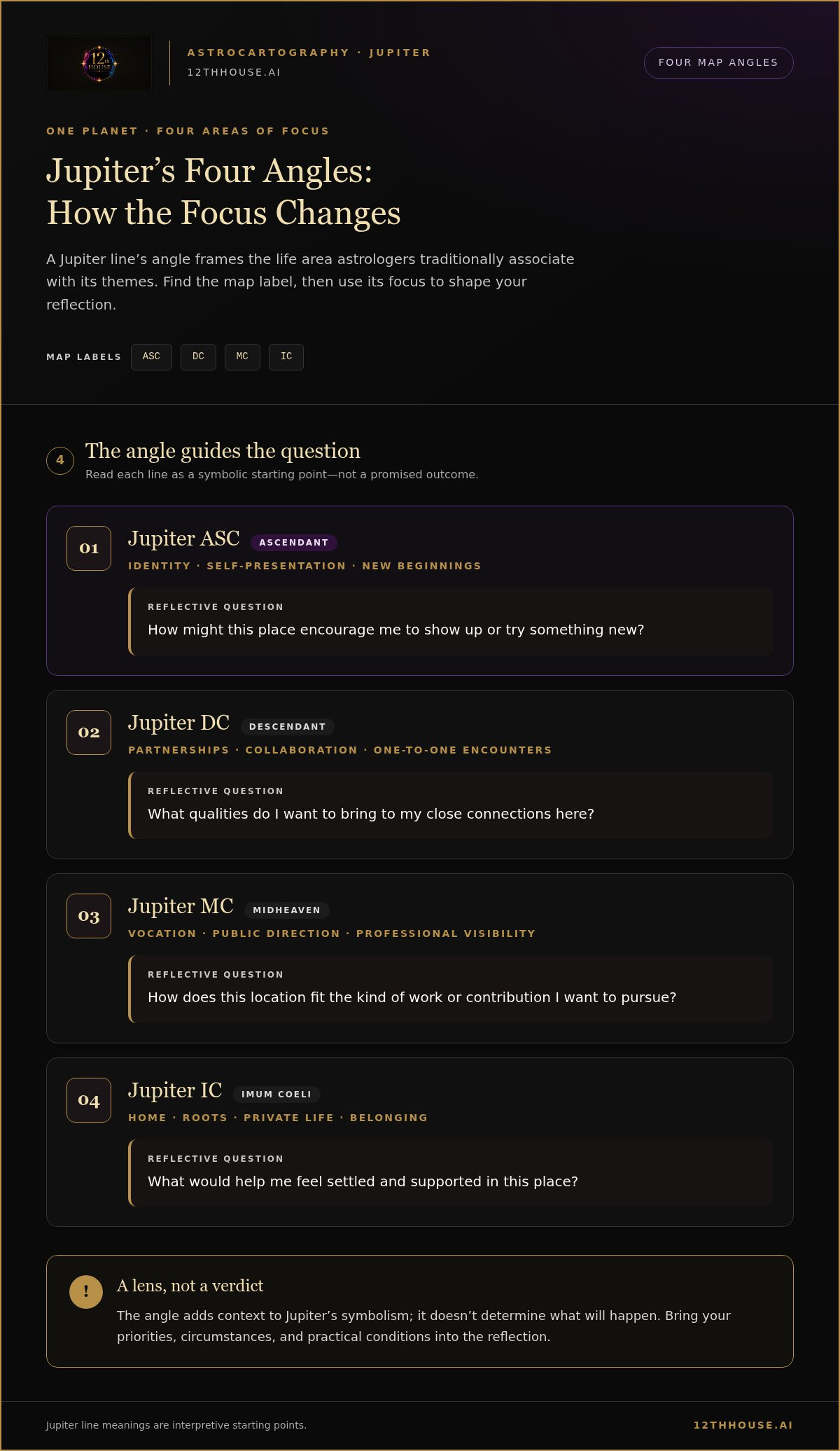
A Jupiter line doesn’t carry one fixed meaning across the map. Its angle identifies the life area through which astrologers traditionally interpret Jupiter’s themes. First, locate the exact label on your map: ASC, DC, MC, or IC. Then use that angle to frame your reflection, rather than treating any line as a guaranteed route to success.
| Angle | Traditional focus | Reflective question |
|---|---|---|
| Jupiter ASC | Identity, self-presentation, and new beginnings | How might this place encourage me to show up or try something new? |
| Jupiter DC | Partnerships, collaboration, and one-to-one encounters | What qualities do I want to bring to my close connections here? |
| Jupiter MC | Vocation, public direction, and professional visibility | How does this location fit the kind of work or contribution I want to pursue? |
| Jupiter IC | Home, roots, private life, and belonging | What would help me feel settled and supported in this place? |
These are interpretive starting points, not outcomes. A Jupiter line may invite you to consider expansion in one part of life, but your priorities and circumstances shape what that means. For background on Jupiter’s traditional associations with growth and wisdom, see Jupiter in Astrology. The map’s angle adds context; it doesn’t determine what will happen there.
Jupiter on the Ascendant or Descendant
With Jupiter on the Ascendant, attention turns to identity, self-presentation, and your approach to unfamiliar experiences. Ask: What parts of myself do I want to develop or express in this place? On the Descendant, the focus shifts to partnership and collaboration. Ask: How do I want to participate in one-to-one relationships here? Neither placement predicts who you’ll meet or how a relationship will unfold.
Jupiter on the Midheaven or Imum Coeli
The Midheaven, or MC, frames questions of vocation, public direction, and professional visibility. Consider what kind of work you want to pursue, not just whether a place seems promising. The IC turns attention inward, toward home, roots, private life, and belonging. Ask what would make daily life feel supportive. A career change, family responsibilities, or need for stability can shape how either theme applies.
Use the angle as a lens for a specific question, then compare its symbolism with practical conditions and your own experience. If you’re exploring a location through your chart, astrocartography mapping can help you examine location-based themes as part of a self-guided process. Keep your judgment in the frame: the angle can focus reflection, but it can’t make the decision for you.
Is a Jupiter Line Always Positive? Read Opportunity Alongside Excess
No. An astrocartography line isn’t universally positive, and it isn’t a shortcut to success. Jupiter’s traditional themes of growth and opportunity can offer an encouraging lens, but they don’t override the conditions of your life or guarantee a particular result.
A Jupiter line describes symbolic emphasis, not a promised outcome. That distinction matters when you’re weighing a move or trip. A map may help you name what you hope to explore, but it can’t tell you whether a job will be secure, a relationship will thrive, or your finances will improve.
Read the Jupiter line astrocartography interpretation alongside practical evidence. Consider available work, your budget, existing relationships, health, and support systems. These aren’t footnotes to the chart. They’re part of the decision itself.
When expansion may feel supportive
Jupiter symbolism can be a useful prompt if you’re seeking learning, new perspectives, or a wider field of experience. Ask what kind of growth you actually want. A student might consider whether a location offers relevant courses; someone changing careers might reflect on whether its opportunities align with their skills and resources.
Keep the inquiry personal. Would this place give you room to pursue a goal you’ve already identified? What would you need to feel supported while exploring it? The line can focus your attention on possibility, while your plans and circumstances help you assess whether that possibility is workable.
When more can become too much
Expansion can also describe a tendency to say yes too quickly, expect rapid progress, or take on more than you can sustain. Before interpreting a Jupiter line as an invitation to leap, check your actual capacity: available time, savings, obligations, and emotional energy. A stimulating environment may still require boundaries and careful planning.
This isn’t a warning to avoid the place. It’s a reason to examine your assumptions. Are you drawn to the location because it fits your goals, or because you hope it will solve a problem on its own? What would a realistic first step look like? The answers can help separate considered ambition from wishful thinking.
Use the map as one input among several. Write down what you hope a location will make possible, then list what would need to be true in everyday life for that hope to take shape. Compare the symbolism with practical details and, if you visit, notice how the place feels in lived experience. Neither a promising line nor a challenging circumstance settles the question alone. A grounded interpretation considers both what the chart invites you to explore and what your life can realistically support.
How to Interpret Your Jupiter Line Before Considering a Place
A map becomes more useful when you give it a clear question. Before treating a Jupiter line as a reason to travel or relocate, follow a simple sequence: locate the line, identify its angle, define your purpose, then compare the symbolism with your chart and actual circumstances. This keeps your interpretation focused and leaves room for evidence beyond astrology.
Start with the map, angle, and question
- Locate Jupiter. Find the Jupiter line connected to the place you’re considering. Check the map legend to identify the symbol or line style for Jupiter.
- Confirm the angle. Note whether the line is ASC, DC, MC, or IC. The angle frames the area of life associated with Jupiter’s symbolism, so don’t interpret the line without this detail.
- Define your purpose. Are you considering a short trip, a move, a work opportunity, or personal exploration? A focused question such as “Would this place support the kind of study I want to pursue?” is more useful than asking whether it’s simply a lucky location.
- Reflect in context. Consider the line alongside your natal chart and the realities of the place. Record what resonates and what doesn’t.
A Jupiter line astrocartography map shows one layer of a larger chart. Read it alongside your natal placements rather than in isolation: the planet’s position and connections in your birth chart can add context to how you approach its traditional themes. For a wider framework, use a thorough astrocartography map interpretation to understand how the map’s lines and angles fit together.
Bring chart symbolism back to everyday life
Translate the theme into concrete questions. If you’re exploring a Jupiter MC line for work, look at the roles available, the skills they require, and whether they match your professional aims. For an IC line and a possible move, consider housing, family needs, community, and what helps you feel at home. If education is your focus, examine real programs, costs, and the support you’d need to take part.
Keep a short record: write down your goal, the angle, the Jupiter theme you’re considering, and the practical facts that support or complicate the idea. If you visit, note your observations afterward instead of deciding in advance what the location “should” feel like. This creates a useful comparison between the chart’s symbolic language and your lived experience.
A grounded map reading treats symbolism as a question to test against real life, not a verdict to obey. Use the chart to sharpen your inquiry, then make decisions with your priorities, resources, and firsthand experience in view. To explore location-based chart themes in a structured way, explore 12th House astrocartography mapping.
Explore Your Jupiter Line with 12th House
A general description can help you recognize Jupiter’s themes. Your own map gives you a more specific starting point: a location, an angle, and a question that matters to you. Treat the chart as a tool for reflection, not a verdict. You remain the interpreter, and your real-world needs remain central to any decision.
Turn a general meaning into a personal inquiry
Choose one place you’re curious about, then locate its Jupiter line and note the angle: ASC, DC, MC, or IC. Connect that angle to the area you want to examine. For example, if you’re weighing a move and want to think about home and belonging, an IC line may offer a relevant symbolic frame. Ask what you hope to understand, rather than what the map will guarantee.
Make the question concrete. Are you curious about how a place might relate to your professional direction, your relationships, or your appetite for learning? Compare the Jupiter theme with your natal chart and current circumstances. A chart can help organize your inquiry, but it can’t decide whether a destination suits you. Keep your own observations and judgment in the process.
Continue your astrocartography exploration
12th House’s astrocartography mapping offers a way to explore location-based chart themes. You can also use astrocartography and spatial intelligence as a broader frame for thinking about how chart symbolism and place are connected. Keep the focus on the specific question you brought to the map, rather than expecting one line to explain every dimension of a location.
For personalized chart-related questions, Ask Lala is an AI assistant that can support further exploration. You might use it to examine a question about a Jupiter angle or consider which chart themes you want to reflect on. Treat any interpretation as material for thought, not a prediction or instruction. Your goals, practical circumstances, and firsthand experience still shape how you make meaning.
Before you begin, write down the place you’re exploring, the angle shown, and the question you want to consider. Afterward, note what the symbolism brings to mind and what real-world information you still need. That simple record can help separate your hopes from what you learn through reflection and experience. If you’re ready to continue, explore your astrocartography map as a structured, self-guided way to investigate location-based chart themes.
Make Your Next Place a Thoughtful Inquiry
A location can hold more than one meaning. Let your Jupiter line astrocartography reading open a question, then give that question room to evolve as you learn about the place and experience it for yourself. What are you hoping to grow into? What would support that growth in daily life? Your answers may shift as your priorities become clearer, and that’s part of a grounded practice.
Choose one destination and write down what draws you to it before studying its symbolism further. Later, compare those first impressions with what you discover. This small act of attention can help you distinguish genuine curiosity from the expectation that a location will change everything. Astrology is most useful here as a language for reflection, not a substitute for your own judgment.
When you’re ready to explore your chart in relation to place, explore your astrocartography with 12th House. Let the map inform your questions, and shape your answers through reflection and lived experience.
Frequently Asked Questions
Is a Jupiter line always a good place to live?
No. A Jupiter line doesn’t guarantee that a location will suit your needs or bring success. Consider everyday conditions such as housing, employment, health care, and your support network alongside the chart symbolism. A place may feel stimulating to explore but still be impractical for your budget or responsibilities. Use the map as one perspective, not the deciding factor.
How far from a Jupiter line can its influence be felt?
Astrologers don’t use one universal distance boundary for a line’s influence. Interpretations often treat locations nearer a line as more relevant, but the distance considered meaningful can vary by mapping approach. Check how your map represents proximity, and avoid treating a line as a hard border where its symbolism suddenly begins or ends. If comparing two places, note their relative distances and keep that detail in context.
Can I have more than one Jupiter line on my astrocartography map?
Yes. A map can show Jupiter connected with different angles in different geographic areas, such as an ASC line in one region and an MC line elsewhere. These are distinct chart-location relationships, not duplicate versions of one message. Read each line’s angle and location separately, then compare them with the question you’re exploring. A map may also show lines for other planets, each with its own symbolic framework.
What does it mean if a Jupiter line crosses another planetary line?
Astrologers may interpret a crossing or close meeting of lines as bringing both planetary themes into the same location-based reading. The specific symbolism depends on the second planet and the angles involved. Don’t assume the combination is automatically stronger or more favorable. Identify both lines, note their angles, and consider what each represents before forming an interpretation. The crossing is a prompt for closer study, not a guarantee of a particular event.
Can a short trip to a Jupiter line affect my experience?
A short visit can give you direct experience of a place, but astrology can’t predict how you’ll feel or what will happen during the trip. If you’re exploring a Jupiter line astrocartography map, set a modest intention, such as noticing what you learn or which environments you find engaging. Keep a few notes during or after the visit. Your observations can inform reflection without being treated as proof that the line caused an experience.
Do I need an exact birth time to find my Jupiter line?
An accurate birth time is important because astrocartography calculates where planets align with chart angles, and those angles depend on time. If your birth time is uncertain, the mapped line positions and angle labels may be less precise. You can still use a chart generated from the information you have, but keep the time uncertainty in mind when interpreting specific locations. Don’t treat a narrow line placement as exact if its key input is approximate.


