

What if the numbers you keep noticing are less like predictions and more like prompts to pay attention? The spiritual meaning of numbers can feel personal, especially when a sequence appears repeatedly, but its symbolism isn’t universal or certain. A number may carry different associations across traditions, and the meaning you give it depends on context.
If 11:11, 222, or another pattern has caught your eye, it’s natural to wonder whether it matters. Numerology offers a symbolic language for exploring that question, not proof that events are destined or instructions you must follow. Consider interpretations as possibilities, then ask what genuinely resonates with your experience.
This guide explains how numbers acquire spiritual meaning, why systems such as Pythagorean, Chaldean, and Kabbalistic numerology may interpret them differently, and what common numbers from 0 to 12 are often said to represent. You’ll also find a practical way to reflect on repeating patterns without turning coincidence into certainty. The aim is to use symbolism as a personal lens for self-inquiry, while keeping your own judgment in charge.
Key Takeaways
- Understand spiritual number meanings as symbolic interpretations, distinct from mathematical facts or guaranteed predictions.
- Compare how numerology, religious symbolism, and cultural context can shape a number’s meaning.
- Explore common symbolic themes for numbers 0-12 while keeping their interpretations flexible rather than universal.
- Use a four-step reflection method to examine repeating numbers, their context, and your response before drawing conclusions.
- Learn how general number symbolism differs from a personal numerology profile, and when an individualized exploration may be useful.
What Is the Spiritual Meaning of Numbers?
Spiritual number meanings are interpretations attached to numbers within belief systems. They may connect a number with a quality, life theme, sacred story, or ritual. The spiritual meaning of numbers is symbolic, not a measurable property built into the number itself. A number can invite reflection, but its interpretation isn’t an objective fact or a guaranteed message about what will happen next.
Mathematics describes quantities and relationships. Symbolism works differently: people use shared ideas and traditions to give a number significance beyond its mathematical value. The number 3, for example, is an odd integer whether it appears on a clock or in a poem. Some contemporary numerology interpretations associate it with creativity or expression, but that association belongs to a symbolic framework, not to arithmetic.
How can a number carry symbolic meaning?
A number can gather meaning through its repeated use in cultural stories, religious texts, customs, and rituals. As an image or idea recurs, people may connect the number with a particular theme. These connections can be studied as number symbolism across cultures and historical periods, rather than treated as one fixed code that applies everywhere.
Context matters. A number used to organize a calendar, mark a ritual, or structure a story may take on associations through that role. In one contemporary numerology reading, 3 might suggest self-expression; in another tradition or situation, it could carry a different emphasis. The interpretation comes from the system and its history, not from a universal definition.
Why do repeated numbers feel significant?
Repeated numbers can stand out because attention is selective. Once a pattern becomes meaningful to you, you may notice it more readily on clocks, receipts, or signs, while overlooking other numbers. Memory and emotion also shape the experience: a sequence seen during a stressful decision may feel more charged than the same sequence noticed during an ordinary day.
Some people use synchronicity as a spiritual framework for understanding coincidences that feel personally meaningful. In this view, an outer event may resonate with an inner concern, even without a clear causal link between them. That can offer a prompt for reflection. It doesn’t prove that an external force sent the number or that the pattern predicts an event.
Stay curious while leaving room for more than one explanation. If a sequence keeps catching your eye, note where you saw it and what was happening emotionally and practically. Then ask what the association brings to mind, without assuming the number has issued a command. Meaning can be personally useful without being universal certainty.
How Spiritual Number Meanings Differ Across Traditions
The spiritual meaning of numbers depends on the interpretive lens. Numerology uses structured systems to assign numbers symbolic significance. Religious traditions may read numbers through sacred texts and theology. Cultural symbolism develops through language, history, customs, and shared experience. These lenses can overlap, but they aren’t interchangeable, and none provides a universal dictionary for every number.
Consider 4. In some Western numerological interpretations, it is linked with stability or structure. In parts of East Asia, its pronunciation resembles the word for death in some languages, contributing to associations with misfortune. Neither association defines the number everywhere. Language, tradition, and situation shape how people understand it.
What does numerology contribute to number symbolism?
Numerology is a symbolic system that assigns interpretive significance to numbers and, in some approaches, connects numbers with letters. Pythagorean numerology is a well-known framework named for the ancient Greek philosopher Pythagoras and his school’s interest in numerical relationships. Modern systems associated with this tradition use their own conventions, so they shouldn’t be treated as a single, historically unchanged doctrine.
Chaldean and Kabbalistic numerology are also distinct interpretive frameworks. Systems can differ in how they connect numbers with letters and in the meanings they emphasize. Even within a framework, practitioners may interpret symbols differently. When comparing a reading, look for the system it uses and the method behind its interpretation. This section is about the systems themselves, not about calculating an individual chart.
How do religious and cultural meanings differ?
Religious symbolism draws on a tradition’s texts, teachings, and practices. For example, eighteenth-century Christian theologian Emanuel Swedenborg interpreted numbers in the Bible as carrying spiritual significance within his theological framework. His approach is one specific biblical interpretation, not a rule for all Christians or religions. Cultural symbolism, by contrast, can arise from local language, custom, or historical experience.
The comparison below maps interpretive approaches, not fixed meanings.
| Tradition or lens | Interpretive focus | Scope |
|---|---|---|
| Contemporary numerology | Symbolic themes assigned to numbers | Meanings vary by system and practitioner |
| Pythagorean numerology | Numerical relationships and, in modern practice, number-letter associations | One numerological framework, not a universal standard |
| Swedenborg’s biblical interpretation | Spiritual correspondences in biblical numbers | A particular theological reading |
| Cultural symbolism | Associations shaped by language, customs, and history | Local context matters; meanings don’t transfer automatically |
When you encounter a confident claim about what a number “means,” ask which system it comes from, what sources or customs inform it, and whether the interpretation belongs to a specific community. A meaning can matter within its own framework without becoming a universal fact. Keeping the lens visible helps you compare interpretations without collapsing them into one answer.
If you want to explore how symbolic themes might relate to your own numerology, a personal numerology report can offer a structured point of reflection, not a guaranteed prediction.
Spiritual Meanings of Numbers 0-12: Common Symbolic Themes
The themes below are common contemporary numerology associations, not universal definitions or predictions. Use them as a reference for comparing interpretations, not as a fixed code. Zero is often treated as a symbol in its own right, while 1-9 are the basic digits used in many numerological systems. Numbers 10, 11, and 12 are compound numbers; interpretations may draw on the digits they contain, their place in a sequence, or traditions outside numerology.
Numbers 0-4: beginnings, individuality, and foundations
- 0: Often associated with potential, wholeness, or the void in modern spiritual interpretation. Its role differs across systems, and it isn’t treated like the other single digits in every numerological framework.
- 1: Commonly linked with beginnings, initiative, or individuality. Religious and cultural settings may frame it differently, including as unity or singularity.
- 2: Often symbolizes partnership, balance, or duality in contemporary numerology. The emphasis can shift depending on whether the framework values cooperation, contrast, or balance.
- 3: Commonly associated with creativity, expression, or growth. These are modern symbolic themes, not a universal meaning shared across religious traditions.
- 4: Often linked with structure, stability, or foundations in contemporary numerology. Cultural associations can differ, so this theme shouldn’t be applied everywhere.
Numbers 5-8: change, harmony, and material themes
- 5: Often represents change, adaptability, or freedom in modern numerological interpretations. The association is symbolic, not a forecast that change is coming.
- 6: Commonly connected with care, responsibility, or harmony. The meaning may depend on how a particular system treats family, service, and balance.
- 7: Often associated with introspection, study, or spiritual inquiry in contemporary numerology. Other traditions may attach different significance to it.
- 8: Commonly linked with material ambition, authority, or abundance in modern numerology. It doesn’t promise wealth or success.
Numbers 9-12: completion, transition, and cycles
- 9: Often symbolizes completion, compassion, or the end of a cycle in contemporary numerology. It doesn’t mean that every situation is nearing an ending.
- 10: May suggest a completed cycle followed by a new beginning in numerology, where some interpretations consider the relationship between 1 and 0. This is a system-specific reading.
- 11: Often treated as a “master number” in some modern numerology traditions and associated with intuition or heightened awareness. Not all systems preserve or interpret it in the same way.
- 12: May represent cycles, order, or completeness in religious and cultural symbolism, as well as in some contemporary interpretations. The source tradition shapes the association.
To use these themes thoughtfully, identify the framework first, then compare its interpretation with the number’s context and your own associations. The same number can mean different things across numerological systems, religions, and cultures.
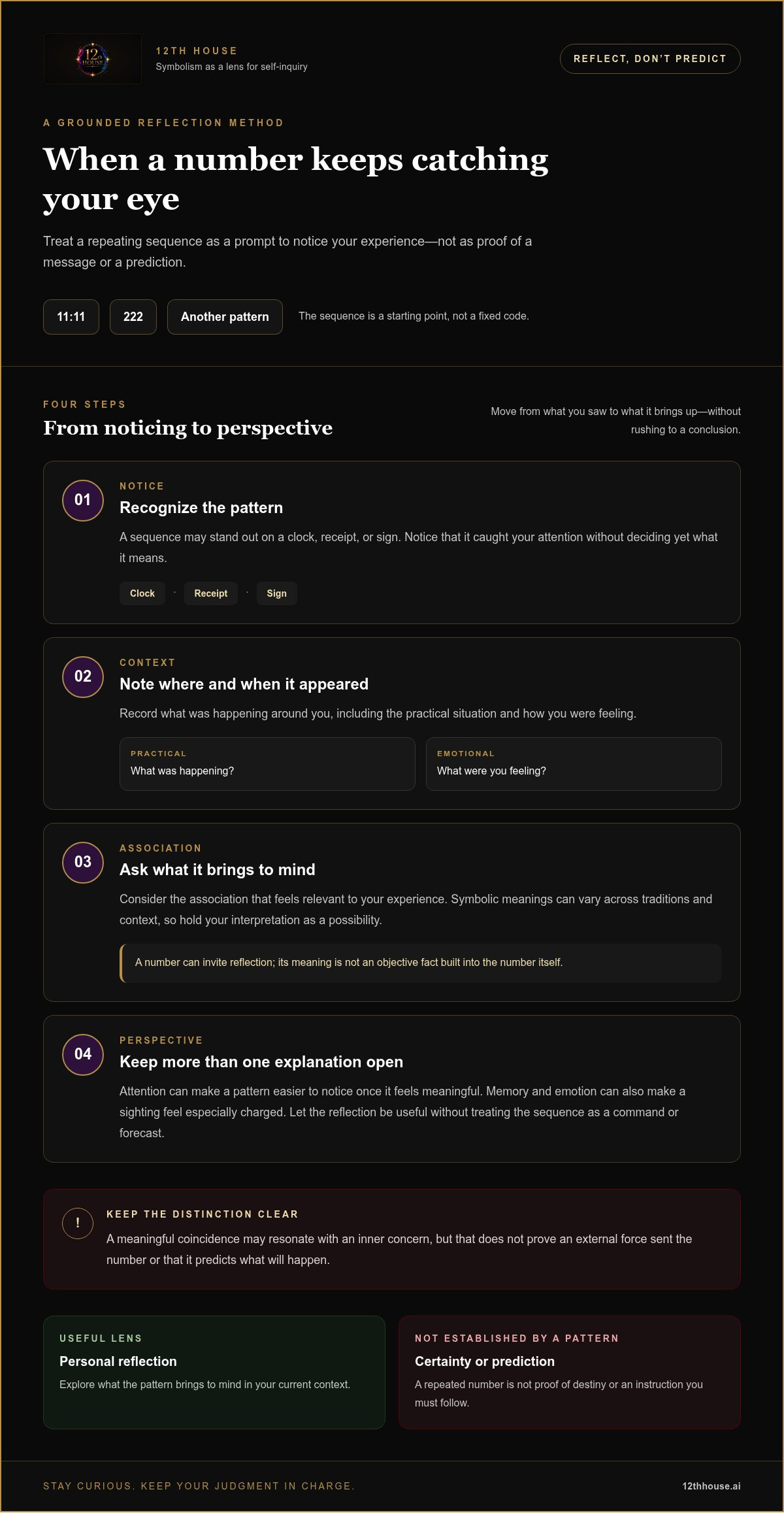
How to Interpret Repeating Numbers Without Overreading Them
A repeating sequence can catch your attention without carrying a single, certain message. Use it as a prompt to observe, compare, and reflect. This method keeps curiosity intact while separating what you saw from what you think it means. It also helps prevent one striking moment from becoming the basis for an urgent decision.
- Note the pattern. Record the number or sequence as you saw it, such as on a clock, receipt, or sign. Write down the observation first, without interpreting it.
- Record the context. Note where and when it appeared, what you were doing, and what was on your mind. Include practical circumstances as well as emotions: were you weighing a choice, feeling unsettled, or simply going about your day?
- Compare symbolic lenses. Look at more than one interpretation and identify its source. A contemporary numerology reading, a cultural association, and your own personal connection may offer different perspectives.
- Reflect before concluding. Ask which interpretation feels useful and whether it helps you see a situation more clearly. Revisit your notes later rather than treating the first explanation as final.
What should you ask when a number keeps appearing?
Start with questions that open inquiry rather than dictate an answer: Where did I notice this sequence? What was happening emotionally and practically? Does it connect with a current concern, or remind me of something personal? What are two plausible interpretations? Journaling your answers can help you spot patterns in your own associations without assuming that every sighting has the same significance.
How can you stay grounded while exploring synchronicity?
Keep the observation and interpretation distinct. “I saw 222 on a receipt” is an observation; “it means I should accept the offer” is an interpretation. You can explore that interpretation while also weighing relevant evidence, practical consequences, and your own judgment. If a reading creates fear or pressure to act immediately, pause. You’re allowed to set it aside and return when you feel more settled.
Symbolic interpretation can prompt reflection, but it cannot establish a future outcome. A journal can help you see whether an association remains meaningful over time or felt compelling only in one moment. Don’t let a number alone decide matters involving health, money, relationships, or safety. Treat it as one perspective among others, not as an instruction that overrides your agency.
For a structured space to explore what a number brings up, explore your question with Lala, 12th House’s AI spiritual guidance assistant. Use the conversation to consider possibilities, not to seek a guaranteed prediction.
From General Number Symbolism to Personal Numerology
A general number reference gives you a broad symbolic theme. A personal numerology profile uses a system’s framework to consider number symbolism in relation to an individual’s birth date, name, or questions. The distinction matters: looking up a number offers a starting point, while a profile places symbols within a more specific interpretive structure. Neither turns symbolism into a fixed identity or certain forecast.
Keep the purpose clear. Personal numerology can give you language for exploring themes and noticing what feels relevant. It shouldn’t define your character or make decisions on your behalf. Treat interpretations as prompts to examine alongside your own experience, values, and practical circumstances.
When is a personalized numerology reading useful?
A personalized reading may be useful when you want to move beyond a general theme and explore how number symbolism relates to a question you’re considering. For example, a relationship concern might lead you to explore numerology compatibility as one reflective lens, while still considering communication, shared values, and the relationship itself. The interpretation offers perspective, not a verdict about who you are, whom you should choose, or what will happen.
Use personal context carefully. A statement can feel compelling because it matches what you already hope or fear; that feeling alone doesn’t establish it as true. Notice what resonates, what doesn’t, and what the interpretation helps you ask. You remain the authority on your choices. Numerology is a symbolic map for reflection, not a substitute for evidence, conversation, or sound judgment.
How can you continue exploring number meanings?
Start simply: record the number or pattern, note where it appeared and what was happening, then name the question it brings to mind. This keeps the inquiry connected to real context instead of letting a symbol dictate a conclusion. Revisit the note later and see whether the association still feels useful.
12th House offers numerology reports and Lala, an AI spiritual guidance assistant for exploring personal questions. Its metaphysical library also supports self-guided learning. Use these resources as tools for reflection, not as authorities that guarantee predictions. The value lies in the questions and perspective you develop, not in treating an interpretation as certainty.
To explore number symbolism in a more personal way, explore 12th House numerology tools.
Let Symbolism Open a Better Question
Let a number’s meaning begin an inquiry, not end one. Ask what the symbol brings into focus, then decide what deserves your attention through your own values, evidence, and lived experience. The spiritual meaning of numbers can be a useful language for reflection when you remain free to question and revise your interpretation.
12th House offers numerology reports, Lala for AI spiritual guidance, and a metaphysical content library. These tools can help you explore personal questions and deepen your understanding without outsourcing your judgment or treating an interpretation as a guaranteed prediction.
Explore 12th House numerology tools to continue your inquiry with curiosity, clarity, and your own agency intact.
Frequently Asked Questions
Is there one universal spiritual meaning for each number?
No. Number meanings depend on the tradition, historical setting, and personal associations involved. A symbol used in a religious text may have a different role from the same number in contemporary numerology or a local custom. Before applying an interpretation, identify where it comes from and what it means within that framework. Treat it as one lens, not a definition that must fit every person or culture.
Why do I keep seeing the same number everywhere?
It may feel significant because your attention has become tuned to that sequence. If you check the time often, for instance, a familiar pattern on a digital clock can stand out and stick in memory, while ordinary times fade. Some people interpret such moments spiritually; pattern recognition offers another explanation. You could note each sighting, including numbers that catch your eye less, to see what you’re actually noticing.
Can numbers predict the future?
Numbers can’t establish a certain future outcome. Numerological interpretations may prompt you to consider your priorities or feelings, but they aren’t a reliable basis for knowing what will happen. If a number seems connected to a decision, use it to clarify the question rather than answer it. Weigh relevant evidence, possible consequences, and advice from trusted people before making a consequential choice.
What is the spiritual meaning of 11:11?
In some contemporary spiritual interpretations, 11:11 is associated with alignment, awareness, or a moment to set an intention. These are possibilities within particular symbolic frameworks, not universal facts. If you notice it, you might pause and ask what deserves your attention that day. Consider whether the association helps you reflect, rather than taking the time display as proof that a specific event is coming.
Do repeating numbers have the same meaning as angel numbers?
Not necessarily. “Repeating numbers” describes a visible pattern, such as 333 or 11:11. “Angel numbers” refers to a spiritual framework in which some people interpret number sequences as guidance from angels or a higher source. Someone may notice repetition without using that framework at all. Consider an angel-number interpretation as one belief-based reading, not an established explanation for why the pattern appeared.
How can I find the spiritual meaning of a number that matters to me?
Begin with the situation: where did the number appear, and what question or feeling was present? Then compare interpretations from clearly identified traditions instead of relying on an unattributed list. The spiritual meaning of numbers can shift across systems, so note which source you’re using and what resonates personally. Give yourself time to consider more than one possibility before deciding whether any interpretation is useful.
Is numerology a religion or a spiritual practice?
Numerology is an interpretive system that assigns symbolic significance to numbers; it isn’t a religion with one shared doctrine. People engage with it in different ways. Some incorporate it into a spiritual or religious practice, while others use it as a framework for self-reflection or cultural study. Its symbolic claims aren’t established scientific facts, so distinguish personal meaning from evidence-based conclusions.


