

What if the most useful AI astrology reading doesn’t tell you what will happen, but helps you understand the patterns shaping your choices? A Sun-sign horoscope can offer a moment of recognition, yet still feel too broad to speak to your chart, relationships, or turning points.
A chart-based reading can draw on more of your astrological map, including planetary placements and, when available, your birth date, time, and location. But detail alone doesn’t make an interpretation meaningful, and symbolic insight isn’t a guaranteed prediction. Its value depends on the question you bring and how thoughtfully you consider the response.
In this guide, you’ll learn what an AI reading can interpret, how to ask focused questions that move beyond generic statements, and how to use the answers for reflection without handing over your judgment. We’ll also look at how conversational tools such as Lala can help you explore birth chart and transit questions as an ongoing inquiry. Treat the reading as a framework for noticing, not a verdict about your fate.
Key Takeaways
- See how natal placements and current transits can offer different kinds of context in a chart-based interpretation.
- Assess whether a reading explains its reasoning, adds useful nuance, and acknowledges uncertainty.
- Make an AI astrology reading more relevant by asking one focused question and inviting the tool to connect its response to chart details.
- Turn requests for fixed predictions into open-ended questions that support reflection and preserve your judgment.
- Explore how Lala and 12th House’s astrology birth chart and transit analysis can support continued chart inquiry.
What Is an AI Astrology Reading, and What Makes It Personal?
An AI astrology reading is a generated interpretation that brings astrological chart information together with a question or area of focus you provide. Instead of offering the same message to everyone born under one sign, it can use chart details to shape a response around an individual’s symbolic map. How relevant it is depends on the information the tool uses and how clearly you frame your question.
A chart-based interpretation connects astrological placements to your specific chart and question; a generic horoscope offers broad themes for everyone sharing a zodiac sign. That distinction matters. Personalization isn’t just using your name or repeating your concern. It means the interpretation draws on individual chart context rather than treating one sign as the whole picture.
How a chart-based reading differs from a daily horoscope
A daily horoscope usually addresses a sign group with a concise theme or prompt. A chart-based reading can consider how multiple placements relate to one another, adding individual context. To learn about astrology’s traditions and how it differs from astronomy, see What is Astrology?
Two people can share a Sun sign and still have different Moon signs, Rising signs, planetary placements, or house arrangements. Imagine two people with the same Sun sign asking how they approach a new project. One person’s chart might include placements astrologers interpret in relation to communication, while another’s might emphasize routines or collaboration. These are different symbolic angles for reflection, not factual conclusions about either person or predictions of what will happen.
This example shows why birth details and chart context matter. A sign-only answer can’t distinguish between those chart patterns. A chart-based tool may be able to, if it has the relevant information and incorporates it into its interpretation.
What an AI reading can and cannot tell you
Astrology offers a symbolic framework for interpreting patterns and exploring questions. AI can organize that symbolism into language, help you examine a concern from another angle, or prompt reflection on themes you may want to consider. It doesn’t turn symbolism into scientific certainty. Different tools may interpret or present chart information differently, so treat a response as an interpretation, not an objective measurement.
Use a reading to open inquiry: What patterns am I noticing? What assumptions might I be bringing to this situation? Which parts of this interpretation feel useful, and which don’t fit my experience? These questions keep you active in the process. You can accept, question, or set aside an idea instead of treating the output as an instruction.
No reading can guarantee that an event will happen, determine another person’s intentions, or decide what you should choose. Don’t use spiritual interpretation as a substitute for professional advice in high-stakes matters involving health, finances, legal issues, or safety. Let it support personal reflection, then make consequential decisions with relevant evidence, qualified guidance, and your own judgment.
How an AI Astrology Reading Uses Chart Details and Current Transits
A chart-based interpretation begins with a natal chart, a symbolic map calculated from birth information. An AI astrology reading may use that map to organize an answer around your question. Tools can differ in which chart details they consider and how they interpret them, so look for a response that makes its context visible rather than treating every placement as interchangeable.
A transit gains meaning through its relationship to a natal chart, not as a standalone forecast. This distinction separates an interpretation of the chart’s underlying structure from one focused on current planetary movement.
Natal placements: the chart’s underlying structure
A natal chart brings several interpretive dimensions together. The Sun is commonly associated with identity and vitality, the Moon with emotional responses and needs, and the Rising sign with presentation and approach. Houses connect placements to areas of life, while aspects describe angular relationships between planets. These are symbolic conventions, not measured traits or fixed descriptions of personality.
Context changes what an interpretation can address. For example, a question about communication could invite an astrologer to consider Mercury’s sign, house, and aspects together instead of interpreting Mercury’s sign alone. The house may add a life-area lens, while an aspect may describe a relationship between chart factors. Together, they create a more specific symbolic reading, not a definitive claim about how you communicate.
Birth-time precision matters most for time-sensitive chart details. The Rising sign and house placements are tied to the time and location used to calculate the chart, so an uncertain birth time can affect those parts of the map. It doesn’t mean every placement changes; the practical effect depends on the chart and the time difference.
Transits: reading current planetary movement in context
Transits refer to current planetary positions considered alongside placements in a natal chart. A natal interpretation describes the chart’s symbolic pattern at birth. A transit interpretation adds a time-based layer by exploring how current planetary positions relate to that pattern. Some tools may focus on selected planets or aspects, so methods can differ between readings.
Suppose a current planet forms an aspect to a natal planet. An interpretation might use that connection as a prompt to examine a theme associated with the two placements. It shouldn’t turn the configuration into a promise that a specific event will occur on a particular date. Treat timing language as an interpretive lens, not a calendar of guaranteed outcomes.
For a broader look at how computational methods have been discussed in this field, see AI and Machine Learning in Astrological Predictions. A paper about technical approaches doesn’t establish that astrology can predict events with certainty. Software can process chart information and generate an interpretation; the meaning you give that interpretation remains a matter of reflection.
To explore these layers through chart-focused questions, use 12th House astrology birth chart and transit analysis as a starting point for further inquiry.
How to Judge an AI Astrology Reading: Specificity, Context, and Limits
A polished answer can sound perceptive. That alone doesn’t show that it used your chart well or that its claims are reliable. Look beneath the language: what kind of reading is it, which chart details does it reference, and does it explain how those symbols relate to your question?
Use this comparison to identify what an answer offers, rather than expecting every format to provide the same depth.
Generic horoscope: Offers broad themes for a zodiac sign. It can provide a general prompt, but usually doesn’t reflect an individual chart.
Natal-chart reading: Interprets placements in a birth chart. Its specificity depends on which chart factors it includes and how clearly it connects them to your question.
Transit reading: Considers current planetary positions in relation to a natal chart. It adds a time-based interpretive layer, not a certain forecast.
Conversational follow-up: Develops an initial interpretation through further questions. Follow-ups can clarify the reasoning, but more dialogue doesn’t automatically make an answer more accurate.
For any format, look for four qualities: relevant chart context, clear reasoning, useful nuance, and honest uncertainty. These help distinguish an interpretation with a visible framework from one that simply sounds personal.
Signs a reading is meaningfully personalized
A personalized answer names chart factors relevant to the question, then explains how they connect. If it mentions a placement, it should make clear why that symbol matters instead of using astrological terminology as decoration. It should also leave room for complexity: a chart can suggest competing themes, not one totalizing description.
Try asking, “Which chart factors are shaping this interpretation, and how do they connect to my question?” A useful response should make its logic easier to examine. If it only repeats broad traits you could find in a sign-based horoscope, its personalization may be limited.
Red flags in overconfident or vague interpretations
Be cautious of absolute predictions, fear-based claims, or language that pressures you to make an immediate decision. An evocative phrase may feel powerful, but without a clear connection to chart context, it’s atmosphere rather than explanation. Ask which symbols support the interpretation and what other readings might be possible.
An AI astrology reading can be a prompt for reflection, not a verdict. A fluent response isn’t proof of accuracy, and no interpretation guarantees a future event or determines your choices. Keep your own experience in view. If the answer doesn’t fit, question it. If it resonates, consider what it helps you notice without treating resonance as evidence that a prediction will come true.
How to Ask Better Questions and Work With an AI Astrology Reading
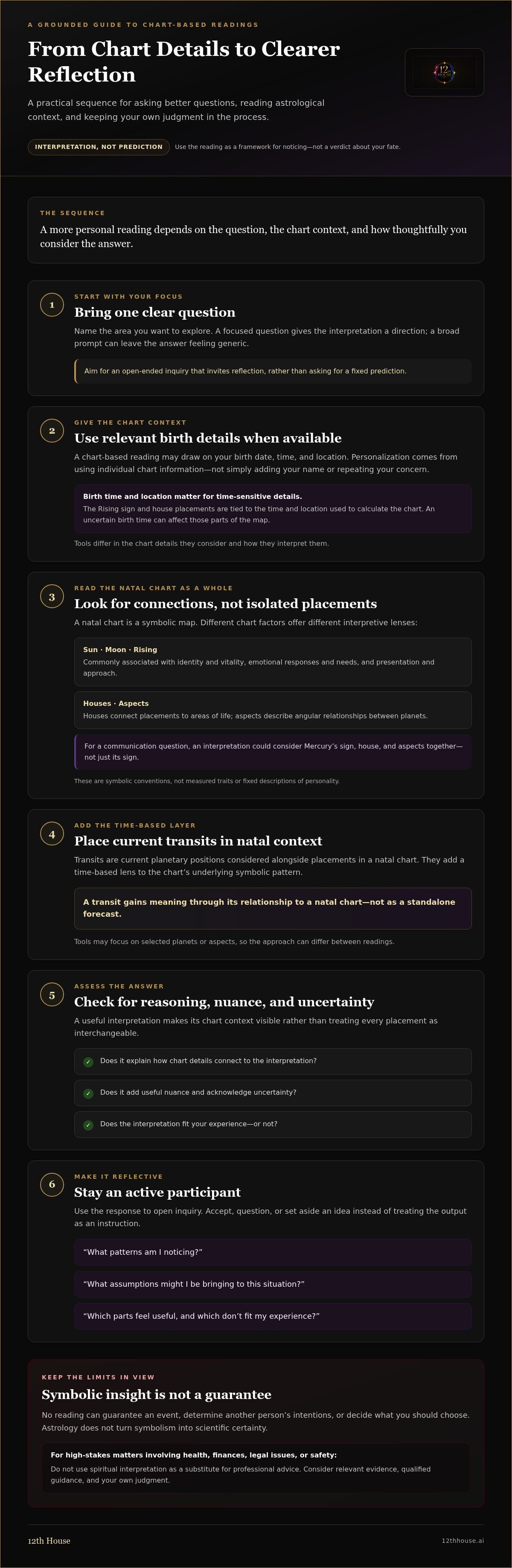
A focused question gives an interpretation a useful frame. Start with a real situation, then ask for insight into one part of it. Avoid asking a chart to decide your future. Instead, use the exchange to examine themes, assumptions, and possible ways of responding.
Follow this sequence:
- Name the situation. Give brief, relevant context, such as adjusting to a new role or considering a change in routine. Leave out identifying details that aren’t needed.
- Ask one focused question. Choose a single decision, relationship dynamic, or area of self-understanding. A question that tries to address everything at once can produce a scattered answer.
- Request chart context. Ask which placements or transits inform the interpretation and how they relate to your question. Request plain language if the explanation relies on unfamiliar terms.
- Reflect before acting. Separate the symbolic reading from what you know about your situation. Decide what feels useful, what doesn’t fit, and what other information you need.
Turn a broad concern into a focused astrology question
Compare “Will my career work out?” with “As I adjust to a new role, what themes in my chart might help me reflect on how I approach change?” The first asks for a guaranteed outcome. The second invites an interpretation without treating astrology as a verdict.
Keep the scope narrow. If you’re exploring a relationship, focus on one dynamic rather than asking whether the relationship is destined to last. For questions about relationship charts, birth chart compatibility can be a useful lens for considering how two people’s symbolic patterns interact, not proof of a relationship’s future.
Continue with precise follow-ups: “Which chart factors are shaping that interpretation?” “How does the placement connect to the situation I described?” “What’s another possible way to read this?” These prompts invite reasoning and nuance. They also help show whether the answer uses the chart context you asked it to consider.
Reflect on the answer without handing over your agency
An AI astrology reading may offer language for reflection, but the symbols aren’t personal facts. A reading might suggest a theme to consider; your lived experience helps you decide whether it applies. Resonance can make an interpretation worth exploring, but it doesn’t make it certain.
If an answer sounds absolute, ask for a more balanced interpretation or alternative readings of the same factors. You can also ask what assumptions the interpretation depends on. Keep practical decisions anchored in relevant evidence and your own judgment, especially when the stakes are high.
Protect your privacy as you prompt. Share only the context needed to frame the question, and avoid unnecessary names, contact details, or intimate information about other people. To explore chart questions through conversation, ask Lala about your astrology chart.
Explore AI Astrology Readings With Lala at 12th House
A chart reading becomes more useful when you can stay with a question, examine the interpretation, and ask what it rests on. Lala is 12th House’s AI spiritual guidance assistant for personalized questions about charts, spells, and compatibility. It offers a conversational way to explore astrology, while the platform’s astrology birth chart and transit analysis supports the chart-focused approach described in this guide.
Bring the same standards to any AI astrology reading: ask which chart details inform the response, request plain-language reasoning, and treat the result as material for reflection. Lala can help you explore a topic through follow-up questions. It doesn’t replace your judgment or make decisions on your behalf.
Continue a chart question as a conversation
Begin with one clear inquiry, then use the response to decide what to examine further. You might ask which chart factors relate to a theme, how a transit is being interpreted in your chart, or what another symbolic reading could be. Follow-ups can take you from a broad first impression to a more considered exploration without mistaking fluent language for certainty.
A conversational AI astrology assistant is most useful as a guide through questions, not an authority over your choices. Keep your lived experience in the frame. If an interpretation feels too definite, ask for nuance or another possible reading. If it doesn’t fit, set it aside. The exchange should support your discernment, not override it.
Build a self-guided practice with 12th House
Exploration can continue beyond a single response. Lala supports unlimited interactions, so you can return to chart questions and follow their threads over time. Membership also includes access to a metaphysical library, with books, videos, and ritual frameworks for self-guided learning. Use the library to inform your inquiry, not as a substitute for your own interpretation.
The platform also offers personalized data storage. Keep your prompts purposeful and share only what’s relevant to the question you want to explore. A focused practice might mean returning to a theme, noting which interpretations resonate, and considering how your perspective changes. The value lies not in collecting answers, but in using them thoughtfully.
Ready to continue exploring? Bring a chart question to Lala and use the conversation as a starting point for your own work. Let the chart offer a symbolic lens. You decide what meaning, if any, it holds in your life.
Let Your Next Question Open the Door
Choose one question that still feels alive after reading your chart. Not the question that demands certainty, but the one that helps you notice what you value, what feels unresolved, or where you want to direct your attention. An AI astrology reading can offer a fresh symbolic lens, but its lasting value comes from what you do with the reflection. Pause, consider what fits your experience, and leave room for what doesn’t.
Let curiosity lead the next step. Ask a follow-up, explore another chart factor, or return to the question later with a different perspective. You don’t need to accept every interpretation to learn from the process. Your judgment remains central, and your choices remain your own.
Ready to continue exploring? Explore Lala and continue your chart questions. Bring one thoughtful question and see where your own reflection takes you.
Frequently Asked Questions
Is an AI astrology reading accurate?
It can offer a coherent interpretation, but its accuracy depends on the chart information used and the interpretive framework behind the response. Astrology isn’t a scientifically proven system for predicting events. To assess an answer, look for specific chart factors, a clear explanation of how they relate to your question, and acknowledgment that other interpretations are possible. A compelling tone can make a response feel convincing, but it doesn’t prove the reading is correct or that an event will happen.
Can AI read my birth chart?
AI tools can generate interpretations from birth-chart information, though their capabilities and methods vary. Receiving an interpretation isn’t the same as independently verifying every chart calculation. If a response discusses a house placement, for example, see whether it explains why that placement matters to your question. Personal-sounding language alone doesn’t show that the tool considered the whole chart. Treat the answer as an interpretation to examine, not proof of a complete or independently checked analysis.
What information do I need for an AI astrology reading?
A natal chart is generally calculated using your birth date, time, and place, but different tools may ask for different details. Birth-time precision can matter for time-sensitive factors, such as the Rising sign or house placements. If you don’t know the exact time, avoid presenting an estimate as certain. Share only information relevant to your question; you usually don’t need to include names, contact details, or intimate background that doesn’t help frame the interpretation.
Can an AI astrology reading predict my future?
No reading can guarantee a future event or determine what you’ll choose. Astrological interpretations of placements and transits can offer symbolic themes to consider, but they aren’t certain forecasts. Use a response to reflect on possibilities or clarify what matters to you, then make decisions using appropriate evidence and judgment. Don’t base medical, financial, or legal decisions solely on an AI interpretation, and don’t treat it as proof of how a relationship will unfold.
How do I get a more personalized AI astrology reading?
Ask one open-ended question about a specific concern, then request the chart factors behind the response. For instance, if you’re weighing a change in routine, ask what placements might offer a useful perspective instead of asking whether the change will succeed. Add only context that helps explain the situation. A follow-up such as “What’s another way to interpret those factors?” can invite nuance. Clear reasoning matters more than dramatic language or absolute claims.
Is an AI astrology reading different from a horoscope?
Often, yes. A horoscope may give broad guidance for a zodiac sign or a particular period, while a chart-based reading can draw on individual placements and, if the tool supports them, transits. The depth depends on the information available and how the tool uses it. Neither format offers a guaranteed prediction. To understand what you’re reading, notice whether the interpretation uses personal chart context or addresses a sign group in general terms.
Can I ask an AI astrology reader about relationships?
Yes. You can ask about relationship patterns, compatibility, or your own responses within a connection. Keep the focus on what you can reflect on, rather than asking AI to establish another person’s private thoughts or predict their actions. A chart interpretation can’t prove what someone feels. For a structured way to explore how two charts may be interpreted together, see the guide to birth chart compatibility, and use its ideas as a reflective lens.


