

What if the Venus line that looks like a map to love is really pointing toward a broader question: which parts of your life might feel more vivid in this place? Venus line astrocartography offers a symbolic lens on connection, beauty, ease, and values. But a favorable-looking line can still leave you wondering whether it speaks to romance, a sense of home, or the way you move through the world.
That uncertainty makes sense. A Venus line isn’t a guarantee of a soulmate, effortless success, or perfect happiness. Its meaning depends on the angle it activates, your natal chart, and the realities of the location you’re considering. Read the map as a framework for reflection, not a verdict.
This guide explains how to interpret Venus on the Ascendant (ASC), Descendant (DSC), Midheaven (MC), and Imum Coeli (IC), then connect each expression to your personal goals. You’ll learn what to consider about place, birth-time accuracy, and practical needs, so you can explore the symbolism without handing your decision-making over to the map.
Key Takeaways
- Venus line astrocartography offers a symbolic way to explore where themes of connection, pleasure, aesthetics, and values may stand out.
- Compare the ASC, DSC, MC, and IC to consider whether a location’s Venus symbolism relates more to self-expression, relationships, career, or home life.
- Read a Venus line in the context of your natal chart and nearby planetary lines, rather than treating it as a prediction of what will happen.
- Use accurate birth details, clarify your goals, and weigh practical factors before drawing conclusions about a location.
- A digital astrocartography map can help you locate and explore Venus lines. 12th House mapping supports reflection, not guaranteed outcomes.
What Venus Line Astrocartography Shows About a Place
A place might catch your eye for its beauty, social life, or the way you imagine living there. A Venus line offers an astrological lens for exploring that attraction, not proof that the location will deliver a particular experience. In a birth chart, Venus is associated with attraction, connection, pleasure, aesthetics, and values. Astrocartography projects planetary symbols onto geography.
Venus line astrocartography is a symbolic map of locations where Venus occupies one of the chart’s major angles. It offers a lens for reflection, not a prediction about what life there will bring.
What does a Venus line represent in astrocartography?
Astrocartography takes the positions of the planets at the time of birth and projects their angular relationships onto a world map. A Venus line marks places where Venus was on a key angle, such as rising or setting, at that moment. The map helps identify locations to explore through the language of astrology. It doesn’t measure a force acting on you or guarantee that a place will feel comfortable.
Think of the line as a prompt, not a verdict. If you’re considering a city near a Venus line, ask what Venusian themes mean in your life. Do you want more room for creative work, a richer social life, or surroundings that reflect your taste? Then compare those hopes with what you know about the city, including its culture, opportunities, and day-to-day conditions.
Astrology supplies an interpretive framework. It can help you organize questions about place, but your experience remains personal. A location may feel inviting at first and still prove impractical for your work, finances, or support network. The symbol points toward themes to consider; it can’t settle the decision for you.
Why a Venus line is more than a “love line”
Romance is one possible expression of Venus, but it’s only one. Venus also describes how you connect with others, what you find beautiful, what brings pleasure, and which values shape your choices. Depending on your goals, a Venus line might prompt reflection on friendship, artistic practice, social ease, comfort, or the kind of environment that feels harmonious to you.
For example, someone looking for a creative community might use Venus symbolism to think about shared tastes and collaboration. Someone weighing a move for a relationship might focus on intimacy and partnership. Neither interpretation predicts what will happen. The useful question is more specific: which Venus themes matter to the life you want to build, and how might this place support them in practical terms?
For a wider view of how planetary lines form a geographical framework, explore the astrocartography mapping guide. It places a Venus line within the larger map, where each planet and angle contributes a different symbolic perspective.
Venus ASC, DSC, MC, and IC Lines: Four Different Interpretations
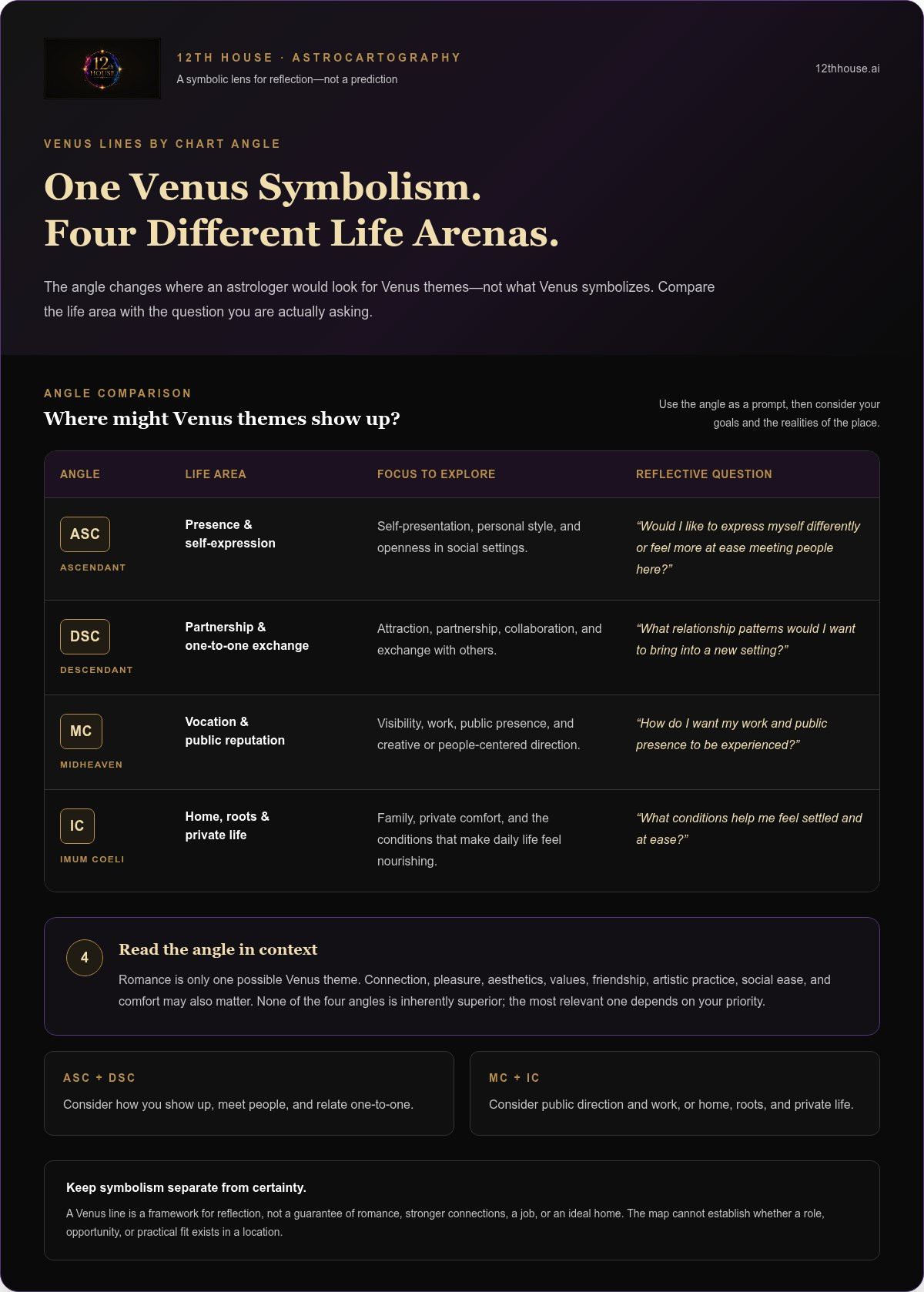
On a Venus line, the angle changes the part of life through which Venus is interpreted. Use the comparison below to connect the map to a question you actually have, rather than searching for a universally “best” line.
| Angle | Life area | Reflective question |
|---|---|---|
| ASC (Ascendant) | Presence and self-expression | How do I want to show up and connect in daily life? |
| DSC (Descendant) | Partnership and one-to-one exchange | What kind of relationships or collaborations do I want to cultivate? |
| MC (Midheaven) | Vocation and public reputation | How do I want my work and public presence to be experienced? |
| IC (Imum Coeli) | Home, roots, and private life | What conditions help me feel settled and at ease? |
The angle doesn’t change Venus’s symbolism; it changes the life arena where an astrologer would look for its themes. That distinction gives you a practical way to read Venus line astrocartography: begin with your goal, then consider which angle speaks most directly to it. None is inherently superior. A line associated with partnership may be less relevant than one associated with home if your priority is building a stable private life.
Venus ASC and DSC: self-expression and one-to-one connection
On a Venus ASC line, interpretation centers on presence: self-presentation, personal style, and openness in social settings. Ask, “Would I like to express myself differently or feel more at ease meeting people here?” A Venus DSC line shifts attention to exchange with others, including attraction, partnership, and collaboration. Ask, “What relationship patterns would I want to bring into a new setting?” Neither angle predicts a romance or guarantees stronger connections.
Venus MC and IC: public direction and private life
A Venus MC line brings the symbolic focus to visibility, vocation, and public reputation. It can be a useful prompt if you’re weighing how you want to be seen at work or what kind of creative or people-centered direction appeals to you. A Venus IC line turns inward, toward home, roots, family, and private comfort. Ask what would make daily life feel nourishing there. These are interpretive themes, not promises of a job, welcoming household, or ideal home.
Let the angle answer your question, not replace it. If you’re considering a move for career reasons, Venus on the MC may be the relevant symbolism to explore, but the map can’t establish whether a role or industry is available. If you’re prioritizing home life, the IC offers a different point of reflection. Keep the practical decision separate from the symbolic reading, then consider whether both offer useful perspective.
To apply the framework to your own map, explore your personal astrocartography map and use the angle as a starting point for focused questions, not a forecast.
How to Read Venus Line Meaning Without Overpromising
A compelling Venus line can make a location seem immediately appealing. Treat that reaction as a question to investigate, not evidence that the place will suit you. In astrology, a line is interpreted through your natal chart, your aims, and the wider map. Its symbolism can offer a perspective, but it can’t account for every condition that shapes daily life.
A favorable Venus interpretation is one lens on a location, not a complete location decision. Affordability, safety, community, work, access to support, and personal circumstances need their own careful consideration. The symbolism may help you clarify what you’re seeking; practical research helps you assess whether a place can meet those needs.
Can a Venus line feel different from its traditional symbolism?
Yes. Traditional interpretations offer shared themes, but they don’t describe a uniform experience. Venus may symbolize social connection or pleasure in a reading, while your actual experience depends on the people you meet, your circumstances, and what you value. Your natal chart also informs the interpretation. Use the symbolism as a hypothesis to reflect on, then compare it with your observations over time.
Separate expectation from evidence. Before visiting or moving, write down what you hope the location will support. After spending time there, notice what actually happens: Do you find meaningful connections? Do your routines feel sustainable? Does the place fit your needs beyond its initial appeal? This practice keeps the reading personal without turning a first impression into a fixed conclusion.
How do nearby lines and location context shape a reading?
Other planetary lines may add themes to an astrologer’s interpretation of a region. They don’t make a destination automatically beneficial or difficult. The meaning depends on the chart and the question being explored, so avoid reducing a complex map to a simple formula. A nearby line is a reason to look more closely, not a verdict on what you’ll experience there.
Keep two kinds of inquiry distinct. Astrology helps you reflect on symbolic themes; practical research helps you assess conditions in a specific place. A map can’t establish whether housing is affordable, a job is available, a community feels welcoming, or a neighborhood meets your safety needs. Investigate those questions directly and weigh them alongside your astrological reflection.
- Name the goal: Are you exploring partnership, creative life, comfort, or another priority?
- Check the context: Consider your natal chart and any nearby lines as interpretive factors, not fixed outcomes.
- Test the fit: Compare the symbolism with firsthand observations and practical research before making a major decision.
This approach lets Venus line astrocartography inform your reflection while keeping your judgment anchored in lived conditions. Let the map open a line of inquiry. Let your needs and evidence shape the decision.
A Practical Process for Evaluating a Venus Line Location
A map becomes more useful when you give it a clear question. Use this sequence to move from birth details to a grounded reflection on a specific place. Keep your purpose in view: a short visit, a possible relocation, and simple curiosity call for different levels of research.
What information helps you interpret a Venus line?
Begin with your birth date, birth location, and the most accurate birth time available. Birth time matters especially for angle-based lines, so note whether it’s recorded or estimated. Then name the life question you want to explore, such as connection, creativity, home, or public life. A specific question gives the map a useful frame.
- Clarify your use case. If you’re curious, a broad exploration may be enough. For a visit, consider what you hope to notice during your time there. For relocation research, plan to examine daily-life factors in depth.
- Set a personal goal. Write one focused question, such as whether a city’s symbolic themes resonate with your interest in creative community or partnership. Avoid trying to make one line answer every life question.
- Choose a place. Identify a specific city or region you might visit or consider. A line in isolation is harder to relate to your plans than a named location with real-world context.
- Read the relevant angle. Connect the line’s angle to the life area you’re considering, then note nearby map signals as additional context. Treat proximity as something to interpret, not a guaranteed measure of effect.
- Test the reading against reality. For a visit, observe your experience without expecting it to match a prediction. For a move, research housing, work, safety, community, and other needs before making a decision.
How should you compare two Venus-line locations?
Use the same goal and angle for both places. If you’re comparing cities for creative work, for example, ask the same question of each map rather than shifting your criteria to favor one. Note where each location sits relative to the line and what other chart factors may add to the interpretation. Don’t treat distance alone as proof that a theme will be stronger or more favorable.
Then build a practical comparison alongside the symbolic one. Look at the realities that matter for your use case: a short visit calls for different planning than a permanent move. For relocation, consider whether everyday life could support your priorities, including work, cost, safety, and social connection. Astrocartography can organize reflection; it can’t supply those local facts.
Use 12th House’s digital astrocartography mapping to explore your personal Venus line, then bring a specific goal and location to your interpretation. Let the map guide your questions, and let careful research inform your next step.
Explore Your Venus Line with 12th House Astrocartography
A digital astrocartography map gives you a structured way to locate your Venus lines and see how their angles relate to places you’re considering. Use it to narrow your inquiry: identify a city, notice which Venus angle is relevant, and connect that symbolism to a personal question. 12th House’s digital astrocartography mapping helps you explore your personal map. The map can support reflection, but it can’t promise love, ease, career success, or a particular experience in any location.
That distinction matters. Treat the map as an instrument for organizing your questions, not as an authority making a decision for you. If a location draws your attention, ask what you hope to find there and what you can learn through practical research or direct experience. Keep symbolic interpretation and real-world conditions in view at the same time.
Turn a map into a more focused Venus-line inquiry
Start with a specific place and the angle connected to your question. If you’re curious about relationships, focus your reflection on partnership and exchange; for a question about public life, consider vocation and visibility. Then ask what you want to understand about yourself in that setting, rather than asking whether the map guarantees a partner or a perfect outcome.
12th House’s Lala AI spiritual guidance assistant can help you explore personalized questions about astrology and chart themes. It’s a tool for inquiry, not a source of guaranteed predictions. For broader context on using an AI assistant to explore astrology, the AI astrology assistant guide explains the role of this kind of digital support.
Continue your astrocartography exploration
Let curiosity lead, then give your interpretation a reality check. Note what the Venus line suggests to you, what remains uncertain, and what you’d want to investigate about the place itself. A short visit may help you observe your response to a city; relocation calls for deeper consideration of work, housing, community, safety, and everyday needs. Your map can inform the questions, while your judgment guides the choice.
Use 12th House astrocartography mapping to explore your personal map at your own pace. Bring a clear question, compare the symbolism with your goals, and keep practical context part of the reading. Begin with 12th House astrocartography to map your personal questions and continue your exploration.
Let Your Next Location Question Take Shape
A map can’t choose a life for you, but it can help you notice what you’re seeking from a place. Turn that awareness into a practical next step: name one question you want to explore, then stay open to what your experiences and circumstances reveal. The most useful reading sharpens your judgment rather than replacing it.
Use Venus line astrocartography as a starting point for reflection on the kind of connection, creativity, or ease you hope to invite into your life. 12th House offers digital astrocartography mapping to help you explore your personal map, while Lala provides AI-based spiritual guidance for personalized astrology questions. Both can support inquiry without promising a particular outcome.
Explore 12th House astrocartography and bring your location questions into focus. Follow the symbols with curiosity, weigh them against your lived reality, and trust yourself to make the next move thoughtfully.
Frequently Asked Questions
Is a Venus line in astrocartography always positive?
No. Venus is often linked with harmony and pleasure, but those themes don’t guarantee an easy experience. A location could bring your social preferences, desire for comfort, or spending habits into sharper focus, which may feel supportive or create tension depending on your circumstances. Ask what you might prioritize there, and consider whether those priorities fit your current needs. Interpret the line as a theme to examine, not a rating of the place.
Can a Venus line predict when or where I will meet a partner?
No. A Venus line can’t reliably identify a future partner or predict the timing of a relationship. In an astrological reading, it may offer a lens for thinking about connection in a location, but it doesn’t establish that you’ll meet someone there. If partnership is your focus, use the map to clarify what kind of connection you value, then consider ordinary ways to meet people, such as shared interests, community events, or social networks.
How far from a Venus line can a location be and still matter in an interpretation?
Astrologers commonly consider a line’s influence within roughly 70 to 100 miles, or about 110 to 160 kilometers, on either side. This is a convention, not a measured boundary or guarantee. A city near the edge of that range isn’t automatically more or less meaningful for you. Note the city’s distance as context, then focus on the line’s angle, your chart, and what you’re trying to understand about the location.
Can you read Venus lines accurately without an exact birth time?
You can explore a map made with an estimated time, but angle-based lines may be substantially misplaced. The Ascendant, Descendant, Midheaven, and IC depend closely on birth time; even a 15-minute difference can shift angle lines by hundreds of miles. If your recorded time is uncertain, treat the locations as provisional and avoid making a major decision based on that map alone. A time estimate should be clearly distinguished from a verified birth record.
Why might two astrocartography maps show Venus lines differently?
Different results can come from different birth details or calculation settings. Check that both maps use the same date, time, birthplace, and time-zone assumptions before comparing them. A small time discrepancy can matter, especially for angle lines. Maps may also present line labels or visual layouts differently, so compare the underlying Venus angle and location rather than relying only on color or line appearance. Consistent input data makes the comparison more useful.
Can you explore a Venus line without moving or travelling there?
Yes. You can use a map to study a location symbolically without visiting it or relocating. Choose a city that interests you, identify the Venus angle, and write down what you hope to learn about your priorities or chart themes. You might also discuss personal astrology questions with Lala, 12th House’s AI spiritual guidance assistant. Treat that exploration as reflection, not a substitute for firsthand experience or local research.
How is a Venus line different from Venus in a natal birth chart?
Your natal Venus describes Venus’s placement and symbolism within your birth chart, independent of where you live. An astrocartography map projects that birth chart across geography, showing where Venus is associated with particular angles. The map doesn’t replace or rewrite your natal placement. For example, comparing a city’s Venus line with your natal Venus can help frame a location-based question, while the natal chart remains the foundation for interpreting your personal Venus themes.


