

What if your Human Design chart wasn't just a static image on a screen, but a precise mechanical blueprint for every movement you make? Most seekers treat their BodyGraph as a one-time revelation rather than a dynamic operating system. You might understand your Type, yet you still battle decision fatigue or the heavy friction of burnout because you're forcing results that contradict your nature.
This guide explores exactly how to use human design in daily life to transition from cognitive overthinking to a state of high-frequency alignment. We'll move beyond the abstract to build a functional framework for your energy. You'll learn to decode your unique architecture so your daily choices become calculated and effortless. We'll analyze how to audit your physical environment, manage your internal battery, and utilize tools like the Lala AI assistant to interpret how planetary transits influence your immediate mood.
Key Takeaways
- Shift from mind-led willpower to a body-led operating system to eliminate decision fatigue and structural burnout.
- Discover how to use human design in daily life by transforming your Strategy and Authority into a functional GPS for real-time navigation.
- Optimize your daily rhythm by auditing your energy centers to determine when to engage your motor and when to prioritize rest.
- Protect your energetic frequency in professional environments by identifying and shielding your open centers from external stress.
- Utilize advanced digital tools to decode complex chart gates and analyze how shifting transits impact your immediate psychological state.
Decoding the Daily Blueprint: Why Energetic Strategy Trumps Willpower
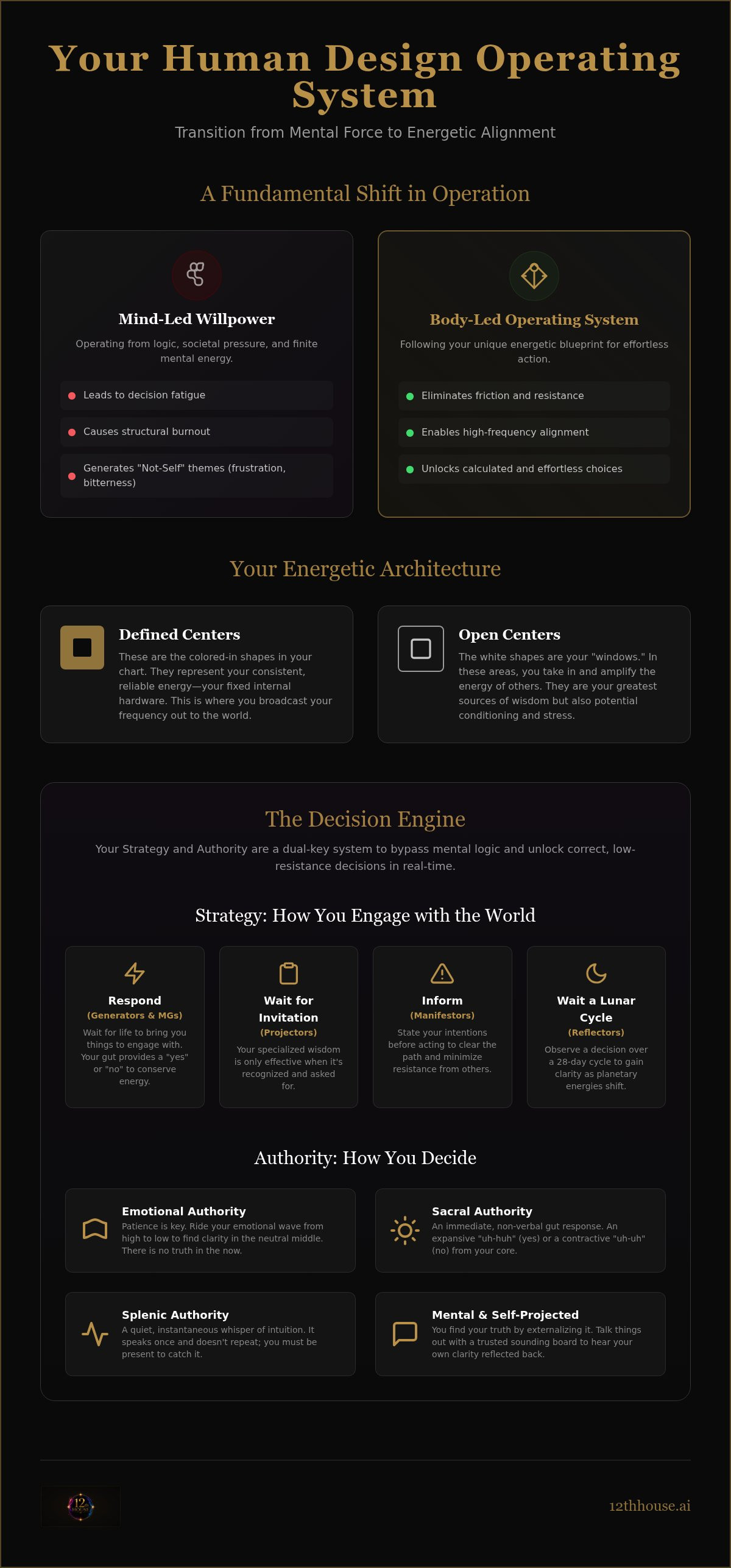
Human Design functions as a technical manual for your energetic frequency. It's not a belief system; it's a mechanical framework. Most of us were raised to live "Mind-Led," using logic and societal expectations to dictate our path. This is a fundamental design flaw. When you try to force outcomes through sheer willpower, you're often pushing against your own structural integrity. Learning how to use human design in daily life requires a shift from cognitive control to mechanical observation.
Willpower is a finite resource. In the Human Design system, consistent willpower is only available to those with a defined Heart Center. For everyone else, "trying harder" is a recipe for systemic collapse. When you move out of alignment, your body triggers a "Not-Self" theme. This internal alarm system, whether it manifests as frustration, bitterness, or anger, signals that you're operating from the mind rather than your body's innate intelligence.
The Architecture of the Bodygraph
Your Bodygraph is a circuit board of defined and open centers. Defined centers are the colored shapes in your chart. They represent your consistent, reliable energy. These are the parts of you that stay the same regardless of who you're with. They're your "fixed furniture." Conversely, open centers are white. These are your windows to the world. In these spaces, you don't have consistent energy; instead, you take in and amplify the energy of others. Understanding this architecture allows you to stop judging your "inconsistency" in open areas and start relying on the strength of your defined centers.
From Theory to Practice: The Experiment
Human Design is often called the "Science of Differentiation." It's an invitation to treat your life as a clinical experiment. Don't take the information as dogma. Instead, observe your daily interactions through the lens of your specific type and strategy. Analyzing how to use human design in daily life starts with small, low-stakes decisions. Notice the difference in your body when you wait for a response versus when you initiate out of fear. By shifting from a participant to an objective observer of your own mechanics, you begin the process of deconditioning from the "shoulds" that cause burnout. You aren't changing who you are; you're stripping away the layers of who you aren't.
The Decision Engine: Implementing Strategy and Authority in Real-Time
Your mind is designed to process data, not to direct your life. Real-time alignment occurs when you bypass the logic of "why" and focus on the mechanical "how." This is the core of how to use human design in daily life. Your Strategy and Authority act as a dual-key system that unlocks effortless movement. By shifting the seat of power from your thoughts to your body, you eliminate the friction that leads to chronic burnout.
Strategy by Type: The Four Modes of Action
Strategy is your aura's specific way of interacting with the world. It dictates how you engage with opportunities to ensure they're energetically correct for you. Generators and Manifesting Generators are designed to respond. This isn't passive waiting; it's an active observation of life's "sacral sparks." When you wait for something to respond to, you ensure your energy is used efficiently rather than being drained by forced initiation.
Projectors must wait for the invitation. Your intelligence is specialized and requires recognition to be effective. Forcing your wisdom onto others leads to bitterness. Waiting for the door to open ensures your guidance is valued. Manifestors, conversely, use the strategy of informing. You don't ask for permission. You state your intent to clear resistance from those in your path. Reflectors navigate by the lunar cycle. Significant pivots require a 28-day observation period to see how the decision reflects across the shifting energetic landscape.
Authority: Your Personal Calculation for Truth
If Strategy is how you engage, Authority is how you decide. Emotional Authority requires patience because there's no truth in the "now." You must ride the wave of feeling until you reach a neutral baseline. Sacral Authority is a gut-level response, often experienced as a non-verbal sound like "uh-huh" or "uh-uh." It's an immediate pulse of "yes" or "no" that bypasses rationalization.
Splenic Authority is even faster. It's a quiet, immediate whisper of intuition that doesn't repeat itself. If you miss it, the mind will quickly take over. Mental and Self-Projected Authorities require externalizing thoughts. You need to hear yourself speak in a supportive environment to decode your truth. For a technical analysis of your specific configuration, generating your Human Design Profile provides the data needed to stop overthinking and start living.
To master this decision engine, practice the "Sacred Pause." When a choice arises, notice if your mind starts listing pros and cons. Stop. Redirect your awareness to your specific Authority center. This transition from mental calculation to somatic intelligence is the definitive way to reduce fatigue and reclaim your internal energy.
The Daily Rhythm: Morning to Night Practices for Every Type
To understand how to use human design in daily life, you must treat your schedule as a sequence of energetic transitions. Alignment isn't a static destination; it's a maintenance protocol. Your daily rhythm should mirror the specific mechanics of your Bodygraph, ensuring you don't overextend your motor centers or amplify the wrong frequencies. By structuring your day around your design, you move from a state of constant friction to one of metabolic and energetic efficiency.
Morning Alignment: Setting the Frequency
Before the digital noise of the world enters your field, check in with your internal architecture. Understanding the nuances of the five Human Design types allows you to set a pace that respects your definition. Ask yourself: "Am I feeling a mental pressure to initiate, or am I waiting for a spark to respond to?" This distinction is the difference between starting the day in alignment or slipping into your "Not-Self" theme. Use movement to clear your open centers. A brief walk or stretching helps discharge the energetic debris you may have absorbed the previous day, especially if you have an open G-center or Spleen.
During the mid-day peak, manage your motor energy with clinical precision. If you're a Generator or Manifesting Generator, your goal is to spend your Sacral fuel on tasks that provide a "yes" response. For non-sacral beings, the mid-day challenge is "energetic borrowing." You might feel a frantic burst of productivity that isn't actually yours. When this happens, step out of the shared aura of your office or coffee shop. Recalibrating in your own space for fifteen minutes prevents the burnout caused by running on a motor you don't actually possess.
The Evening Transition: Discharging Energy
Sleep architecture is where the deepest deconditioning occurs. For Projectors, Manifestors, and Reflectors, the ritual begins before you're tired. You need to be in a horizontal position at least 30 to 60 minutes before sleep. This allows your system to discharge the borrowed sacral energy you've amplified throughout the day. If you wait until you're exhausted, your nervous system remains "wired" by external frequencies, leading to poor sleep quality and morning brain fog.
Generators require the opposite approach. You must ensure your Sacral motor is fully spent. If you aren't physically tired, you haven't completed your daily cycle. Regardless of type, create a "Digital Sanctuary." Eliminate screens an hour before bed to protect your Ajna and G-center from over-stimulation. By isolating your aura during sleep, you allow your body to return to its natural state, ensuring you wake up as yourself rather than a composite of everyone you encountered the day before.
Social and Professional Architecture: Protecting Your Open Centers
Meetings are energetic pressure cookers where individual Bodygraphs collide. When you enter a shared aura, your open centers act as biological receptors, absorbing and amplifying the frequencies of those around you. This "Energetic Enmeshment" often leads to a false sense of urgency or borrowed stress that doesn't belong to you. Understanding how to use human design in daily life means recognizing that the sudden anxiety you feel in a boardroom might be a mechanical reflection of the person with the defined Root center sitting across from you.
The "Wisdom" of open centers lies in the art of non-identification. You're designed to observe these external energies rather than becoming them. By treating your open centers as high-fidelity sensors rather than storage units, you can navigate high-pressure social environments without absorbing the emotional or mental debris of others. This allows you to set energetic boundaries silently. You don't need to speak; you simply remain anchored in your own defined circuitry, refusing to provide a "hook" for the external conditioning to latch onto.
The Corporate Human Design: Navigating Work Culture
In a professional setting, pressure centers like the Head and Root often dictate the "pace" of the office culture. If your Root is open, you likely feel a crushing, physical need to finish tasks immediately just to be free of the pressure. This is a mechanical trap that leads straight to burnout. Similarly, non-sacral beings often try to keep up with the relentless, 24/7 output of Generators, which is physically unsustainable. Your physical environment also dictates your success. Beyond internal mechanics, analyzing your astrocartography can reveal if your current geographic location supports your professional architecture or creates unnecessary energetic friction.
Relationship Synastry: Understanding the Other
Conflict in relationships is rarely personal; it's almost always mechanical. When two people interact, their charts create a temporary third entity, the "composite" chart. Your defined centers project a consistent frequency that others must process, whether they want to or not. If you have a defined Solar Plexus, your emotional wave will impact everyone in your aura. Recognizing these triggers as simple mechanics reduces resentment and blame. While Human Design provides the energetic blueprint for these interactions, integrating birth chart compatibility adds a necessary layer of psychological nuance to your connections.
To audit your professional and personal circuitry with clinical precision, access your Human Design Profile and identify exactly where you are most vulnerable to external conditioning.
Advanced Integration: Leveraging AI for Real-Time Design Mastery
Integration is the terminal phase of the experiment. While the previous sections provided the architectural logic for energy management, mastery requires real-time data processing. Understanding how to use human design in daily life at an advanced level means transitioning from manual observation to a digitized feedback loop. By leveraging sophisticated technology, you can decode the complex interplay between your fixed blueprint and the shifting celestial environment. This analytical approach ensures that your spiritual practice remains grounded in clinical precision rather than vague intuition.
Ask Lala: Your Digital Sage for Daily Questions
The most significant hurdle in the deconditioning process is the gap between ancient symbolic language and modern, high-stakes dilemmas. This is where a AI astrology assistant becomes an essential tool for the metaphysical architect. Instead of searching through dense textbooks, you can query Lala AI for immediate clarity on your current state. You might ask, "Why do I feel frustrated today?" Lala analyzes the current planetary transits against your specific Bodygraph gates, identifying where external forces are activating your "Not-Self" themes.
This real-time decoding allows you to move beyond the basic question of "What is my type?" and into functional mastery. You can analyze specific channels that are being triggered during high-stress periods, providing a clinical perspective on your emotional or mental pressure. This digital sanctuary transforms a static map into a responsive operating system. It provides the technical support needed to maintain your frequency in an increasingly chaotic environment. You're no longer guessing why you feel "off"; you're looking at the raw data of your energetic architecture.
Your Personalized Human Design Report
A comprehensive Human Design Profile serves as your life's reference manual. It's a deep-dive analysis that archives your specific gates, channels, and lines into a structured format. Within the 12th House platform, you can store this metaphysical data to build a personalized ritual library. This isn't a passive document; it's a dynamic resource you can access whenever you encounter friction in your career or relationships. It allows you to track your progress as you decondition from societal expectations.
Your next step is to move from theory to clinical application. Generate your profile and begin using the Lala assistant to audit your daily interactions. By treating your spiritual growth as a structured discipline, you ensure that alignment isn't a fleeting moment but a permanent state of being. The experiment is ongoing. With the right digital tools, you have the calculation power to navigate your design with precision and ease. Stop forcing results. Start observing your mechanics.
Master Your Energetic Architecture
Transitioning from theoretical knowledge to active alignment requires a commitment to the experiment. You've explored how to use human design in daily life by shifting from cognitive willpower to mechanical strategy. By honoring your Authority and protecting your open centers in high-pressure environments, you reclaim the energy previously lost to burnout and indecision. This isn't about changing who you are; it's about stripping away the conditioning that obscures your natural frequency.
The journey toward mastery is a continuous calculation. You don't have to navigate these complex layers of your Bodygraph alone. Within the 12th House digital sanctuary, you can access personalized human design profiles and AI-powered metaphysical intelligence to decode your unique blueprint with clinical precision. Whether you're managing a boardroom or a bedroom, the right data ensures you move with effortless clarity.
Ask Lala: Decode your Human Design in real-time on 12th House and begin your integration today. Your blueprint is ready to be activated. Step into the sanctuary and start the work of becoming your most aligned self.
Frequently Asked Questions
How do I know if I am following my Strategy correctly?
Alignment is felt mechanically through the absence of friction. If you're a Generator, you'll experience a sense of satisfaction in your work. Projectors feel recognized, Manifestors experience peace, and Reflectors feel a sense of surprise. If you're encountering your Not-Self theme, such as frustration or bitterness, it's a technical indicator that you've initiated from a mental "should" rather than following your body's specific action mode.
Can my Human Design type change over time?
Your Human Design type is a fixed energetic architecture established at birth. It doesn't evolve or shift as you age. While your personality and level of conditioning will change through life experience, the underlying circuitry of your Bodygraph remains constant. Learning how to use human design in daily life is about aligning your behavior with these immutable mechanics rather than attempting to alter your fundamental nature.
What is the 'Not-Self' theme and how do I recognize it daily?
The Not-Self theme is your biological alarm system. It triggers when you make decisions based on mental conditioning rather than your Inner Authority. You recognize it through specific somatic markers: Generators feel a grinding frustration, while Projectors experience a sharp bitterness. These aren't just passing moods. They're precise data points signaling that you're operating from your mind’s logic instead of your body's innate intelligence.
How does Human Design differ from traditional Astrology?
Astrology analyzes the influence of celestial bodies on your personality and timing. Human Design is a synthesis that incorporates astrology but adds the I Ching, Kabbalah, and the Chakra system to map internal energy flow. While astrology describes the "weather" of your life, Human Design provides a functional operating system. It offers a mechanical blueprint for how your specific body should process energy and make decisions.
Can I use Human Design to improve my career and productivity?
Productivity is essentially the efficient management of your energetic battery. By understanding how to use human design in daily life, you can audit your professional tasks against your defined motor centers. Non-sacral types can stop forcing a traditional 40-hour grind, while Manifesting Generators can learn to pivot between projects without guilt. This structural alignment naturally increases your output while protecting you from systemic professional burnout.
What happens if I ignore my Inner Authority for a major decision?
Ignoring your Authority creates systemic resistance. When the mind overrides your body’s intelligence, you often end up in environments that drain your battery without providing satisfaction. You'll likely find yourself in the Not-Self cycle, expending more energy to manage the consequences of an incorrect choice. Over time, consistently bypassing your Authority is the primary cause of chronic fatigue and a deep sense of being "off" track.
How can an AI assistant like Lala help me understand my chart?
Lala AI functions as a digital sage that decodes complex metaphysical data into actionable guidance. Instead of manually cross-referencing dense textbooks, you can query Lala for real-time analysis of your gates and transits. It bridges the gap between ancient symbolic logic and your modern dilemmas. This provides a structured environment where you can analyze your chart’s influence on your current psychological state without the need for live human consultations.
Is it possible to have a successful relationship with someone of a different Human Design type?
Success in any connection depends on mechanical awareness rather than type matching. Every combination of types creates a unique composite chart with specific strengths and pressure points. When you understand your partner’s Strategy and Authority, you stop taking their energetic requirements personally. A relationship thrives when both individuals honor their own architecture while respecting the distinct energetic boundaries and decision-making processes of the other person.


