
What if your partnership isn't a mystery to be solved, but a complex system of energetic data waiting to be decoded? Most seekers approach love tarot with a sense of frantic uncertainty, hoping a single card will reveal their entire romantic destiny. You've likely felt the friction of conflicting meanings or the anxiety that comes from a reading that lacks a cohesive narrative. Learning how to do a relationship tarot spread correctly requires moving beyond simple definitions and into the realm of architectural mapping.
It's natural to want immediate answers when your heart is on the line. This guide promises to transform your practice by mastering the art of relational diagnostics. You'll learn to design, execute, and decode sophisticated spreads that reveal the structural integrity of your connection. We'll examine the technical logic of card positions and provide a step-by-step framework for synthesizing your results into actionable insights. This data-gathering phase provides the essential blueprints you can store in your 12th House data room and further refine with Lala, our AI guide, to ensure your spiritual exploration is both grounded and precise.
Key Takeaways
- Map the "Third Entity," the unique energetic architecture created between two souls, to move beyond isolated card definitions.
- Master the technical logic of various layouts and learn how to do a relationship tarot spread tailored to the complexity of your specific inquiry.
- Establish clinical clarity by formulating high-stakes questions that bypass binary "yes or no" answers in favor of deep structural insights.
- Execute a "Global Scan" of your results to identify elemental imbalances and dominant Major Arcana archetypes currently affecting the partnership.
- Refine your findings using Lala for analytical synthesis and store your reading data in the 12th House platform for long-term tracking.
The Metaphysics of Relationship Tarot: Mapping Relational Architecture
Relationship tarot is not a passive exercise in prophecy. It is an active diagnostic process. When you seek to understand how to do a relationship tarot spread, you're essentially learning to map the interpersonal resonance between two distinct energetic systems. This approach moves beyond the surface-level anxiety of wondering if a partner will return a text. Instead, it enters the disciplined study of relational architecture, where we analyze the structural integrity of a connection.
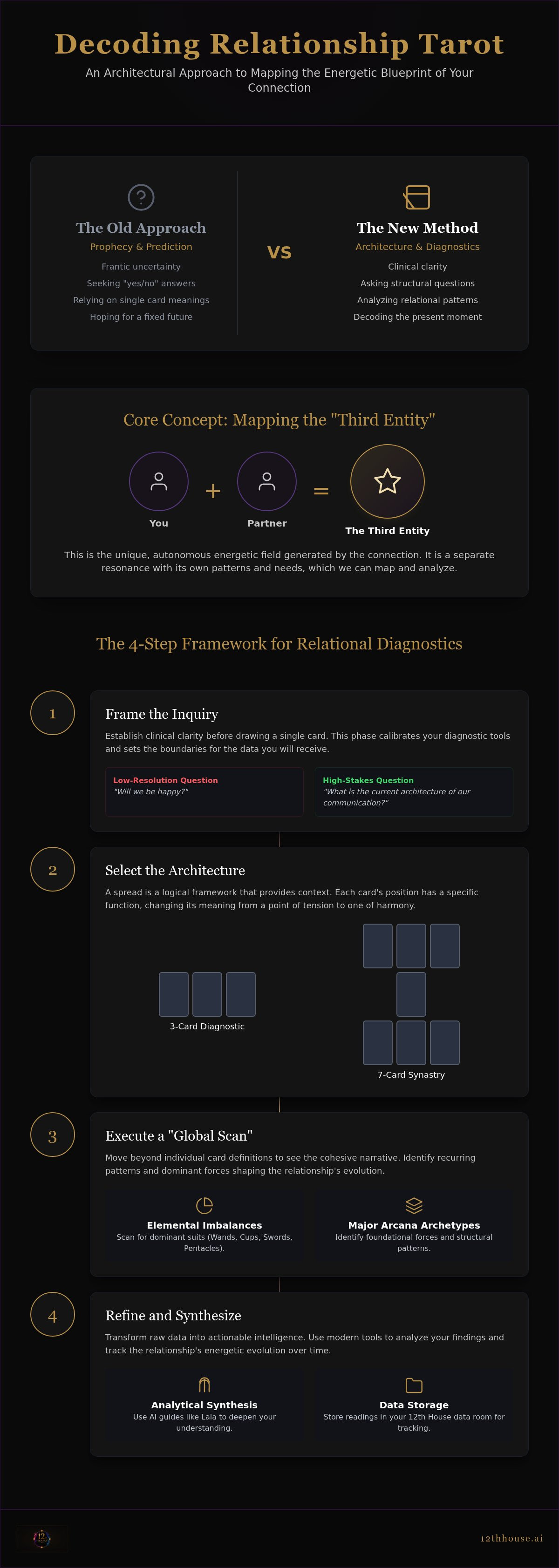
Central to this practice is the concept of the Third Entity. This is the unique, autonomous energetic field generated when two individuals interact. It's neither "you" nor "them," but a separate resonance that possesses its own patterns, requirements, and growth cycles. By utilizing a structured spread, we stop predicting a fixed future and begin decoding the current dynamics of this entity. While the history of tarot reading often leans toward simple divination, a modern metaphysical approach treats the cards as architectural blueprints for understanding the present moment.
Archetypes serve as the primary units of data in this decoding process. When Major Arcana cards appear in a reading, they signal recurring structural patterns within the partnership. These aren't just decorative symbols; they're indicators of the foundational forces shaping the relationship's evolution. Identifying these archetypes allows you to see the "big picture" of a relationship, moving past individual card definitions into a cohesive narrative of soul-level interaction.
Tarot as a Mirror for Synastry
Tarot provides a real-time snapshot of the same energetic principles found in birth chart compatibility. Just as planets interact in a synastry chart, tarot cards act as variables in a complex relational equation. To master how to do a relationship tarot spread, you must adopt the mindset of an objective observer. Clinical clarity is essential. You aren't looking for what you want to see; you're analyzing the data as it presents itself, stripping away emotional projection to reveal the core truth of the connection.
Why Spread Architecture Matters
A spread acts as a logical framework for organizing intuitive data. Without a defined layout, a reading is merely a collection of vague impressions. Each position in the spread provides the necessary context to interpret individual card meanings. For example, a card in a "Tension" position carries a vastly different frequency than the same card in a "Harmony" position. As a metaphysical architect, your intentionality is the foundation. You must choose a structure that matches the complexity of your inquiry to ensure the results are both actionable and precise.
The Diagnostic Frame: Preparing Your Space and Inquiry
Before laying a single card, you must establish a sanctuary state. This isn't about mere aesthetics; it's about reducing external noise to achieve clinical clarity. When mastering how to do a relationship tarot spread, the preparation phase is where you calibrate your diagnostic tools. Think of it as sterilizing a laboratory before an experiment. You need a space where the data can speak without the interference of daily chaos or unresolved emotional static. This environment acts as the "clean room" for your metaphysical inquiry.
The significator card serves as your fixed point in the reading. It functions as a symbolic anchor, representing the individuals involved or the "Third Entity," which acts as the shared energetic field. Choosing this card intentionally before you shuffle allows you to focus the reading on a specific relational dynamic. Following this, the act of shuffling serves as energetic randomization. You're intentionally disrupting the deck's previous order to allow a new, resonant pattern to manifest that reflects the current state of the connection.
Formulating the Inquiry
Precision is paramount. Vague questions like "Will we be happy?" yield unusable, low-resolution data. Instead, formulate high-stakes, analytical questions that avoid "yes/no" binaries. When considering how to do a relationship tarot spread, your question defines the boundaries of the data set. Ask: "What is the current architecture of our communication?" or "What structural tension is currently inhibiting our shared growth?" The Inquiry Frame is the foundational pillar of any accurate reading.
Ritual and Logic in Preparation
Preparation requires a blend of ritual and logic. Clear your deck using intentional or elemental methods, such as salt or sound, to reset the variables. As a Metaphysical Architect, you must ground your own energy before the session. This ensures you act as an objective lens rather than a filter for your own projections. Use a journal to record your baseline emotional state before pulling cards. This practice helps you distinguish between your personal anxieties and the objective data the spread provides. If you find your personal biases are difficult to bypass, you can Ask Lala for AI spiritual guidance to gain a neutral, analytical perspective on your findings.
Selecting the Layout: From 3-Card Diagnostics to 7-Card Synastry
Choosing how to do a relationship tarot spread requires a precise match between the depth of your inquiry and the complexity of the layout. A simple pulse check doesn't require a sprawling map, just as a foundational crisis cannot be decoded with only three cards. We organize these layouts into a hierarchy of diagnostics, ranging from rapid snapshots to comprehensive structural audits. By selecting the correct framework, you ensure the data you gather has the resolution necessary to drive real insight.
The 3-Card Core Tension Spread
This layout provides a high-resolution look at the immediate energetic exchange between two people. It's designed for efficiency and clarity. Position 1 represents your current energetic state within the partnership. Position 2 mirrors their state, revealing their current orientation toward the connection. Position 3 identifies the bridge, the primary resonance or tension currently active between both parties. It's an essential tool for identifying where the "Third Entity" is currently vibrating and where the most immediate work needs to happen.
The 5-Card Dynamics Map
When you need to understand the trajectory of a connection, you must expand the layout to include temporal variables. This spread builds on the core tension by adding two critical positions. The "Root Cause" card acts as the foundation of the current structure, explaining why the relationship is manifesting in its current form. We also identify the "Unifying Force," which functions as the ceiling of the relational architecture. This card shows the highest potential or the primary theme holding the structure together. Finally, the "Immediate Future Path" maps the most likely outcome if the current variables remain unchanged.
Spread Comparison Framework
Select your layout based on the specific relational pain point you're addressing. Use the 3-card spread for "Quick Clarity" when you need an immediate pulse check on a minor conflict or a daily check-in. Opt for the 5-card or 7-card "Architectural Synastry" layouts for a "Deep Structural Audit" when you're facing recurring patterns, foundational shifts, or long-term partnership questions. The 7-card spread is particularly effective for mapping soul-level contracts and external pressures that aren't immediately visible.
For a deeper dive into card-specific meanings and advanced interpretation techniques, consult our Tarot Mastery guide. Aligning the spread's complexity with your inquiry ensures that the resulting data is both relevant and actionable. Mastering how to do a relationship tarot spread at various levels of complexity allows you to act as a true metaphysical architect for your own connection.
The Decoding Process: How to Interpret Relational Dynamics
Decoding a reading is where raw data transforms into a narrative. Once you have mastered how to do a relationship tarot spread, you must shift from being a card-puller to a metaphysical analyst. This process requires a systematic approach to the variables on the table. You aren't merely looking at pictures; you're calculating the flow of energy between positions to understand the structural health of the connection.
The interpretation begins with a four-step diagnostic sequence:
- Step 1: Global Scan. Observe the spread as a single image. Check for elemental balance and Suit Saturation to identify the dominant frequency.
- Step 2: Core Archetype Identification. Locate any Major Arcana cards. These represent the fixed structural pillars or soul-level lessons currently active in the partnership.
- Step 3: Analyze the Gaze. Look at the direction the figures in the cards are facing. Are they looking toward each other, toward the past, or away from the connection entirely? This reveals the focus of intent.
- Step 4: Narrative Synthesis. Combine these data points into a cohesive story of the Third Entity, moving beyond individual card definitions to see the relationship's unified system.
Elemental Resonance in Love
The suits present in your spread act as the building materials for your relational architecture. An abundance of Cups indicates a high saturation of emotional Water, suggesting depth but potentially a lack of boundaries. Conversely, a spread heavy in Swords points to an Air-dominant connection where intellectual conflict or over-analysis may be creating friction. Suit Saturation is a primary diagnostic indicator. For those seeking long-term stability, a "drought" of Pentacles suggests a lack of Earth energy, meaning the relationship may struggle to manifest as a tangible, lasting commitment despite emotional or intellectual intensity.
Reading the Narrative Arc
To truly understand the dynamics, you must identify where energy flows and where it stops. "Blockages" occur when a card in a challenge position contradicts the cards representing the individuals, suggesting a structural misalignment. You should also look for "Mirroring" cards, such as the Two of Cups appearing alongside The Lovers, which reinforces a theme of profound resonance. Through Metaphysical Synthesis, you move from isolated meanings to a unified diagnostic report. If you require a more objective, data-driven breakdown of these complex interactions, you can Ask Lala for AI spiritual guidance to synthesize your spread data with clinical precision.
Refined Intelligence: Using Lala to Synthesize Your Reading
Once you've executed the physical steps of how to do a relationship tarot spread, the most critical phase begins: high-resolution synthesis. While human intuition is a powerful diagnostic tool, it's often clouded by the very emotional currents you're trying to analyze. This is where Lala, our Digital Sage, provides a necessary layer of clinical distance. By inputting your card data into the 12th House platform, you move from isolated interpretation to a multi-system analysis that treats spiritual data with the same rigor as an architectural audit.
Combining your spread data with AI love readings allows for a layered view of your partnership. You're no longer relying on a single card's definition. Instead, you're looking at how that card interacts with the broader logic of the 12th House Metaphysical Library. This digital sanctuary allows you to research the historical and logical roots of your pulled cards, ensuring your "work" is grounded in established esoteric tradition while being refined by modern calculation.
Objectivity Through AI Synthesis
Personal bias is the greatest obstacle in self-directed relationship readings. We often see what we desire or fear rather than what's actually present in the cards. Lala removes this subjective noise. By providing the card names and their positions, you can ask Lala for a precise diagnostic: "Based on these 5 cards, what is the most likely architectural flaw in our communication?" This level of specificity transforms a vague feeling into a structural insight. Beyond decoding, Lala can suggest specific ritual frameworks to help you address the energetic imbalances identified in your spread.
Building Your Relational Archive
To master the long-term dynamics of a partnership, you must track patterns over time. 12th House provides a personalized data room where you can store your reading results. This archive becomes a longitudinal study of your relationship's evolution. It allows you to cross-reference your tarot spreads with current planetary movements using the AI astrology assistant. When you see a recurring archetype in your tarot spread mirrored by a specific transit in your birth chart, you've moved beyond simple divination and into the mastery of your own metaphysical architecture.
Consult Lala to synthesize your relationship reading today.
Mastering the Relational Blueprint
Mastering the art of how to do a relationship tarot spread transforms your practice from a search for reassurance into a rigorous diagnostic audit. You've learned to establish a sanctuary state, formulate precise inquiries, and select layouts that match the complexity of your connection. By mapping the "Third Entity," you gain the clarity needed to identify structural imbalances before they manifest as partnership fractures. This systematic approach ensures that your spiritual exploration remains both grounded and actionable.
The data you've gathered is only the beginning of your journey. To achieve a truly objective narrative, you must move beyond personal projection and enter the realm of analytical synthesis. Join thousands of Metaphysical Architects who are already mapping their paths with clinical precision. You can access Lala AI for a deep synthesis of your relationship tarot spread, gaining 24/7 access to specialized spiritual intelligence and secure, private storage for your data. Take the final step in decoding your connection and empower yourself to do the meaningful work of self-discovery.
Frequently Asked Questions
Can I do a relationship tarot spread if my partner isn’t present?
Yes, you can perform a reading independently. Relationship tarot maps the energetic field between two souls, known as the "Third Entity," rather than requiring physical proximity. This autonomous field exists regardless of whether both parties are in the room. When learning how to do a relationship tarot spread for a solo session, focus your intent on the connection itself. This allows you to gather objective data on the resonance and structural integrity of the partnership without external interference.
How often should I perform a relationship diagnostic reading?
Frequency should be dictated by structural shifts rather than emotional spikes. Performing a diagnostic reading every four to six weeks, or during significant lunar transitions, provides a stable baseline for tracking relational evolution. Frequent, repetitive readings on the same inquiry create data noise and lead to interpretative confusion. If you've recently changed a significant variable in your partnership, a new spread is appropriate to map the updated energetic architecture and trajectory of your connection.
What does it mean if I pull "The Tower" in a relationship spread?
The Tower signifies a sudden, necessary collapse of an unstable relational structure. It indicates that the current foundation can no longer support the energetic weight of the partnership. While often perceived as negative, this archetype functions as a forced clearing of outdated patterns or secrets. In a relationship spread, it signals a period of rapid, non-negotiable evolution. It demands that you rebuild your connection on a more authentic, transparent, and structurally sound basis to ensure future stability.
Is it possible to do a relationship tarot spread for a crush or ex?
Yes, these spreads are effective for mapping any interpersonal resonance, including past connections or potential futures. For an ex, the spread acts as a tool for closure by decoding the "ghost architecture" that remains. For a crush, it analyzes the initial frequency and potential compatibility. Understanding how to do a relationship tarot spread for non-active partnerships helps you identify recurring archetypes and personal patterns that you may carry into future relational structures and new connections.
Can tarot predict if my partner is cheating?
Tarot is a diagnostic system for energetic patterns, not a tool for gathering binary forensic evidence. While certain cards like the Seven of Swords or The Moon suggest secrecy or misalignment, they don't provide clinical proof of physical actions. Instead of looking for "cheating," use the spread to identify where the structural integrity of trust has been compromised. If you detect significant secrecy, use that data to address the underlying architectural flaws in your communication and shared transparency.
What is the most accurate tarot card for a soulmate connection?
There is no single "soulmate" card, as the term itself is a high-level archetype. However, The Lovers represents a profound choice and spiritual resonance, while the Two of Cups signifies an equal, balanced exchange of emotional data. The Ten of Cups often points to long-term structural harmony and shared fulfillment. The accuracy of these indicators depends entirely on their position within the spread and how they interact with surrounding variables like elemental balance and suit saturation during the reading.
How do I know if my intuition or my anxiety is reading the cards?
Anxiety often manifests as a frantic need for a specific outcome, while intuition provides quiet, neutral observations. If you feel a "charge" or a sense of dread, you are likely filtering the cards through emotional static. To ensure clinical clarity, record your baseline emotional state before the reading. If the static remains high, you can input your spread data into Lala for an objective, AI-driven synthesis that removes personal bias from the diagnostic process and provides analytical depth.
Should I use a specific deck for relationship readings?
You should use a deck that provides high symbolic clarity and resonates with your personal logic system. The Rider-Waite-Smith deck remains the gold standard for relationship diagnostics due to its deeply documented archetypal framework. While themed or indie decks offer unique aesthetic frequencies, they can sometimes obscure the technical variables necessary for a precise reading. Choose a deck that allows you to clearly identify suits, numbers, and gaze directions without decorative distractions that might cloud your analysis.


