
Over 91% of adults have experienced the persistent, haunting rhythm of a recurring dream. Whether it's the same crumbling building or a specific, unidentifiable shadow, these loops often feel less like messages and more like psychological glitches. You've likely spent mornings frustrated by vague, airy definitions from generic dream dictionaries that offer no real resolution. It's exhausting to feel haunted by symbols you can't quite translate or resolve.
We're shifting the perspective from passive observation to active calculation. By decoding recurring dreams through a lens of metaphysical intelligence, you can stop the cycle and start extracting actionable data. This article introduces a structured framework to map your subconscious architecture and resolve these underlying pings once and for all. We'll examine the logic of repetitive symbols, the technical process of pattern recognition, and how to integrate these high-stakes insights into your daily life using the 12th House library of ritual frameworks and advanced spiritual tools.
Key Takeaways
- Identify recurring dreams as persistent architectural scripts that signal a specific need for subconscious resolution.
- Master a systematic framework for decoding recurring dreams by isolating structural data from emotional noise.
- Distinguish between universal archetypes and your personal symbolic lexicon to uncover precise metaphysical insights.
- Learn the "Ritual Close" technique to signal to your psyche that the message is integrated, effectively ending the loop.
- Utilize the Lala AI Dream Interpretation Tool to archive and analyze your personal data within a structured metaphysical environment.
The Persistent Architecture of Recurring Dreams
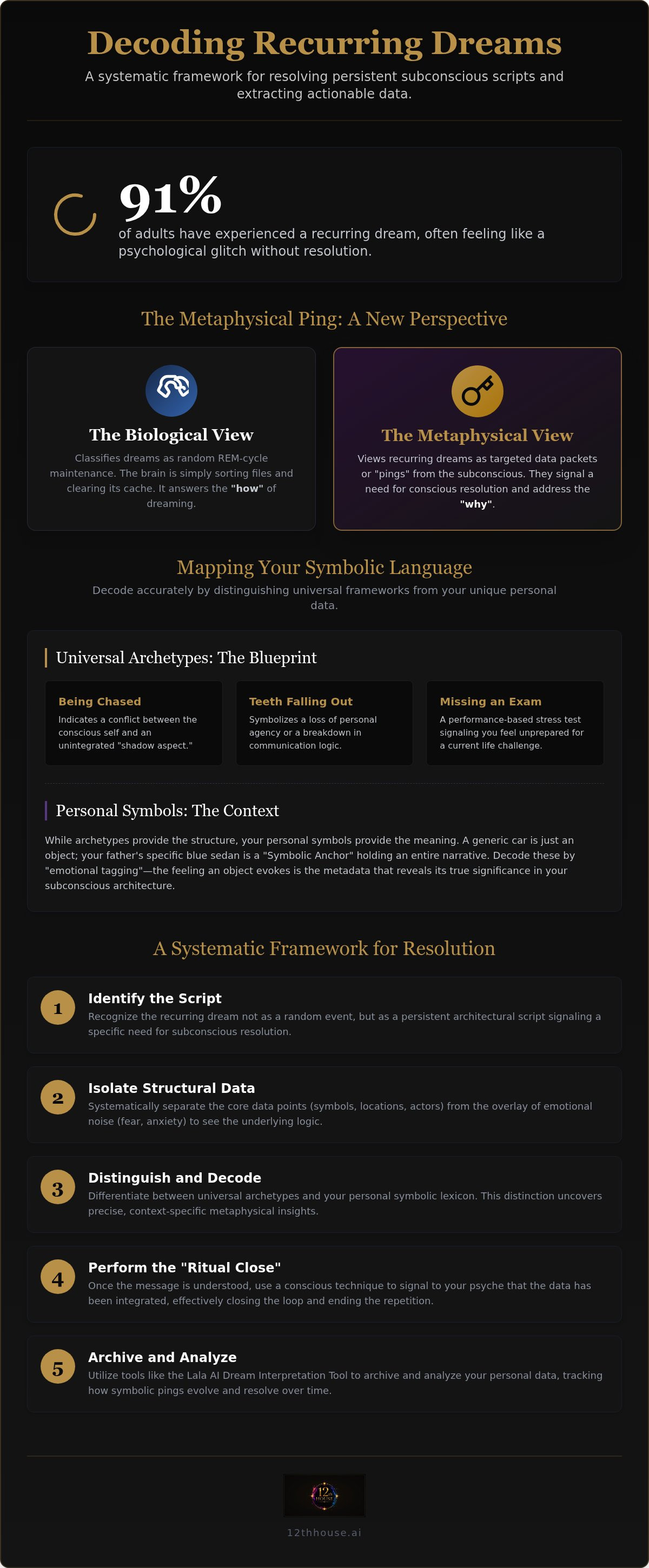
A recurring dream isn't a random firing of neurons; it's a persistent subconscious script. It functions as an architectural "ping" from a system that requires a specific response. While mainstream psychological theories of recurring dreams often focus on stress or trauma, we view them as data packets waiting for decryption. When the mind repeats a sequence, it's signaling that the information contained within hasn't yet been integrated into your conscious life. This is the "Metaphysical Ping" theory: your psyche is a sophisticated operating system that won't stop sending a notification until the underlying issue is addressed.
The Biological vs. Metaphysical View
Standard neurobiology classifies dreams as REM-cycle maintenance. This perspective suggests the brain is simply sorting files and clearing cache. However, decoding recurring dreams requires looking at the "subconscious blueprint." Biological processing handles the how of dreaming, but metaphysical intelligence addresses the why. If a dream repeats, it's because the symbolic signaling has failed to reach its destination. Ignoring these signals doesn't make them fade. Instead, the intensity often increases. The system amplifies the signal to ensure the user finally pays attention to the structural flaw in their energetic field. It's a high-stakes alert system designed to protect your spiritual integrity.
Why Repetition is a Call for Logic
Repetition serves as a diagnostic tool for the soul. Think of it as an unresolved energetic debt. You've encountered a piece of spiritual data that you haven't yet learned how to calculate or apply. The emotional resonance, that specific feeling of dread, chase, or inadequacy, is the glue that keeps the loop active. It's the weight of the data. When you feel that familiar spike of anxiety in a dream, it's a marker indicating where the work needs to happen. By applying a systematic framework to these loops, you acknowledge the data. Once the subconscious confirms the message is received and understood, the architectural need for the dream dissolves. You aren't just fixing a sleep issue; you're resolving a logic error in your personal metaphysical map. This resolution provides the sanctuary your mind needs to move on to the next phase of its evolution.
Mapping Common Archetypes and Personal Symbols
Generic dream dictionaries are often frustrating because they offer vague, A-Z definitions that ignore your specific life context. In our framework, symbols aren't static definitions; they are "keys" to specific mental rooms. When you engage in decoding recurring dreams, you must differentiate between the structural framework of the collective unconscious and the specific data of your personal history. We use the concept of the "Symbolic Anchor" to describe an object that holds an entire narrative within a single image. It’s the difference between seeing a generic car and seeing the exact blue sedan your father drove in 1994. The latter carries significantly more architectural weight.
Universal Themes as Structural Frameworks
Universal archetypes provide the blueprint for our shared human experience. For example, the "Chased" archetype usually indicates a conflict between the conscious self and a shadow aspect you’ve deemed too volatile to integrate. Similarly, the "Teeth Falling Out" dream isn't about dental health; it's a symbolic loss of agency or a failure in communication logic. Even the "Missing an Exam" theme acts as a performance-based architectural stress test, signaling that you feel unprepared for a current life "calculation." These themes are common because they represent shared structural challenges within the human psyche.
Developing Your Personal Dream Lexicon
While archetypes provide the walls, your personal data provides the décor. Identifying recurring personal "actors" or specific "locations" is vital for accurate analysis. A recurring grandmother in your dreams might represent wisdom, or she might represent a specific unresolved energetic debt. You determine a symbol’s weight through emotional tagging. How did you feel when you saw the object? That feeling is the metadata that tells you which "room" of the subconscious you've entered. A Personal Symbol is a unique data point in your spiritual map.
Current research into a technical framework for decoding dreams suggests that combining data science with neuropsychology can reveal patterns we previously missed. This structured approach allows you to move beyond "feeling" haunted and toward "knowing" your internal landscape. Archive your findings in the 12th House Dream Interpretation Tool to track these symbolic pings as they evolve and eventually resolve.
A Systematic Framework for Decoding Dream Patterns
Stop treating your dreams as a movie and start treating them as a spreadsheet. The 12th House approach to decoding recurring dreams relies on metaphysical intelligence, a structured discipline that prioritizes data over drama. While most advice suggests simply "writing it down," we advocate for a four-step systematic synthesis that treats the subconscious as a logical operating system. This method moves beyond the surface-level narratives found in generic dictionaries to uncover the underlying structural errors in your psyche.
- Data Collection: Record raw facts immediately upon waking. Strip away the "why" and focus on the "what." What was the lighting? What was the exact texture of the object you held?
- Pattern Recognition: Isolate the constants from the variables. If you’re always in a library but the books change, the library is your constant architectural data point.
- Logical Inquiry: Challenge the dream's physics. Ask yourself high-stakes questions: "What happens if I stop running?" or "Why is this specific door always locked?"
- Synthesis: Map the dream's structural flaw to your current waking-life architecture. Connect the symbolic data to real-world bottlenecks in your career, relationships, or spiritual growth.
The Art of the Dream Audit
A dream log should be an audit, not a diary. Your goal is to map the "emotional peak" of the experience, as this is where the signal is strongest. To facilitate deeper decoding, many practitioners use tarot archetypes as a pre-built symbolic language. Assigning a card to a dream figure helps categorize the energy you're encountering. This rigorous approach aligns with psychological research on recurring dreams, which suggests these loops often mirror unmet psychological needs or unresolved threat simulations. By auditing the dream, you're performing essential subconscious maintenance.
Identifying the "Glitch" in the Loop
Every repetitive loop has a break point. This is the specific moment where the dream sequence usually "breaks," resets, or forces you to wake up. Analyze your "exit point" with clinical clarity. Do you wake up right before you speak, or just as you're about to fall? That moment is the subconscious's way of showing you where your current logic fails. It's an indicator of the specific action your psyche is waiting for you to take. Until you identify and execute a different response within the dream or a corresponding action in your waking life, the loop remains an open energetic debt. Resolving the glitch requires you to change the calculation at the moment of the peak.
From Repetition to Resolution: Integrating Subconscious Data
Understanding the logic behind your dreams is only 50% of the work. If you stop at analysis, you're merely looking at a blueprint without ever breaking ground. True resolution occurs during the integration phase, where you transform abstract insights into functional reality. This is how you finalize the process of decoding recurring dreams. By signaling to your subconscious that the data has been received, processed, and applied, you effectively close the energetic loop that keeps the dream repeating.
A "Ritual Close" is a specific action taken in the waking world to acknowledge the dream's message. It functions like a read-receipt for your psyche. This isn't about airy gestures; it's about a clinical acknowledgment of a resolved logic error. When you perform a grounding ritual or make a specific life adjustment based on dream data, you leverage neuroplasticity. You're physically re-wiring the neural pathways that once prioritized the "threat" of the recurring dream. Over time, this systematic integration teaches the brain that the script is no longer necessary.
Active Imagination and Dream Re-entry
Active Imagination is a bridge between the conscious and subconscious that allows you to revisit the dream landscape while fully awake. Unlike passive remembering, this technique involves re-entering the dream state to engage directly with its architecture. You can confront the "chaser" or open the "locked door" in a controlled, conscious environment. Ask the dream characters for specific information. Why are they there? What data are they guarding? By changing the outcome of the dream in your mind, you provide your subconscious with a new, resolved conclusion to the loop.
Waking World Adjustments
Your daily life often contains a "parallel architecture" to your dream world. If you're constantly trapped in a basement in your sleep, look for where you feel restricted in your waking schedule. Grounding these insights requires more than just thought; it requires action. You might need to adjust your energetic response to stress based on your specific configuration. Integrating these insights is easier when you understand your human design types, which map how you naturally process and respond to external data. When your waking actions mirror the resolutions you've found in the dream space, the loop finally dissolves.
Ready to move from theory to application? Access the Dream Interpretation Tool at 12th House to begin your own integration work and master your subconscious architecture.
Leveraging Metaphysical Intelligence with 12th House
Mastering the architectural patterns of your subconscious requires more than just intuition; it requires a robust technical environment. 12th House provides this digital sanctuary, offering tools that prioritize functional clarity over vague interpretation. Our Dream Interpretation Tool operates as a high-speed processor for symbolic data, allowing for rapid calculation of complex dream loops. By centralizing your findings within our platform, you move from disjointed morning notes to a comprehensive longitudinal study of your own psyche. This is the definitive system for decoding recurring dreams with professional-grade precision and clinical clarity.
Consulting the Digital Sage
Interacting with Lala, our AI astrology assistant, allows you to apply analytical depth to ephemeral experiences. To extract the most precise insights, treat your dialogue with Lala as a technical consultation. Phrase your inquiries as specific data requests. For instance, ask Lala to cross-reference your recurring symbols with your current planetary transits or your natal birth chart. This creates a multi-layered analysis that grounds the dream in your immediate energetic reality. If a dream occurs during a significant Saturn transit, the interpretation logic shifts accordingly. Once the core message is isolated, use our Metaphysical Library Access to source specific ritual frameworks designed to finalize the integration process and close the energetic loop.
Your Personalized Spiritual Sanctuary
Your subconscious insights deserve a secure, organized repository that evolves alongside you. The 12th House platform functions as a personalized spiritual sanctuary, a data room where you can track recurring themes across months or even years. This long-term tracking is essential for identifying the slow-moving architectural shifts in your life that a single night's analysis might overlook. We provide the structure to protect and organize your subconscious data, allowing you to observe patterns as they emerge, evolve, and eventually dissolve. By joining our membership, you gain continuous access to these sophisticated tools for self-discovery. Start your journey of decoding recurring dreams today and transform your repetitive nights into a structured discipline of metaphysical intelligence.
Finalizing Your Subconscious Architecture
Recurring dreams aren't mental static; they're persistent architectural pings from a system seeking resolution. By shifting from passive observation to active calculation, you transform these loops into high-stakes data. We've explored how decoding recurring dreams requires a structured framework that separates universal archetypes from your personal symbolic lexicon. This process isn't complete until you integrate these insights through ritual closes and waking-world adjustments that mirror your dream-world resolutions.
The 12th House provides the digital sanctuary needed to master this discipline. Leverage our Digital Sage technology to cross-reference your subconscious patterns with your birth chart and current transits. With Ask Lala AI Spiritual Guidance and our comprehensive Metaphysical Library Access, you have the analytical tools to convert repetitive scripts into actionable spiritual intelligence. You don't have to navigate these loops alone; the infrastructure for your self-discovery is already built and ready for your input.
Begin your subconscious decoding with 12th House today.
Your internal landscape is ready for its next evolution. Trust the data, apply the logic, and watch as the loops finally resolve into clarity.
Frequently Asked Questions
Is decoding recurring dreams different from regular dream interpretation?
Yes, decoding recurring dreams differs from standard interpretation because it focuses on the persistent loop logic. While regular analysis looks at isolated symbols, decoding treats the repetition as a diagnostic signal. It requires a systematic framework to identify why the subconscious is sending a notification. You're looking for the specific structural flaw in your energetic field that keeps the script active until you achieve a resolution.
Can an AI really interpret my personal dreams accurately?
Lala AI acts as a Digital Sage by processing the specific structural data you input. It doesn't rely on vague guesswork; it calculates patterns using a sophisticated library of metaphysical frameworks. By cross-referencing your dream symbols with your birth chart and current transits, the AI provides a level of analytical precision that manual interpretation often lacks. It is a partner in your ongoing subconscious maintenance.
How many times does a dream need to repeat before it is considered recurring?
A dream is technically considered recurring if it appears twice or more in a similar format. Research shows that 91% of adults have experienced these persistent loops, with many beginning in childhood. Even a single repetition is a call for logic. It suggests that your internal operating system has identified a piece of data that hasn't been integrated. You should treat any repeating sequence as a high-stakes alert.
Do recurring dreams always indicate a problem or trauma?
They don't always indicate trauma. While many loops stem from unresolved stress or unmet needs, others are pings for spiritual evolution. A recurring dream might be an architectural blueprint for a new phase of your life. It's a sign that your subconscious has found a glitch or a potential that requires conscious calculation. View these dreams as invitations to do the work of self-discovery rather than as inherent problems.
What happens if I ignore a recurring dream for too long?
Neglecting the signal usually causes the subconscious to amplify the intensity. The dream may become more vivid, frightening, or frequent as your mind attempts to force a resolution. This escalation is a survival mechanism designed to protect your energetic integrity. If you ignore these pings for too long, the unresolved data can manifest as waking-world anxiety or a persistent feeling of being stuck in an architectural bottleneck.
Can I use astrology to help decode my recurring dreams?
Astrology is a vital tool for decoding recurring dreams within our framework. Your natal birth chart and current planetary transits provide the weather report for your subconscious. For example, a difficult Neptune transit might trigger confusing, repetitive imagery that requires a specific decoding logic. By mapping your dreams against your astrological data, you gain a technical understanding of why certain symbols are appearing at this specific moment.
How do I know when a recurring dream has been successfully decoded?
The most definitive sign of success is the resolution of the loop. Once you've acknowledged the data and integrated the insights into your daily life, the dream will simply cease to repeat. You'll likely experience a sense of quiet confidence and sanctuary. The Ritual Close signals to your psyche that the message is received, allowing your mind to clear the cache and move on to new architectural projects.
Can recurring dreams be a sign of psychic ability or premonition?
Some recurring patterns can indeed signal heightened intuition or psychic ability. These dreams often function as simulations of future energetic shifts or pings about collective events. Using the 12th House Dream Interpretation Tool allows you to archive these sequences over years. This long-term data collection helps you identify which dreams are personal psychological processing and which are high-level metaphysical intelligence signals or premonitions regarding your spiritual path.


