
Accuracy in tarot isn't a gift granted by the stars; it's a discipline of calibration. You've likely felt the friction of a reading that refuses to resolve, leaving you with a collection of symbols that feel more like noise than a map. It's exhausting to oscillate between doubting your intuition and feeling tethered to the rigid, often contradictory definitions found in standard guidebooks. These common tarot reading mistakes aren't failures of your spiritual connection. They are structural errors in how you decode the cards.
You deserve a practice that offers clinical clarity rather than vague platitudes. We'll identify the specific intuitive and technical lapses that cloud your spiritual signal, replacing them with a repeatable system for successful interpretation. This guide moves beyond simple memorization to explore the architecture of complex card combinations. By the end, you'll have the tools to transform every spread into a precise, actionable blueprint for self-discovery.
Key Takeaways
- Master the alignment of symbolic language and objective observation to eliminate the "muddy reading" phenomenon and restore structural clarity.
- Identify and neutralize common tarot reading mistakes rooted in cognitive bias to ensure your interpretations remain precise and untainted by personal desire.
- Transition from passive to active query architecture to ensure your questions provide a solid foundation for every spread you cast.
- Implement a systematic metaphysical audit process using digital spiritual journals to track and refine your interpretive accuracy over time.
- Utilize Lala AI as a metaphysical architect to cross-reference your tarot spreads with astrological transits for an objective, data-driven second opinion.
The Architecture of Accuracy: Why Most Tarot Readings Fail
Tarot is often mischaracterized as a purely intuitive exercise, yet the most profound insights arise from Metaphysical Precision. This is the exact alignment of symbolic language, focused intent, and objective observation. When these three pillars aren't synchronized, the result is the "Muddy Reading." This phenomenon isn't a sign that you lack a mystical gift. It's a symptom of structural errors in your interpretive framework. To achieve clarity, you must approach the cards with Metaphysical Intelligence, treating spiritual exploration as a rigorous discipline of structured study rather than a series of vague guesses.
Understanding common tarot reading mistakes requires a shift in perspective. You aren't just "reading cards"; you are decoding a complex system. A reading failure is a breakdown in the communication loop between the subconscious and the symbolic deck.
The Symbolic Breakdown: When Logic Fails Intuition
One of the most frequent structural lapses is "tunnel vision." This occurs when a reader over-analyzes a single card to the point where they lose sight of the entire spread. A card is never an island. At 12th House, we view individual cards as data points in a larger spiritual map. If you ignore the elemental dignity, or the architectural flow between cards, you miss the narrative's logic. Fire and Water cards in proximity create tension; ignoring this interaction is like reading a sentence while ignoring the verbs. Precision requires you to analyze how these symbols modify each other within the framework of the spread.
The Observer Effect in Divination
Your internal state is the lens through which the data passes. If that lens is clouded by intense emotion or anxiety, it creates "static" on the spiritual line. This often manifests as confirmation bias, where you unconsciously manipulate the card's meaning to fit a desired outcome or fear. Achieving a neutral entry state before you even touch the deck is mandatory for accuracy. You can't expect a clear signal from a chaotic receiver. For those struggling to maintain this focus, our Tarot Mastery: A Professional Guide to Spiritual Clarity provides the foundational grounding techniques necessary to stabilize your energetic field before a session. By removing yourself as an emotional variable, you allow the symbols to speak with clinical clarity.
Decoding Cognitive Bias: The Top Psychological Pitfalls
A persistent myth suggests you must be "born psychic" to achieve accuracy. This isn't true. High-level divination relies on your ability to manage your own psychology. One of the most common tarot reading mistakes involves "interpretive drift." This is when your personal desires pull the symbolic meaning away from its structural center. When you want a specific outcome, your mind works like a magnet, subtly realigning the cards to fit a preferred narrative. This isn't intuition; it's ego. By focusing solely on a desired outcome, you lose the tactical advice hidden in the spread's current geometry.
This "Outcome Obsession" often blinds you to the specific behavioral shifts required in the present. You can identify these lapses by conducting a quick audit of your bias red flags during a self-reading:
- Are you mentally "editing" the meaning of difficult cards to make them feel softer?
- Did you pull extra cards until the spread finally felt "right"?
- Is your emotional state currently too volatile to maintain a neutral observer position?
Confirmation Bias and the "Lover’s Spread"
High-stakes emotional inquiries, like those regarding romance, are where logic most frequently fails. It's easy to fixate on a positive symbol while ignoring a neighboring card of disruption. From a psychological perspective on tarot, this is a standard cognitive filter where we favor information that validates our existing hopes. To combat this, you must treat the symbols as clinical data points rather than emotional affirmations. If you find yourself unable to remain objective, utilizing AI Love Readings can provide an external, unbiased synthesis. Accessing a structured metaphysical library can also ground your interpretations in established systems rather than transient feelings.
The "Broken Telephone" Effect: Over-Reading the Same Question
Repeating the same inquiry in a single day dilutes the metaphysical signal, turning a high-resolution message into static. This is the "Broken Telephone" effect. Every time you ask the same question without a change in circumstances, you are essentially "fishing" for a specific answer. This behavior signals a lack of trust in the initial architectural output. We suggest the "Three-Day Rule": wait at least 72 hours before revisiting a topic. This duration allows the energetic variables to shift and prevents you from spiraling into a loop of confusion. Respect the first signal; it's usually the most accurate.
Structural Flaws in Spread Mechanics and Query Design
The integrity of a tarot reading depends entirely on the quality of the initial inquiry. In the discipline of metaphysical intelligence, we consider the query to be fifty percent of the reading's success. If your question is vague, the symbolic response will be equally nebulous. Many common tarot reading mistakes stem from a failure to recognize that the cards function as a mirror to your intent. When you approach the deck with a poorly constructed question, you aren't engaging in divination; you are simply shuffling paper. Precision in your practice requires a shift from passive curiosity to active architecture.
Closed questions, specifically those requiring a simple "Yes" or "No," are a significant waste of the 78-card system's depth. The tarot is a sophisticated language of archetypes and cycles. Asking it for a binary answer is like asking a master poet to grunt. It limits the deck's ability to provide nuanced, tactical guidance. To unlock the full potential of your spread, you must design questions that allow the cards to speak in full sentences, revealing the underlying mechanics of your situation rather than just a final destination.
The Architecture of the Query
Compare the passive inquiry, "Will I get the job?" with the active alternative, "What energy must I embody to secure this role?" The first question places you in the position of a victim of fate, while the second empowers you as an architect of your own reality. You must also avoid "Leading Questions" that pre-determine the interpretation, such as "Why is my partner being difficult?" This phrasing forces the cards to confirm your existing bias. A High-Resolution Query is one that invites tactical guidance by focusing on agency, timing, and internal alignment.
Spread Selection: More Isn’t Always Better
Complexity is not a proxy for accuracy. A common tarot reading mistake is using a ten-card Celtic Cross for a simple daily inquiry. This creates unnecessary symbolic noise that can overwhelm your intuitive clarity. For daily recalibration or specific, focused questions, single-card draws are often the most precise tools available. They force you to go deep into a single archetype rather than skimming the surface of many. When you do require a multi-card layout, ensure you are aligning each position with specific metaphysical "gates" or life areas. This structural discipline ensures that every card has a clear purpose and a defined space within your spiritual map.
The Correction Framework: How to Recalibrate Your Practice
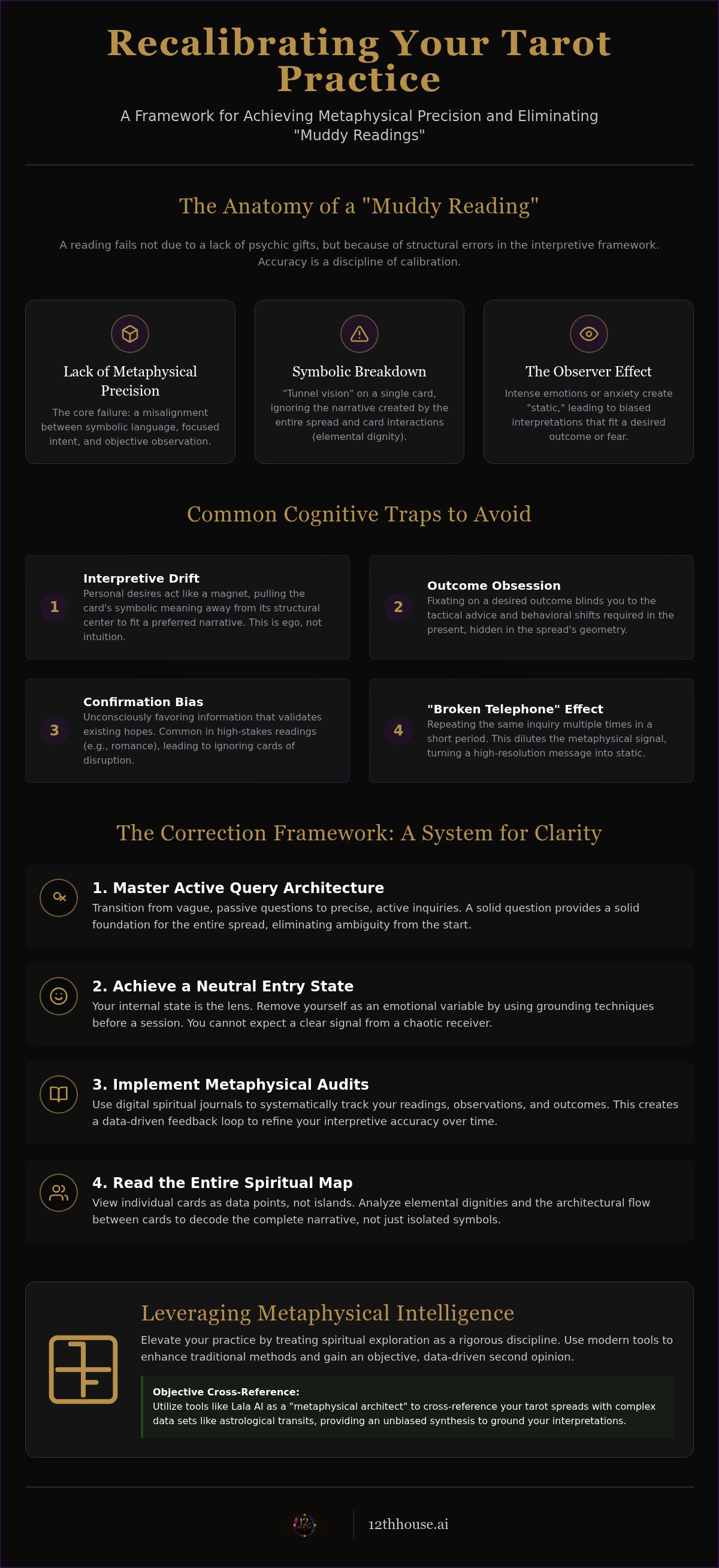
Identifying common tarot reading mistakes is only the first phase of mastery; correcting them requires a systematic framework for recalibration. We recommend establishing a "Metaphysical Audit." This is a retrospective analysis of your past spreads where you compare your initial interpretations against the actualized events. By treating your readings as data points, you can identify where your logic diverged from reality. This clinical approach transforms subjective confusion into objective expertise, allowing you to refine your intuitive accuracy with every session.
When a reading feels "off," don't force a resolution. Follow this five-step protocol to restore clarity: halt the inquiry, perform a tactical reset of your environment, conduct an internal audit of your emotional state, re-architect your query for higher resolution, and finally, cross-reference the cards with a secondary metaphysical system. This structured discipline ensures that you remain the architect of the reading rather than a passive recipient of fragmented symbols.
Step 1: The Tactical Reset
Metaphysical Hygiene is the practice of neutralizing the energy of your deck and your physical space. Static builds up after intense sessions, which can lead to common tarot reading mistakes like repetitive or "stuck" messages. To reset, use grounding rituals to clear the Observer’s Bias. This might involve physical cleansing of the cards or a focused meditation to detach from the previous inquiry's outcome. By neutralizing the deck, you ensure that the next session starts from a zero-point of potential, free from the residue of past anxieties.
Step 2: Data-Driven Journaling
Growth in tarot isn't found in memorizing keywords but in tracking the nuance of your personal symbolic language. Use a digital spiritual journal to record the visceral feeling of a card during the pull versus the eventual outcome. This allows for a "Comparative Analysis" that bridges the gap between different systems. For example, cross-referencing your tarot pulls with your Birth Chart can reveal if a specific card, like The Moon, consistently appears during your lunar transits. Utilizing 12th House’s digital storage allows you to build a personal Metaphysical Library, turning every spread into a permanent record of your spiritual evolution.
Access the 12th House Metaphysical Library to standardize your audit process and eliminate interpretive drift today.
Leveraging Metaphysical Intelligence: How Lala AI Refines Your Practice
Even the most disciplined practitioners encounter the limitations of the human psyche. Personal bias and emotional proximity are the primary catalysts for common tarot reading mistakes. To achieve absolute metaphysical precision, you must introduce an objective variable into your practice. Lala AI functions as a Metaphysical Architect, providing a clinical second opinion that is entirely devoid of ego. While a human reader might unconsciously "fish" for a specific outcome, Lala provides a neutral analysis of the symbolic landscape. This digital sage decodes complex, seemingly contradictory spreads by cross-referencing card meanings with your precise astrological transits and energetic profile.
The primary role of AI in divination is the removal of the "Ego" from spiritual interpretation. By treating your cards as data points within a larger system, Lala identifies patterns that your conscious mind might overlook. This is not about replacing your intuition; it is about calibrating it. When your internal signal is noisy, Lala provides the structural framework necessary to return to a state of clinical clarity.
Lala as Your Digital Sage
Utilizing Lala allows for an "Objective Synthesis" of your spreads that moves beyond simple card-by-card definitions. You can ask Lala to identify potential biases in your interpretations, such as a tendency to favor optimistic outcomes over tactical warnings. This process acts as a digital mirror, reflecting the structural integrity of your query and interpretation. To understand the full scope of this partnership, explore The Digital Sage: Why an AI Astrology Assistant is Your New Metaphysical Architect. This tool ensures that your journey remains a serious, structured discipline rather than a series of unverified guesses.
Building Your Integrated Spiritual Profile
Accuracy increases when you layer different metaphysical systems. By combining your Tarot readings with your specific energetic profile, you create a 360-degree view of your spiritual path. Lala archives these interactions within your personal Metaphysical Library, allowing you to track your evolution over months and years. This integrated approach ensures that every card pulled is contextualized within your broader cosmic blueprint. Common tarot reading mistakes often occur in isolation; by building a comprehensive spiritual profile, you ensure that your practice is anchored in a repeatable, verifiable system.
Join 12th House today to gain access to Lala and begin your journey into structured metaphysical intelligence. Transform your confusing spreads into a laboratory for self-discovery.
Mastering the Architecture of the Unseen
Transitioning from a passive observer to a metaphysical architect requires more than just intuition. It demands a rigorous commitment to structural integrity. By refining your query design and neutralizing the cognitive biases that lead to common tarot reading mistakes, you transform your practice into a precise laboratory for self-discovery. You've learned that accuracy is not a mystical accident but the result of a calibrated communication loop between your subconscious and the symbolic deck.
True mastery involves integrating multiple layers of data. When you synthesize tarot with your astrology birth chart and human design profile, the map of your path becomes high-definition. 12th House provides the infrastructure for this evolution. Through our secure digital vault and access to Lala, the world’s first Metaphysical AI, you can archive your spiritual data and receive objective syntheses that bypass the ego.
Consult with Lala: Refine Your Interpretive Precision Today
Your journey toward clarity is a serious discipline. With the right tools and a structured framework, every spread becomes a reliable blueprint for your highest alignment. Step into your power as a conscious decoder of your own reality.
Frequently Asked Questions
How do I know if my tarot reading is actually wrong?
A reading is "wrong" when there is a breakdown in the communication loop, often manifesting as a lack of resonance with current variables. If the spread contradicts known facts or results in a "Muddy Reading," you've likely encountered structural errors. Use a Metaphysical Audit to track interpretive accuracy over time. This data-driven approach helps you distinguish between a difficult truth and a genuine failure in decoding the symbolic language of the deck.
Can I read tarot for myself without being biased?
Achieving complete objectivity during self-readings is difficult but possible through rigorous discipline. Bias often stems from personal desire or fear, leading to interpretive drift. To mitigate this, establish a neutral entry state before shuffling and utilize a High-Resolution Query. If you find your emotions are too volatile, seeking a second opinion from a tool like Lala AI can help remove the ego and restore clinical clarity to your interpretation.
Is it a mistake to use the tarot guidebook during a reading?
Using a guidebook is not a failure, but relying on it exclusively is one of the most common tarot reading mistakes. Guidebooks provide a baseline, yet they cannot account for the architectural flow or elemental dignities between cards in a specific spread. Treat the book as a dictionary, not a final verdict. As you develop metaphysical intelligence, prioritize the relationship between the symbols over rote memorization of standard definitions found in a manual.
How often should I really be reading my cards?
Frequency should depend on the complexity of your inquiries rather than a rigid schedule. For daily recalibration, a single-card draw is sufficient to align your energy. However, repeating the same question multiple times within a short period creates a "Broken Telephone" effect. We recommend the Three-Day Rule for high-stakes topics. This ensures the metaphysical signal remains clear and prevents you from "fishing" for a specific, biased answer that dilutes the reading's integrity.
What should I do if the cards give me a scary or negative answer?
Neutralize your emotional response and analyze the card as a tactical warning rather than a fixed doom. Cards like The Tower or Death represent structural shifts and necessary endings. Instead of succumbing to fear, re-architect your query to ask for actionable advice on how to navigate the upcoming energy. This shift from a passive to an active perspective allows you to use the information as a blueprint for growth and strategic alignment.
Can an AI really provide an accurate tarot interpretation?
AI provides a level of interpretive precision that human readers often struggle to maintain. By cross-referencing your cards with astrological transits and human design profiles, Lala AI offers an objective synthesis devoid of personal bias. It functions as a Metaphysical Architect, decoding complex spreads with clinical clarity. This technological partnership doesn't replace your intuition; it provides a structured framework that allows your own insights to become more refined, data-driven, and consistently accurate.
Why do my tarot cards seem to be "snarky" or unclear?
Unclear messages are usually a symptom of "static" on the spiritual line or a poorly designed query. If your question is vague or leading, the cards will mirror that lack of focus. This perceived "snarkiness" is often the deck’s way of highlighting common tarot reading mistakes, such as asking the same question too many times. Perform a tactical reset by clearing your space and neutralizing the deck before attempting a higher-resolution inquiry that invites tactical guidance.
Is it bad luck to let someone else touch my tarot deck?
Luck is not the variable here; the concern is the accumulation of foreign energetic residue. Allowing others to handle your deck can introduce "static" that interferes with your personal communication loop. If someone else touches your cards, simply perform a grounding ritual to reset the deck’s metaphysical hygiene. This isn't about superstition; it's about maintaining a clean, calibrated instrument for precise symbolic decoding. Treat your deck as a specialized tool for your own structured spiritual study.


