

Your daily dread over a cryptic push notification isn't an astrological accident; it is an intentional architectural choice. When evaluating Co-Star vs The Pattern, most seekers assume they are simply comparing two digital interfaces reading the exact same sky. In truth, you are choosing between two fundamentally conflicting operating systems: raw planetary exposure versus psychologized behavioral abstraction. If you have ever felt unsettled by blunt lock-screen alerts that spark anxiety without context, or frustrated by platforms that bury actual planetary data behind black-box summaries, your skepticism is completely justified.
True self-discovery requires structured clarity, not manufactured fatalism. In this guide, you will discover the core algorithmic differences, psychological depth, and analytical strengths of Co-Star versus The Pattern, giving you an objective framework to select your ideal metaphysical system. We break down the underlying mechanics across house calculation models, relationship synastry algorithms, and transit timing cycles to reveal exactly how each platform decodes your personal blueprint.
Key Takeaways
- Understand the core architectural split between raw astronomical planetary data and behavioral psychological translation.
- Compare the technical mechanics of Co-Star vs The Pattern to evaluate how house calculations, transit tracking, and synastry engines operate beneath the surface.
- Learn why The Pattern abstracts traditional astrological terminology into interpersonal timing cycles and relational bonds.
- Identify the psychological limitations of passive, static daily notifications when confronting complex life transitions.
- Gain a structured framework to determine whether traditional chart scaffolding or therapeutic behavioral mapping best serves your personal growth.
The Paradigm Divide: Co-Star vs The Pattern in 2026
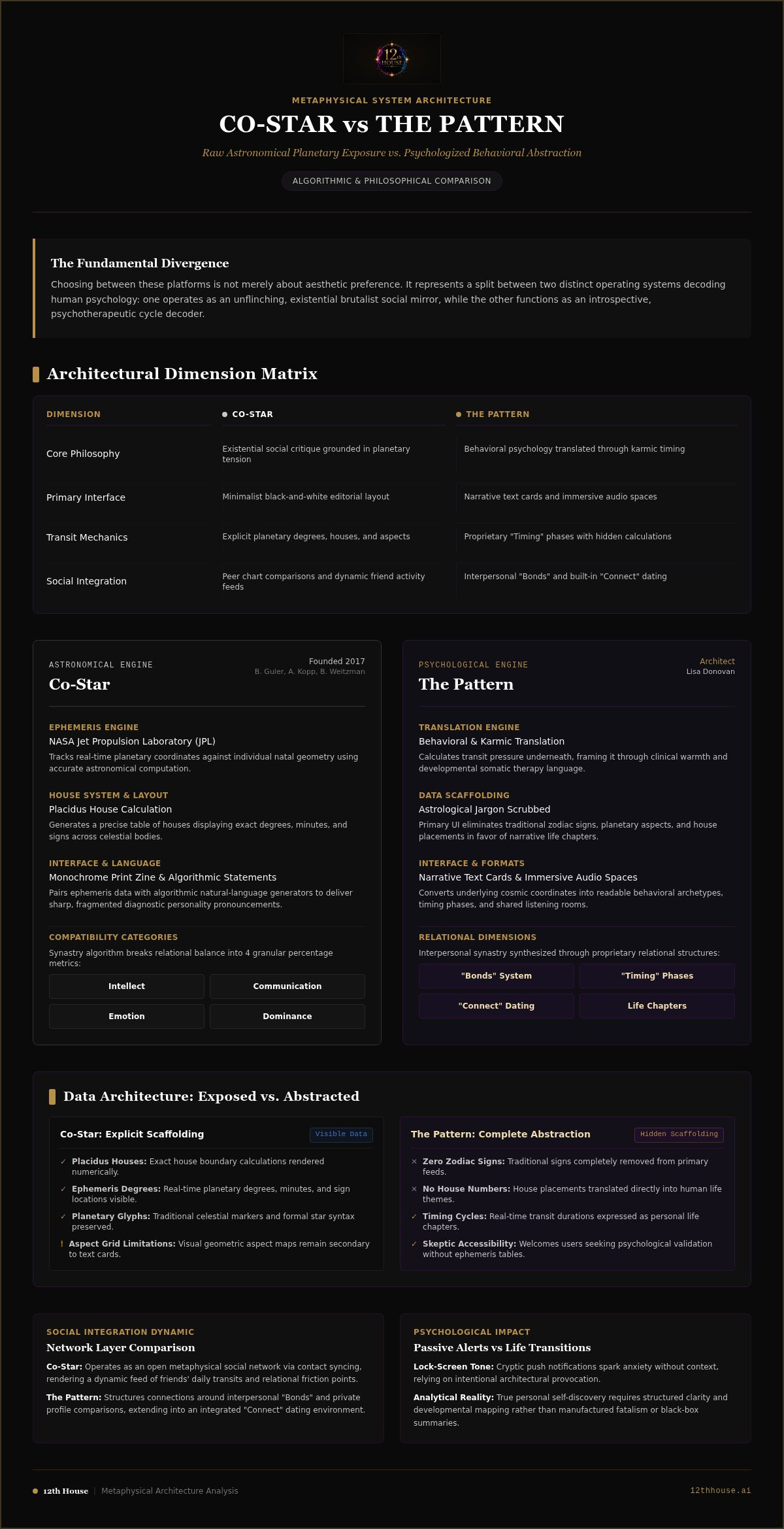
Astrology apps have permanently outgrown syndicated sun-sign columns. Today, digital metaphysical tools operate on sophisticated computational engines designed to map human psychology in real time. Yet, the debate surrounding Co-Star vs The Pattern is not merely about aesthetic preference. It represents a fundamental divergence in how esoteric mechanics are presented to the seeker. One platform acts as a brutalist social mirror; the other functions as an introspective, psychotherapeutic decoder.
| Architectural Dimension | Co-Star | The Pattern |
|---|---|---|
| Core Philosophy | Existential social critique grounded in planetary tension | Behavioral psychology translated through karmic timing |
| Primary Interface | Minimalist black-and-white editorial layout | Narrative text cards and immersive audio spaces |
| Transit Mechanics | Explicit planetary degrees, houses, and aspects | Proprietary "Timing" phases with hidden calculations |
| Social Integration | Peer chart comparisons and dynamic friend activity feeds | Interpersonal "Bonds" and built-in "Connect" dating |
The Aesthetic and Philosophical Split
Co-Star treats personal analysis as an unflinching social reality check. Drawing on a stark, zine-inspired visual framework, it delivers sharp algorithmic pronouncements that challenge your ego. The platform speaks directly to external social tension, inviting users to dissect interpersonal friction. In contrast, The Pattern, engineered by Lisa Donovan, replaces sharp edges with clinical warmth. It mirrors the language of somatic therapy, framing transit pressure not as impending doom, but as a deliberate developmental cycle.
Core Systems: Astrological Jargon vs Psychological Translation
How do you absorb symbolic data? Your answer determines your platform allegiance. Co-Star places traditional scaffolding front and center. You see your Placidus houses, planetary glyphs, and exact degrees mapped across your chart. It assumes you want to learn the formal syntax of the stars.
The Pattern does the exact opposite. It actively scrubs all astrological jargon from its primary interface. You will not find zodiac signs, planetary aspects, or house placements in its main feeds. Instead, the underlying transit calculations are translated into behavioral archetypes, life chapters, and relational bonds. This deliberate abstraction welcomes skeptics who want psychological validation without parsing ephemeris tables. For practitioners who demand visible calculations, however, that missing data structure feels like a locked door.
Co-Star Architecture: Ephemeris Data, Social Dynamics, and Algorithmic Tone
Co-Star transformed mobile astrology by treating celestial computation as an exact science layered beneath minimalist editorial design. Founded in 2017 by Banu Guler, Anna Kopp, and Ben Weitzman, the platform rejects soft cosmic imagery in favor of a stark, monochrome aesthetic reminiscent of independent print zines. Beneath this brutalist interface sits an ephemeris calculation engine powered by data from NASA’s Jet Propulsion Laboratory (JPL), tracking real-time planetary coordinates against each user's natal geometry.
Technical Precision and Chart Layout
Co-Star computes natal charts using the time-tested Placidus house system, rendering a clean table of houses that records exact planetary degrees, minutes, and signs. Co-Star directly pairs astronomical ephemeris data with algorithmic natural-language generators to synthesize fragmented diagnostic statements for every celestial body. While seasoned practitioners appreciate seeing precise natal coordinates on screen, visual aspect grids remain secondary to typographic text cards. Users receive quick, descriptive personality fragments rather than an interactive geometry map of natal sextiles or oppositions.
The Social Layer and Compatibility Metrics
Unlike solitary charting tools, Co-Star operates as a metaphysical social network. Syncing your phone contacts reveals a dynamic feed of friends' daily transits and relational friction points. Its synastry algorithm breaks compatibility down into granular categories: intellect, communication, emotion, and dominance.
These percentages provide an entertaining social snapshot, but real interpersonal synthesis requires a structural assessment of planetary cross-aspects. You can analyze the deeper mechanics of these relational geometric angles in our guide to birth chart compatibility.
Limitations of the Provocative Notification Model
Co-Star achieved viral momentum through deadpan, unsettling lock-screen alerts like "Don't pretend you're fine." These cryptic nudges grab attention, but they often trigger unnecessary anxiety without providing constructive remedies. In the broader debate over Co-Star vs The Pattern, these static alerts highlight an architectural bottleneck: one-way pronouncements offer diagnosis without dialogue. When navigating an intense personal crisis, you cannot interrogate a pre-written push notification. True metaphysical autonomy requires moving beyond passive daily alerts into responsive environments like 12th House, where conversational analysis transforms static horoscopes into an actionable personal blueprint.
The Pattern Blueprint: Psychological Cycles, Human Timing, and Translation Without Jargon
Where competitor platforms expose raw astronomical coordinates, The Pattern operates through systematic translation. Created by Pattern Home, Inc., the platform decodes exact planetary positions into an introspective psychological lexicon. Over 15 million registered profiles rely on this translation engine to map interpersonal behavior and internal growth. By stripping away esoteric symbols, the software translates ancient sky-tracking mechanics into clear, human developmental stages.
Translating Transits into Psychological Cycles
The system converts heavy planetary transits into grounded, practical cycles called "Timing." A challenging Saturn square or a transformative Pluto transit is never labeled as such. Instead, the interface introduces phases like "Emotional Restructuring" or "Major Life Pivot." Each cycle includes a clear timeline displaying its onset, peak intensity window, and eventual resolution. This structural framing helps non-astrologers prepare for prolonged energetic shifts without getting lost in technical terminology.
Relational Bonds and Synastry Analysis
Interpersonal synastry forms the platform's core analytical strength. The engine cross-references two complete natal profiles to establish specific relationship dynamics known as "Bonds." These connections receive clear qualitative ratings:
- Soulmates or Extraordinary: High harmonic resonance across core emotional and developmental vectors.
- Powerful or Meaningful: Significant transformative friction that forces mutual maturity.
- Challenging or Frustrating: Inherent psychological misalignments requiring deliberate conscious negotiation.
These designations are supported by detailed behavioral breakdowns and integrated into "Connect," the app's proprietary matchmaking ecosystem. Rather than offering basic compatibility scores, the engine diagnoses the exact friction points between two distinct behavioral patterns.
The Black Box Conundrum: Concealing the Astrological Mechanics
This heavy abstraction introduces serious analytical limitations. When comparing Co-Star vs The Pattern, seasoned researchers quickly confront The Pattern's "black box" design. By hiding planetary signs, degrees, and house positions, the platform prevents you from verifying its mathematical foundations. You cannot tell whether an "Identity Shift" stems from an incoming Uranus conjunction or a subtle progressed lunar aspect.
This opacity can also provoke unnecessary anxiety. Reading that you are entering an intense two-year emotional trial without knowing which planetary transit is active creates psychological helplessness. Static narrative paragraphs cannot capture the dynamic interplay of overlapping transits. You receive a fixed psychological diagnosis, but the underlying architectural blueprints remain hidden from your view.
Evaluating Accuracy, Relational Synastry, and Analytical Utility
Measuring utility between Co-Star vs The Pattern depends on whether you value technical transparency or behavioral synthesis. Both platforms compute natal charts from precise astronomical positions, yet their underlying calculation engines serve radically different developmental purposes. Co-Star calculates houses using the Placidus system, which creates documented distortions at extreme northern and southern latitudes. The Pattern applies its proprietary calculations invisibly, prioritizing emotional resonance over auditable mathematics.
- Co-Star Strengths: Displays explicit degree coordinates; supports quick peer comparisons; builds foundational literacy in signs, houses, and planetary aspects.
- Co-Star Vulnerabilities: Rigid Placidus house defaults; fragmented interpretive copy; limited synthesis across multiple simultaneous transits.
- The Pattern Strengths: Exceptional behavioral and psychological depth; maps multi-week transit arcs; delivers nuanced relational dynamic tracking.
- The Pattern Vulnerabilities: Zero mathematical transparency; conceals active planetary transits; risks user helplessness through deterministic phrasing.
Chart Precision vs Psychological Resonance
Co-Star provides superior technical visibility for studying birth chart architecture. Observing exact degree contacts helps you understand why specific planetary alignments trigger tension. The Pattern bypasses technical architecture entirely to articulate your internal emotional state with therapeutic precision. Many seekers run both concurrently: Co-Star provides the raw structural coordinates, while The Pattern translates the felt psychological impact of the transit.
Relational Dynamics: Friendships vs Deep Psychological Synastry
Social compatibility measures surface-level behavioral harmony across conversation styles, whereas true synastry maps the complex psychological contracts and karmic friction activated when two natal charts collide. Co-Star designs its relational layer around social networking. It delivers quick snapshots of interpersonal friction across intellect, communication, and social dynamics among friend groups.
The Pattern approaches synastry as an in-depth behavioral audit. Its bonding engine identifies unresolved subconscious patterns, attachment dynamics, and mutual timing windows. It tells you not just where you align, but how two individual personalities challenge each other over multi-year developmental chapters.
Actionability: Do These Apps Empower or Paralyze?
Both applications share a significant structural limitation: one-way communication. A static alert warning of impending relational collapse creates paralysis rather than clarity. When an app delivers an ominous diagnostic pronouncement, you cannot ask clarifying questions or explore mitigation strategies. You remain a passive consumer of algorithmic tension.
Metaphysical exploration should empower your agency, not undermine it. If you are ready to move beyond static notifications and interrogate your planetary placements with real-time conversational clarity, access our Astrology Birth Chart & Transit Analysis to decode your life cycles with conscious precision.
Beyond Passive Push Notifications: The Rise of Interactive Metaphysical Intelligence
Static push notifications have reached their architectural limit. A pre-scripted alert flashing across your lock screen cannot account for the fluid nuance of a career crossroads, a sudden family rupture, or an unexpected creative breakthrough. The primary friction point in the Co-Star vs The Pattern debate stems from this shared limitation: both engines rely largely on one-directional delivery. They broadcast predetermined interpretations, leaving you to assemble the practical meaning on your own.
Interactive metaphysical intelligence represents the next evolutionary step. Rather than forcing you to absorb cryptic diagnostic summaries, modern conversational architectures turn chart reading into a dynamic inquiry. Seekers are discovering that partnering with an AI astrology assistant replaces passive horoscope consumption with active personal inquiry.
From One-Way Alerts to Real-Time Spiritual Dialogue
Static alerts highlight current celestial tension, but they rarely offer a strategic path forward. Conversational intelligence bridges this operational gap. When you encounter a challenging transit, a responsive system lets you interrogate the placement directly:
- How does this transit affect my 10th house career ambitions this month?
- What behavioral adjustments soften the impact of this active square?
- Where does this transit offer an opening for structural reinvention?
Through tools like Ask Lala AI Spiritual Guidance, this shift turns abstract sky maps into responsive, real-time counsel tailored to your immediate choices.
Architectural Synthesis: Unifying Astrology, Human Design, and Esoteric Systems
A single symbolic tradition rarely captures the entire human blueprint. While consumer astrology apps isolate zodiac placements, comprehensive self-discovery thrives when multiple esoteric maps converge. 12th House pioneers this holistic standard by synthesizing classical Astrology Birth Chart & Transit Analysis alongside Human Design Profiles and curated Metaphysical Library Access.
Connecting your natal geometry with energetic decision-making mechanics clarifies the internal frictions that single-system apps frequently miss. You see not just the planetary triggers, but the operational strategy required to integrate them.
Reclaiming Sovereignty in Your Metaphysical Journey
Spiritual systems must never foster algorithmic dread or external dependency. True metaphysical intelligence functions as an architectural compass, providing the structural clarity necessary to exercise personal agency. Instead of letting automated notifications dictate your emotional baseline, reclaim authority over your developmental path with 12th House spiritual intelligence.
Constructing Your Personal Metaphysical Framework
Choosing between Co-Star vs The Pattern comes down to how you process symbolic information. Co-Star offers raw astronomical coordinates wrapped in a social, editorial format. The Pattern translates planetary movements into behavioral timelines and psychological relationship bonds. Both systems provide value, yet both remain tethered to static, one-way push notifications that often leave you navigating complex emotional cycles alone.
Your spiritual journey deserves more than automated alerts. Real clarity emerges when you cross-examine your chart within an interactive, multi-dimensional environment. By unifying classical astrology with Human Design and deep metaphysical wisdom libraries, you transform esoteric theory into a structured blueprint for conscious living. Step beyond passive daily horoscopes and explore interactive metaphysical intelligence with 12th House to unlock direct, conversational guidance tailored to your life's evolving architecture.
Frequently Asked Questions
Is Co-Star or The Pattern more accurate for calculating birth charts?
Both apps derive planetary positions from precise astronomical ephemeris data, making their raw planetary calculations equally accurate. Co-Star uses the Placidus house system, which can distort house cusp boundaries at high northern or southern latitudes. The Pattern calculates transits accurately behind the scenes, but hides degree numbers and house divisions completely. If you need verifiable coordinates, Co-Star provides mathematical transparency, whereas The Pattern prioritizes behavioral interpretation over visible calculations.
Why does The Pattern avoid using traditional astrological terminology?
The Pattern deliberately strips out astrological glyphs, zodiac signs, and house placements to eliminate technical barriers. Founder Lisa Donovan engineered the platform to function as a behavioral diagnostic tool rather than a classical chart reader. By converting complex planetary aspects into developmental cycles called "Timing" and synastry into "Bonds," the system translates celestial geometry into clear psychological language for seekers who prefer self-reflection without parsing astrological jargon.
Can I use Co-Star and The Pattern simultaneously for personal guidance?
Running both platforms simultaneously is an effective strategy that balances technical visibility with psychological narrative. When evaluating Co-Star vs The Pattern for your personal stack, Co-Star serves as your visual reference for active planetary degrees, house placements, and natal sign alignments. Meanwhile, The Pattern articulates the subjective, emotional impact of those multi-week transit arcs. Using them together gives you structural awareness on one screen and therapeutic context on the other.
How do Co-Star and The Pattern calculate relationship compatibility?
Both platforms analyze synastry by comparing two complete natal charts, but they structure results through divergent frameworks. Co-Star measures alignment across social and behavioral dimensions like intellect, communication, and dominance, catering to peer interactions. The Pattern uses a deep behavioral engine that classifies relationships into qualitative archetypes like "Soulmates" or "Challenging." It evaluates mutual transit timing to diagnose recurring emotional friction and long-term developmental growth between partners.
Are the daily push notifications from Co-Star and The Pattern generated by AI?
Co-Star pairs ephemeris transit tracking with algorithmic natural-language generation engines to assemble its provocative, minimalist daily notifications. The Pattern delivers curated narrative text libraries matched algorithmically to your active transit cycles. While both platforms rely on sophisticated computational rules, their daily alerts remain pre-scripted, one-way messages. Neither platform uses daily notifications for interactive, real-time dialogue unless you specifically submit queries through dedicated generative chat modules.
What makes interactive metaphysical intelligence different from traditional astrology apps?
Traditional tools like Co-Star vs The Pattern rely on one-directional broadcasts that describe celestial tension without helping you resolve it. Interactive metaphysical intelligence, such as Ask Lala AI Spiritual Guidance, introduces responsive two-way inquiry. Instead of accepting a static alert, you interrogate active transits directly. Combining classical Astrology Birth Chart & Transit Analysis with holistic modalities like Human Design Profiles allows you to build actionable strategies rather than passively absorbing automated notifications.


