
What if the persistent exhaustion you feel isn't a sign of weakness, but a symptom of structural misalignment in your energetic output? Most professionals navigate their professional lives using external logic, only to end up in a cycle of burnout and frustration. It's common to feel a deep sense of confusion about whether you're meant to be a specialist or a generalist, or to experience sharp anxiety over making yet another "wrong" move. You aren't failing at the game; you're simply playing by a rulebook that wasn't written for your specific design.
Understanding your career path according to human design provides the analytical precision needed to exit this cycle. By decoding your professional blueprint, you can translate your unique energetic signature into a high-impact trajectory that feels both sustainable and expansive. This article offers a clear framework for professional decision-making, moving beyond vague intuition into the realm of metaphysical intelligence. We will analyze how to validate your natural working style and provide actionable steps to calibrate your current role, ensuring your career becomes a structured sanctuary for your highest potential.
Key Takeaways
- Shift your professional focus from arbitrary job titles to your structural energetic role to ensure long-term sustainability and impact.
- Decode your specific career path according to human design by identifying your "Workforce Engine" and its optimized protocol for networking and engagement.
- Replace unreliable mental pro/con lists with your Inner Authority, the precise logic center designed for navigating high-stakes career decisions.
- Analyze your defined and undefined centers to distinguish between your consistent professional output and the spaces where you absorb industry wisdom.
- Leverage AI-driven synthesis to translate complex metaphysical data into a structured, actionable roadmap for calibrating your current or future role.
The Architecture of Purpose: Why Career Paths are Encoded in Your Design
Human Design represents a sophisticated synthesis of ancient symbolic languages and modern systems thinking. It functions as a precise instrument for professional calibration, moving beyond the surface level of personality into the mechanics of energetic output. When you analyze your career path according to human design, you stop searching for a specific job title and start identifying your structural role. This shift is fundamental. It moves the professional focus from "what" you do to "how" you are designed to execute it.
The Bodygraph is your professional blueprint. It provides a technical map of how you process information, exert influence, and manage resources. A common misconception is that this system dictates a specific vocation, such as becoming a surgeon or an architect. It doesn't. Instead, it reveals how you should function within those roles. One surgeon might be designed to lead a department through visionary strategy, while another is built for the deep, repetitive mastery of a specific procedure. By decoding these internal mechanics, you transform your work from a series of tasks into a systematic expression of your nature.
Moving Beyond Traditional Career Quizzes
Tools like MBTI or the Enneagram offer valuable psychological insights, yet they often fail to account for energetic timing. Personality is fluid; your energetic signature is fixed. Human Design analyzes the specific mechanics of your sustainability. It identifies exactly where you are prone to exhaustion and where your energy is self-replenishing. This prevents burnout before it manifests physically by aligning your workload with your actual capacity rather than your mental expectations. It is a transition from self-reported traits to calculated energetic logic.
The ROI of Energetic Alignment
Alignment is not a luxury; it is a functional necessity for high-impact performance. When you operate within your design, you reduce the friction that typically characterizes corporate environments. Communication becomes streamlined. Leadership becomes natural rather than forced. Efficiency increases because you are no longer attempting to utilize energy centers that are structurally inconsistent. Career Alignment is the intersection of Strategy and Authority. Use these technical frameworks to calibrate your professional trajectory with clinical clarity and quiet confidence.
Decoding the Five Energetic Engines in the Workplace
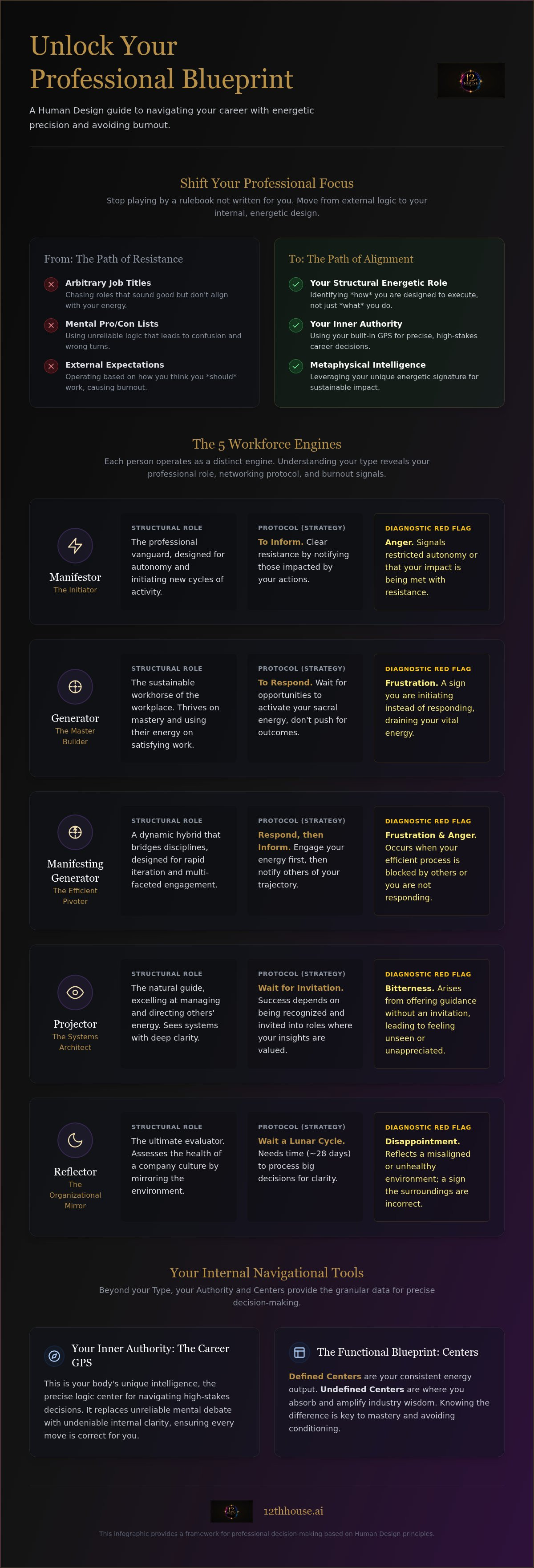
In the architecture of a high-functioning organization, individuals operate as distinct workforce engines. Each type possesses a unique operational role and a specific networking protocol, known as Strategy. When you analyze your career path according to human design, you move beyond generic job descriptions into the mechanics of how your energy interacts with the collective. Understanding your "not-self" theme is equally critical. These themes serve as diagnostic red flags, signaling when your professional trajectory has deviated from your structural blueprint.
Initiators and Builders: Manifestors and Generators
Manifestors function as the professional vanguard. They are designed for autonomy and the power to initiate new cycles of activity. Their protocol is to inform those impacted by their actions, which clears resistance and establishes a sanctuary for their creative flow. If a Manifestor feels chronic anger, it's a structural sign of restricted autonomy. Generators, by contrast, are the sustainable masters of the workplace. They thrive when they respond to opportunities that activate their sacral energy. For a Generator, persistent frustration indicates they are pushing for outcomes rather than responding to the work that lights them up. Manifesting Generators act as efficient pivoters, bridging multiple disciplines with a speed that often bypasses traditional linear steps. They require a career model that permits rapid iteration and multi-faceted engagement.
The Guides and Evaluators: Projectors and Reflectors
Projectors are the systems architects of the professional world. They don't possess the same sustainable work engine as Generators; instead, they excel at managing and directing others' energy. Their success depends on being recognized and invited into roles where their unique insights are valued. Bitterness is their diagnostic red flag, often appearing when they offer guidance without an invitation. Reflectors serve as organizational mirrors, assessing the health of a company culture through their open design. They require a slow, lunar-based rhythm to reach clarity, which fundamentally redefines productivity in a traditional 9-to-5 environment. These types prove that professional impact isn't always measured by hours logged, but by the precision of the guidance provided. To begin calibrating your specific role, you can explore your Human Design Profile to see how these mechanics manifest in your chart.
Professional Navigation: Using Authority as Your Career GPS
Your mind is a brilliant researcher but a poor executive. It can analyze market trends, calculate salary benchmarks, and synthesize complex data, yet it lacks the structural capacity to determine your correct career path according to human design. Most professional anxiety stems from the mind attempting to play the role of CEO. When you rely on mental logic for high-stakes decisions, you often find yourself trapped in "shoulds" and "what-ifs." Inner Authority is the internal logic center designed to bypass this mental noise, providing a precise mechanism for professional navigation.
Contrast this with the traditional pro/con list. While a list provides a surface-level analysis of a role, it cannot account for energetic sustainability. Energetic decision-making is about structural resonance. In a job interview or salary negotiation, your mind focuses on the "correct" answer to secure the position. Your Authority, however, assesses whether the opportunity aligns with your blueprint. By shifting the decision-making power from the mind to your designated Authority, you ensure that every career move is grounded in energetic fact rather than mental speculation.
Common Professional Authorities
Emotional Authority is the most common logic center, requiring a "Waiting for Clarity" protocol. In business cycles, this means refusing to sign contracts or accept offers during the peak of excitement or the depth of doubt. Clarity is a product of time; wait for the wave to settle into a neutral state before committing. Sacral Authority functions as a "Gut-Level Response" to immediate opportunities. It is an internal "yes" or "no" that identifies if you have the resources to execute a project. Splenic Authority is the "Instant Instinct" often found in fast-paced startup environments. It provides a quiet, one-time whisper of survival logic that must be acted upon immediately before the mind intervenes.
The Ethics of Informing and Responding
Utilizing your Strategy in conjunction with your Authority is the most effective way to eliminate professional resistance. For Projectors in leadership, waiting for the invitation ensures their systems-level guidance is recognized and implemented rather than ignored. For Manifestors, the act of informing stakeholders before initiating a move prevents the structural friction that leads to anger. This isn't about seeking permission; it's about clearing the energetic path for your Authority to lead. Authority is the internal mechanism that bypasses career anxiety by grounding professional choice in energetic fact rather than mental speculation.
The Functional Blueprint: Centers, Channels, and Impact
Your Bodygraph functions as a complex circuit board, where defined and undefined centers dictate the flow of your professional output. Defined centers are the load-bearing walls of your career path according to human design. They represent your "fixed" skills and consistent energy. When a center is defined, you have reliable access to that specific frequency, allowing you to project it into your work environment with authority. Conversely, undefined centers are not "empty" spaces; they are your most sensitive sensory tools. These are the areas where you absorb and amplify the energy of others, eventually developing deep professional wisdom through observation.
Beyond the centers, Channels represent your specialized "genius zones." These are the specific energetic circuits that bridge different aspects of your chart, creating unique talents that set you apart in a crowded market. At the core of this system is the G-Center, the hub for professional identity and direction. A defined G-Center provides a fixed internal compass, while an undefined G-Center allows you to be a chameleon, finding direction through the people and environments you choose to inhabit. To begin mapping these specific mechanics, you can generate your Human Design Profile for a granular look at your internal architecture.
Mapping Your Reliability in Teams
Understanding which centers are defined allows you to identify exactly where you are most reliable within a team dynamic. If you have a defined Root or Sacral center, you act as the "Powerhouse" of the organization. You possess the structural capacity to handle intense deadlines and maintain a high volume of output without collapsing. If your Head or Ajna centers are defined, you are the "Visionary." You provide the structured intellectual frameworks and consistent conceptual processing that teams need to stay on track. Identifying these defined areas helps you lean into roles that require your specific brand of consistent excellence, rather than forcing yourself to perform in ways that aren't sustainable.
The Wisdom of Openness
Undefined centers are often mislabeled as vulnerabilities, but in a professional context, they are your wisdom centers. An open Solar Plexus allows you to read the emotional temperature of a room, making you an exceptional negotiator or therapist. An open Ego center, however, suggests you shouldn't be in a role that requires constant self-validation through competition or quotas. Instead of trying to "fill" these open spaces, you can use them as diagnostic tools to read clients, markets, and organizational health. This transition from feeling "open" to practicing metaphysical intelligence allows you to consult and guide others with clinical clarity, using your openness as a sophisticated data-gathering instrument.
Calibrating Your Future: AI-Driven Career Synthesis
The traditional approach to interpreting your career path according to human design often requires hours of manual study or expensive, scheduled consultations. Metaphysical Intelligence represents the next evolution of professional coaching, where advanced algorithms synthesize your Bodygraph data into precise, actionable steps. This digital approach removes the ambiguity often found in spiritual spaces, offering a structured environment for self-discovery. By leveraging The Digital Sage, you gain an architect for your professional life who operates with clinical clarity and 24/7 availability.
Asking the Right Questions
You can utilize Lala to decode specific gates and channels within the context of a new job description or a complex project. Instead of wondering if a role fits, you can analyze the synastry between your energetic blueprint and a company's specific culture. Ask Lala high-stakes questions about how your defined centers will interact with a potential manager's profile or how to negotiate a contract using your emotional wave. This immediate access to specialized data is invaluable when you face a career crisis or a sudden professional pivot. It transforms your chart from a static image into a responsive GPS for your career path according to human design, ensuring you never have to make a high-stakes move in the dark.
The Modern Library of the Occult
A 12th House membership functions as a digital sanctuary, providing a secure data room to track your professional evolution. This is your personal library for deep-diving into the Mathematics of the Soul, a discipline that treats spiritual exploration with the same rigor as architecture or engineering. You are empowered to do your own "work" rather than being a passive recipient of information. As you move through different stages of your career, your understanding of your centers and channels will refine. Having a structured, digitized record of your metaphysical architecture allows for ongoing calibration as you ascend into new levels of leadership and influence. It is a systematic approach to career longevity that respects both your intuition and your need for data-driven results.
Architect Your Professional Future
Your career isn't a series of random events; it's a structural expression of your energetic design. By identifying your workforce engine and following your designated decision logic, you bypass the burnout and anxiety that plague the modern professional. We've moved beyond vague personality traits into metaphysical intelligence, where your defined centers provide consistency and your open centers offer profound market wisdom. This architectural approach ensures that every career move you make is grounded in energetic fact rather than mental speculation.
Navigating your career path according to human design requires the right instruments for ongoing calibration. Our AI Spiritual Guide, Lala, is available 24/7 to synthesize complex Bodygraph data into precise professional steps. Within our secure, personalized digital data rooms, you can track your evolution and deep-dive into the technical mechanics of your soul. You possess the blueprint; now you have the tools to begin the build.
Calibrate your career with a personalized Human Design Profile at 12th House and step into a professional life designed for your highest potential.
Frequently Asked Questions
Can Human Design tell me exactly what job I should have?
Human Design does not provide a specific job title like "Accountant" or "Surgeon." Instead, it reveals the energetic mechanics of how you should function within any role. Your career path according to human design is defined by your decision logic and output engine. Whether you are a creative or a CEO, the system dictates your operational protocol rather than your specific industry.
What is the best Human Design type for leadership?
Every type possesses a unique leadership architecture. Projectors lead through systems-level guidance and recognition, while Manifestors lead by initiating new cycles and informing their teams. Generators lead through the infectious mastery of their craft. Success in leadership is not about your type, but about how precisely you adhere to your specific Strategy and Authority to minimize organizational friction.
How do I explain my Human Design 'Strategy' to my boss?
Translate your Strategy into professional terminology to ensure it lands effectively. A Generator might say, "I am most efficient when I have specific projects to react to rather than brainstorming from scratch." A Manifestor might state, "I'll keep you informed of my progress to ensure we stay aligned as I move through phases." This frames your design as a functional productivity tool.
Can my Human Design change over time as my career progresses?
Your energetic blueprint is fixed and does not change. While your skills, job titles, and levels of professional conditioning will evolve, the underlying mechanics of your Bodygraph remain constant. Career progression is about refining your ability to operate within this fixed architecture rather than attempting to alter the blueprint itself to fit a new role or industry standard.
Why do I feel burnt out even if I'm a Generator?
Burnout in Generators usually occurs when you initiate projects from the mind instead of responding with the sacral center. If you commit to work that doesn't genuinely light you up, your sustainable energy engine won't activate. This leads to a state of chronic frustration, which is the structural signal that you are misaligned with your career path according to human design.
What happens if my career doesn't match my Human Design at all?
You don't necessarily need to quit your job immediately. Start by calibrating how you handle your current responsibilities using your Strategy and Authority. Often, small adjustments in how you communicate or make decisions can reduce significant friction. If the environment structurally prevents you from following your design, use your Authority to navigate toward a more resonant professional space with clinical clarity.
How does Human Design differ from a standard career aptitude test?
Standard tests measure personality traits, interests, and current skill sets, which are often influenced by external conditioning. Human Design measures your energetic sustainability and the mechanics of your decision-making. It identifies where you have consistent energy and where you are designed to be a student of the world, providing a deeper level of structural analysis than a typical quiz.
Is there a specific 'money' gate in the Human Design chart?
Several gates, such as Gate 45 and Gate 21, relate to resource management and material success. However, financial abundance is a byproduct of total alignment rather than a single point in your chart. When you operate according to your full professional blueprint, you naturally move toward environments where your specific value is recognized and rewarded by the market.


