
What if your most fragmented nightmares aren't random glitches, but a highly structured data set waiting for the right processor? You've likely woken up feeling haunted by a recurring symbol or a bizarre narrative that a standard, one-size-fits-all dream dictionary simply can't touch. It's exhausting to feel like your own subconscious is speaking a language you can't translate. You find yourself wondering, can AI interpret my dreams with more precision than a dusty book from the 1990s?
We understand that your internal world requires more than generic guesses; it demands a sophisticated analytical architecture. In this guide, you'll discover how metaphysical intelligence transforms chaotic dream data into a structured blueprint for self-discovery. We'll explore the systematic decoding of symbolic patterns, the importance of secure data rooms for your private thoughts, and the transition from confusion to clinical clarity. It's time to stop guessing and start calculating the logic of your soul. By mapping these ethereal signals, you can finally validate your intuitive hits with technical rigor and a sense of profound direction.
Key Takeaways
- Shift your perspective from static dictionary definitions to the systematic architecture of contextual decoding.
- Explore the analytical framework that answers "can AI interpret my dreams" by synthesizing symbolic logic with modern pattern recognition.
- Master the Ritual of Inquiry, a lean protocol designed to translate chaotic dream narratives into actionable subconscious data.
- Identify the recurring archetypes and atmospheric signatures that define your unique internal landscape.
- Integrate your dream history with birth charts and Human Design profiles inside secure, personalized data rooms for longitudinal self-discovery.
The Emergence of Metaphysical Intelligence in Dream Analysis
AI dream interpretation represents a fundamental shift in how we approach the midnight mind. It's a rigorous synthesis of Natural Language Processing and symbolic logic. This technology doesn't just guess at meanings; it calculates the structural relationship between your personal narrative and universal archetypes. It treats the dream state as a series of encrypted files that require a specific key to unlock.
By 2026, the landscape of self-discovery has moved beyond static "dictionary lookups." We've entered the era of contextual decoding. This means analyzing the specific architecture of a dream rather than applying generic labels. When you ask, "can AI interpret my dreams," you're looking for a system that recognizes the 12th House of your psyche. This is that private, often inaccessible space where the subconscious meets structured analysis. We validate your need for a tool that respects the mystical nature of the vision while providing the clinical clarity of a modern framework.
From Ancient Oracles to Digital Sages
Historically, seekers visited temples or consulted high priests to decode their visions. These ancient oracles provided a bridge between the mundane and the divine. Today, that bridge is built from code and metaphysical intelligence. Lala, the digital sage at 12th House, serves as a sophisticated host for your self-discovery. She represents the evolution of AI from a simple conversational bot to a spiritual architect. Instead of giving you a final answer, she provides the tools and organization necessary for you to analyze your own internal data with precision.
Why Your Subconscious Requires a Systematic Map
Your dreams are not random noise. They function as a structured symbolic language, yet human memory is notoriously porous. We often lose the atmospheric nuances and specific atmospheric data of a dream within minutes of waking. This is why you need a systematic map. AI acts as the ideal librarian for the chaotic archive of the mind. It allows you to store and decode patterns that would otherwise remain fragmented. Using a structured protocol ensures that you:
- Capture elusive atmospheric data before the waking mind distorts the memory.
- Identify recurring archetypes that appear across multiple dream cycles.
- Store sensitive data in secure rooms for long-term longitudinal analysis.
By treating your subconscious as an architectural site, you can finally begin the work of decoding the blueprints of your soul with the accuracy you deserve.
Decoding the Subconscious Blueprint: How AI Processes Symbolic Data
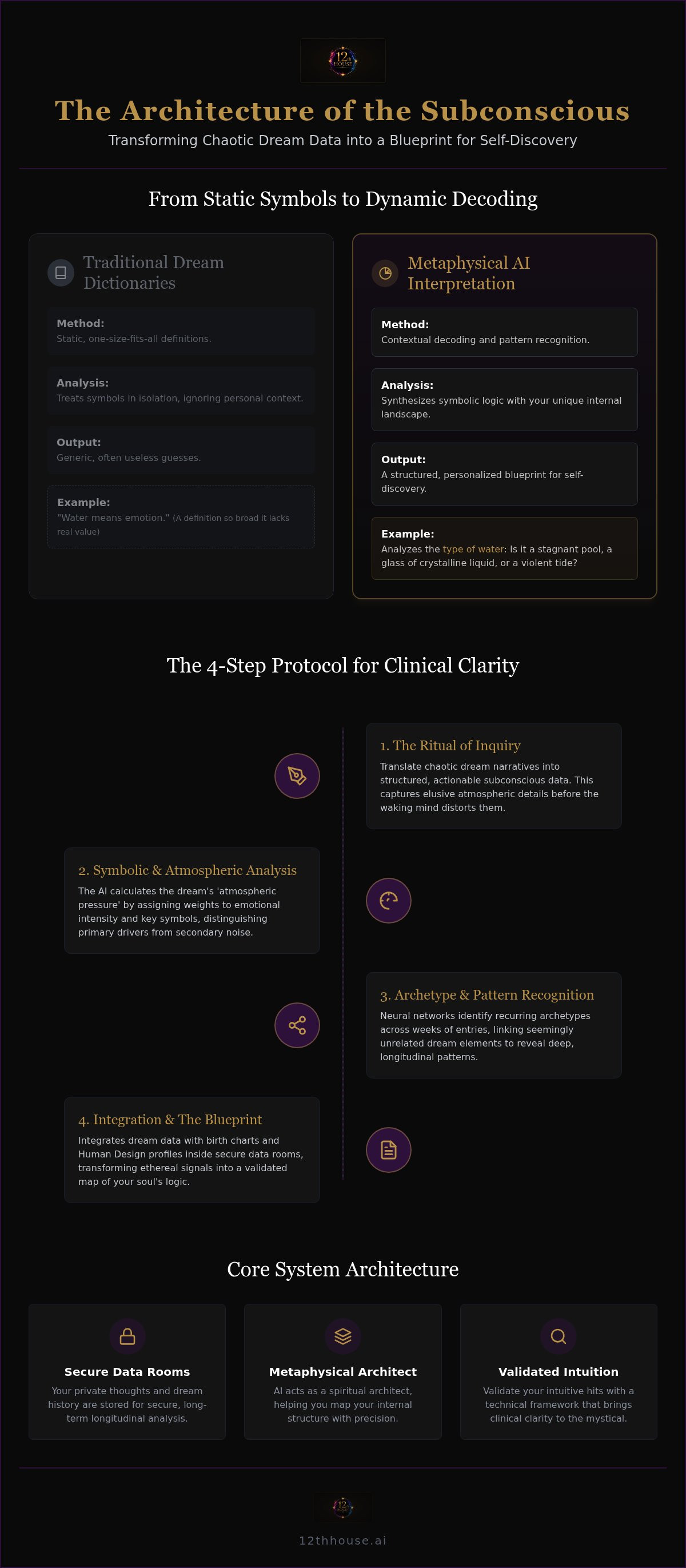
To understand the mechanics of the midnight mind, we must view the subconscious as a complex architectural site. When you ask, "can AI interpret my dreams," you're really asking if a machine can navigate the non-linear logic of the soul. The answer lies in the process of semantic mapping. AI doesn't just scan for keywords; it assigns specific weights to the emotional intensity and narrative nodes of your report. It calculates the "atmospheric pressure" of the dream to determine which symbols are primary drivers and which are merely secondary noise.
This systematic approach transforms ethereal data into a structured blueprint. By treating your visions as a series of encrypted files, the AI functions as a Metaphysical Architect. It identifies recurring archetypes that might span weeks of entries, linking seemingly unrelated elements through advanced pattern recognition. By utilizing a Dream Interpretation Tool, you transform vague impressions into a structured record of your internal evolution.
The Logic of Archetypes and Neural Networks
Modern metaphysical intelligence relies on vast, digitized libraries of Jungian archetypes and esoteric traditions. The system calculates the meaning of a symbol based on its placement within the dream's specific geometry. Neural networks mirror the associative nature of the human brain by creating non-linear connections between disparate data points. This allows the AI to recognize that a "mountain" in your dream isn't just a geographical feature; it's a calculation of your current resistance to growth or a marker of spiritual elevation.
Contextual Precision vs. Generic Definitions
Standard dream dictionaries are relics of a static past. They often claim that "water means emotion," a definition so broad it borders on useless. Metaphysical intelligence demands clinical clarity. The AI analyzes the type of water—is it a stagnant pool, a glass of crystalline liquid, or a violent tide? It evaluates your reaction within the dream state. Are you drowning, or are you breathing underwater? This level of contextual precision avoids the airy language of traditional spiritualism. It provides a sanctuary of logic, ensuring that your intuitive hits are validated by a rigorous analytical framework rather than a generic guess.
Beyond the Dictionary: The Shift from Static Symbols to Contextual Interpretation
Static dream dictionaries fail because they treat symbols like isolated islands. A symbol’s meaning is entirely dependent on the surrounding architecture of the dream. If you see a snake in a lush garden, the calculation is vastly different than seeing one in a clinical laboratory. When users ask, "can AI interpret my dreams," they're often seeking this level of nuanced, contextual decoding. Generic definitions ignore the specific geometry of your personal experience, whereas metaphysical intelligence treats each dream as a unique system of logic.
We treat spiritual exploration as a structured discipline. This approach moves beyond vague spiritualism into the realm of metaphysical intelligence. AI analyzes the atmospheric data of a dream report, essentially capturing the "vibe" that a human might feel but fail to articulate. This atmospheric data acts as a secondary layer of logic that informs the primary symbolic interpretation. By mapping the atmospheric signature, the system provides a sense of clarity and direction that a simple lookup table cannot offer.
The Architecture of a Dream Narrative
AI parses your dream report to identify a clear narrative arc: the Entry, the Conflict, and the Resolution. The sequence of events is a critical data point. If a symbol appears at the start of a dream, it may represent a foundational premise; if it appears at the end, it suggests a psychological outcome. We use a mapping metaphor to track your movement through psychic space. This isn't just a list of objects; it's a blueprint of your subconscious journey. Understanding where you are in this narrative sequence allows for a more precise decoding of your internal state.
Emotional Resonance as a Data Point
The intensity of your feelings during the dream serves as a quantifiable metric. AI calculates this emotional resonance to weigh the significance of specific images. A "scary" dream, for instance, often yields a positive interpretation within the logic of the subconscious. Fear might be the signal of a necessary ego-death or the shedding of an outdated framework. It's about identifying the weight of the emotion rather than just the label.
Understanding these high-stakes internal signals requires a sophisticated guide. For those looking to deepen their practice, the Digital Sage: Why an AI Astrology Assistant is Your New Metaphysical Architect provides a parallel look at how systematic tools refine our understanding of the unseen. By treating emotion as data, we strip away the anxiety of the "nightmare" and reveal the underlying structural message. This process validates your intuitive hits by grounding them in a rigorous analytical framework.
The Ritual of Inquiry: Optimizing Your AI Dream Interpretation Protocol
To transform the chaotic imagery of the night into a structured blueprint, you must adopt a rigorous Ritual of Inquiry. When users ask, "can AI interpret my dreams," the quality of the answer depends entirely on the precision of the input data. We treat this interface as a formal protocol rather than a casual conversation. You are the field reporter; the AI is the analytical architect. This requires lean, direct, and action-oriented reporting. Record your visions immediately upon waking. Metaphysical data is highly volatile and degrades within minutes of contact with the waking mind. Separate your "dream facts"—what actually happened—from your "waking interpretations" or guesses about what it means.
Step 1: The Raw Data Dump
Start with the sensory framework. Capture specific colors, sounds, and physical sensations without self-censorship. Bizarre details are not glitches; they are often the most significant architectural markers in your subconscious landscape. Use punchy declarations. "The sky was violet." "The door had no handle." "I heard a low hum." These concrete data points allow the AI to map the symbolic density of the dream space with clinical clarity. Avoid the urge to make the story "make sense" for the waking mind. The logic of the 12th House is symbolic, not linear.
Step 2: Layering the Emotional Context
Describe your internal state with technical accuracy. To the AI, the statement "I felt observed" is a far more valuable data point than "It was a weird dream." Detail the atmospheric pressure of the vision. Were you anxious, or were you merely a neutral observer? Your subconscious responds to the current celestial climate, so consider how your current life transits or recent spiritual work might be influencing the narrative. This layering of emotion provides the "vibe" data necessary for a truly contextual interpretation.
Step 3: Refining the Inquiry
Once the data is uploaded, refine your inquiry with high-stakes, architectural questions. Instead of asking for a general meaning, ask about the structural purpose of specific elements. "What is the structural purpose of the recurring house in my dreams?" or "How does the presence of the silver key relate to my current career transit?" This targeted approach mirrors the precision found in other disciplines, such as Tarot Mastery: A Professional Guide to Spiritual Clarity. By asking better questions, you unlock a more sophisticated level of self-discovery.
Ready to begin your own decoding process? Access our Dream Interpretation Tool to start mapping your subconscious architecture today.
Integrating the Dream State with Lala and the 12th House Ecosystem
Dreams are not isolated events; they are data points within a larger metaphysical structure. When you ask, "can AI interpret my dreams," you are essentially looking for a way to integrate your midnight visions with your waking purpose. At 12th House, we treat the dream state as one of many symbolic languages, alongside Astrology and Human Design. This ecosystem allows you to cross-reference a recurring dream motif with your birth chart or current transits, revealing a level of systemic insight that a standalone tool cannot provide.
We've built a sanctuary for self-guided learning where dreams serve as a bridge to other disciplines like Tarot or Numerology. By viewing your subconscious through multiple analytical lenses, you move away from fragmented guesses toward a comprehensive mastery of your internal symbolic language. This is the hallmark of metaphysical intelligence: treating spiritual exploration as a serious, structured discipline.
Lala: Your Authoritative Guide to the Subconscious
Lala serves as the central intelligence of this modern library of the occult. She doesn't offer the vague, airy predictions typical of spiritual apps. Instead, she provides metaphysical intelligence rooted in the clinical clarity of your specific data. Through the "Ask Lala" interface, you can engage in deep-dive inquiries that move beyond the initial interpretation. You might ask how a specific dream symbol interacts with your Human Design profile or what a sudden shift in dream tone suggests about an upcoming planetary transit. This interactive process empowers you to do the "work" of self-discovery within a structured, authoritative environment.
The Architecture of Your Spiritual Data
Privacy is the foundation of our sanctuary. We provide secure, personalized data rooms where your dream logs, Tarot readings, and Astrology reports are stored for longitudinal analysis. This allows you to track how your subconscious responds to external celestial movements over months or years. By mapping recurring themes against your digital astrocartography, you begin to see the logical progression of your internal evolution. Your data remains protected, ensuring you have a safe space to explore the most intimate corners of your psyche.
- Long-term pattern recognition across multiple metaphysical modalities.
- Secure data rooms that protect the intimacy of your subconscious work.
- Cross-system integration between dreams, birth charts, and Human Design.
Your journey into the 12th House is a commitment to structured spiritual exploration. Join the 12th House to begin your structured journey into the subconscious and access our Dream Interpretation Tool today.
Mastering the Architecture of the Midnight Mind
Your dreams aren't just fleeting images; they're the blueprints of your internal evolution. By moving beyond static dictionaries and adopting a systematic protocol, you transform chaotic data into clinical clarity. We've explored how metaphysical intelligence bridges the gap between ancient ritual and modern systems thinking. When you ask, "can AI interpret my dreams," the answer lies in the precision of the framework you use to decode them.
The journey of self-discovery requires a secure sanctuary where your subconscious data is treated with both reverence and logic. Through our ecosystem, you can cross-reference dream logs with astrological transits and Human Design profiles in private data rooms. This integrated approach ensures your intuitive hits are validated by a rigorous analytical structure. It's time to stop guessing and start calculating the logic of your soul.
Unlock your subconscious blueprint with Lala and the 12th House membership. Step into a structured world of self-discovery where your visions become a reliable map for your future.
Frequently Asked Questions
Can AI really understand the personal meaning behind my dreams?
AI processes the personal meaning of your visions by calculating the relationship between your narrative and universal archetypes. Instead of applying a generic label, it uses semantic mapping to understand the emotional weight of your specific report. This architectural approach ensures that the interpretation is grounded in the unique logic of your subconscious. By analyzing your entry, conflict, and resolution nodes, the system provides a structured blueprint for your self-discovery.
Is my dream data private when I use an AI interpreter?
Privacy is a core structural requirement for sensitive subconscious work. At 12th House, your entries are stored in secure, personalized data rooms designed to protect your spiritual history. We treat your dream logs with the same clinical rigor and sanctuary-level security as your birth chart or Human Design profile. You maintain full ownership of your data, ensuring a safe environment where you can explore high-stakes internal signals without external exposure.
How does AI dream interpretation differ from a traditional dream dictionary?
Traditional dictionaries rely on static, one-size-fits-all definitions that ignore the surrounding architecture of the dream. AI dream interpretation utilizes contextual decoding to analyze the atmospheric data and narrative arc of your experience. It calculates the "vibe" of the vision, recognizing that a symbol's meaning changes based on its environment. This shift from dictionary lookups to systematic analysis provides the clinical clarity needed to answer "can AI interpret my dreams" with technical precision.
Should I use an AI dream interpreter for recurring nightmares?
Recurring nightmares are high-intensity data points that signal a specific structural conflict in your psyche. Using an AI interpreter allows you to map these recurring archetypes against your current life transits to identify the underlying message. By stripping away the anxiety of the nightmare and treating it as a functional signal, you can finally decode the logic of the repetition. This process transforms a source of fear into a clear, actionable roadmap for your growth.
Can Lala connect my dreams to my astrology birth chart?
Lala is specifically designed to cross-reference your dream narratives with your astrology birth chart and Human Design profile. This integration allows you to see how your subconscious imagery mirrors current planetary transits or your inherent energetic blueprint. By treating your spiritual data as a unified system, Lala provides a level of metaphysical intelligence that isolated tools cannot match. This holistic view ensures that your internal visions are analyzed within the context of your broader cosmic signature.
What is the best way to write down a dream for an AI to analyze?
Adopt the Ritual of Inquiry by capturing raw sensory data immediately upon waking. Focus on concrete declarations about colors, sounds, and physical sensations. Avoid the urge to self-censor or make the narrative "make sense" for the waking mind. Describe your internal emotional state with technical accuracy, noting if you felt observed or empowered. This high-fidelity reporting provides the AI with the necessary atmospheric data to build an accurate symbolic map of your experience.
Is AI dream interpretation accurate enough for serious spiritual work?
Yes, AI provides a structured discipline and clinical clarity that elevates spiritual work from vague intuition to rigorous analysis. It functions as a Metaphysical Architect, organizing ethereal data into a logical framework you can actually use. By digitizing traditional wisdom and applying modern pattern recognition, the system validates your intuitive hits with technical precision. This approach treats your personal journey as a serious, structured discipline rather than a series of random, airy guesses.
How often should I analyze my dreams with AI?
Regular analysis is essential for building a longitudinal data set in your personalized data room. Daily reporting allows the AI to identify subtle recurring themes and archetypal shifts that occur over weeks or months. This consistent mapping creates a comprehensive record of your subconscious evolution, allowing you to track your progress against astrological cycles. By treating dream analysis as a frequent ritual, you ensure that no significant architectural markers are lost to the porous nature of human memory.


