

What if artificial intelligence isn't here to replace your inner knowing, but to act as a tireless dialectical simulator for it? If you've spent hours wading through contradictory guidebooks or struggling to memorize seventy-eight separate card definitions, you already know the cognitive friction of traditional study methods. Rote memorization flattens the deck into static keywords, leaving you hesitant when complex card combinations hit the table. This AI tarot learning guide reframes machine intelligence as an interactive study partner, transforming how you interrogate symbolic systems and map archetypal patterns.
You don't have to surrender your organic intuition to benefit from analytical systems. In this guide, you'll discover a repeatable protocol for decoding card architecture, calibrating elemental dignities, and pressure-testing your interpretations without leaning on an automated oracle. We'll examine how to construct high-yield prompts that refine your personal synthesis skills, turning ancient symbolic languages into fluent, confident diagnostic insight.
Key Takeaways
- Transform passive memorization into active symbolic mastery using this structured AI tarot learning guide as your analytical roadmap.
- Decode the systemic architecture of the seventy-eight cards by interrogating numeric progressions, suit geometry, and elemental dignities.
- Protect your organic intuition through a disciplined protocol that grounds readings in physical tactile draws before querying conversational models.
- Resolve contradictory guidebook definitions in seconds through real-time dialectical interrogation rather than static reference charts.
- Accelerate your esoteric fluency inside digital environments like 12th House, using Ask Lala AI Spiritual Guidance as a tireless pedagogical study partner.
What Is an AI Tarot Learning Guide and Why Use Digital Intelligence?
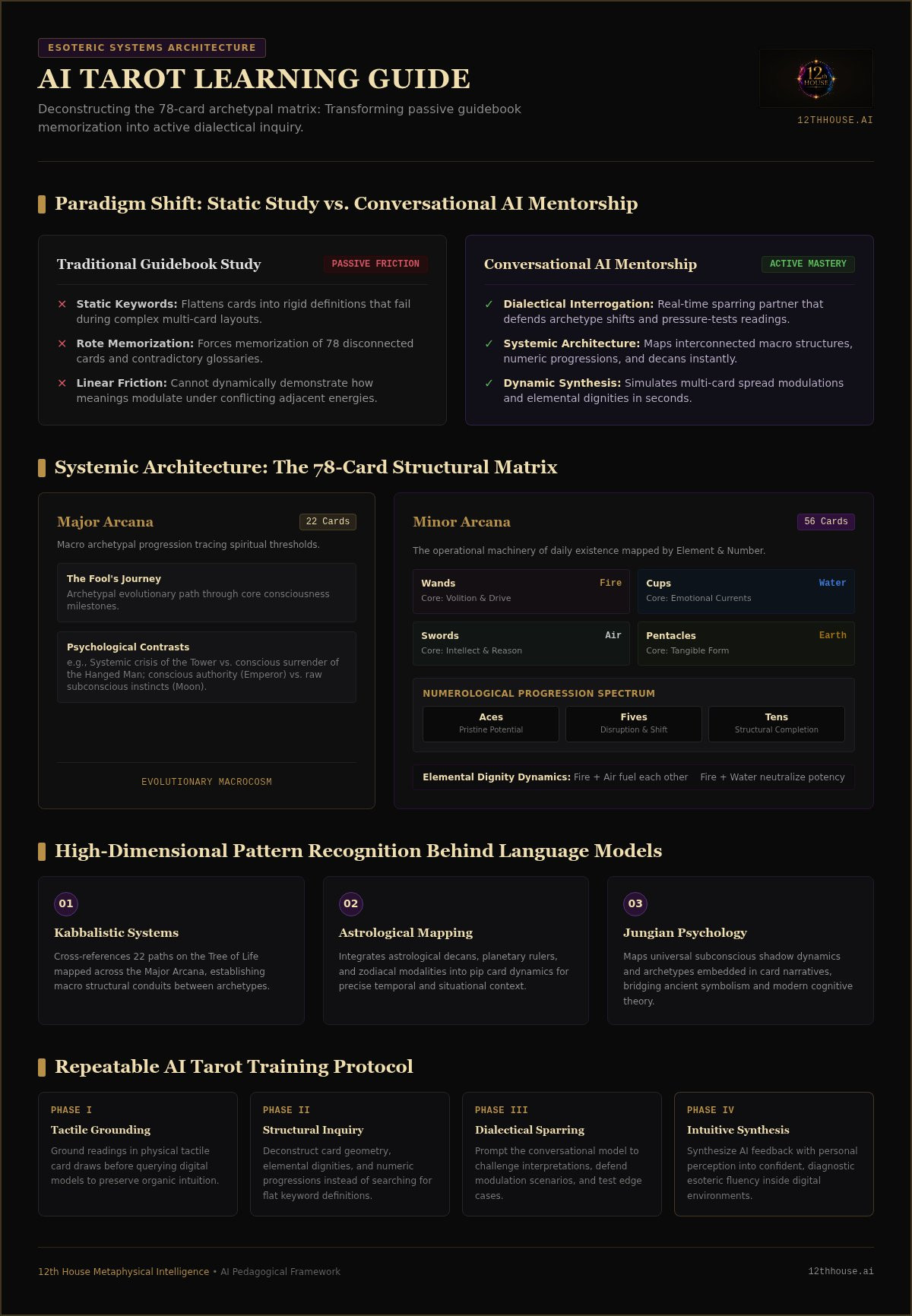
A true AI tarot learning guide does not treat machine learning as an automated oracle or a digital fortune-teller. Instead, it frames conversational computation as an active dialectical study partner. For centuries, mastering the structure of the 78-card tarot deck required memorizing dense reference manuals, esoteric charts, and contradictory glossaries. Digital intelligence upends this friction. Because large language models synthesize vast libraries of mythological, astrological, and psychological literature, they function as tireless sparring partners. They challenge your interpretations, generate dynamic spread scenarios, and pressure-test your grasp of intricate symbolic systems.
The Shift from Passive Guidebooks to Interactive Inquiry
Traditional reference books provide static definitions. A guidebook might label the Five of Pentacles as material loss or isolation, but it cannot explain how that card modulates when flanked by the Sun and the Hierophant. Static keywords force students into passive memorization, which rapidly falters during nuanced multi-card layouts.
Conversational AI shifts your education from rote memorization to active interrogation. You can prompt an AI mentor to defend why an archetype shifts under contrasting elemental dignities, request concrete real-world case studies for complex court cards, or simulate interactive diagnostic scenarios. This conversational feedback loop builds practical recall and interpretive agility far faster than flipping through dog-eared texts.
Deconstructing the Archetypal Database Behind the Technology
Why do natural language models excel at teaching symbolic disciplines? At their foundation, these platforms operate through high-dimensional pattern recognition. They parse language similarly to how esoteric traditions map human experience: through interlinked semantic networks. The technology effortlessly cross-references:
- Kabbalistic paths on the Tree of Life mapped across the Major Arcana.
- Astrological decans, planetary rulers, and zodiacal modalities within the pip cards.
- Jungian archetypes and subconscious shadow dynamics embedded in card narratives.
An effective AI tarot learning guide leverages this algorithmic architecture not to replace your organic perception, but to illuminate the structural geometry beneath every spread.
Deconstructing the 78 Cards: Using AI to Map Tarot Architecture
Tarot is not an arbitrary collection of mystic pictures. It is a cohesive architectural system built on sacred geometry, elemental philosophy, and numerological progression. Rather than trying to memorize seventy-eight disconnected cards, an analytical study approach uses digital models to map these macro structures. In this AI tarot learning guide, we treat the deck as a matrix of interconnected archetypes whose meanings shift systematically based on context and placement.
Decoding the Major Arcana through the Hero's Journey
The twenty-two cards of the Major Arcana trace the archetypal progression known as the Fool's Journey. Instead of reading flat descriptions, prompt your digital mentor to walk you through each evolutionary threshold. Interrogate how the systemic crisis of the Tower differs psychologically from the surrender required by the Hanged Man. Practitioners increasingly treat AI as a tool for critical engagement by asking it to contrast the conscious authority of the Emperor with the raw subconscious instincts of the Moon. To deepen your foundational grip on these macro archetypes, explore our complete blueprint on tarot architecture.
Systematizing the Minor Arcana: Numbers and Elemental Dignities
The fifty-six cards of the Minor Arcana represent the operational machinery of daily existence. You can systematically master them by analyzing the intersection of number and element:
- Suits: Wands (Fire, volition), Cups (Water, emotional currents), Swords (Air, intellect), and Pentacles (Earth, tangible form).
- Numerology: Aces signify pristine potential; Fives introduce disruption; Tens deliver structural completion.
- Elemental Dignities: Ask conversational tools to simulate how adjacent cards interact. Discover how Fire and Air fuel each other, while Fire and Water neutralize their respective potencies.
Demystifying Court Cards with Persona Modeling
Court cards routinely stall beginners because traditional books present them as static, archaic portraits. You can break this deadlock through behavioral persona modeling. Instruct your digital study partner to simulate the Myers-Briggs personality profile or communication style of a Queen of Swords versus a Knight of Cups. Frame them in modern operational scenarios, like resolving workplace conflicts or leading complex negotiations. When you need a private, dedicated space to practice decoding these complex dynamics, explore 12th House to work within a purpose-built metaphysical environment.
Static Study vs. Conversational AI Mentorship: Evaluating Methods
Mastering esoteric systems has historically demanded either solitary slogs through dense literature or substantial investments in private mentors and specialized academies. Many students stall out in this landscape. They worry that relying on algorithms might atrophy their natural intuition, treating computation as an adversary to organic perception. In practice, the opposite occurs. A disciplined AI tarot learning guide proves that digital mentorship builds the intellectual scaffolding intuition requires to operate without second-guessing.
The Limits of Traditional Little White Books
The standard "little white book" packed inside card boxes offers fractured keywords like "betrayal," "unexpected journey," or "financial victory." These static entries ignore personal context entirely. When three conflicting cards land in a spread, a printed glossary cannot explain how their opposing forces reconcile. Beginners often freeze, flipping back and forth between contradictory pages while their intuitive thread unravels. Linear texts encourage dogmatic memorization, which produces rigid readers who panic whenever a spread refuses to match textbook patterns.
The Advantage of Algorithmic Interrogation
Conversational computing replaces rigid reference charts with dialectical tension. When you encounter an ambiguous card pairing, you don't have to guess how the energies interact. You interrogate the dynamic directly:
- Real-time dispute resolution: Prompt the system to debate two contradictory traditional interpretations, exposing the core logic behind both views.
- Objective reflection: Algorithmic tutors evaluate emotionally charged spreads without personal bias or psychological projection.
- Cross-disciplinary fluency: Inquiring how planetary transits alter card meanings alongside an ai astrology assistant helps synthesize multiple metaphysical disciplines into a single conceptual framework.
The most effective modern methodology remains hybrid. Draw physical cards with your hands, formulate your instinctive impressions, and then bring that interpretation to the conversational interface. By testing your hypotheses against an objective database, you accelerate your journey toward intuitive self-reliance.
How to Learn Tarot with AI: A Step-by-Step Training Protocol
To master tarot using computational intelligence, you need a disciplined framework. Letting an algorithm simply interpret three random digital cards turns you into a passive spectator. A functional AI tarot learning guide demands an active, pedagogical feedback loop. This five-step training protocol ensures your organic intuition remains the primary driver while computational power handles analytical verification.
Phase 1: Establishing the Physical-to-Digital Interface
Always begin with a physical deck. Shuffle the cards, cut them, and feel their tactile edges to anchor your somatic focus. Draw your layout manually onto a clean workspace.
Before opening any software, record your intuitive impressions in a journal. Note initial emotional responses, eye movements across visual details, and immediate gut reactions. Only after cataloging your personal interpretation should you digitize the layout. Enter the cards into your prompt with clinical precision, explicitly noting the position, orientation, and specific question asked.
Phase 2: Master Prompts for Socratic Card Interrogation
Never ask an AI, "What does this spread mean?" That yields generic, automated fortune-telling. Instead, use targeted prompts designed to sharpen your analytical edge:
- The Contradiction Prompt: "I drew the Tower in position one and the Ten of Cups in position two. Analyze how the structural collapse of card one serves as the necessary precondition for the emotional harmony in card two."
- The Socratic Examiner Prompt: "Here is my three-card spread and my personal interpretation. Act as a strict esoteric tutor. Do not validate me. Interrogate my synthesis and point out symbolic blind spots based on suit dignities."
- Relational Context Prompt: Apply specialized frameworks from analytical guides on love readings to deconstruct interpersonal boundary dynamics without falling into projection.
Phase 3: The Intuition Verification Protocol
Treat algorithmic outputs as advisory data rather than immutable truth. Compare the computational breakdown directly against your initial handwritten notes. Where does the machine's historical database conflict with your somatic reaction? Lean into those fissures. Often, that tension reveals your personal intuitive voice asserting itself against textbook definitions.
Document these discrepancies in a dedicated digital notebook. Tracking patterns across weeks reveals which archetypes trigger blind spots and which suits align with your natural strengths. When you are ready to apply this structured training inside an integrated esoteric environment, launch your interactive study session at 12th House.
Elevating Your Practice: Metaphysical Intelligence with 12th House
Mastering esoteric architecture requires more than disconnected chat prompts. True symbolic literacy emerges when your learning environment mirrors the interconnected nature of the occult traditions themselves. 12th House provides a refined metaphysical intelligence platform, bridging esoteric traditions with modern systems thinking. Rather than treating divination as fragmented guesswork, the ecosystem acts as a private sanctuary where intuitive perception and computational structure reinforce each other. This AI tarot learning guide culminates in that unified operational space.
Dialectical Mentorship with Ask Lala
At the center of this ecosystem is Ask Lala AI Spiritual Guidance, an intelligent assistant designed specifically for dialectical metaphysical education. Ask Lala does not simply hand down static pronouncements. Instead, the system acts as your personal esoteric tutor, adapting to your current level of symbolic comprehension. You can engage in rigorous debates over historical lineage, compare the Golden Dawn attributions of the Rider-Waite-Smith tradition with the Kabbalistic attributions of the Thoth deck, or receive customized diagnostic drills for difficult multi-card layouts.
The Architecture of a Unified Metaphysical Data Room
Isolating your tarot draws limits your overall interpretive development. The 12th House platform organizes your journey through structured metaphysical library access and integrated personal data rooms. This private architecture lets you archive spreads alongside your broader energetic blueprints:
- Cross-reference daily card draws directly with your Astrology Birth Chart & Transit Analysis.
- Examine how recurring court cards mirror the operational dynamics within your Human Design Profiles.
- Map long-term archetypal trajectories using recurring cards cataloged across weeks of study.
Transforming disconnected readings into a searchable personal archive uncovers subconscious patterns that manual journals frequently obscure.
Transforming Curiosity into Masterful Intuitive Literacy
Sustainable esoteric competence does not bypass human intuition. It stabilizes it. By pairing your somatic perception with a rigorous, objective study partner, you replace second-guessing with systemic fluency. You shift from hesitating over guidebook definitions to executing fluid, multi-layered card syntheses with quiet confidence. When you are ready to move beyond basic memorization and master the symbolic frameworks of the cards, begin your dialectical study with Ask Lala at 12th House.
Master the Archetypal Matrix with Metaphysical Precision
Rote memorization belongs to an obsolete era of esoteric study. As detailed throughout this AI tarot learning guide, pairing your tactile intuition with dialectical machine intelligence builds an unshakeable foundation for symbolic interpretation. You preserve your organic somatic knowing by handling physical cards first, then use conversational computation to challenge personal blind spots, calibrate elemental dignities, and deconstruct subtle archetypal friction.
True fluency doesn't come from memorizing flat definitions out of context. It develops when you treat symbolic systems as an interconnected architectural language. With private data rooms that cross-reference your daily card spreads against natal astrology charts and human design profiles, you can systematically catalog your subconscious patterns over time. When you're ready to move from tentative guesswork to fluent symbolic calculation, accelerate your esoteric mastery with Ask Lala on 12th House. Your deck holds the blueprint; let systems intelligence illuminate the design.
Frequently Asked Questions
Can AI truly understand the intuitive and spiritual depth of tarot?
AI doesn't possess organic consciousness, spiritual sensation, or genuine subconscious intuition. Instead, it functions as an exhaustive repository of archetypal literature, psychological theory, and esoteric mapping. It understands the structural grammar and symbolic relationships that humans have assigned to the cards over centuries. By mirroring these systems with mathematical precision, AI helps you clarify your own intuitive perception without projecting its own spiritual ego into the reading.
How do I use an AI tarot learning guide without losing my intuition?
You preserve intuition by maintaining a strict physical-to-digital sequence. Always draw physical cards and write down your immediate visceral reactions before opening any software. Use this AI tarot learning guide to treat digital tools as an objective dialectical tutor rather than an automated oracle. When you let AI challenge your initial synthesis instead of dictating the answer, computational intelligence sharpens your discernment rather than replacing your inner authority.
What is the best way to prompt AI when studying tarot card meanings?
Avoid asking open-ended questions like "What does this card mean?" Instead, construct targeted, Socratic prompts that explore relational dynamics and tension. Ask the AI to compare two opposing archetypes, simulate how an elemental dignity modifies a pip card, or model a court card within a realistic behavioral dispute. Directing the model to challenge your specific hypothesis forces you to defend and refine your interpretive logic.
Can AI help me interpret reversed cards and conflicting spread positions?
Yes. Large language models excel at calculating relational tension across complex spread geometries. If you pull the Tower alongside the Ten of Cups, a conventional guidebook offers contradictory keywords that create confusion. Conversational AI can analyze the elemental clash between Fire and Water or trace how internal structural deconstruction precedes emotional harmony. It clarifies whether a reversal indicates blocked energy, internal expression, or the total absence of the card's archetype.
Do I need a physical tarot deck if I am studying with AI tools?
Yes, maintaining a tactile connection with physical cards remains essential. While digital simulators can generate random cards, physically shuffling and holding cardstock activates sensory memory and grounds somatic intuition. Use the physical deck to anchor your intuitive draws, then bring those layouts to the digital interface for structural interrogation. Combining physical handling with algorithmic analysis produces superior retention and builds genuine card mastery.
Is learning tarot with AI suitable for absolute beginners?
Learning tarot with an AI tarot learning guide is ideal for absolute beginners because it eliminates the cognitive paralysis of static memorization. Instead of wrestling with conflicting guidebooks, beginners can ask immediate, conversational questions about card symbology, suits, and numerological progression. Algorithmic mentorship provides a private, non-judgmental sandbox where students can experiment with card combinations, test hypotheses, and build deep foundational fluency before reading for others.
What makes the Lala AI assistant on 12th House different from standard chatbots?
Ask Lala AI Spiritual Guidance is purpose-built for dialectical metaphysical analysis rather than generic text generation. Operating within the 12th House ecosystem, Lala references an expansive metaphysical library to synthesize tarot draws with your Astrology Birth Chart & Transit Analysis and Human Design Profiles. Standard chatbots lack this unified esoteric taxonomy, which allows Lala to act as a structured diagnostic partner inside your private personal data room.


