
A spiritual AI differs from a general-purpose assistant in what it helps you explore: meaning, emotion, and symbolic patterns, not just everyday tasks. An AI metaphysical assistant can offer prompts and interpretations for reflection, but it has no human consciousness or spiritual authority. Its responses are generated from patterns in language, so consider them ideas to explore, not truths to accept.
That distinction matters when you’re looking for insight. You may want words for a difficult feeling, a fresh way to explore a dream, or a framework for turning a symbol into creative work. A focused spiritual tool can organize your questions and open new avenues for reflection. You decide what resonates and what doesn’t.
This article explains how spiritual AI differs from standard assistants, how it can support emotional processing and symbolic exploration, and where its limits matter. You’ll also learn how to use it as a reflective aid for personal meaning, family conversations, and creative practice, without mistaking a generated interpretation for a human relationship or a final answer.
Key Takeaways
- Use spiritual AI to structure questions about meaning and life purpose, then assess its interpretations against your own values and experience.
- Turn emotional reflection into clearer language by exploring patterns and prompts, without treating generated responses as therapy or a diagnosis.
- Read names, numbers, dreams, and other symbols as interpretive frameworks; context shapes what they may mean to you.
- Explore how emerging AI features could support reflection and creative work while keeping your judgment at the center.
- Choose a focused spiritual tool, such as Ask Lala AI Spiritual Guidance, when you want a more metaphysical lens for your inquiry.
Conversations about meaning and life purpose
A question about purpose rarely arrives as a neat abstract problem. It may begin with a decision: stay in familiar work, leave a strained relationship, or pursue a creative practice. A spiritual conversation can help you map the values and fears beneath that choice. Ask yourself what feels meaningful, what feels obligatory, and what everyday evidence supports each answer. The aim is clearer reflection, not a prediction that takes away your agency.
Henri Nouwen described spiritual direction as a relationship in which a mature person of faith prays and responds wisely to a seeker’s questions about spiritual living. That model depends on human connection and discernment. An AI assistant can offer prompts or organize themes, but it doesn’t pray, hold personal faith, or know your life beyond what you share. Use it as a reflective tool, not an oracle or substitute for someone you trust.
AI responses are produced in a different way. Generative AI uses a statistical model to predict likely text based on its training. It can connect your words with familiar ideas about vocation, grief, identity, or change. Fluency may feel intimate, but it isn’t proof of understanding or insight. Nummi states that AI does not have consciousness in the way humans do. Treat each interpretation as a hypothesis and test it against your experience.
Make the exchange more useful by giving it a specific task. For example, describe a choice between a secure job and a demanding art project. Ask the assistant to identify the values in tension, then suggest questions to help you examine each one. Separate the response into three parts: what you said, what the tool inferred, and what you recognize as true. If an interpretation feels wrong, correct its premise instead of accepting its confident tone.
Are there laws or regulations for AI psychic and spiritual advice services in the United States? The answer depends on what a service does and claims, not simply on its spiritual label. Distinguish symbolic reflection from services presented as clinical care, and read the service’s terms before sharing sensitive details.
What are the privacy and data security risks of AI spiritual advice apps? A personal entry may include intimate details about relationships, health, beliefs, or family. Before typing, review how the app describes its data collection, storage, sharing, and deletion. Avoid entering identifying details you don’t need for reflection.
Can AI metaphysical assistants replace professional mental health or medical advice? No. They can help organize questions or explore personal meaning, but they can’t diagnose conditions or provide medical treatment. Bring health concerns to a qualified professional, and use AI only as a separate reflective aid.
Deepak Chopra says he has authored over 90 books, translated into over forty-three languages. His work offers one example of how people use established spiritual ideas to frame purpose. An AI can help you examine such frameworks, but the final map remains yours: choose the values, relationships, and actions that give your answer substance.
Emotional processing and healing
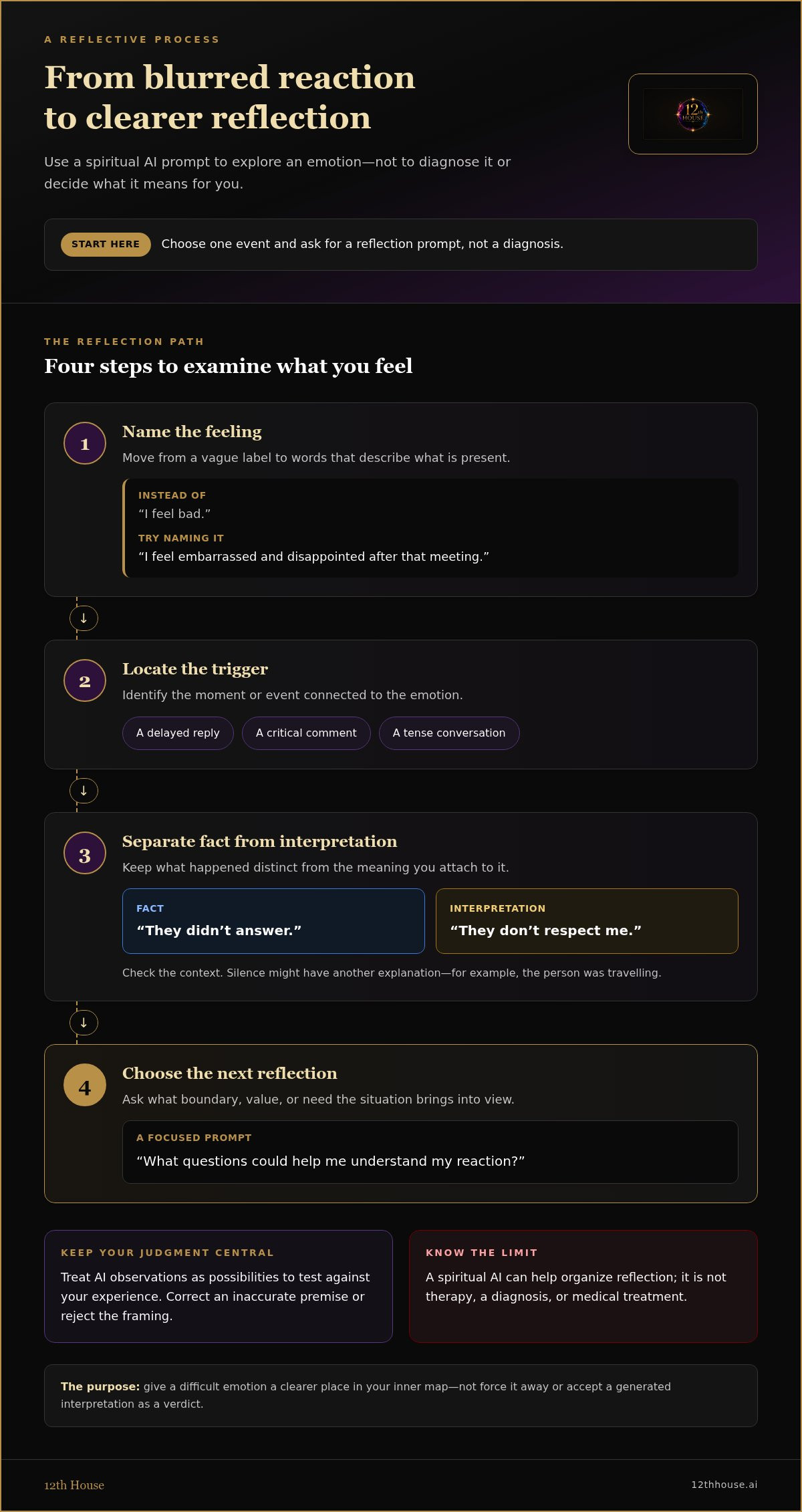
Emotional processing starts with naming what’s present, not forcing an immediate solution. After a tense conversation with a sibling, you might notice anger, guilt, and fear arriving together. A focused prompt can help separate those feelings: “What happened, what did I feel, and what do I need now?” This structure turns a blurred reaction into something you can examine with care.
A spiritual assistant can support reflection with language, questions, and alternative perspectives. It may help you notice that resentment follows repeated boundary crossings, or that sadness accompanies a major transition. Treat these observations as possibilities to test against your experience. Wisdom comes from discernment, not from accepting every interpretation as a verdict.
Make the exchange specific. Describe one event, name the emotion, and ask for a prompt rather than a diagnosis. For example: “I felt overlooked when my colleague presented my idea. What questions could help me understand my reaction?” The response might help you distinguish hurt, workplace expectations, and the conversation you want to have next.
- Name the feeling: Replace “I feel bad” with “I feel embarrassed and disappointed after that meeting.”
- Locate the trigger: Identify the moment, such as a delayed reply or a critical comment.
- Separate fact from interpretation: “They didn’t answer” is different from “They don’t respect me.”
- Choose a next reflection: Ask what boundary, value, or need the situation brings into view.
These steps don’t erase a difficult emotion. They give it a clearer place in your inner map. If a prompt feels inaccurate, revise the details or reject its framing. For instance, an assistant might interpret silence as avoidance, while you know the person was travelling. Correcting that context keeps your reflection anchored in lived experience.
Use the tool to prepare for a real-world conversation, too. Before discussing a conflict with a partner, ask it to draft a calm opening statement and identify the point you need to communicate. Then edit the wording until it sounds like you. A generated script is a starting point, not a substitute for your voice or the other person’s response.
For recurring emotional themes, keep a short record of the situation, feeling, and insight that emerged. Compare entries over time to notice whether the same trigger appears in different settings. If a guided spiritual lens would help you explore those reflections, Ask Lala AI Spiritual Guidance offers a focused place to bring your questions.
Etymology, names, numbers, and symbols
Words carry histories, and those histories shape interpretation. “Symbol” comes from the Greek symbolon, a token or sign used to recognize or represent something. In a reading, a key, mirror, or crossing may prompt different associations. Ask an assistant to explain a symbol’s traditional meanings, then compare them with your own context. The result is a map of possible interpretations, not a fixed definition.
Names work similarly. A name can have linguistic roots, family associations, and personal memories. Ask about the name’s origin separately from what it evokes for you. For example, a reader might connect “Rose” with a relative, a garden, or a particular season. Keeping those layers distinct prevents an etymology from being mistaken for a complete account of someone’s identity.
Numerology interprets names or dates through a chosen calculation system. Different traditions may use different letter values or reduction rules, so the method matters as much as the final figure. Ask the assistant to show its calculation and identify the convention it used. Then check the arithmetic yourself. A transparent process lets you explore how a number becomes meaningful without treating the result as a proven description of your character.
Can AI metaphysical assistants provide accurate astrology, tarot, or numerology readings? They can apply stated interpretive frameworks to the information you provide, but accuracy depends on correct inputs and consistent methods. A symbolic reading can support reflection, but it doesn’t establish a prediction as fact.
For astrology, provide the birth details required by the chart method and ask which assumptions shape the interpretation. A missing or incorrect birth time can affect chart features that rely on time. For tarot, name the question and the cards drawn, then ask for interpretations that distinguish traditional associations from personal reflection. For numerology, request each calculation step. These checks help reveal whether an answer follows a framework or simply sounds persuasive.
Symbols also change with context. A snake might suggest transformation in one story and danger in another. Ask the assistant for contrasting readings, then identify which details support each interpretation. This comparison helps you notice your own assumptions and gives you room to reject an interpretation that conflicts with the actual event or your experience.
- Separate origin from meaning: Ask for a word’s history, then explore your personal associations.
- Request the method: Have the assistant show how a numerological result was calculated.
- Supply context: Connect a tarot image or dream symbol to the specific question or event.
- Compare interpretations: Ask what evidence supports each reading before deciding what resonates.
Use these distinctions to turn symbolic language into inquiry. A birth chart, tarot image, or meaningful name can open a line of reflection, while context and method keep the interpretation grounded. Don’t ask only, “What does this sign mean?” Ask what it brings into focus, which framework shaped the answer, and what you can verify in your own experience.
Possible future AI features
Future spiritual tools may become more structured, not more oracular. A reflection workspace could separate your question, the symbolic framework, and your own response. For example, a dream entry might show the image you described, several interpretive lenses, and notes you add afterward. This design would make the path from prompt to interpretation easier to examine. Its value would come from clearer organization, not claims of hidden intelligence.
Another possibility is user-controlled memory. A tool might let you save a theme, such as recurring work anxiety, then choose whether to connect it with later entries. The interface should show what it remembers and let you revise or remove that context. If you ask about a difficult meeting, it could distinguish that event from earlier notes about family tension. Such boundaries could help prevent unrelated details from being blended into one story.
Framework selection could also become more explicit. Instead of mixing astrology, tarot, and numerology in one answer, a future assistant might ask which system you want to use. It could show the method behind a result, then separate traditional associations from personal reflection. For example, a tarot response could label a card’s conventional symbolism before offering questions about how it relates to your current situation.
Creative features may help people turn reflection into practice. A tool could draft a daily mantra, inspirational quote, personal affirmation, or inner reflection, then invite you to edit the language. A writer exploring a moonlit garden in a story might request different symbolic readings of the setting. The output would be raw material. Your judgment would decide which image belongs in the work.
More accessible interfaces may combine text with voice, images, or guided journaling. Imagine describing a dream aloud, then reviewing a written summary before exploring its symbols. An image feature might help organize a collage of recurring motifs, such as doors, rivers, or birds. Each mode would need clear boundaries: an image is an input for reflection, not evidence that an interpretation is objectively true.
Trustworthy design will matter as much as new capabilities. A future tool should make its limits visible, explain how it uses personal entries, and avoid presenting generated text as professional care. For example, someone asking about persistent distress should be directed toward appropriate human support, not given a confident spiritual diagnosis. Clear controls and careful wording could make the tool more useful without turning it into an authority.
When assessing a new feature, ask: What information does it use? Which interpretive framework shapes its response? Can you correct or discard the result? These checks apply whether the tool creates a mantra, compares symbols, or organizes a journal. The strongest design would support deliberate reflection while keeping you in control of meaning.
Use cases for individuals, families, seekers, and creators
What can an AI metaphysical assistant help with? It can organize reflection, explore symbolic frameworks, and generate creative prompts. For example, you might use it to draft a mantra, examine a dream image, or prepare questions for a family conversation. It offers material to work with; you decide what fits.
For an individual, daily reflection can turn a broad concern into a focused inquiry. Suppose you feel stuck between returning to school and staying in a familiar role. Ask for a personal affirmation or inner reflection centered on the values behind that decision. Then edit the language until it feels honest, not imposed. A short prompt can be powerful when it directs your attention to one clear choice.
Families can use symbolic prompts to start a shared conversation without asking the tool to settle a disagreement. A parent and teenager might each describe what “home” means, then ask for questions that reveal where their expectations differ. Keep the exchange grounded in what each person actually says. The assistant can suggest a conversation structure, but it shouldn’t speak for a family member or assign motives to them.
Seekers can use the tool to explore a spiritual question from several angles. Someone reflecting on a career change could ask for an inspirational quote, a mantra, and an open-ended journaling prompt. Comparing the results may show which words feel supportive and which feel hollow. Save useful language, revise the rest, and connect any insight to a practical choice in daily life.
Creators can treat AI as a symbolic brainstorming partner. A poet writing about a locked garden might ask what the image could suggest about privacy, growth, or fear. A visual artist could request motifs around renewal, then select only those that strengthen the intended work. The aim isn’t to outsource authorship, but to open possibilities the creator can shape with personal taste and purpose.
Try these distinct prompts to match the tool to your task:
- For reflection: “Write a daily mantra about patience that avoids certainty or prediction.”
- For family dialogue: “Suggest three neutral questions about what fairness means in this disagreement.”
- For symbolic exploration: “Offer contrasting interpretations of a recurring river image in my journal.”
- For creative work: “Generate five images connected to renewal, then explain each in one sentence.”
Each prompt defines a purpose and gives you something specific to assess. Keep the result that deepens your inquiry, revise what misses the mark, and set aside language that doesn’t feel like yours. This keeps the assistant in its proper role: a structured aid for personal meaning, family dialogue, and creative exploration.
12Th House: Ask Lala AI Spiritual Guidance
12th House offers Ask Lala AI Spiritual Guidance for exploring personal questions through a spiritual lens. Turn to it when you want structured prompts for reflection, meaning, or symbolic inquiry, while keeping your own judgment central.
Choose a focused framework when your question points to a specific system. Astrology Birth Chart & Transit Analysis explores chart themes and transits; Tarot Readings and Numerology Reports offer other symbolic lenses. Each can help you shape a question and consider an interpretation without treating it as a final verdict.
Start with the inquiry you want to explore, such as a recurring pattern or a decision that feels unclear. Then note what resonates and what does not. Visit 12thhouse.ai to explore Ask Lala AI Spiritual Guidance.
Let your next question shape the practice
Choose one question that matters now, then decide what kind of exploration would help. You might want a reflective prompt, a symbolic reading, or a broader framework for understanding a recurring theme. Let your question guide the tool, rather than asking a tool to decide what your life means.
An AI metaphysical assistant can become part of a thoughtful practice when you set a clear intention and keep your discernment active. Record what you asked, what surfaced, and which idea you want to carry into daily life. Over time, that record can help you notice which questions deserve deeper attention.
For a focused next step, 12th House offers Ask Lala AI Spiritual Guidance, Astrology Birth Chart & Transit Analysis, and Tarot Readings. Choose the path that fits the question you’re ready to explore, then contact 12th House to explore options.
Begin with curiosity. Your attention is the instrument that gives each interpretation meaning.
Frequently Asked Questions
What Makes Spiritual AI Different?
Spiritual AI is designed to engage with metaphysical questions and interpretive frameworks, rather than focusing only on general information or everyday tasks. For instance, you could ask it to compare how two spiritual traditions approach forgiveness, then identify questions for your own reflection. Its specialized framing can make an inquiry more relevant to spiritual practice, while the response still depends on your prompt and the framework used.
What is an AI metaphysical assistant?
An AI metaphysical assistant is a digital tool for exploring spiritual questions, symbolic systems, or personal meaning through conversation. You might ask it to explain a tarot card’s traditional associations, help shape a meditation intention, or suggest questions for examining a recurring theme. It generates responses from language patterns, not personal spiritual experience. Use it to gather perspectives and structure your inquiry, then decide what meaning fits your life.
How do you use an AI metaphysical assistant?
Start with one clear subject, such as choosing a meditation focus or understanding a spiritual term. State the relevant context, then specify the response you want: a comparison, a short reflection, or journaling questions. If the answer blends interpretation with fact, ask it to separate the two. Review the result, correct mistaken assumptions, and keep only ideas that help you think more clearly.
What are the best AI metaphysical assistant apps and services?
Ask Lala AI Spiritual Guidance is a focused option for exploring questions through a metaphysical lens. Use its interpretations as material for reflection, not as final answers.


