
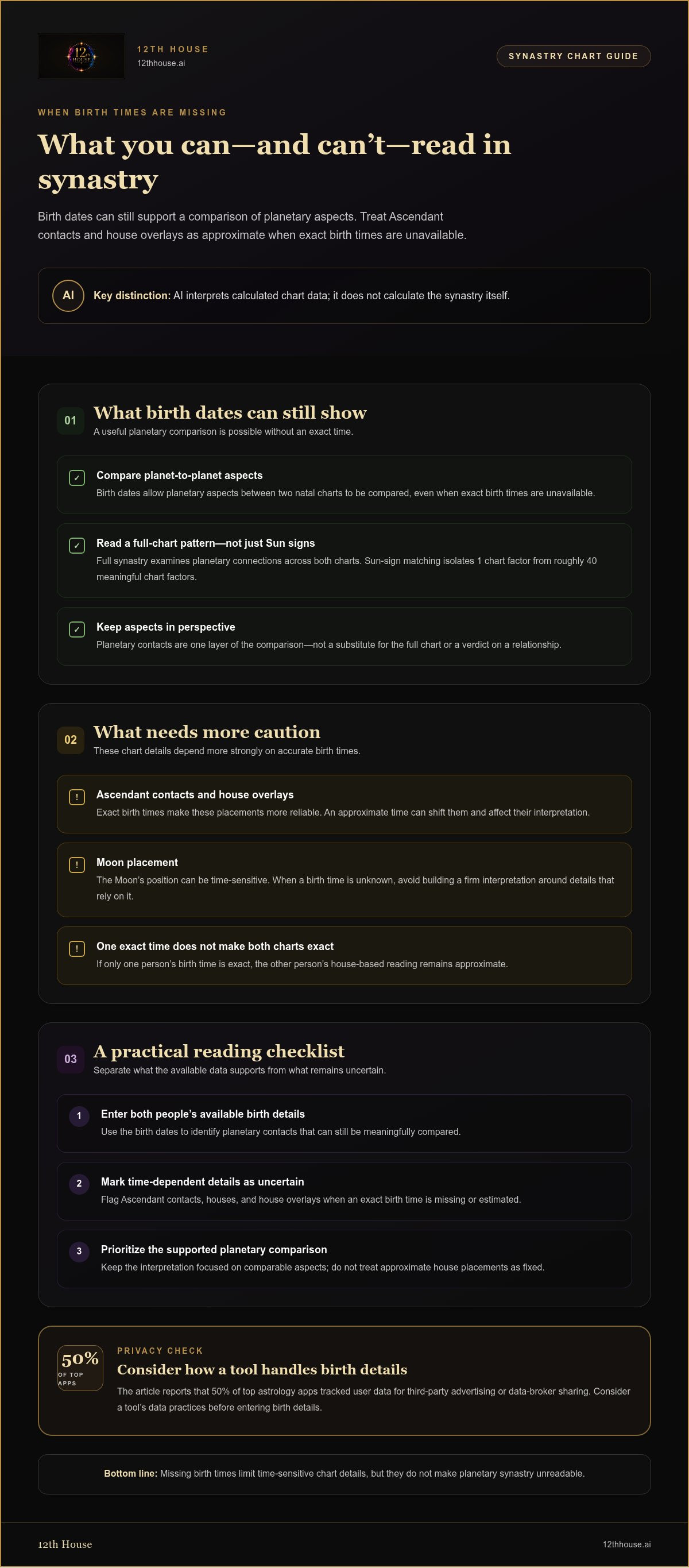
Missing birth times don’t make synastry unreadable. An AI synastry chart reading can still compare planetary aspects calculated from birth dates, but Ascendant contacts and house overlays are approximate without exact birth times. AI interprets the calculated chart data; it doesn’t calculate the synastry itself.
That distinction matters when you want insight without treating uncertain details as fixed. Planetary connections can offer a framework for exploring how two people communicate, respond emotionally, and relate, while house-based themes call for more caution.
Learn how AI interprets synastry data, which birth-time details shape the chart, and how to consider compatibility in romantic, friendship, family, and other relationships. We’ll also explain what aspects, orbs, and house overlays can reveal, and why no single score or placement defines a bond.
Key Takeaways
- Compare both natal charts, not just Sun signs, and look at planetary connections as a pattern rather than in isolation.
- Use birth dates to explore planetary aspects; exact birth times make Ascendant contacts and house overlays more reliable.
- Read compatibility scores as limited summaries, not verdicts. Weigh aspects, orbs, houses, and recurring themes together.
- Adapt the interpretation to the relationship: romantic, family, friendship, and workplace dynamics call for different questions.
- Use AI to organize and explain calculated chart data, while keeping personal choices and the meaning of the relationship in your hands.
What is a Synastry Chart?
A synastry chart compares two full natal charts, showing how one person’s planets interact with the other’s. Its chart wheel, aspect table, and house overlays provide a framework for exploring those connections.
Cross-Chart Planetary Aspects
Read an aspect as an angular relationship between planets in separate charts. A conjunction is 0°, a sextile is 60°, a square is 90°, a trine is 120°, an opposition is 180°, and a quincunx is 150°. Each angle offers a different symbolic lens, not a verdict on compatibility.
A synastry chart can contain forty or more aspects, so begin with the closest contacts. A smaller orb means the planetary connection is closer and generally merits attention first. Then look for recurring themes: several contacts involving Venus and Mars, for example, may emphasize attraction, while one isolated aspect carries less interpretive weight.
Full Natal-Chart Comparison
Full-chart synastry goes beyond comparing two Sun signs. It places both natal charts side by side, allowing the interpretation to examine the Sun, Moon, Mercury, Venus, and Mars, along with house overlays and other planetary contacts. A calculator may display these layers in its wheel, table, and overlay view.
Start by noticing what each chart contributes, then trace the connections between them. The Sun can frame identity, Venus affection, and Mars desire; the Moon adds emotional needs. For example, a Venus-Mars contact and a Moon-Moon contact describe different dimensions of a romantic relationship, so neither represents the full comparison on its own.
Mercury and Moon Communication
Mercury aspects offer a symbolic way to explore how two people exchange ideas, process information, and communicate. A Mercury contact to another person’s Moon connects communication with emotional responses. In practice, notice whether a discussion feels easy to follow, emotionally charged, or in need of extra clarification.
Moon aspects focus on emotional needs and instinctive reactions. Compare Moon-Moon contacts with Mercury links rather than reading either in isolation: one may describe emotional resonance, while the other highlights how people express and interpret thoughts. This distinction can help explain why two people feel close yet misunderstand each other in a particular conversation.
Harmonious and Challenging Aspects
Trines at 120° and sextiles at 60° are commonly read as supportive connections; squares at 90° and oppositions at 180° can point to friction or contrasting approaches. A conjunction at 0° brings planetary themes together, while a quincunx at 150° can suggest adjustment. The planet involved shapes the interpretation.
Consider both ease and tension. Venus-Mars can highlight attraction, while Saturn contacts may bring responsibility, limits, distance, or pressure. Pluto contacts may emphasize intensity, control, or transformation. A careful reading weighs the aspect, its orb, the planets involved, and recurring chart themes instead of letting one difficult contact define the relationship.
Can I do a synastry analysis without an exact birth time?
Yes. Planetary aspects can still be compared using birth dates, but an unknown time makes Ascendant contacts and house overlays approximate. Privacy matters, too: 50% of top astrology apps tracked user data for third-party advertising or data-broker sharing, so consider how a tool handles birth details before entering them.
Full Chart and Sun-Sign Comparisons
Sun-sign compatibility compares one placement in each chart. Full synastry examines planetary aspects between two natal charts, offering a broader framework for understanding compatibility. Sun-sign matching isolates 1 chart factor from roughly 40 meaningful chart factors, so it can’t describe every emotional, communicative, or relational theme.
For a useful comparison, start with the birth dates and examine planet-to-planet contacts. Birth dates allow planetary aspects to be compared even when exact birth times are unavailable. Whether you’re comparing charts with a partner, friend, or family member, distinguish what planetary contacts show from what depends on uncertain house placements.
This distinction keeps the reading precise. An AI synastry chart reading can interpret calculated aspects, but missing birth-time data limits time-sensitive chart details. Treat the planetary comparison as one layer, not a substitute for the full chart.
Birth Details and Chart Accuracy
A synastry calculator uses both people’s birth details to create and compare their charts. Birth dates support planet-to-planet aspect analysis. Exact birth times make the Ascendant, houses, and house overlays more reliable, while approximate times can shift those placements and affect their interpretation.
The Moon’s position also requires care because it can be time-sensitive. When a birth time is unknown, focus on aspects that can be meaningfully compared using the available data. Avoid building a firm interpretation around a house overlay or Ascendant contact calculated from an estimated time.
Use this practical sequence: enter each person’s birth details, identify which chart features depend on exact times, then prioritize planetary aspects that can still be compared. If only one person’s birth time is exact, the other chart’s house-based reading remains approximate. This matters whether you’re exploring a romantic relationship or compatibility with friends.
For a broader personal chart framework, Astrology Birth Chart & Transit Analysis can help you explore how birth-chart placements fit together beyond a single compatibility question.
Does a higher compatibility score mean a better relationship?
No. A compatibility score compresses a complex chart into one figure; it can’t measure how two people communicate, respond emotionally, or make choices. Read the chart’s specific patterns instead of treating a number such as “78% compatible” as a relationship verdict.
Compatibility Across Relationship Types
Synastry can frame romantic, friendship, family, business, and workplace dynamics. The useful question depends on the relationship: romantic partners might explore attraction and emotional needs, while colleagues might focus on communication and contrasting work styles. The same planetary contact can have different meanings in different contexts.
In a friendship, consider whether Mercury contacts support conversation and whether Moon contacts suggest emotional understanding. In a business partnership or workplace, examine how the charts describe differing approaches to ideas, responsibilities, and boundaries. In a family relationship, focus on recurring emotional patterns rather than imposing a romantic interpretation on the chart.
Astrology can describe themes for reflection, but it cannot establish what another person thinks or feels. An AI synastry chart reading can organize those themes, but it can’t determine whether a colleague is trustworthy or whether a friendship will last.
Interpreting Compatibility Scores
Ask what a score actually represents. If a calculator displays “78% compatible” without explaining its derivation, the figure doesn’t tell you which aspects, orbs, or house overlays shaped it. Look for the underlying chart details, then weigh repeated themes across both birth charts instead of relying on one result.
Astrology, numerology, and BaZi offer distinct symbolic frameworks. You can consider what each contributes to reflection, but don’t average their scores or treat agreement as proof. For example, a numerology reading and a synastry chart may frame different questions; neither reveals another person’s private feelings.
A composite chart also differs from synastry: it creates a relationship chart using midpoints from both birth charts. It offers another perspective, not a final rating. Keep it distinct from cross-chart aspects when interpreting the relationship.
Some calculators reserve deeper AI-generated relationship insights for users with a login or credits. Whether an interpretation is freely viewable or requires access, consider what it actually explains. A detailed account of Mercury contacts gives you more to consider than a score without an explanation of how it was derived.
Scores and chart patterns can prompt useful questions, but AI can’t predict marriage, breakup, reconciliation, cheating, or pregnancy. Use the interpretation to reflect on real interactions and choices. The chart is a symbolic map, not evidence that a relationship will succeed or fail.
Synastry for friendships, family, and other relationships
Synastry can map dynamics in friendships, family ties, workplaces, and romantic partnerships. Read the chart in the context of the actual relationship, not through a romantic template.
Synastry Beyond Romantic Relationships
For friends, compare Mercury and Moon contacts to explore conversation and emotional responsiveness. In a family chart, the same placements can help frame familiar patterns between relatives. For colleagues or business partners, focus on communication, differing priorities, and how each person approaches shared responsibilities.
Begin with a question that fits the relationship. For a friendship, ask whether conversations feel reciprocal; for a work relationship, examine how ideas are exchanged. Planetary positions describe symbolic themes, not a person’s character or private intentions. Keep the interpretation grounded in observed interactions.
Conflict and Recurring Patterns
Squares at 90° and oppositions at 180° can describe friction between chart themes. Mars contacts may bring assertive or reactive energy, while Saturn contacts can point to limits, distance, responsibility, or pressure. Look for repeated connections before treating one aspect as a pattern.
For example, if several contacts involve Mars, consider whether disagreements repeatedly center on pace, initiative, or boundaries. Then compare that pattern with what actually happens between the people. A chart can offer language for reflection, but it can’t prove why conflict occurs or determine who is at fault.
House Overlays and Relationship Dynamics
House overlays show where one person’s planets fall within the other person’s chart, linking planetary themes with particular life areas. The 1st, 5th, 7th, and 8th houses are especially associated with relationship overlays. A partner’s Sun in the 7th house may feel partnership-oriented; in the 5th, it may emphasize playfulness or romance.
Read each overlay alongside its planet and aspects. A 5th-house placement may highlight shared creativity between friends, too; context shapes the interpretation. Exact birth times make house positions more reliable. A shared city can alter relocated Ascendants and house overlays, but it doesn’t change natal aspects between charts.
Long-Term Relationship Themes
For long-term bonds, examine Saturn contacts for themes of commitment, responsibility, boundaries, or pressure. These themes can matter in marriage, family, or a business partnership, but they don’t predict whether people will stay together. Weigh Saturn alongside emotional contacts and recurring chart patterns.
Separate a symbolic theme from a forecast. A 7th-house overlay may suggest that partnership is prominent, while a Saturn contact can prompt questions about shared obligations. Neither establishes marriage or lasting commitment. Use the chart to identify topics for honest conversation, then assess the relationship through choices and behavior.
AI interpretation of calculated synastry data
An AI synastry chart reading interprets chart data that has already been calculated. It doesn’t calculate the synastry itself. The distinction matters: charting establishes planetary positions and connections, while AI organizes those results into language. If a birth detail changes, the underlying chart may change before interpretation begins.
The interpretation can draw on birth details, Ascendants, planet signs, whole-sign houses, inter-chart aspects, aspect orbs, and house overlays. Each input adds a different layer. A close aspect may receive more attention than a wide one, while an overlay places a planet within the other person’s house framework. Read the explanation alongside these underlying details.
Use a simple audit. First, identify the chart feature the AI describes. Next, match it to the data, such as a Mercury aspect or a planet’s house placement. Then ask whether the explanation reflects that specific connection or turns it into a broad statement about the entire relationship. This process helps separate chart-based interpretation from personal-sounding language without a clear chart reference.
AI can bring several chart signals together in one analysis. For example, an AI synastry chart reading may connect an aspect, its orb, and a house overlay in a single explanation. That synthesis can make the chart easier to navigate, but it doesn’t make every interpretation equally important. Look for recurring themes across the data, and distinguish them from a single placement presented without context.
Know the boundaries. This interpretation doesn’t cover asteroids, progressed synastry, composite charts, transits, or timing windows. It also can’t determine someone’s private feelings or predict whether a relationship will last. An AI synastry chart reading explains calculated synastry patterns; it isn’t a complete account of a relationship.
For Saturn, the reading may describe responsibility, commitment, limits, distance, or pressure. Squares and oppositions involving Saturn, Mars, or Pluto can bring friction and growth. Consider the planet, aspect, orb, and surrounding chart context to understand why the interpretation emphasizes a theme. Don’t treat one AI-generated sentence as a conclusion about either person.
Use AI as an interpretive layer, not an oracle. Keep the chart data visible, follow each claim back to its placement, and compare the explanation with lived interactions. To explore your own planetary placements in a structured way, explore a birth-chart analysis.
12Th House: Ask Lala AI Spiritual Guidance
12th House offers Ask Lala AI Spiritual Guidance as a next step when you want to explore relationship questions through a structured spiritual lens. Use it to reflect on themes raised by a synastry chart, not to replace your judgment or define another person’s feelings.
To explore your own placements in more depth, Astrology can add personal chart context. Tarot and Numerology offer other frameworks for reflection when your question extends beyond planetary connections. Choose the path that fits what you’re trying to understand, whether that’s communication, emotional patterns, or your own response to a relationship.
Visit 12thhouse.ai to explore Ask Lala AI Spiritual Guidance.
Turn Reflection Into a Clearer Next Step
Let the chart sharpen your questions, not answer them for you. Notice which relationship pattern feels most relevant, then decide what you want to understand about your own role in it. This turns symbolic insight into a deliberate practice of reflection.
An AI synastry chart reading can help organize that inquiry, while your lived experience remains central. If you want to continue exploring, 12th House offers Ask Lala AI Spiritual Guidance, Astrology Birth Chart & Transit Analysis, and Tarot Readings as distinct paths for examining personal questions. Choose the one that matches the kind of reflection you’re seeking, whether you want to explore chart patterns or approach a question through another spiritual framework.
Bring a specific question and an open, discerning perspective. Contact 12th House about a reading and continue your exploration with care and curiosity.
Frequently Asked Questions
Can I check compatibility with someone I haven't met?
Yes, you can compare two people’s birth-chart data without having met them. The result describes astrological patterns, not verified knowledge of a person’s character, intentions, or behavior. For example, a chart may point to contrasting communication styles, but only real interaction can show how those differences play out. Treat the comparison as a prompt for reflection, not a reason to make assumptions about someone you don’t know.
Does this page generate composite or Davison charts?
No. This page focuses on interpreting calculated synastry data, not generating composite or Davison charts. Synastry compares placements across two natal charts, while composite and Davison methods use different chart frameworks. Keep the distinction clear when reading an interpretation: a description of inter-chart aspects is not a composite or Davison analysis, and it won’t provide those charts’ separate perspectives on a relationship.
How is this different from traditional birth chart matching?
Methods vary. Some matching approaches focus on selected factors, such as Sun signs or the Moon-sign score used in traditional Gun Milan. Synastry compares planetary connections across two natal charts, giving the reading a broader set of chart details. The practical difference is the framework: note which placements and criteria a method uses before interpreting its compatibility result, rather than treating different systems as interchangeable.
Is Online Astrology Synastry Accurate?
Accuracy depends on what you mean. Chart calculations rely on the birth details entered, while interpretation explains the resulting placements and connections. An incorrect birth time can affect time-sensitive features, so distinguish those from planetary aspects that can be compared using birth dates. Astrology offers a symbolic framework for reflection, not a measurement that can establish how a relationship will unfold.
Quick Answer: What Is AI Zodiac Compatibility?
AI zodiac compatibility is a computer-generated interpretation of astrological connections between people. A simple version may compare Sun signs, while a synastry-based version draws on more chart information. The useful distinction is scope: a Sun-sign result describes one part of astrology, whereas a broader chart comparison can consider additional placements. Read the result as an interpretive lens, not a ranking of people or relationships.
What is an AI synastry chart reading?
An AI synastry chart reading uses artificial intelligence to explain relationship themes in calculated data from two birth charts. It can put chart details into readable language, such as describing how a Mercury connection may relate to communication. The reading interprets the information supplied to it; it doesn’t reveal private thoughts or replace your own judgment about a relationship.
How does AI analyze compatibility in a synastry chart?
AI interprets chart elements such as planet signs, inter-chart aspects, aspect orbs, Ascendants, and house overlays. It can connect several details in a written explanation, such as describing how an aspect and its orb contribute to a theme. To assess an output, identify the chart placement behind each claim. This makes it easier to distinguish data-based interpretation from broad language.
What birth information is needed for an AI synastry reading?
Start with both people’s birth dates. Exact birth times add the detail needed for more reliable Ascendant and house calculations, including overlays; if a time is unknown, those parts become approximate. Planetary aspects can still be compared using birth dates. Enter only the information required by the chart tool, and keep time-sensitive conclusions separate from interpretations based on planetary connections.


