
Treat a tarot reading as a mirror, not a verdict. An AI tarot reader online can interpret drawn cards in response to your question and offer a structured perspective for reflection. The reading may prompt insight, but it shouldn’t replace your judgment or professional advice.
If you’re unsure what to ask or which spread to use, start with the concern you want to explore. A focused question and a fitting spread give the cards a clearer frame. Thoughtful follow-ups can then help you examine what the interpretation brings up.
This guide shows you how to prepare a question, choose a spread, and consider AI interpretations with discernment. You’ll also learn how to approach follow-ups and use tarot to explore feelings, choices, and possible paths.
Key Takeaways
- Shape your question around the situation you want to explore, then choose a spread that gives it a useful structure.
- Use follow-up questions to clarify a card’s relevance and examine your own reactions, rather than seeking certainty.
- Read AI interpretations as prompts for reflection, not as fixed predictions or substitutes for professional advice.
- Compare the reading with what you know about your circumstances, values, and available choices.
- Turn to Ask Lala AI Spiritual Guidance when you want a structured space to explore a question through spiritual insight.
What should I pay attention to before a tarot reading?
Before a tarot reading, decide what you want to examine and what boundaries matter. A clear question gives the cards and their interpretation a useful frame.
To get an AI tarot reading online, choose a topic, enter a focused question, then select a spread or draw cards. Read the interpretation as a prompt, then use a follow-up to explore one detail.
Account requirements vary by site. Some allow readings without registration, while others request an email or profile. Share only the context needed, such as “I’m weighing two career paths,” rather than names or identifying information.
Yes, AI tarot readings are available online in the United States. The experience varies by site, including the spreads, reader style, and free features on offer.
Match the reading to the decision in front of you. For love, ask what pattern you want to understand, rather than demanding insight into a partner’s private thoughts. For career, explore what might support your next step. For a decision, compare options or consider what you may be overlooking. A daily reading can offer a theme to reflect on, not a fixed instruction for the day.
Free AI readings can help you try a spread before choosing a longer session. Free access may limit the number of readings, available spreads, or follow-up features. Check what the page offers before entering a detailed question, and focus on one topic at a time.
Personalization and Follow-Up Questions
Personalization starts with the context you provide. “I feel stuck at work” gives a reading a different frame from “Should I quit today?” Keep your question specific, but leave room for interpretation. After the first response, ask a follow-up about one card, symbol, or tension. This can deepen reflection without turning the reading into a search for certainty.
Accuracy and Entertainment
An AI interpretation connects your question and drawn cards with symbolic meanings. It can help organize your thoughts, but it can’t establish what another person feels or predict an outcome with certainty. Treat the reading as personal reflection, spiritual exploration, or entertainment, not professional advice. If a career or relationship interpretation feels striking, compare it with real circumstances before acting.
Privacy and Security Risks
A tarot question may reveal sensitive details about relationships, work, or finances. Before submitting it, read the site’s privacy information and consider whether you can ask without names, contact details, or exact locations. Avoid sharing passwords, payment details in a reading prompt, or another person’s confidential information. A general example can still give the cards useful context while limiting personal exposure.
Choosing a tarot spread based on a question
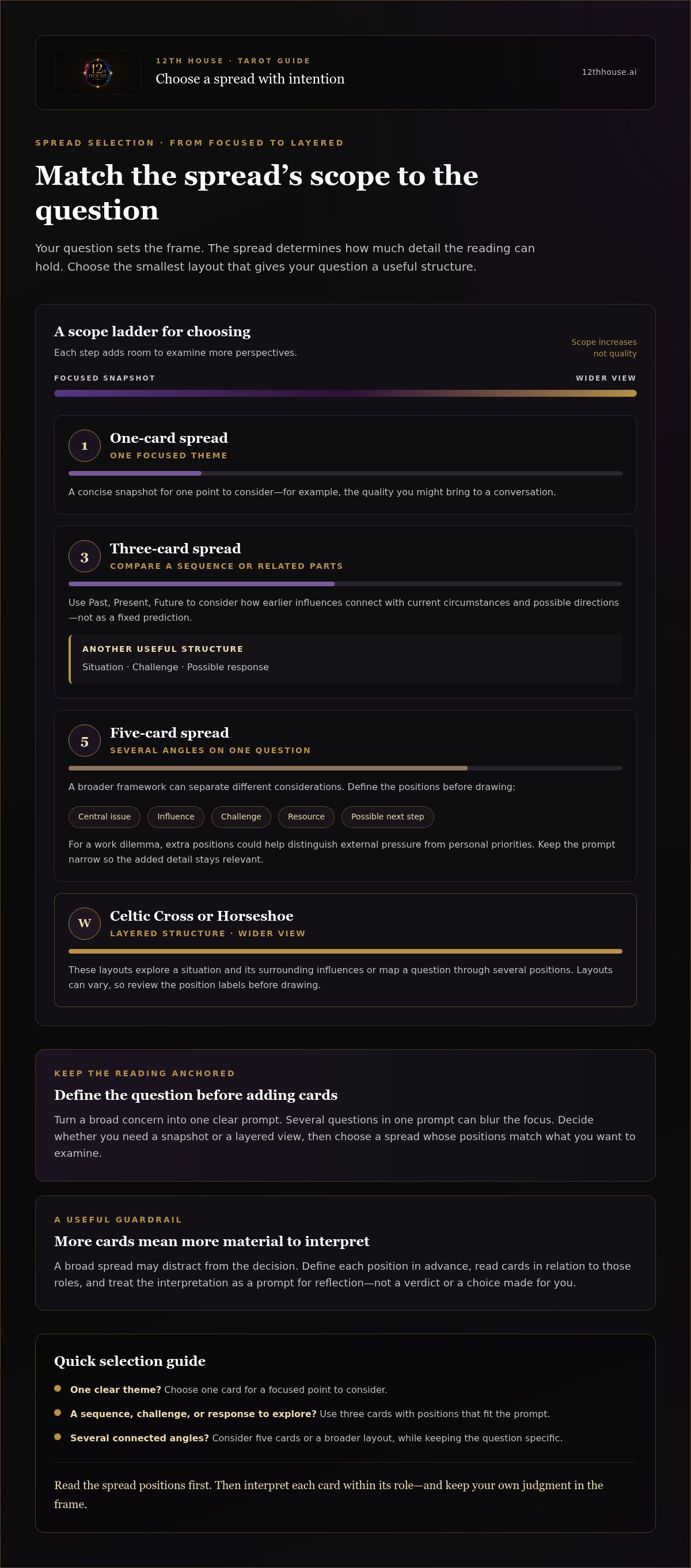
Choose a spread based on the perspective you need: a single point, a sequence, or a wider view. Your question sets the frame; the spread determines how much detail the reading can hold.
Begin by turning a broad concern into one clear prompt. “What should I understand about this transition?” invites reflection, while several questions in one prompt can blur the focus. Then decide whether you need a snapshot or a layered view. A single card focuses on one theme; additional cards create relationships between positions. Choose the smallest spread that addresses your question without adding unrelated details.
One-Card and Three-Card Spreads
A one-card spread offers a focused symbol to consider, such as the quality you might bring to a conversation. A three-card spread allows comparison across positions. In the Past, Present, Future format, each card frames one point in a sequence. Use it to examine how earlier influences connect with current circumstances and possible directions, rather than treating the final card as a fixed prediction.
Three cards can also represent a situation, a challenge, and a possible response. This structure suits a question such as, “What is shaping this choice, and what can I consider next?” Define the positions before drawing. This gives each card a clear role and helps an AI tarot reading stay anchored to your question, instead of generating a general account of every symbol.
Five-Card Spreads
A five-card spread gives you room to examine a question from several angles. For example, assign positions to the central issue, an influence, a challenge, a resource, and a possible next step. These positions are a framework, not a universal formula. Define them before drawing, then read each card in relation to its role and the other cards.
Choose five cards when a three-card layout feels too compressed, but remember that a broad reading may distract from your decision. For a work dilemma, the extra positions could separate external pressure from personal priorities. Keep the question narrow, such as “What should I weigh before accepting this role?” The spread can organize considerations, but it cannot make the choice for you.
Celtic Cross and Horseshoe Spreads
The Celtic Cross offers a layered structure for exploring a situation and its surrounding influences. The Horseshoe spread also maps a question through several positions, often giving a wider view of factors and direction. Layouts can vary, so review the position labels before drawing. Choose the spread whose positions match what you want to examine.
These broader formats can suit a complex question with connected parts, but more cards also mean more material to interpret. Don’t choose the Celtic Cross simply because it’s familiar, or the Horseshoe because it sounds comprehensive. An AI tarot reader online works best when the spread and question share a clear scope. For a direct decision, a smaller layout may offer a more useful focus.
As a final step, read the spread positions first, then interpret each tarot card within that structure. If you want a guided format for exploring a question, a structured tarot reading can provide a clear framework for reflection.
AI reader personalities and follow-up questions
Virtual tarot readers can frame the same card through different personalities and knowledge. Treat the chosen voice as an interpretive lens, then consider whether its guidance helps you understand your emotions and choices.
AI Reader Personalities
Some AI tarot services offer virtual readers with distinct personalities and areas of knowledge. Compare the descriptions before choosing one, and notice which interpretive style suits your question. A direct voice may make a card’s central meaning easier to examine; a more reflective voice may help you explore emotional nuance. Neither personality makes the result more authoritative.
Use the reader’s explanation as a starting point, not a measure of truth. If a card is framed around change, for example, ask how that theme relates to your circumstances. Separate the card’s traditional meanings from the reader’s phrasing. This helps you consider the interpretation without treating a confident tone as evidence of what will happen.
Follow-Up Questions
A useful follow-up narrows the reading to one unresolved detail. If the first response connects a card with hesitation, ask, “What might this hesitation be asking me to examine?” You could also ask how a specific card relates to another position in the spread. Focused prompts keep the conversation connected to the cards and your original question.
Avoid repeating the same question until you receive the answer you want. Instead, identify a phrase that stands out, name the feeling it brings up, then ask what practical choice it illuminates. For example, if a career reading raises fear of change, identify which part of the decision feels uncertain. The follow-up then supports reflection rather than reassurance seeking.
Keep the scope stable as you continue. If your original question concerns a difficult conversation, a follow-up about what you want to express stays relevant. Switching suddenly to a prediction about another person’s private intentions changes the focus and invites unsupported conclusions. Use the cards to examine your perspective, not to claim access to someone else’s thoughts.
For personal growth, record the question, card meanings, and your response in a journal. Revisit the entry when the situation changes and note whether your priorities have shifted. The value lies in comparing your interpretation with lived experience. An AI result can help you articulate feelings or consider a choice; your reflection supplies the context the symbols cannot provide.
Close the reading with one grounded action, such as listing the information you need before making a decision. This turns symbolic guidance into a question you can work with. Keep the action within your control, and let the reading open inquiry rather than dictate an outcome.
Rational interpretation and limitations of tarot
An AI tarot reader takes your question and drawn cards, then generates an interpretation that connects them. Read the result as symbolic guidance, not a factual report of what will happen.
AI-Generated Interpretations
An AI interpretation responds to the question and cards you provide. It may connect a card’s symbolism with your situation, then explain that connection in writing. For example, a card associated with change might prompt you to consider what feels unsettled. The interpretation offers a frame for thought, not proof that change is coming.
To assess the result, separate three elements: the card’s meaning, its position in the spread, and the AI’s explanation. Ask whether the response addresses your question or relies on broad statements that could fit many situations. This review can help you find a useful idea without confusing fluent language with evidence.
Differences Between Interpretations
Interpretations of the same tarot card can differ because the question, spread position, and symbolic emphasis differ. A card in a challenge position may be read differently from the same card in a resource position. Compare how each explanation uses those details, rather than looking for one universally correct sentence.
For example, a reading about a career change may frame a card around risk, while another highlights preparation. Consider whether both interpretations point to a pattern you recognize. Then test that pattern against concrete details, such as your priorities or what you know about the role. Agreement between symbolic interpretations can invite reflection; it doesn’t verify a prediction.
How an AI Tarot Reader Works
An AI tarot reader generates text in response to your question and drawn cards. It uses the supplied details to produce an interpretation, linking card meanings with your prompt. Asking about a strained friendship gives the response a different context from asking about a work decision, even if the same card appears in both readings.
That process has clear limits. The generated interpretation reflects your input and a symbolic framework, not independent knowledge of your life or another person’s thoughts. Tarot readings can support personal reflection, self-awareness, entertainment, and spiritual exploration. Use them to examine emotions and possible choices, not as guaranteed predictions or professional advice.
Keep the distinction practical: a card can suggest a question, but it cannot establish a fact. If an interpretation raises concern about a relationship, consider observable behavior and your own boundaries. If it touches on a career decision, weigh real options and consequences. This lets tarot symbolism support reflection while keeping important decisions grounded in evidence.
Tarot as a tool for self-reflection
Tarot can support reflection when you treat each card as a mirror, not a verdict. A symbol can help you name a feeling or notice a choice you’ve been avoiding. For example, a reading about a difficult conversation may reveal what you hope to say, fear, or protect.
Use the cards to structure your own inquiry. Write down the question, the card’s position, and your immediate reaction. If a card suggests conflict, ask whether it reflects an actual event, an expectation, or a worry. This distinction can bring clarity without asking the reading to establish facts or make decisions for you.
Try this four-step reflection after a reading:
- Name the response. Record the first emotion that appeared, such as relief, resistance, or disappointment.
- Connect it to a detail. Note which image, phrase, or card position prompted that reaction.
- Test the interpretation. Compare it with something you know, such as a recent conversation or a choice you’re weighing.
- Choose a grounded next step. Identify one action within your control, such as gathering information or setting a boundary.
Consider the career question, “What should I examine before accepting this role?” If the reading highlights ambition, ask whether the role fits your priorities, not whether the card guarantees success. List practical factors beside your reflection, such as responsibilities, values, and questions for the hiring conversation. The cards open a line of inquiry; evidence helps you assess it.
Reflection also means noticing when an interpretation doesn’t fit. If a card’s suggested theme feels distant from your experience, record that response instead of forcing agreement. A mismatch can prompt a better question: “What part of this situation am I not considering?” Use the reading to explore possibilities, then let your lived experience shape what feels meaningful.
Keep a brief journal entry for each reading: date, question, card, interpretation, and one real-world observation. Revisiting those notes can show how your understanding changes as circumstances unfold. Look for patterns in your reactions, not proof that the cards predicted events. This practice records your perspective at that moment.
For a reflective reading with a defined symbolic framework, explore Tarot Readings. Bring one question and use the interpretation to deepen your own inquiry.
12Th House: Ask Lala AI Spiritual Guidance
12th House’s Ask Lala AI Spiritual Guidance offers a structured way to explore a spiritual question after a tarot reading. Turn to it when you want to examine an interpretation, clarify what you’re feeling, or consider a question from another angle. Use your own circumstances as context, and treat the guidance as a prompt for reflection rather than a directive.
If your inquiry centers on card symbolism, Tarot Readings offer a closely related path. For questions that call for a different symbolic framework, Astrology Birth Chart & Transit Analysis and Numerology Reports offer other forms of metaphysical interpretation.
Visit 12thhouse.ai to explore Ask Lala AI Spiritual Guidance.
Carry Your Reflection Into the Next Step
Let the reading become a starting point for a more considered question. Before acting, write down what you want to understand, what you already know, and what remains yours to decide. That pause connects symbolic insight with lived experience.
An AI tarot reader online can offer another perspective, while your next step depends on the inquiry. For card-based exploration, 12th House offers Tarot Readings. Ask Lala AI Spiritual Guidance supports broader spiritual inquiry, while Astrology Birth Chart & Transit Analysis offers a distinct astrological framework.
Choose the path that fits your question, and bring one clear point of focus. You don’t need to arrive with certainty. Curiosity and a willingness to examine your own response are enough to begin.
Explore 12th House’s spiritual guidance and take your next step with intention.
Frequently Asked Questions
Can tarot guidance help with life decisions?
Yes, tarot guidance can help you examine what matters in a decision, but it can’t choose for you. Use a card as a prompt to identify a concern, value, or assumption. Before accepting a role, for example, ask what deserves closer attention, then list practical questions about responsibilities and fit. This makes the reading a reflective exercise alongside your judgment, not the sole basis for a major choice.
Can I repeat readings for the same question?
Yes, but repeating a reading immediately can make it harder to distinguish reflection from reassurance seeking. Note the original cards and what you took from them instead. Return to the question when circumstances or your understanding have changed. After a conversation with a manager, for example, you may have new details about a work decision. Use them to refine the question rather than drawing again simply to get a preferred answer.
How often can I use the tarot reader?
How often you can use a tarot reader depends on the platform’s access rules and any limits it sets. Some services may restrict free readings or daily use, while others structure access differently. Review the terms on the reading page before you begin. For your own practice, seek a new reading when you have a distinct question or a meaningful change in circumstances, rather than repeating the same question in one sitting.
Why do different tarot sources give different insights?
Tarot sources can emphasize different symbolism, card positions, and interpretive traditions. The same card may signal a resource in one spread and a challenge in another. AI systems may also phrase interpretations differently based on your question and the context you enter. Compare the reasoning behind each insight: does it connect to the card and spread, or offer a broad statement? That comparison is more useful than seeking identical wording.
Are there free AI tarot readings online?
Yes, some websites offer free AI tarot readings, though features and access limits differ. A free option may restrict how often you can read, which spreads are available, or whether you can ask follow-up questions. Review the terms on the page before entering a question. Start with a low-stakes prompt, such as what to reflect on during a conversation, and see whether the format suits your needs.
How much do paid AI tarot readings cost?
Paid AI tarot readings vary in price. Cost may depend on the reading format, depth of interpretation, and follow-up access. Compare what a paid option includes, such as the spread and level of detail, rather than relying only on an advertised starting price. Payment doesn’t make an interpretation more certain or turn symbolic guidance into a verified prediction.
How accurate or reliable are AI tarot readings?
AI tarot readings can interpret drawn cards in relation to your question, but they can’t verify what will happen. A response is more useful when it connects the spread positions and card symbolism coherently. Check whether it explains why a card relates to your prompt, rather than offering a statement that could fit anyone. Treat a useful insight as one perspective, then compare it with what you know.
Can AI tarot readings provide advice about health, money, or relationships?
AI tarot readings can help you reflect on feelings or concerns in these areas, but they aren’t professional advice. For a health question, use a reading to identify what you want to discuss with a qualified health professional, not to decide on treatment. For money, examine your priorities without treating cards as financial analysis. For relationships, focus on your own boundaries and choices rather than assuming the cards reveal another person’s private thoughts.


