
The app that feels most like The Pattern may not be the best fit for you. A search for “The Pattern app alternative” may mean you want a different reading style, more chart detail, or features that suit your routine. Compare what each app includes for free and with a paid plan before choosing.
If you’re drawn to reflective guidance, interpretation and self-understanding may matter more than a long list of tools. You might prefer a different framework, clearer explanations of chart placements, or an approach more aligned with your interests. Treat “The Pattern app alternative” as a starting point for defining what you want from astrology, not as a feature checklist.
This guide compares five options by reading experience, focus, and free or paid features. Use “The Pattern app alternative” as a prompt to clarify your priorities, then follow the decision guide to find an app that suits the way you engage with astrology.
Key Takeaways
- Start with the kind of insight you want, such as chart interpretation, daily reflection, or relationship dynamics.
- Compare what each app includes for free with the features reserved for a paid plan before choosing.
- Look beyond compatibility labels to see how an app frames bonds, friendship, and chart connections.
- Use the comparison of Co-Star, CHANI, TimePassages, and Sanctuary to match an app’s approach with your preferences.
- When you want to explore a personal question beyond app-based readings, consider a structured spiritual guidance tool.
Choosing an astrology app based on experience and interests
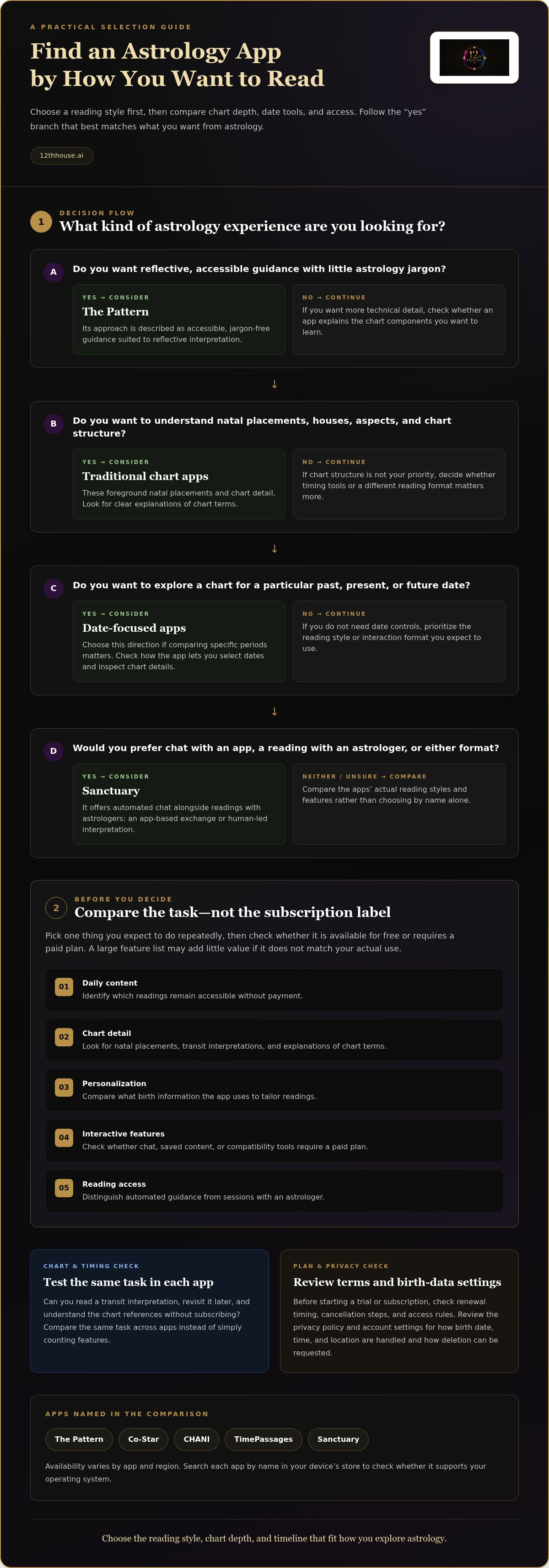
Start with the kind of reading you want. The Pattern offers accessible, jargon-free astrology guidance, while traditional chart tools foreground placements, houses, and aspects. If you want reflective prompts, prioritize the first approach. If you want to learn how a natal chart is structured, choose an app that explains its components.
Timing matters, too. Decide whether you want to explore a natal chart, current transits, or a date in the past or future. Apps present these timelines differently: one may emphasize ongoing cycles, while another lets you inspect chart details for selected dates. If you plan to compare periods, make date controls a key criterion.
Sanctuary offers a different format, with automated chat alongside readings with astrologers. Chat suits a quick exchange with an app, while a reading with an astrologer offers human-led interpretation. The Pattern avoids much of astrology’s technical vocabulary, setting its style apart from apps built around detailed chart terminology.
Which astrology apps are available on both iOS and Android? The Pattern, Co-Star, CHANI, TimePassages, and Sanctuary are options to compare, but availability varies by app and region. Search each app by name in your device’s store to see whether it supports your operating system.
What are the best alternatives to The Pattern if you want less astrology and more personality analysis? Compare how clearly apps explain character and relationship patterns without requiring chart knowledge. The Pattern already centers on accessible guidance; an app focused on natal chart placements may feel more technical than personality-focused.
How do astrology apps handle birth data, privacy, and account deletion? Birth date, time, and location can inform chart calculations, so review an app’s privacy policy and account settings before entering your details. These explain how data is handled and how to request deletion, though practices and steps vary by app.
| Option | Experience | Best fit |
|---|---|---|
| The Pattern | Jargon-free astrology guidance | Reflective, accessible interpretation |
| Sanctuary | Automated chat and astrologer readings | Chat or human-led reading formats |
| Traditional chart apps | Natal placements and chart detail | Learning astrology’s technical structure |
| Date-focused apps | Past, present, or future chart exploration | Comparing specific periods |
Choose an app whose reading style, chart depth, date tools, and privacy controls match how you want to explore astrology.
An app’s tone may matter as much as its chart tools, especially when someone is seeking reflection during a difficult period. One person says they used an astrology app for around 2-3 months while depressed and looking for a job. That is one person’s experience, not evidence that an app can improve mood or employment prospects. It can still help you consider what you want from an app: technical explanations, reflective guidance, or a format that feels comfortable to return to.
Before settling on an app, consider whether its language and prompts suit your interests and whether its approach feels useful rather than demanding. Keep expectations grounded: an astrology app provides the experience described in its features, but cannot promise a particular personal outcome. Choose based on the interpretation style you prefer and the chart details or timeline controls you expect to use.
Free and paid app features
Compare the actual tools each astrology app offers, not just its subscription label. A free tier may provide a daily reading, while a paid plan may add deeper interpretations or more chart tools. These are comparison criteria, not claims about any particular app. Review the current feature lists for The Pattern, Co-Star, CHANI, TimePassages, and Sanctuary. If you searched “The Pattern app alternative,” start by naming the feature you hope to find elsewhere.
Choose one task you expect to repeat. If you want to connect a daily reflection with your natal chart, look for both features in the plan you’ll use. If you mainly want a quick horoscope, an extensive library of paid reports may add little value. Match each feature to a question you actually bring to the app, such as understanding a transit or revisiting a chart interpretation.
Use this checklist to compare access clearly:
- Daily content: Identify which readings remain accessible without payment.
- Chart detail: Look for natal placements, transit interpretations, and explanations of chart terms.
- Personalization: Compare what birth information the app uses to tailor readings.
- Interactive features: Note whether chat, saved content, or compatibility tools require a paid plan.
- Reading access: Distinguish automated guidance from sessions with an astrologer, as Sanctuary presents both formats.
Next, check what’s included for free and what requires payment. Open the app’s plan screen and note which features trigger an upgrade prompt, then compare the same task across apps. For example, see whether you can read a transit interpretation, revisit it later, and understand its chart references without subscribing. This is more useful than simply counting features.
Plan terms matter as much as tools. Before starting a trial or subscription, read the renewal timing, cancellation steps, and access rules shown in the app store or account screen. A trial helps you assess an app only if it includes the features you want to test. Set a reminder before the stated end date, and follow the cancellation method in the subscription settings if you decide not to continue.
Keep a comparison note for each app: free features, paid features, and the tool you expect to use most. This gives your search for “The Pattern app alternative” a practical test: does another app support how you want to explore astrology? Revisit your comparison if an app’s plan screen changes, as publishers can update feature access.
If you want to explore a personal question beyond app feature tiers, structured spiritual guidance offers another way to reflect and connect insight with your concerns.
Which astrology apps offer The Pattern’s bond and compatibility features?
The Pattern’s Bonds feature makes relationships central to its astrology experience. For a similar purpose, compare apps with compatibility readings or synastry, which compares two birth charts. Co-Star offers compatibility features, while TimePassages supports chart comparison. These approaches explore connection through different interpretive frameworks.
Co-Star is a closer comparison if you want app-based compatibility features. Consider how it describes the connection between two people and whether the reading emphasizes shared traits, tension, or broader dynamics. The Pattern frames bonds in its own interpretive language, so compare the reading style as well as the feature name.
TimePassages suits readers who want to examine the chart mechanics behind a relationship. Synastry compares placements across two natal charts to explore how one person’s planets relate to another’s. This can feel more technical than a narrative bond reading. Decide whether you want an interpretive summary or chart details you can study directly.
CHANI and Sanctuary offer different points of comparison. CHANI centers its experience on astrology interpretation, while Sanctuary combines automated chat with readings from astrologers. Compare the specific relationship tools in each app before treating either as a substitute for a dedicated bond feature. Their value may instead be in a different style of guidance.
Let the relationship question guide your choice. A friendship reading, romantic compatibility overview, and detailed chart comparison are different tasks. For example, if you want to understand why two people communicate differently, synastry may offer chart placements to examine. If you prefer a concise interpretation, a compatibility reading may feel more direct.
- Choose Co-Star to explore an app-based compatibility feature.
- Choose TimePassages if comparing natal charts and placements appeals to you.
- Compare CHANI and Sanctuary for distinct interpretation or reading formats, rather than assuming they duplicate Bonds.
- Keep The Pattern in the comparison if its relationship-centered framing is what you want to preserve.
Before committing to an app, open its relationship feature and note what information it asks you to enter, what kind of interpretation it provides, and whether it explains the chart logic. Compare the same two-person question across The Pattern, Co-Star, and TimePassages. This practical test can show whether you prefer narrative guidance, compatibility summaries, or a more technical synastry lens.
The closest alternative depends on what you mean by “bond”: a relationship narrative, a compatibility score, or a chart comparison. Define what you need first, then choose the app whose approach offers insight you’ll use.
How do Co-Star, CHANI, TimePassages, and Sanctuary compare with The Pattern?
The Pattern, Co-Star, CHANI, TimePassages, and Sanctuary offer different astrology experiences. The Pattern is known for accessible, relationship-aware guidance. Co-Star offers another app-based interpretation style, while CHANI brings a distinct astrology voice. TimePassages suits chart-focused exploration, and Sanctuary combines automated chat with astrologer readings. Choose based on the insight you want to return to.
If you value reflective language, The Pattern’s jargon-free approach can make interpretations easier to engage with. Co-Star is worth comparing if you want a different daily astrology experience and compatibility features. See how each app expresses the same concern, such as tension in a friendship. One may offer a narrative reflection, while another foregrounds chart-based explanations.
CHANI and TimePassages serve different interests. CHANI may appeal if you want astrology through a distinctive interpretive lens. TimePassages suits readers who want to examine natal chart placements and learn how chart components relate. If you’re learning astrology, consider whether you prefer to start with an interpretation or the underlying chart structure.
Sanctuary stands out for its format. Automated chat offers an interactive way to explore astrology, while readings with astrologers provide a human-led experience. Compare Sanctuary if conversation matters more to you than a static chart report. Its approach differs from The Pattern’s familiar, jargon-free guidance, so consider how you prefer to engage with an interpretation.
| App | Distinctive comparison point | Consider it if you prefer |
|---|---|---|
| The Pattern | Accessible, reflective guidance | Interpretation without dense astrology terms |
| Co-Star | Alternative daily astrology experience | App-based readings and compatibility exploration |
| CHANI | A distinct interpretive voice | Astrology presented through a clear perspective |
| TimePassages | Natal chart detail | Placements and chart structure |
| Sanctuary | Automated chat and astrologer readings | Interactive or human-led formats |
Use the same test for each app. Choose one question, such as understanding a recurring relationship pattern, and compare how each app frames it. Note whether the reading feels interpretive, technical, or conversational. This keeps the comparison grounded in your actual use, not just branding.
For a quick decision, choose The Pattern for accessible reflection, Co-Star for another app-based daily experience, CHANI for its interpretive voice, TimePassages for chart detail, or Sanctuary for chat and astrologer readings. Review each app’s current features before relying on a particular tool.
When evaluating these options alongside alternatives like 12th House, consider whether you want an alternative daily reading and compatibility feature, CHANI if its interpretive voice suits you, TimePassages if you want to work from placements, and Sanctuary if chat or a human-led reading feels more engaging. Chani Nicholas began a career in astrology in 2015. Treat that detail as background rather than a substitute for testing the app: a career timeline does not by itself tell you which reading style will feel useful.
Before settling on an app, decide what you want it to do after the reading: help name a feeling, explain a chart component, or make room for a back-and-forth. Keep the same question in mind as you compare, and consider clarity and tone, not just the amount of information. If an interpretation’s wording leaves you unsure what to do with it, another format may be easier to revisit. The best fit is an approach you understand and want to return to.
Are there alternatives to The Pattern for relationship compatibility and friendship insights?
Yes. Co-Star and TimePassages offer different ways to explore connections, while The Pattern centers its experience on relationship bonds. Compare the method, not just the feature name. A friendship reflection, romantic compatibility reading, and synastry chart each answer different questions.
Start by defining your relationship question. Do you want to understand recurring tension, shared strengths, or how two charts interact? The Pattern’s bond-focused approach may suit readers seeking an interpretive overview. Co-Star offers a separate compatibility experience. TimePassages supports chart comparison, helping readers examine the astrological components behind a connection.
Chart comparison takes a more technical approach. Synastry places two natal charts in relation and interprets how their placements interact. For example, you might examine how one person’s communication-related placements connect with another’s. This approach gives astrology learners chart structures to explore rather than relying only on a short relationship summary.
A friendship reading calls for its own criteria. Look for language about communication, emotional needs, and shared patterns, rather than treating every relationship as romantic compatibility. Compare how The Pattern and Co-Star describe the same friendship question. Then consider whether TimePassages’ chart-based approach gives you details you can interpret yourself.
Use this comparison to choose a starting point:
| App | Relationship approach | Useful for |
|---|---|---|
| The Pattern | Bond-focused interpretation | Readers seeking relationship reflections |
| Co-Star | Compatibility feature | Exploring a separate app-based reading |
| TimePassages | Comparison of natal charts | Examining chart placements and connections |
Test the apps with the same prompt. For example, ask how a friendship’s communication style appears in the reading. Note whether each app offers a narrative, compatibility interpretation, or chart details. That distinction shows whether the tool answers your question or simply offers a different astrology format.
Then assess the interpretation itself. Does it explain the basis for its reading? Can you connect its language to specific chart details or recognizable relationship patterns? A useful reading gives you something to reflect on, not a fixed verdict about another person. Focus on curiosity and understanding rather than treating compatibility as a final judgment.
Choose Co-Star for compatibility features, TimePassages for chart comparison, or The Pattern for bond-centered reflection. The best fit depends on whether you want an overview, a chart framework, or insight into a specific friendship. Define that need first, then compare the same question across apps.
12Th House: Ask Lala AI Spiritual Guidance
12th House offers Ask Lala AI Spiritual Guidance for readers who want to explore a personal question beyond an app’s compatibility summary. Use it when a relationship reading prompts reflection about your own patterns or choices. For chart-based context, Astrology Birth Chart & Transit Analysis explores birth chart and transit themes. Tarot Readings and Numerology Reports offer other interpretive frameworks when you want to approach a question through a different symbolic system.
Choose the lens that fits what you’re exploring: astrology for chart patterns, tarot for a reading, or numerology for number-based interpretation. Visit 12thhouse.ai to explore Ask Lala AI Spiritual Guidance.
Choose a path that keeps your questions moving
An app can offer a reading, but reflection gives it meaning. Notice which questions stay with you, then choose a framework that helps you examine them thoughtfully. “The Pattern app alternative” can lead you to a different style of insight, not just another app with similar features.
For a further way to explore personal questions, 12th House offers Ask Lala AI Spiritual Guidance, Astrology Birth Chart & Transit Analysis, and Tarot Readings. Consider which lens fits what you want to examine next. A search for “The Pattern app alternative” can be the beginning of that inquiry, rather than its conclusion.
Explore spiritual guidance at 12th House and continue with curiosity. Your discernment remains central as you make meaning from the symbols and insights you encounter.


