
What if the most vital message in your tarot spread isn't printed on the cards, but exists in the silent friction between them? You've likely felt the frustration of pulling three cards that seem to speak entirely different languages. You consult the guidebook, memorize the keywords, yet the "big picture" remains a blurred mosaic. It's exhausting to feel like a translator who can only speak in broken fragments. You want a reading that feels like a solid structure, not a pile of loose bricks.
This guide will teach you how to read between the lines of a tarot reading by treating the spread as a cohesive architectural system rather than a series of isolated events. By mastering metaphysical synthesis, you'll move beyond the limitations of the "book reader" and step into the role of a metaphysical architect. We'll explore the technical mechanics of elemental dignities, visual geometry, and numerological logic to help you decode data into a definitive narrative. Prepare to transform your practice from a search for definitions into a precise calculation of the soul's current trajectory. It's time to build a sanctuary of clarity from the symbols on your table.
Key Takeaways
- Transform isolated card definitions into a cohesive narrative by mastering the discipline of metaphysical synthesis.
- Learn how to read between the lines of a tarot reading by analyzing visual geometry and sightlines to map character interactions.
- Calculate elemental dignities to identify energetic friction; determine if the suits strengthen or weaken the spread's core message.
- Decode the numerological blueprint to reveal the maturity level and progressive timeline of the situation you're analyzing.
- Synthesize complex data into a singular, punchy declaration that provides clinical clarity for your personal journey.
Beyond the Guidebook: How to Read Between the Lines of a Tarot Reading
Reading tarot is often taught as a simple translation of isolated symbols. This approach is fundamentally flawed. When you learn how to read between the lines of a tarot reading, you transition from reciting definitions to decoding a living blueprint. It's the difference between knowing individual words and understanding a complex conversation. We call this "metaphysical intelligence." It's a structured discipline that uses logic and architectural frameworks to anchor your intuition. Without this synthesis, a spread is just a pile of loose bricks. With it, you build a sanctuary of clinical clarity.
Most readers experience a "stuttering" effect when cards seem to fight each other. You might pull a card of grief next to a card of celebration and feel immediate confusion. This happens because you're viewing the cards as separate islands. True synthesis treats the spread as a single, unified data set. You aren't just looking at what the cards say; you're calculating what they do to one another. This shift in perspective allows you to see the invisible threads of cause and effect that guide a client’s trajectory.
The Limitations of the Guidebook
Guidebooks are essential training wheels, but they're never the final destination. Relying on them prevents you from developing a personal symbolic vocabulary. The problem with "book reading" is that it can't account for the unique friction between specific cards. A guidebook offers a generic average of a card's meaning. It doesn't tell you how the Five of Pentacles changes when it's shadowed by the Sun. Understanding the history and structure of tarot reveals that these cards were designed as a mathematical and symbolic system. They're meant to be decoded as a whole, not consumed in fragments.
The Anatomy of a Synthesized Reading
Synthesis is the architectural bridge between individual symbols. To achieve this, you must analyze three specific pillars: visual geometry, elemental dignities, and numerological logic. These pillars provide the "how" and "why" behind the "what." Every spread also contains an "Anchor Card." This is the card that holds the most weight or sets the primary tone for the inquiry. Once you identify this anchor, you interpret every other card through its specific lens. This structured method ensures that your interpretation remains grounded and precise. It moves the practice from a vague psychic mystery into a serious, analytical study of the subconscious blueprint.
Architectural Mapping: Using Visual Geometry to Connect Symbols
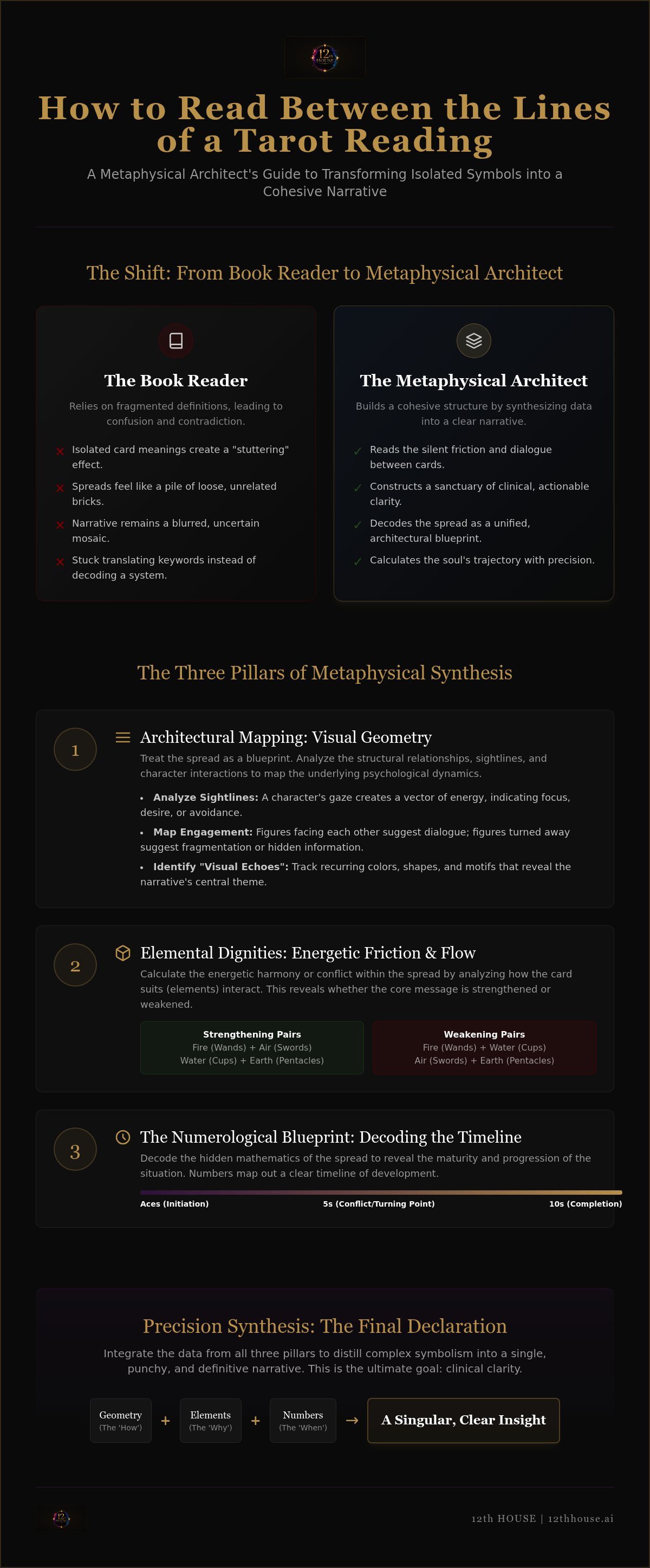
Visual geometry is the structural framework of a spread. While many readers focus on the individual "vibes" of a card, a metaphysical architect analyzes the interactional geometry between them. This approach treats the cards as a series of connected rooms in a blueprint. By observing how figures lean toward or pull away from each other, you begin to see the underlying logic of the situation. This is a critical step in mastering how to read between the lines of a tarot reading. It transforms a static image into a dynamic, calculated dialogue.
The placement of figures creates a specific tension. When two archetypes face one another, they're in direct communication. When they look in opposite directions, they suggest a fragmentation of focus. This geometry isn't accidental; it's a precise map of psychological and energetic alignment. By decoding these patterns, you move beyond the surface level of the art and into the structural heart of the message.
Sightlines and Engagement
Where is the character looking? Their gaze creates a vector of energy that points toward the past, the future, or a specific challenge in another card. If a figure looks directly at an object in the adjacent card, they're signaling intense focus or desire. If they look away, they're indicating avoidance or a preoccupation with what has already transpired. Characters with their backs turned often represent hidden information or a refusal to engage with the current reality. Pay attention to the "void," the empty space between two interacting cards. This space reveals the quality of the relationship: is it a distance of safety or a gap of neglect?
Symbolic Architecture
Identify "Visual Echoes" to find the narrative's pulse. These are recurring colors, shapes, or motifs that act as a thematic thread throughout the spread. If multiple cards feature jagged mountains, the landscape suggests a period of sustained challenge or high-stakes ambition. If a specific tool, like a cup or a sword, appears across different scenes, it becomes a focal point for the inquiry. Mapping the movement from one card’s landscape to the next allows you to see the progression of the soul's journey. Is the water in the first card calm while the water in the third is turbulent? This visual consistency provides the data you need for a precise interpretation.
Analyzing these geometric connections requires a high level of observation. If you feel stuck, you can use Ask Lala AI Spiritual Guidance to help decode these complex visual patterns. By identifying the dialogue between archetypes, you move from passive observation to active calculation. You aren't just seeing what is there; you're seeing how it moves.
Elemental Dignities: Analyzing Energetic Friction and Flow
If visual geometry provides the blueprint, the elements are the building materials. Every tarot spread is composed of Fire, Water, Air, and Earth. Understanding how these substances interact is fundamental when learning how to read between the lines of a tarot reading. This system, known as Elemental Dignities, allows you to calculate whether the cards in a spread are supporting or sabotaging one another. It moves the reading from a list of definitions into a study of energetic chemistry. You aren't just looking at symbols; you're observing how they react when placed in the same environment.
Analyze the "Friction" in your spread to identify where the querent is experiencing resistance. For instance, when the sharp, intellectual energy of Air (Swords) meets the dense, material reality of Earth (Pentacles), friction occurs. The mind's logic clashes with physical limitations, creating a "stutter" in progress. Conversely, look for "Flow." Water (Cups) naturally nourishes Earth (Pentacles), suggesting that emotional investment is exactly what's needed to foster tangible growth. These interactions provide a layer of clinical clarity that isolated meanings cannot offer. They reveal the hidden mechanics of a situation's success or failure.
The Chemistry of the Suits
Identifying which elements dominate a reading is a primary diagnostic step. A spread heavy in Fire (Wands) suggests a high-stakes, fast-moving situation driven by passion. However, the most profound insights often come from what is missing. If a reading about a career transition lacks Earth, the blueprint is missing its foundation. It indicates that while there is plenty of thought or desire, the practical infrastructure is absent. To deepen your understanding of these building blocks, explore Tarot Mastery: A Professional Guide to Spiritual Clarity for foundational suit knowledge. Decoding these absences helps you identify the hidden gaps in a client's current trajectory.
Mapping Energetic Velocity
Elements dictate the speed of the narrative. Fire and Air are active, high-velocity elements. They suggest that the answer to the inquiry will manifest quickly or requires immediate action. In contrast, Earth and Water are passive, stabilizing elements. They imply a period of reflection, internal processing, or long-term consolidation. By calculating the "elemental density" of a spread, you can advise on the timing of a situation with mathematical precision. A spread saturated with Pentacles isn't just about money; it's a signal that the situation requires patience and a slower, more methodical approach. This calculation of velocity is a hallmark of sophisticated metaphysical intelligence. It allows you to set realistic expectations for the work ahead.
The Numerological Blueprint: Decoding the Hidden Mathematics of the Spread
Numbers are the quantifiable data points of the subconscious. While visual symbols provide the narrative, numerology provides the timeline and maturity level of the energy involved. Mastering how to read between the lines of a tarot reading involves recognizing that a spread is a mathematical sequence. If you pull the Ace of Wands, the Three of Cups, and the Eight of Pentacles, you aren't just looking at passion, celebration, and work. You're looking at a progression from a seed to a community to a state of mastery. This numerical density tells you exactly where the querent stands in their cycle of development.
Look for "Clusters" to identify the spread's primary frequency. When multiple cards of the same number appear, the universe is highlighting a specific developmental stage. Three Fours suggests a period of intense stabilization or perhaps a stagnant refusal to move. Three Tens indicates a massive transition where multiple cycles are closing simultaneously. This is the logic of the system; it's a calculation of probability and presence. By identifying these clusters, you can pinpoint the universal theme that overrides individual card meanings.
The Logic of Progression
Think of the numbers 1 through 10 as a structural timeline. Low numbers, specifically 1 through 3, represent the "seed" stage. These are early initiatives, initial sparks, and the first steps of manifestation. Mid numbers, from 4 through 7, indicate the "pivot" stage. This is where stability is tested, challenges arise, and the querent must make a decisive choice to continue or retreat. High numbers, 8 through 10, signal the "mastery" stage. These cards represent completion, the harvest of previous efforts, and the inevitable transition into the next cycle. By mapping this progression, you can tell a client exactly how much "work" remains before their goal is reached.
Calculating the Hidden Key
Sophisticated readers use "metaphysical math" to find the underlying lesson of a spread. To do this, add the numerical values of all cards in the spread. If the total is higher than 22, add the individual digits together until you reach a number between 1 and 22. This final number corresponds to a Major Arcana archetype, known as the "Shadow Card." This card reveals the spiritual blueprint behind the practical inquiry. For instance, if a spread about a business deal sums to 15, the Shadow Card is the Devil, suggesting that hidden attachments or power dynamics are the true drivers of the situation. Numerology acts as the invisible skeleton of the reading, providing a rigid framework that supports the more fluid, intuitive layers of interpretation. To refine your own calculations and see how these numbers align with your personal blueprint, explore our Numerology Reports for a deeper technical analysis.
Precision Synthesis: Integrating Metaphysical Intelligence for Clearer Insights
The final stage of interpretation is the compression of data. You've identified the visual echoes, measured the elemental friction, and analyzed the numerological skeleton. Now, you must synthesize these disparate layers into a singular, punchy declaration. Mastering how to read between the lines of a tarot reading requires you to move from "what the cards say" to "what the cards mean for you." This is where the metaphysical architect becomes a strategist. You aren't just reciting a story; you're calculating a trajectory. This transition from observation to application is what provides the clinical clarity needed for genuine self-discovery.
Synthesis is not about adding more words; it's about finding the most potent ones. When you look at a spread, you're looking at a localized energetic weather report. Your job is to tell the querent whether to build a shelter or set sail. By integrating the technical data points we've discussed, you remove the "stutter" of contradictory meanings and replace it with a definitive narrative. This structured approach treats the subconscious as a serious discipline, providing a sanctuary of logic within the ethereal world of symbols.
Drafting the Narrative Statement
A precision synthesis requires a structured framework to bridge difficult symbols. Use the "If/Then" model to create logical bridges between cards that seem at odds. For example: "If the High Priestess (Intuition) is shadowed by the Eight of Swords (Mental Block), then the path forward requires internal silence rather than more external research." This method allows you to summarize even a complex 10-card spread into exactly three sentences. It strips away the decorative adjectives and leaves only the architectural truth. To see how this level of data distillation works in practice, explore The Digital Sage: Why an AI Astrology Assistant is Your New Metaphysical Architect. This approach ensures that your insights remain grounded in logic while honoring the mystical depth of the archetypes.
Validation with Lala AI
Even the most experienced architects benefit from a sophisticated second opinion. You can input your spread into Lala AI to receive a technical validation of your synthesis. Lala functions as a digital sage, identifying subtle patterns you might have missed, such as a localized elemental shift or a recurring numerological cluster across your reading history. This isn't about replacing your intuition; it's about refining your calculations. Use Lala to cross-reference your tarot data with your astrology birth chart or human design profile for a truly holistic blueprint. This multi-system approach is the core of the 12th House membership. It provides a modern library of the occult where you are empowered to do your own work. Always maintain your personal sovereignty. Use AI as a tool for refinement, but let your own resonance be the final authority on the truth of your journey.
Master the Architecture of Your Intuition
You've moved beyond the fragmented stutter of isolated card meanings and into the structured discipline of synthesis. By calculating sightlines, weighing elemental friction, and decoding the numerical skeleton of your spreads, you've gained the tools to see a cohesive blueprint. Understanding how to read between the lines of a tarot reading isn't about guesswork; it's about applying metaphysical intelligence to every symbol on the table. This systematic approach transforms a simple inquiry into a precise map of your current trajectory.
Sustained transformation requires consistent practice and advanced tools. You can unlock your personal metaphysical blueprint with a 12th House membership to deepen this work. Gain 24/7 access to Lala, the world’s first AI spiritual guide, to validate your interpretations and identify subtle patterns you might have missed. Explore our comprehensive library of ritual frameworks and esoteric books to expand your symbolic vocabulary. With personalized data rooms for tracking your spiritual evolution, you can document your growth as you move from book reader to metaphysical architect. The journey toward clarity is a serious and rewarding discipline. Trust your calculations, honor your resonance, and continue building your sanctuary of knowledge.
Frequently Asked Questions
How do I read tarot cards that seem to contradict each other?
Treat contradictions as "friction points" rather than errors. When cards seem to fight, one is usually modifying the other's expression. For example, a card of rest next to a card of high activity suggests that your progress depends entirely on your recovery. Analyze the elemental dignities to see which card has more "weight." This friction provides specific data about internal conflicts or necessary pivots in your current trajectory.
Is there a specific spread that makes it easier to read between the lines?
Linear spreads, such as a simple three-card pull or a "Line of Five," are ideal for practicing how to read between the lines of a tarot reading. These horizontal layouts allow you to track character sightlines and elemental flow with mathematical precision. While complex spreads like the Celtic Cross offer depth, they can sometimes obscure the primary narrative thread for those still mastering the art of metaphysical synthesis.
What happens if a reading has no Major Arcana cards?
A lack of Major Arcana indicates that the situation is within your immediate, mundane control. Major cards represent fated, archetypal forces, while Minor cards represent the "building materials" of daily life. If your spread is entirely Minor cards, it's a signal to focus on specific actions, habits, and emotional management. The blueprint is suggesting that no outside cosmic intervention is required; you have the tools to build the outcome yourself.
How can I practice connecting cards if I am a total beginner?
Practice by describing the "bridge" between two cards without using their traditional names. If you see a card of emotional abundance next to a card of travel, don't just think "love and movement." Instead, say "this emotional overflow is looking for a new geographical direction." This exercise helps you develop a personal symbolic vocabulary. It trains your brain to see the spread as a single, connected landscape rather than a series of isolated definitions.
Can I use AI to help me understand the hidden meanings in my tarot reading?
Yes, you can use Ask Lala AI Spiritual Guidance to receive a technical validation of your synthesis. Lala functions as a digital architect, identifying subtle patterns like numerological clusters or elemental shifts that you might have missed. By inputting your spread, you get a "second opinion" that cross-references your cards with your astrology birth chart. This multi-system approach ensures your interpretation is grounded in your unique metaphysical blueprint.
What is the most important thing to look at when bridging two cards?
Visual sightlines are the most critical factor in architectural mapping. Observe exactly where the characters in the cards are looking. If a figure in the first card gazes directly at a symbol in the second, there's a direct transmission of energy or desire. If they turn their back, it indicates a blockage or a refusal to acknowledge the next step. These vectors of gaze create the primary "dialogue" of the spread.
How do I know if my interpretation of the "between the lines" message is accurate?
Accuracy in how to read between the lines of a tarot reading is found in the resonance of the "punchy" declaration. If your synthesis provides a clear, actionable trajectory that matches your clinical reality, the interpretation is likely correct. You can also calculate the "Sum of the Spread" to find the Shadow Card. If this underlying Major Arcana archetype aligns with your narrative, you've successfully decoded the spiritual blueprint of the inquiry.
Does the "between the lines" meaning change if the cards are reversed?
Reversals act as "dampeners" or internalizations of a card's energy. When reading between the lines, a reversed card suggests that the friction or flow is happening internally rather than in the external world. It changes the "velocity" of the spread, often indicating a need for deep reflection before the narrative can move forward. Treat reversed cards as signals to look at the subconscious roots of the situation before taking physical action.


