
Can you work with an astrocartography line without booking a flight or moving across the world? The idea behind remote activation astrocartography is appealing: you can explore a place’s symbolism from home through focused reflection rather than physical presence. The term isn’t a standardized rule of chart interpretation. It describes a contemporary spiritual practice, so approach it with curiosity and clear expectations.
If travel isn’t practical, you can still study what a line represents and reflect on how its themes connect with your life. Remote practice doesn’t reproduce the experience of being in a location or guarantee a particular outcome. Your chart can offer a symbolic framework, while your choices and circumstances remain your own.
This guide explains what remote activation means, how it compares with visiting a planetary line, and how to try a grounded practice without treating symbolism as certainty. You’ll also learn how digital astrocartography mapping can help you explore location-based themes, and how AI spiritual guidance can support your inquiry without acting as an oracle.
Key Takeaways
- Understand why remote activation astrocartography is an interpretive practice, not a technical chart calculation.
- Learn how to connect a planetary line’s symbolism with a reflective practice or practical action that suits you.
- Compare what you can explore from home with the sensory, social, and environmental experience of visiting a location.
- Use a simple sequence to choose a theme, set an intention, and reflect without relying on ritual or a specific belief system.
- Explore location-based chart symbolism with digital mapping and use AI spiritual guidance as a prompt for your own interpretation.
What Is Remote Activation in Astrocartography?
Remote activation means engaging with the symbolism of an astrocartography line while you’re somewhere else. You might study a line on your map, consider the planetary themes associated with it, then use those themes to guide reflection, creative work, or a personal intention. The practice doesn’t alter the map or place you in the location it represents.
Remote activation is a contemporary interpretive practice for exploring a place’s astrological symbolism from a distance, not a standardized calculation or a promise of specific effects. Astrocartography maps planetary placements across geography; remote practices are ways people choose to relate to that symbolism. A line can be a meaningful prompt without being treated as a measurable force acting on you.
Astrocartography belongs to the broader tradition of Astrology, which interprets relationships between celestial patterns and human experience. People may find that framework personally useful, but symbolic interpretation is different from evidence that a line causes a particular event. Keep that distinction in mind as you explore.
Why people explore a planetary line without visiting it
Travel takes time and money. Work, caregiving, health, safety, or other personal circumstances can make a trip impractical, even when a place on your map captures your attention. Remote exploration lets you engage with the idea without making travel a requirement.
For example, if a line’s symbolism raises questions about communication or connection, you could journal about how those themes show up in your current relationships. You could also research the place and use what you learn to prompt a creative project. These activities happen where you are. They don’t recreate the sounds, daily rhythms, social encounters, or environment of being there.
What astrocartography contributes to the idea
Astrocartography maps planetary placements across geographic locations, creating lines that astrologers interpret through the symbolism of the planets and their chart positions. A planetary line is an interpretive chart feature. It marks a location-based pattern within an astrological framework, not a physical signal or measurable energy field.
The map provides the symbolic reference point; a remote practice is a separate, optional way of engaging with it. You don’t need to treat every line as a directive or assume that focusing on one will produce a life change. For a closer look at chart construction and line-reading, see the astrocartography overview. Here, the focus is what you choose to do with a line’s meaning once you’ve identified it.
How Remote Activation Turns a Planetary Line into Practice
A useful practice starts with interpretation, not action for action’s sake. Choose a line that interests you, consider its planetary symbolism in the context of your chart and question, then select an activity that helps you examine the theme. The activity is a framework for reflection, not a technique for making the map produce a result.
Remote activation is a personal practice for engaging with astrological symbolism, not a proven causal mechanism that guarantees change. That boundary keeps the process grounded. You can explore an idea, notice your response, and decide what meaning it has for you without assuming an external force is directing events.
Choose a practice that fits the planetary symbolism
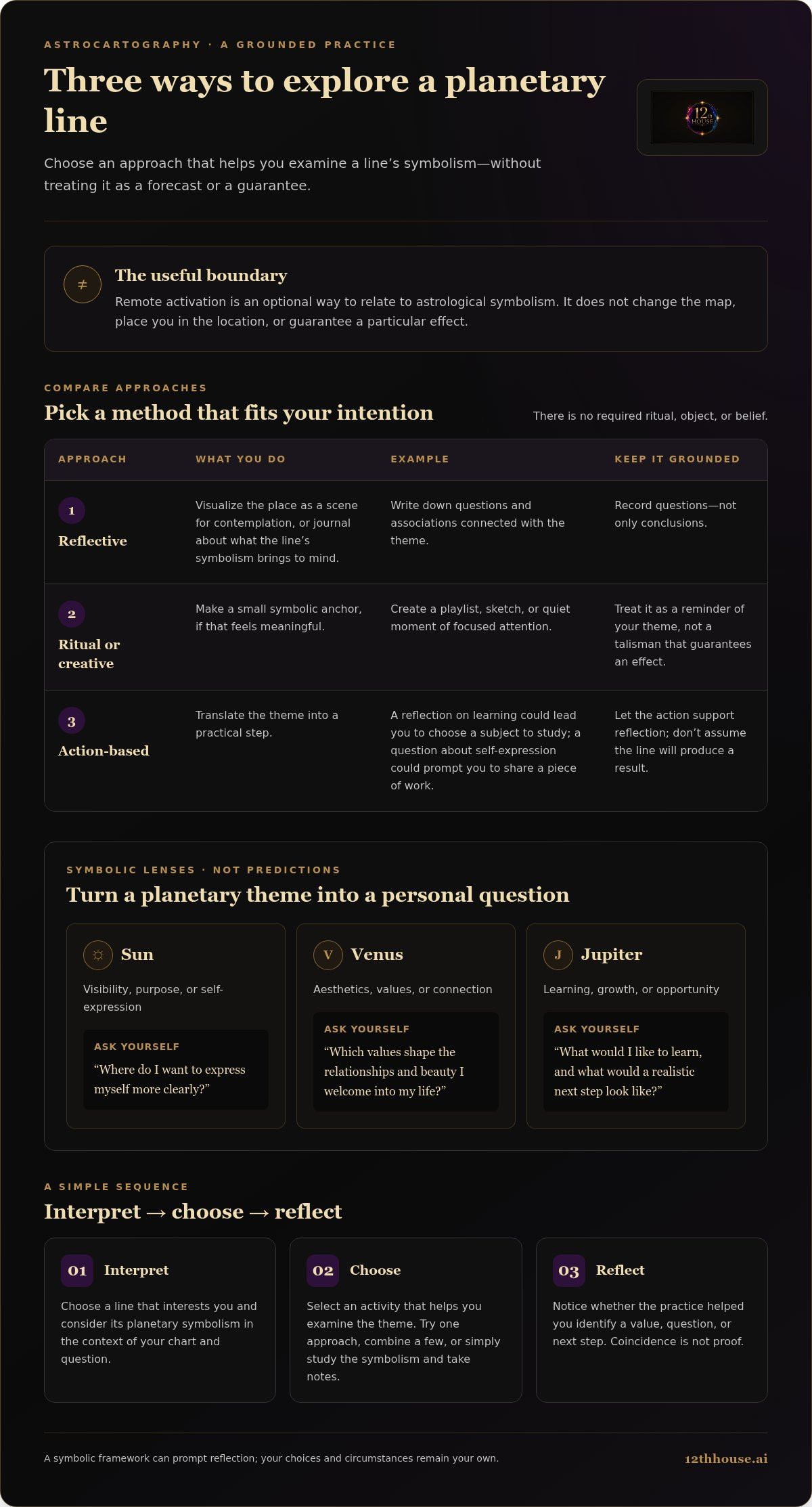
Let the theme guide the exercise, but treat each association as a symbolic lens rather than a forecast. In common astrological interpretations, the Sun can prompt reflection on visibility, purpose, or self-expression. Venus may invite inquiry into aesthetics, values, or connection. Jupiter can serve as a lens for learning, growth, or opportunity. None predicts that these experiences will occur because you focus on a line.
Make the inquiry specific. For a Sun theme, ask, “Where do I want to express myself more clearly?” For Venus, consider, “Which values shape the relationships and beauty I welcome into my life?” For Jupiter, try, “What would I like to learn, and what would a realistic next step look like?” These questions turn broad archetypes into personal prompts without treating them as instructions.
Compare reflective, ritual, and action-based approaches
Choose a method that suits your temperament and intention. There’s no required ritual, object, or belief. You might try one approach, combine a few, or simply study the symbolism and take notes.
- Reflective: Visualize the place as a scene for contemplation, or journal about what the line’s symbolism brings to mind. Record questions and associations, not just conclusions.
- Ritual or creative: If it feels meaningful, create a small symbolic anchor, such as a playlist, sketch, or quiet moment of focused attention. Treat it as a reminder of your theme, not as a talisman that guarantees an effect.
- Action-based: Translate the theme into a practical step. A reflection on learning might lead you to choose a subject to study; a question about self-expression might prompt you to share a piece of work.
Afterward, ask whether the practice helped you notice a value, question, or next step. You don’t need to interpret coincidence as proof. A digital astrocartography map can help you locate and explore chart symbolism, while Ask Lala AI spiritual guidance can offer prompts for further reflection. Explore 12th House’s digital astrology tools as a starting point, and keep your own judgment at the center of the process.
Remote Activation vs. Travel: What Can, and Cannot, Change?
Remote practice doesn’t place you in the location marked by a planetary line. Looking at a map, visualizing a city, or reflecting on its symbolism can help you explore an astrological idea from home, but it isn’t the same as arriving there. Travel involves an actual environment, with its own sensory details, social encounters, routines, and demands.
This distinction matters because an astrocartography map is an interpretive tool, not scientific proof that planetary influence causes predictable outcomes. Remote activation can give you a structured prompt for considering place, identity, intention, or a decision. What you take from that reflection depends on your circumstances and perspective. The comparison below separates the practice from the experience of travel.
| Aspect | Remote practice | Travel or time in the location |
|---|---|---|
| Setting | You stay where you are and engage with a map or an idea of the place. | You enter the location’s physical environment. |
| Experience | Reflection is shaped by your chosen prompts, study, or creative practice. | You encounter local surroundings, people, culture, and daily conditions directly. |
| Effort | It can be more accessible when distance, cost, time, or personal circumstances limit travel. | Travel requires planning and participation in the realities of being there. |
| Interpretive limits | It can support personal inquiry, but does not reproduce life in the location or guarantee effects. | Being there offers direct experience, but does not guarantee an astrological outcome either. |
What remote practice can offer as reflection
Think of the map as a framework for asking a question, not as an answer in itself. A line may draw your attention to a place and invite you to consider what that place represents to you, what you hope to explore, or how a decision fits your values. If visiting isn’t feasible, you can still use the chart theme to organize that inquiry at home.
For one person, this might clarify an assumption about a place; for another, the same symbolism may feel abstract or unhelpful. Personal meaning varies. Notice your response and allow uncertainty rather than forcing a conclusion.
What remote activation cannot promise
Remote work cannot give you a location’s lived atmosphere, local relationships, or everyday conditions. Nor can a visualization or ritual promise relocation, career, relationship, or financial results. The phrase remote activation astrocartography describes an interpretive practice, not a reliable method for producing external change.
If you’re considering a major move or other consequential choice, pair spiritual reflection with practical information. Research the place, consider your resources and responsibilities, and weigh the real-world options. Let the symbolism contribute a perspective, not make the decision for you.
How to Try Remote Activation: A Grounded Astrocartography Practice
Give the practice a clear frame. Remote activation astrocartography can be approached as a personal inquiry: select a theme, use your own map to identify a related line, choose one way to reflect, then review what you noticed. You don’t need a special object, ritual, or belief system. The value is in the quality of your attention, not in producing a predetermined result.
Set up a focused remote activation session
Keep the exercise narrow enough to evaluate. Choose one question or area of reflection rather than trying to work with every line at once. Then follow these steps:
- Name the theme. Decide what you want to consider, such as purpose, connection, learning, or a choice you’re weighing. Phrase it as an open question, not a demand for a particular outcome.
- Select a line and place. Use your own astrocartography map to note the planetary line and location you’re exploring. Record these details so you can distinguish the map reference from your interpretation of it.
- Set a modest intention. For example: “I want to notice what this theme brings up for me.” Avoid framing the intention as a promise that a person, opportunity, or event will appear.
- Choose one practice. Journal, visualize the place, read about its culture, or take a small practical action connected to your question. Pick an approach that feels manageable and relevant; there’s no need to perform a ritual.
- Record the session. Note the date, line, place, intention, and activity. Add what you observed and what was happening in ordinary life at the time, including relevant conversations, pressures, or plans.
This record gives your reflection context. If you return to the same theme later, you can compare what changed in your thinking without assuming that any shift was caused by the planetary line.
Reflect on the experience without forcing a conclusion
After the practice, write down emotions, memories, questions, or resistance as observations. A coincidence may feel striking, but it isn’t proof of planetary causation. Instead, ask: Did this exercise help me see the original question differently? Did it clarify a value, or leave me with a useful next question? “No clear insight” is a valid result.
Keep subjective insight separate from practical evidence. If the reflection concerns a move, career choice, relationship, or financial decision, use real-world information to assess options and consequences. Let the exercise support your thinking, not replace it or make the decision on your behalf.
To ground your reflection in a clear map reference, explore 12th House’s digital astrocartography mapping and use the chart as a starting point for your own interpretation.
Explore Remote Activation with an Astrocartography Map and 12th House
A digital astrocartography map gives your exploration a clear starting point. It helps you locate planetary lines and the places associated with them, so you can focus your inquiry rather than work from a vague idea of “global energy.” With 12th House’s astrocartography mapping, you can explore location-based chart symbolism digitally, then bring a selected line into your own reflection.
The map is a reference, not a verdict. It can help you identify planetary themes to consider, but your questions, experience, and circumstances shape how those symbols resonate. Use it to orient your attention. For detailed chart construction and line interpretation, turn to dedicated astrocartography guidance rather than expecting the map alone to explain every nuance.
Use a digital map as a starting point for reflection
Begin with a question that matters to you, then use your map to identify a line and location connected to the theme you want to explore. Note the place and the symbolism you’re considering. Ask what the location brings to mind and how that association relates to your lived experience. This makes remote activation astrocartography more deliberate: the map sets the frame, while your reflection supplies personal context.
Keep the inquiry open. A line doesn’t tell you what you must do, and an appealing interpretation isn’t proof that a place will meet your expectations. Treat the symbolism as one lens among others, then compare it with what you know about your needs, priorities, and real-world options.
Keep the reader at the centre of the interpretation
Ask Lala offers AI spiritual guidance that can help you develop questions or consider a symbolic theme from another angle. Treat its responses as prompts, not predictions or final authority. You decide which ideas feel relevant, what deserves further thought, and whether any practical action makes sense. The AI astrology assistant guide explores how digital guidance can support inquiry.
To keep your interpretation grounded, compare what the map or AI guidance suggests with your journal notes and practical circumstances. If a theme raises questions about a move, a relationship, or work, separate the symbolic reading from evidence about the decision itself. What do you want? What constraints or opportunities are actually present? Those questions keep agency with you.
Use the tools as part of a wider practice of study, not as a substitute for judgment. Explore 12th House’s astrocartography mapping and spiritual tools to continue examining location-based symbolism at your own pace.
Let Your Next Question Guide the Map
Approach remote activation astrocartography as an invitation to ask better questions, not to force certainty from a symbol. Choose one theme that matters now, explore it with curiosity, and give yourself room to revise your interpretation as your circumstances shift. The map can open a line of inquiry; your discernment shapes where it leads.
12th House brings astrocartography mapping together with Ask Lala AI spiritual guidance and access to a metaphysical content library, giving you digital tools and resources for continued exploration. Use them to support your own study, not to hand over your judgment or expect a guaranteed outcome.
Explore your astrocartography map and begin your inquiry with 12th House. Start with a question, stay open to what you learn, and choose your next step for yourself.
Frequently Asked Questions
Can you activate astrocartography lines without travelling?
Yes, you can explore a line’s symbolism from home without travelling to its mapped location. For example, you might use a line as a prompt to examine what you’re seeking in a place or why a particular city interests you. That exercise won’t give you first-hand knowledge of the city’s people, conditions, or daily life. Use remote reflection to develop questions, then seek reliable information about the place itself.
Does remote activation in astrocartography actually work?
It can work as a reflective exercise if it helps you organize your thoughts or notice a perspective you hadn’t considered. That’s different from demonstrating that a planetary line caused an event or changed your circumstances. To assess the practice for yourself, write down the question you’re exploring and what you notice afterward. Avoid treating coincidences as proof, and don’t judge its value by whether it produces a predicted result.
How do you remotely activate a planetary line?
Start with one topic you want to explore, such as creative direction or belonging. Find a relevant line on your personal map, choose a reflective activity, and note what comes up. You could journal about a place connected to the line, visualize a visit, or take a small step related to your topic. Record the activity and your observations so you can review them without assuming the line caused them.
What does Venus line remote activation mean?
Venus line remote activation means using the symbolic associations of Venus as a lens for reflecting on a location shown on your map. You might consider what beauty, connection, pleasure, or personal values mean to you, and how those themes relate to the place. It doesn’t predict romance, popularity, or financial gain. A useful prompt could be, “What kind of connection or environment feels nourishing to me, and why?”
Can remote activation replace travelling to an astrocartography line?
No, not if your aim is to experience a place directly. Remote reflection can help you prepare questions or examine your expectations, but it can’t supply local encounters, sensory impressions, or practical knowledge gained by being there. If travel is possible and relevant, research the destination and consider your actual needs alongside the chart. A visit also doesn’t guarantee that an astrological interpretation or hoped-for outcome will come true.
Do you need your birth time for remote activation?
If you want to explore a line on your personal astrocartography map, an accurate birth time is important because the map is calculated from birth details, including time and place. If your birth time is uncertain, the mapped lines may not be precise enough to confidently identify a location. You can still reflect on general planetary symbolism, but keep that separate from claims about where your personal lines fall.
Is remote activation in astrocartography scientifically proven?
No. There’s no established scientific proof that remotely focusing on an astrocartography line creates planetary effects or predictable events. Some people may still find the practice meaningful as a way to structure reflection, much as they might use journaling or symbolic prompts. Keep those claims distinct: a personal sense of insight is real as an experience, but it doesn’t establish that a line caused an external change.


