
What if an AI spiritual advisor could help you interpret symbols without becoming your spiritual authority? That distinction matters. A polished answer can feel personal and persuasive, but it shouldn’t replace your judgment, beliefs, or reflection.
You may be curious about what spiritual AI can do, yet wary of generic replies or confident claims presented as truth. The right tool should give you a useful framework for exploration while leaving room for your own discernment. It should also fit the traditions and methods you want to explore, rather than treating every spiritual question the same way.
This guide explains what AI spiritual guidance can offer, where its boundaries matter, and how to compare tools by personalization, approach, and practical fit. You’ll also see how 12th House brings interactive guidance and self-directed study together. Its Lala AI assistant responds to personal questions about charts, spells, and compatibility, while membership includes metaphysical tools and a library of books, videos, and ritual frameworks. Use these criteria to find a more structured way to explore, with you, not the AI, holding the final authority.
Key Takeaways
- An AI spiritual advisor can help you explore spiritual questions and symbolic systems, but its interpretations aren’t guaranteed answers or spiritual authority.
- Get more useful reflection by framing a clear question, adding relevant context, and considering how the response depends on the framework used.
- Compare AI guidance, human spiritual guidance, and self-guided resources by interaction style, personalization, scope, and opportunity for human connection.
- Evaluate an AI response by checking its interpretive basis, relevance, uncertainty, boundaries, and openness to alternative readings.
- Explore how 12th House brings Lala’s personalized guidance together with metaphysical tools and resources for self-directed learning.
What Is an AI Spiritual Advisor, and What Can It Actually Do?
An AI spiritual advisor is a conversational tool that uses information you provide and a selected framework to help you explore spiritual questions, symbols, or practices. It can organize ideas and offer interpretations to consider. It doesn’t possess spiritual insight, predict your future with certainty, or hold religious authority.
Think of it as a structured reflection partner, not an oracle. Depending on its design, a response may draw on astrology, tarot, numerology, religious texts, or another symbolic system. Its usefulness depends on the framework, the information available to it, and the context you provide. A broad question may produce a broad answer, while a focused question can make the exchange more relevant.
Keep the boundaries clear. Symbolic interpretation is different from a guaranteed prediction or a definitive verdict about what you should do. AI guidance isn’t therapy, and it shouldn’t replace professional mental health, medical, legal, or financial support. Treat the output as material for reflection. Compare it with your own experience and beliefs, then decide what, if anything, resonates.
How is an AI spiritual advisor different from a horoscope app?
A horoscope app may provide a forecast or daily prompt. A conversational tool can respond to a particular question and continue the exchange as you clarify what you mean or add context. That difference is about interaction, not automatic depth. Personalization varies by tool, and some tools use symbolic systems while others focus on religious texts or prompts. Don’t assume every tool analyzes a complete birth chart.
To understand what a tool can do, look at its framework and required inputs. Does it explain whether an answer draws on a chart placement, a tarot concept, or a general prompt? Can you ask a follow-up, or does it return a fixed message? These distinctions help you judge whether a response is relevant to your inquiry instead of mistaking fluent language for a precise reading.
Which questions can spiritual AI help you explore?
Start with a question that opens reflection rather than demanding a verdict. For example, you might ask:
- “What pattern might I be repeating in how I respond to change?”
- “What meanings could this dream symbol hold for me?”
- “How might this chart placement relate to the tension I feel between stability and independence?”
- “What perspectives could help me reflect on a relationship dynamic?”
Words like “might,” “could,” and “help me reflect” leave room for uncertainty and your own interpretation. A useful response can offer a lens or prompt, but it can’t establish another person’s motives or settle a major life decision for you. If you’re exploring astrology, the AI astrology assistant guide offers more context on conversational chart exploration.
How AI Spiritual Guidance Turns a Personal Question into Reflection
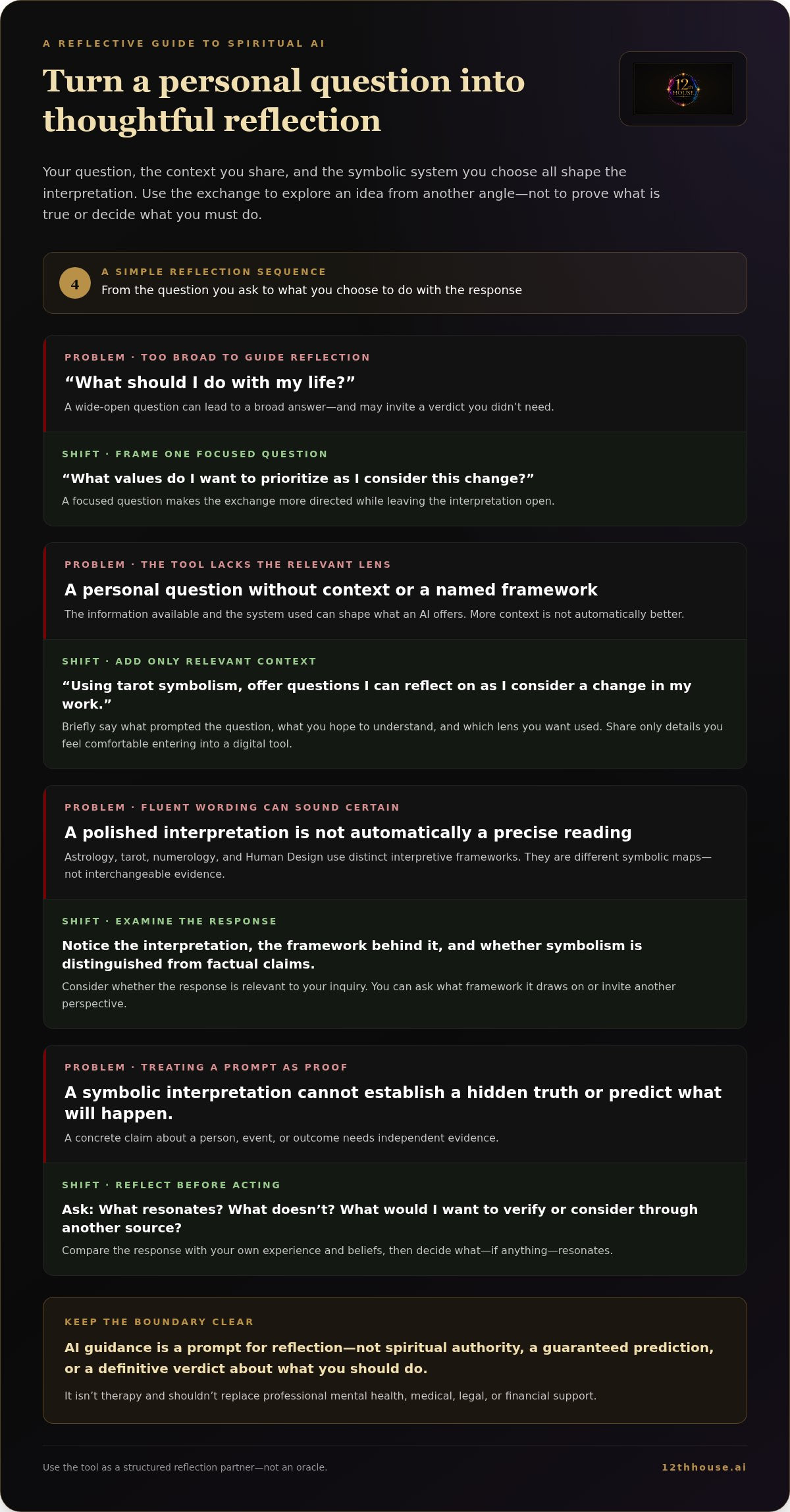
A useful exchange begins before the tool responds. Your question, the context you share, and the symbolic system you choose all shape the interpretation. Treat the process as a way to examine an idea from a new angle, not as a method for proving what is true or deciding what you must do.
Try this sequence:
- Frame one focused question. Replace “What should I do with my life?” with “What values do I want to prioritize as I consider this change?”
- Add relevant context. Briefly explain what prompted the question and what you hope to understand. Leave out details that aren’t needed.
- Examine the response. Notice the interpretation it offers, the framework it uses, and whether it distinguishes symbolism from factual claims.
- Reflect before acting. Ask what resonates, what doesn’t, and what you’d want to verify or consider through another source.
An AI-generated interpretation is a prompt for reflection, not proof of a hidden truth or a prediction of what will happen. A response about a symbolic theme may give you language for thinking; a concrete claim about a person, event, or outcome needs independent evidence. The Expert Perspectives on AI in Spiritual Care offers a research-based lens on potential benefits and ethical considerations when using AI in spiritual contexts.
What context makes a spiritual AI response more relevant?
Give the tool a clear task and name the lens you want it to use. For example: “Using tarot symbolism, offer questions I can reflect on as I consider a change in my work.” This is more directed than asking for a complete life plan. Share only personal details you feel comfortable entering into a digital tool. More context isn’t automatically better; relevance matters more than volume.
How do symbolic systems shape an AI response?
Astrology, tarot, numerology, and Human Design use distinct interpretive frameworks. The same question about relationship patterns might invite reflection through chart placements, card symbolism, or numerological themes, depending on the system. These are different symbolic maps, not interchangeable evidence. For more context on relationship-focused exploration, the AI love readings guide considers how to approach those questions thoughtfully.
When you use an AI spiritual advisor, ask it to explain the framework behind an interpretation or offer another possible reading. That can make its assumptions easier to see and give you room to assess the answer rather than simply accept it. If you want to explore personal metaphysical questions through conversational guidance, Lala AI spiritual guidance offers personalized question-and-answer interactions about charts, spells, and compatibility.
AI Spiritual Advisor vs. Human Guidance: Compare Trust, Scope, and Fit
Which kind of support fits the question you’re carrying? An AI tool can help organize symbolic material and invite follow-up questions. A human spiritual guide can bring a relationship, lived experience, and knowledge of a particular tradition. Self-guided study gives you space to work through books or other resources at your own pace. None is automatically the right choice for every inquiry.
Trust deserves careful attention. A 2026 Barna Group report, in partnership with Gloo, found that nearly one in three U.S. adults consider spiritual advice from AI as trustworthy as advice from a pastor. The share rises to two in five among Gen Z and Millennials. These findings describe reported attitudes in those populations. They don’t establish that an AI answer is accurate or that every person in those groups uses or trusts spiritual AI.
| Factor | AI tools | Human spiritual guidance | Self-guided study |
|---|---|---|---|
| Availability | Can be accessed through the tool when you choose to use it. | Depends on the guide and how you connect with them. | Fits your own schedule and pace. |
| Interaction style | Conversational, with responses shaped by prompts and follow-up. | Relational exchange informed by the guide’s approach. | Independent reading, practice, and note-taking. |
| Personalization | Varies with the tool’s design and the context you provide. | Can develop through conversation and shared context. | You decide which ideas to apply to your experience. |
| Interpretive scope | Limited to its available systems and the way it handles them. | Depends on the guide’s training, tradition, and perspective. | Depends on the materials you choose to study. |
| Human relationship | Doesn’t create a human relationship. | Offers direct human connection. | Usually involves no personal guide, though study may be shared. |
Where can an AI spiritual advisor be useful?
An AI spiritual advisor may help you explore a symbolic concept, organize a question, or follow a line of reflection through follow-ups. It can make material easier to examine, but speed and tailored wording aren’t evidence that an interpretation is correct. A tool can arrange the symbols; the meaning you draw from them remains personal, shaped by your beliefs, experience, and discernment.
Where should AI not be treated as an authority?
An AI response isn’t a human relationship, religious ruling, or guaranteed prediction. For urgent distress, safety concerns, or decisions with serious consequences, seek appropriate human support. Spiritual tools also shouldn’t replace qualified medical, mental health, legal, or financial advice. Use them to open reflection, not to carry decisions that require professional judgment or personal care.
The right format depends on your question and the support you need. Choose AI for structured exploration, human guidance when relationship and tradition matter, or study resources when you want to build understanding independently. You can also combine approaches while keeping their distinct roles clear.
How to Evaluate an AI Spiritual Advisor Before Relying on Its Answers
A compelling answer can still be a poor guide. Before relying on a response, consider how it was formed, whether it fits your question, and whether it leaves room for your judgment. Use this checklist to assess the tool, not just the appeal of a particular interpretation.
- Framework clarity: Can you tell which symbolic system or source the interpretation draws on?
- Response relevance: Does it address your question and context, or could the same answer fit almost anyone?
- Uncertainty: Does it acknowledge that an interpretation is one possible reading, rather than presenting speculation as fact?
- Boundaries: Does it avoid claiming authority over your beliefs, health, relationships, or future?
- User control: Can you challenge the interpretation, ask for alternatives, and decide what to take from it?
Test the reasoning with a follow-up. Ask, “What part of the framework supports that interpretation?” Then try, “What’s another way to read these symbols?” A useful tool should make its interpretive path clearer, not use dramatic language to shut down questions. If it makes a factual claim, separate that claim from symbolic reflection and verify it independently before acting on it.
Confidence is a tone, not evidence. An answer may sound decisive because of its wording, but a confident tone doesn’t establish accuracy or make the response a directive. Useful spiritual AI invites reflection; it doesn’t decide what you must believe.
What makes an AI spiritual response feel relevant rather than generic?
Check whether the answer responds to your question and uses the symbolic framework you named. Look for a clear connection between the interpretation and its reasoning. Be cautious of fear-based language, sweeping claims, or absolute predictions. If the response feels vague, ask for a more grounded explanation or a second interpretation that accounts for different possibilities.
How can you maintain discernment while using spiritual AI?
Use a response as one input for journaling, study, or personal reflection. Note which ideas resonate and which don’t, then consider why. Share only the personal details needed to frame your question, and limit sensitive information. Pause before acting on guidance involving health, safety, money, or major relationships; consult qualified support where appropriate.
For a structured space to explore personal metaphysical questions, try Lala AI spiritual guidance. Its personalized question-and-answer interactions can help you examine charts, spells, and compatibility while leaving interpretation and decisions in your hands.
Explore AI Spiritual Guidance with 12th House and Lala
12th House brings conversational guidance and metaphysical study together in a digital membership. Its Lala assistant answers personalized questions about charts, spells, and compatibility. Membership includes unlimited Lala interactions, personalized data rooms, and access to a library of books, videos, and ritual frameworks. You can move between asking a question and studying the systems that give it context.
What can you explore with Lala and 12th House?
Explore several symbolic frameworks and practices through the platform’s tools:
- Astrology for chart and transit exploration.
- Tarot and numerology for working with distinct symbolic languages.
- Human Design and astrocartography for exploring their respective systems.
- Dream interpretation and palmistry for considering meaning through dreams and hand symbolism.
These tools offer different entry points, not one universal method. You might ask Lala a personal question about a chart, then turn to a book or video in the library to study the relevant ideas in more depth. Ritual frameworks offer another way to structure self-guided exploration. For a focused example of one symbolic practice, the tarot guide to spiritual clarity explores tarot as a practice of interpretation.
How to begin using AI spiritual guidance with intention
Give your exploration a clear starting point. Choose one question that’s open enough to invite insight but specific enough to guide the exchange. Then name the framework that fits what you want to examine. For example, you might ask how a chart placement could offer a lens on a current personal theme. Keep the question focused, and share only context that feels relevant and comfortable.
- Choose the inquiry. Identify the question you want to explore instead of asking for a complete answer to your life.
- Select a framework. Decide whether astrology, tarot, numerology, Human Design, or another available system is relevant.
- Engage with the response. Use Lala’s personalized interaction to explore the question and consider what further context might help.
- Reflect for yourself. Note what resonates, what doesn’t, and what you want to study further. Your judgment remains central.
An AI spiritual advisor can help organize a line of inquiry, while a library gives you room to deepen your understanding beyond a single exchange. Neither needs to dictate your beliefs. Let the question lead, use the framework as a map, and decide what meaning you carry forward.
If this kind of structured exploration fits your practice, explore 12th House and its membership tools at your own pace.
Bring Your Next Question into Focus
Your next step doesn’t need to be a search for certainty. Choose a question you genuinely want to examine, then approach the answer with curiosity and discernment. An AI spiritual advisor can offer a new lens for reflection, but the meaning you make from it remains yours. Let insight open a line of inquiry, not close it.
For a structured space to explore personal metaphysical questions, 12th House brings interactive guidance together with resources for self-directed study. Lala answers personalized questions about charts, spells, and compatibility. Membership includes unlimited Lala interactions and access to a metaphysical library, so you can move between asking, reflecting, and learning at your own pace.
Start with the question that feels most alive for you. Explore 12th House and ask Lala, and let your next discovery begin with your own thoughtful inquiry.
Frequently Asked Questions
Is an AI spiritual advisor the same as an AI psychic?
No. An AI spiritual advisor is a broad term for software that helps explore spiritual questions or symbolic frameworks. “AI psychic” may suggest predictive or intuitive powers, but software shouldn’t present those as established facts. Before using a tool, look at how it describes its role and what sources or systems it draws on. Interpretations framed as possibilities leave more room for your judgment than claims of certain knowledge.
Can I use an AI spiritual advisor without knowing my exact birth time?
Yes, depending on what you want to explore and how the tool works. A general question about an astrological concept may not need birth details, while calculating certain chart placements can depend on precise birth information. If you don’t know your time of birth, say so rather than guessing. You can ask which parts of a response rely on exact time and which can still be considered without it.
What happens if an AI spiritual advisor gives an answer that conflicts with my beliefs?
You can disagree, ask how the answer was formed, or end the exchange. For example, ask the tool to identify the assumptions behind its interpretation or offer a reading that better reflects your stated tradition. You’re not obligated to adopt its framing. If the question concerns a religious commitment, consider how the issue is understood within your tradition and whether the AI’s interpretation reflects that perspective.
Can an AI spiritual advisor make decisions for me?
No. A tool can help you sort through options, but it can’t weigh every consequence or take responsibility for your choice. If you’re considering a major move, for instance, use spiritual reflection alongside practical factors such as finances, responsibilities, and reliable information. For decisions with serious consequences, seek relevant qualified support. Keep the final decision grounded in your own values and circumstances, not a generated instruction.
Is it safe to share personal information with a spiritual AI tool?
Share only what you’re comfortable entering into a digital service, and leave out details that aren’t needed to frame your question. Before using a platform, review its privacy information and available settings so you understand how it describes handling your information. Don’t assume a chat is confidential like a private conversation with a trusted person or a regulated professional. You can often make a question more focused without naming other people.
Can an AI spiritual advisor replace a therapist or counselor?
No. Spiritual exploration and mental health care serve different purposes, and an AI tool can’t provide professional assessment or treatment. If distress is persistent, affecting daily life, or becoming a crisis, reach out to a qualified mental health professional or appropriate urgent support. Spiritual reflection may still be meaningful alongside care, if it feels helpful, but it shouldn’t delay or replace support from a qualified person.


