
For using astrology to choose a business launch date in 2026, prioritize a clear electional window over a date that simply feels auspicious. The guide’s highlighted windows include January 18-February 1, April 17-30, and June 15-28; the next listed window is November 14-22. Mercury retrograde and eclipse dates call for added caution when setting a launch.
That distinction matters when a launch involves real decisions, from announcing an offer to opening a business to the public. Astrology can offer a timing framework, but your launch date should also match the work your business is ready to do.
Here, you’ll find what 2026 may hold for business, plus month-by-month launch dates, timings, favorable weekdays, and astrology-based windows. The guide also explains how to weigh planetary shifts, lunar conditions, and traditional muhurat factors, so you can compare candidate dates with greater clarity and choose a time that aligns with your business priorities.
Key Takeaways
- Compare monthly launch dates and listed muhurat timings to identify options that fit your business calendar.
- Use Mercury retrograde and eclipse dates as caution points when narrowing down a launch day.
- Match the weekday to your business type, then weigh lunar conditions and traditional timing principles.
- Use astrology-based windows as a planning framework, and explore your birth chart and transits for a more personal perspective.
1. Month-by-month business launch dates and timings for 2026
Astrology-based timing offers a symbolic framework; practical readiness should guide the decision. A launch chart can help compare candidate dates, but it cannot replace product readiness, customer demand, or operational planning. For real estate businesses, align any symbolic date with the transaction, property readiness, and the people needed to complete it. In Vedic astrology, muhurat is the selection of a moment considered supportive for beginning an undertaking.
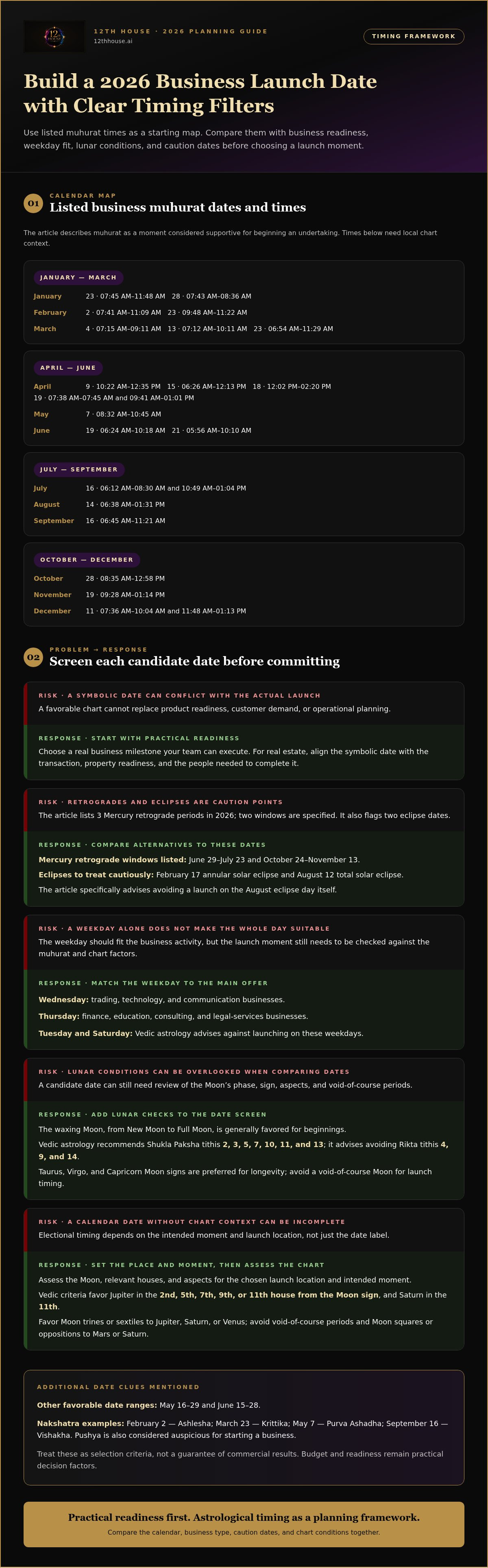
Use this month-by-month calendar as a starting map. January’s listed business muhurat are January 23, 07:45 AM-11:48 AM, and January 28, 07:43 AM-08:36 AM. February’s are February 2, 07:41 AM-11:09 AM, and February 23, 09:48 AM-11:22 AM. March lists March 4, 07:15 AM-09:11 AM, March 13, 07:12 AM-10:11 AM, and March 23, 06:54 AM-11:29 AM. April lists April 9, 10:22 AM-12:35 PM; April 15, 06:26 AM-12:13 PM; April 18, 12:02 PM-02:20 PM; and April 19, 07:38 AM-07:45 AM and 09:41 AM-01:01 PM.
May’s listed date is May 7, 08:32 AM-10:45 AM. June offers June 19, 06:24 AM-10:18 AM, and June 21, 05:56 AM-10:10 AM. July lists July 16, 06:12 AM-08:30 AM and 10:49 AM-01:04 PM. August lists August 14, 06:38 AM-01:31 PM. September lists September 16, 06:45 AM-11:21 AM. October lists October 28, 08:35 AM-12:58 PM; November lists November 19, 09:28 AM-01:14 PM; December lists December 11, 07:36 AM-10:04 AM and 11:48 AM-01:13 PM. These times need local chart context.
Other favorable dates include May 16-29 and June 15-28, while Mercury retrograde and eclipse periods call for caution. The dated retrogrades include Saturn turning retrograde July 27, Neptune retrograde from July through December, Pluto turning direct in October, and Jupiter turning retrograde December 13. The calendar gives no Venus dates; don’t infer them from another planet’s cycle. For electional charts, set the launch location and intended moment first, then assess the Moon, relevant houses, and aspects. Vedic criteria favor Jupiter in the 2nd, 5th, 7th, 9th, or 11th house from the Moon sign, and Saturn in the 11th. Favor Moon trines or sextiles to Jupiter, Saturn, or Venus; avoid void-of-course periods and Moon squares or oppositions to Mars or Saturn. Budget and readiness remain practical decision factors.
2. What does 2026 hold for Business?
Astrologically, 2026 emphasizes recalibration and strategic repositioning over rapid expansion. Jupiter enters Leo on June 30, bringing focus to creative expression, visibility, and launch timing. Uranus enters Gemini on April 26, shifting attention toward communication, learning, and information exchange. These planetary themes can help frame business priorities, but they don’t replace operational readiness.
Mercury retrograde is a caution period for business launches in Vedic astrology. 2026 has three Mercury retrograde periods; two listed windows are June 29-July 23 and October 24-November 13. Avoid scheduling a critical opening or announcement in those windows when alternatives fit your plans. The February 17 annular solar eclipse and August 12 total solar eclipse are also dates to treat cautiously. In particular, avoid launching on the August eclipse day itself.
Lunar alignment adds another layer. The waxing Moon, from New Moon to Full Moon, is generally favored for beginnings. Vedic astrology recommends Shukla Paksha tithis 2, 3, 5, 7, 10, 11, and 13; it advises avoiding Rikta tithis 4, 9, and 14. Astrologers also assess the Moon’s sign, its aspects, and void-of-course periods. Taurus, Virgo, and Capricorn Moon signs are preferred for longevity, while a void-of-course Moon is avoided for launch timing.
Nakshatra names clarify the character of listed muhurat dates. February 2 is associated with Ashlesha, March 23 with Krittika, May 7 with Purva Ashadha, and September 16 with Vishakha. Pushya is also considered auspicious for starting a business. Read these as selection criteria, not a guarantee of commercial results. For a more personal view of how transits relate to your business timing, explore birth-chart and transit analysis.
3. Auspicious weekdays by business type
In Vedic astrology, weekday selection can help narrow your launch calendar. Match the day to your business activity, then compare it with the chosen date’s muhurat and other chart factors. A favorable weekday alone does not mean every moment that day is suitable for a launch.
Wednesday is recommended for trading, technology, and communication businesses. A software launch, publishing venture, or trading operation might therefore make Wednesday its weekday preference. Then compare available Wednesdays with your opening plan and the relevant electional chart. This gives the weekday a clear role without making it the only factor.
Thursday is recommended for finance, education, consulting, and legal-services businesses. A financial advisory firm or education platform might prioritize Thursday for its public opening. Keep the business’s main activity in focus: if a company offers several services, use its central offer to determine which weekday category matters most.
Vedic astrology advises against launching on Tuesday or Saturday. If those are the only practical dates, consider another suitable day rather than forcing the calendar to fit. Your final choice still needs to account for operational readiness, local launch time, and the chart’s lunar conditions. A launch date should support a real business milestone, not disrupt it.
Apply this weekday filter throughout the year, including January, September, and October. First, identify dates your team can execute; then mark Wednesdays or Thursdays according to your business type. Remove dates that conflict with key timing considerations, such as a Mercury retrograde period. This sequence keeps the weekday useful while accounting for the wider planetary alignment.
For a business that combines technology and consulting, choose the launch’s primary purpose. A product release focused on communication points toward Wednesday; opening a consulting practice points toward Thursday. If both functions matter equally, compare candidate dates by their full chart conditions and practical fit. Treat weekday influence as one part of a structured timing decision, not a promise of commercial success.
4. 2026 Astrology-based business launch windows
Using astrology to choose a business launch date in 2026 works best as a comparison framework, not a hunt for one perfect moment. Treat each range as a group of candidates. Your launch purpose, local timing, and operational readiness still shape the final choice. Mercury retrograde dates and eclipse days add important filters.
Five top-tier windows are identified for 2026: January 18-February 1, April 17-April 30, May 16-May 29, June 15-June 28, and August 15-August 25. The June range ends before Mercury retrograde begins on June 29. The August range follows the August 12 solar eclipse. Jupiter enters Leo on June 30, associated with visibility and creative expression, just after that June window.
Four secondary windows offer more options: February 17-February 25, September 11-September 24, October 10-October 23, and November 14-November 22. February 17 is also an annular solar eclipse, so treat that day cautiously within the secondary range. October 10-23 ends before Mercury retrograde begins October 24. The November range starts after that retrograde period ends November 13.
For anyone using astrology to choose a business launch date in 2026, start by removing dates that conflict with logistics. Then compare remaining moments for lunar aspects and suitable local times. Saturn supports disciplined progress and formalizing structures between February and late July. From September, Uranus retrograde favors refinement, while May through October emphasizes reviewing networks, communities, and long-term goals. Those themes can help frame whether your launch prioritizes stability, expansion, or clarity. Jupiter turns retrograde December 13, making review and refinement a stronger year-end focus.
For a chart-based comparison tailored to your birth details and current transits, explore Astrology Birth Chart & Transit Analysis.
12Th House: Ask Lala AI Spiritual Guidance
12th House: Ask Lala AI Spiritual Guidance offers a reflective next step when you’ve compared the 2026 launch windows but still want to examine what the decision means for your path. Use it to explore the questions shaping your choice, then weigh those reflections alongside your practical launch plan. For a more personalized astrological perspective, Astrology Birth Chart & Transit Analysis can help you consider your birth chart and current transits in relation to timing.
Turn to these tools when you want to clarify your priorities, compare symbolic themes, or reflect on the direction of your business. Astrology can inform your decision-making framework, while your readiness and real-world requirements remain central. Visit 12thhouse.ai to explore Ask Lala AI Spiritual Guidance.
Set your launch intention, then act with clarity
Using astrology to choose a business launch date in 2026 can make timing a deliberate planning choice, not a substitute for preparation. Let the date mark work you’re ready to begin: define your first milestone, align your team, and decide what progress will look like after launch. The most useful chart is one you can translate into focused action.
If you’re weighing the symbolic meaning of your options, 12th House offers Tarot Readings as another reflective lens. Explore your remaining questions, then make the operational decision with care. For a next step in exploring spiritual guidance around timing, contact 12th House about launch timing. You don’t need a perfect moment to move forward. A clear intention and grounded plan can help you give your business a purposeful beginning.
Frequently Asked Questions
What does 2026 hold for Business?
Astrologically, 2026 favors reassessing business direction and strengthening strategy over pursuing growth at any cost. For example, a founder considering a new offer can use the year’s shifting themes to examine the audience, message, and business model before expanding. Translate broad planetary patterns into specific planning questions, then base decisions on your goals, resources, and market conditions.
What should I do if I’ve already locked in one of these dates?
Keep a date that fits your practical needs, and use astrology to refine the launch plan. You might choose a meaningful moment that day for a public announcement, first sale, or internal kickoff while keeping essential operations on schedule. Focus on clear messaging, prepared systems, and a defined first milestone rather than treating one calendar date as the sole measure of success.
What business launch planning steps and costs should be considered alongside astrology?
First confirm product and operational readiness, customer demand, logistics, and the people needed for the launch. For real estate, also check the transaction and property readiness. Set a budget, choose a practical local launch time, then compare suitable dates using the astrology factors.


