

Build an astrocartography map using your name, birth date, birth city, and birth time. Aim for a birth time accurate to at least the nearest half hour. Astrocartography for remote workers offers a way to compare planetary lines with cities you’re considering for work, relocation, or a temporary stay. Treat it as a planning lens, not a substitute for weighing the practical realities of a place.
Remote work gives you more choice about where to live, but that freedom can make the decision harder. A city may look ideal on paper yet feel misaligned with the career or daily rhythm you want. Astrocartography offers a symbolic framework for exploring place: each line connects a planetary theme with locations around the world.
Learn how to create and read your map, which career-related lines may bring certain themes into focus, and how to explore a location without moving there right away. Use those insights alongside concrete considerations, including your work needs, lifestyle, and the responsibilities that come with relocating.
Key Takeaways
- Compare planetary line themes with the kind of career, visibility, and daily work rhythm you want from a city.
- Explore a location’s symbolic themes from afar before treating relocation as the next step.
- Read your map as a structured reflection tool, then weigh its insights alongside practical needs and priorities.
- Use Ask Lala AI Spiritual Guidance to explore questions that arise as you interpret your map and plan your next move.
Astrocartography for relocation and career planning
Use your astrocartography map to compare a city’s planetary themes with your career aims. Treat the symbolism as one planning lens, alongside the real-world conditions that shape your working life.
Balancing Maps With Practical Location Factors
Astrocartography adds symbolic context; internet access, living costs, and time zones determine practical fit. A Sun MC line may bring career visibility into focus, but it can’t tell you whether video calls will run smoothly or expenses will suit your income. Compare candidate cities with your actual schedule, budget, and connection needs. A place that supports professional visibility, for example, still needs to work for meetings with your team. Let practical constraints narrow your options, then use the map to reflect on what each remaining place represents.
Recommended Cities for Remote Work
There’s no single city recommended for every remote worker: your map helps you explore places in relation to your priorities. For example, imagine someone living in Australia and working remotely, with a career-themed Sun MC line in California. The MC line is associated with public image, accomplishments, responsibility, and standing in society. Use this as a method, not a universal destination list. First define the career quality you want to explore, such as recognition or responsibility. Then compare cities connected to relevant lines and consider how their themes fit your goals and daily work. A Chiron line, for instance, is associated with addressing personal wounds and gifts that contribute to wholeness.
Risks of Choosing a Location by Astrology
Astrocartography can guide reflection, but it can’t assess every factor involved in relocating or working remotely. A planetary line won’t establish whether a city has the internet access you need, fits your budget, or aligns with your employer’s time zone. Those questions call for practical research specific to the location and your work. Avoid treating a symbolic reading as a prediction about a job offer, promotion, or personal outcome. Instead, write down what a line suggests, then separate that interpretation from the evidence you can gather about daily life. This keeps your relocation decision grounded in real conditions.
Remote activation and planetary line energies
Remote activation means engaging with planetary line energies without traveling to or relocating near them. For remote workers, it’s a symbolic way to explore a location’s themes while remaining based elsewhere.
Astrocartography line effects are considered strongest when you’re physically on a line. Influence is also commonly considered relevant within 100-300 miles. Use that range to identify places for closer study, not as a guarantee of a particular outcome. A city near a line can become a focus for reflection even when you don’t move there.
Remote activation practices connect your routine with places associated with your planetary lines. For example, someone exploring a Mercury Descendant line through New York City might follow creators or media outlets based there. A Moon MC line through California could prompt interest in California podcast hosts. These actions offer a way to connect with a place’s culture and networks without relocating.
Choose an activity that matches the location and the connection you want to explore:
- Follow creators, coaches, musicians, influencers, or media outlets who live near a relevant line.
- Listen to music, meditations, or language connected with a country on your map.
- Explore a dating app location associated with a Sun or Venus Descendant line.
- Engage with cultural media from a place linked to your planetary lines.
Keep the practice specific. If France appears along a Venus line, French music offers one deliberate point of connection. If your map points toward Iceland, explore music or media from that culture. Record the location, line, activity, and your reflections; this gives you a consistent framework for noticing what feels meaningful. For a structured map to support that exploration, consider Astrocartography Mapping.
Using birth time and birthplace to generate a map
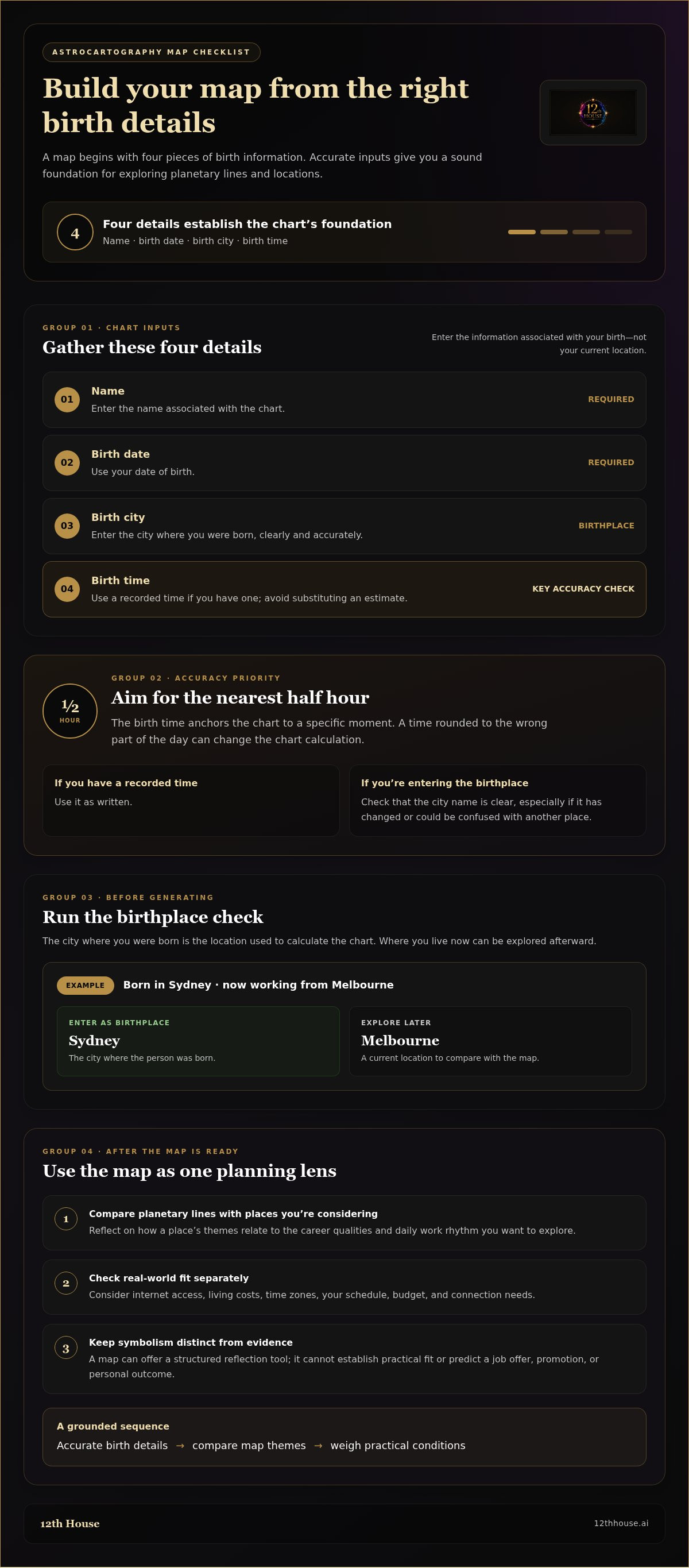
An astrocartography map begins with four birth details: your name, birth date, birth city, and birth time. Enter where you were born, not where you live now. The time anchors the chart to a specific moment, while the city locates that moment geographically. Together, these details provide the information used to calculate the map’s planetary lines.
Accuracy matters most when entering your birth time. Aim for a time accurate to at least the nearest half hour. A time rounded to the wrong part of the day can change the chart calculation, so don’t substitute an estimate for a known birth time. If you have a recorded time, use it as written. Enter the original birth city clearly, especially if its name has changed or could be confused with another place.
Before generating the map, organize the details in a simple record:
- Name: enter the name associated with the chart.
- Birth date: use your date of birth.
- Birth city: enter the city where you were born.
- Birth time: provide the time as accurately as you can, ideally to the nearest half hour.
Review each field before reading the map. For example, someone born in Sydney who now works from Melbourne should enter Sydney as the birthplace. Melbourne may be a location to explore later, but it doesn’t replace the place of birth used to calculate the chart.
These inputs establish the map’s foundation, not a career verdict. Once the map is ready, compare its planetary lines with the places you’re considering and the work themes you want to explore. If you’re also studying how your birth chart relates to personal patterns, Astrology Birth Chart & Transit Analysis offers a related lens. Keep your birth details consistent as you interpret both, so your location comparisons use the same starting data.
Creating an astrocartography chart
Astrocartography maps a birth chart’s planetary positions onto locations around the world. It shows where planets are associated with key chart angles, turning a birth chart into a geographic framework for exploring places and personal themes.
To create a chart, enter your birth details into an astrocartography tool, then examine the planetary lines on the map. Each line links a planet with a particular angle, so begin by identifying both. For example, a Sun line connected with the Midheaven, or MC, brings career visibility and public standing into the reading. The line’s symbolism gives you a question to explore, not a guaranteed outcome.
Use a consistent method to move from the chart to a useful comparison:
- Set a career intention. Decide whether you’re exploring recognition, responsibility, communication, or another work theme.
- Locate relevant lines. Find the planetary lines and angles that connect with that intention.
- Mark candidate places. Note cities near the lines, then compare them with your existing relocation shortlist.
- Record your interpretation. Write down the line, city, and career question it raises.
If a city appears near your Sun MC line, for example, consider how visibility or professional responsibility fits your goals. If another city connects with Mercury, ask whether communication, learning, or networking is more relevant to your remote-work plans. Compare the themes instead of treating one line as a final verdict. Keeping a clear record makes it easier to revisit your reasoning as your priorities shift.
A chart becomes more useful when you combine calculation with deliberate interpretation. Keep planetary symbolism distinct from practical city research, then use both to shape your shortlist. A line may prompt you to explore a city, for instance, while your work schedule and preferred lifestyle determine whether it remains a serious option.
12Th House: Ask Lala AI Spiritual Guidance
12th House’s Ask Lala AI Spiritual Guidance gives you a space to explore questions raised by your map and career plans. Turn to it when you want to clarify what a planetary line brings into focus, or organize your thoughts before weighing a possible move. Treat the reflection as one perspective alongside the practical factors shaping your work and location choices.
If you want to connect location themes with your broader chart, Astrology Birth Chart & Transit Analysis offers another interpretive lens. Tarot Readings and Numerology Reports can support other forms of reflection as you consider your priorities and direction. Choose the approach that best fits the question you’re exploring, and keep your own goals at the center.
Contact 12th House to continue exploring your astrocartography questions.
Make Your Next Move With Intention
Astrocartography for remote workers is most useful as a framework you can revisit as your goals evolve. Before choosing a city, define what you want your next chapter to support: deeper focus, greater professional visibility, or a different relationship with work. Let that intention guide your reflection, then decide with both symbolic insight and lived priorities in view.
If you want another perspective on the questions your map raises, 12th House offers Ask Lala AI Spiritual Guidance, Astrology Birth Chart & Transit Analysis, and Tarot Readings. Each gives you a way to explore your own interpretation and clarify what matters in your decision. Explore your chart with 12th House, and take your next step with greater intention.
Frequently Asked Questions
How can remote workers use astrocartography to choose a place to live?
Astrocartography for remote workers can help organize a shortlist around the kind of work and home life you want. For each candidate, note the line themes that stand out and connect them with priorities such as focus, collaboration, or visibility. Then compare your notes with daily requirements like meeting schedules and workspace needs. This makes the map a reflection tool, not a city-ranking system.
What do the Sun, Moon, Mercury, Venus, Mars, Jupiter, and Saturn lines mean for remote work?
In common astrological interpretation, Sun lines relate to visibility, Moon lines to emotional needs, and Mercury lines to communication and learning. Venus is associated with connection and harmony; Mars with initiative and drive. Jupiter points toward expansion, while Saturn relates to structure, responsibility, and discipline. For remote work, use these themes to frame questions about your work style, not as fixed predictions about what a location will bring.
How do astrocartography lines relate to career, productivity, and work-life balance?
These lines offer symbolic themes for considering how a location might fit your professional aims and personal rhythms. Someone seeking uninterrupted creative work, for example, could compare a place’s map themes with their preferred routine. If you’re using astrocartography for remote workers’ career planning, record your expectations separately from your actual experiences. This helps you assess whether a location supports your priorities without confusing symbolism with measurable work outcomes.
What birth details are needed for an accurate astrocartography chart?
Use your name, birth date, birth city, and birth time as chart inputs. Your recorded birthplace matters, even if you’ve moved since birth, and time accuracy affects the chart calculation. Aim for a birth time accurate to at least the nearest half hour. If you compare chart interpretations later, keep the birth details consistent so changes in your notes reflect interpretation, not different inputs.
How can someone generate and interpret an astrocartography chart for free?
Use a free chart generator, enter your birth details, and identify the planetary lines and angles shown on the map. Begin with one question, such as whether you’re exploring communication, visibility, or personal rhythm. Choose a city you’re considering and note the line themes connected with it. Then compare that reading with your priorities and practical research, rather than treating the map as a decision on its own.


