
What if the true power of a tarot reading doesn't live within the individual cards, but in the invisible tension that exists between them? Learning how to interpret tarot card combinations is the difference between reciting a list of definitions and witnessing a living narrative unfold. It's common to feel paralyzed by the thousands of potential pairings or to feel tethered to a guidebook when the cards seem to contradict one another. You want a cohesive story, yet you often find only a fragmented collection of symbols.
Spiritual study is a serious, structured discipline that requires both intuition and a rigorous analytical framework. This guide provides the architectural logic needed to decode the energetic intersections between cards for deeper, more precise readings. You'll gain the methodology to analyze spreads with clinical clarity and a sense of quiet confidence. We will examine the mechanics of elemental dignities, visual bridges, and the systemic flow that turns a spread into a precise map of the subconscious.
Key Takeaways
- Transition from low-resolution memorization to tarot synthesis by blending individual archetypes into a singular, fluid narrative.
- Learn how to interpret tarot card combinations using elemental dignities to determine if energies are supportive or antagonistic.
- Decode narrative vectors by analyzing visual cues, such as "The Gaze," to map the directional flow of power between cards.
- Implement a structured, step-by-step framework that isolates core frequencies before calculating the systemic impact of the entire spread.
- Integrate Lala AI as a digital partner to analyze complex metaphysical data points and reveal subtle intersections that manual study might overlook.
Beyond the Book: The Art of Tarot Synthesis
To master the deck, you must move past the static definitions found in guidebooks. Tarot synthesis is the technical process of blending two or more archetypes into a single, cohesive narrative. Understanding how to interpret tarot card combinations requires you to think of them like a chemical reaction. When two cards touch, they don't just sit side-by-side; they react, creating an energetic byproduct that is entirely unique. If you approach a spread by memorizing every possible pair, you're engaging in a low-resolution form of study. Calculation is impossible; architecture is necessary. We view the spread as a structural blueprint, a form of Metaphysical Architecture where every card serves as a load-bearing pillar or a functional beam for the central query.
The Trap of Isolated Meanings
Beginners often struggle because they read cards like a series of disconnected sentences. They see the Magician, then they see the Moon, and they try to stack two separate meanings on top of each other. This creates a disjointed, stuttering experience. Understanding the history and mechanics of Tarot card reading requires you to see the "container" first. The question you ask provides the boundaries for the combination. Without this container, the cards float in a vacuum. Transitioning from basic book reading to sophisticated metaphysical mapping is the core of Tarot Mastery. It requires you to treat the spread as a map rather than a glossary. This shift allows you to see how one card's shadow falls across another, altering its color and intent.
The Third Meaning: The Resonance Principle
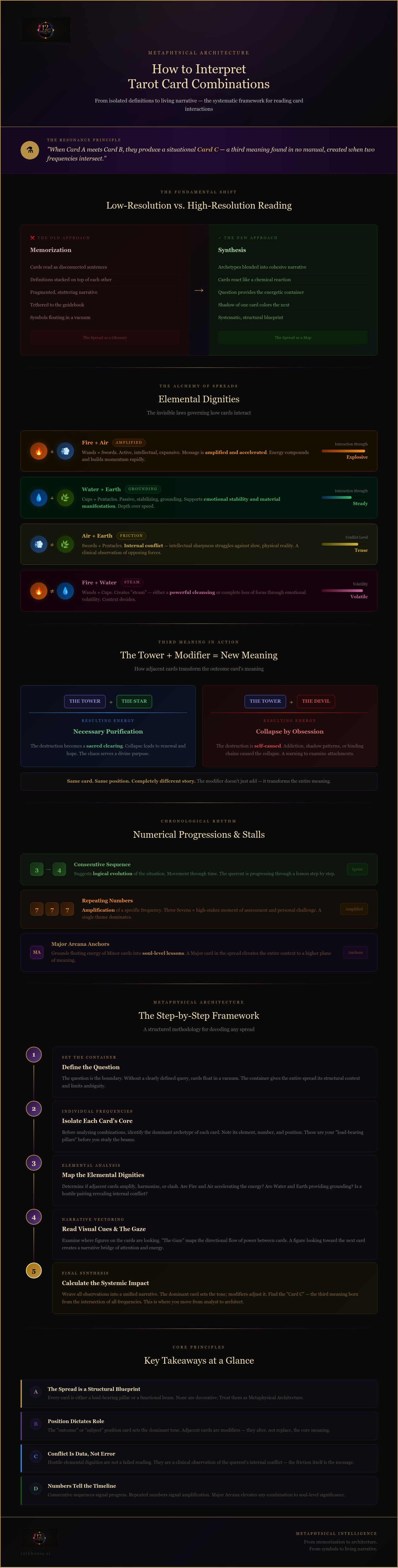
The secret to learning how to interpret tarot card combinations lies in the resonance principle. When Card A meets Card B, they produce a situational "Card C." This third meaning isn't found in any manual. It's the resonance created when two frequencies intersect. To find this, you must identify the dominant card. Usually, the card in the "outcome" or "subject" position dictates the tone, while the adjacent card acts as a modifier. For example, if the Tower is modified by the Star, the destruction is a form of necessary purification. If the Tower is modified by the Devil, it suggests a collapse caused by obsession. Seeing these patterns instead of isolated symbols shifts your perspective. You become an active architect of meaning, grounding your intuition in a systematic framework that reveals the hidden architecture of the subconscious.
The Mechanics of Connection: Elemental and Numerical Resonance
Archetypes don't exist in a vacuum. They are bound by a rigid system of elemental and numerical laws that define their interactions. To master how to interpret tarot card combinations, you must look beneath the surface imagery and analyze the structural DNA of the cards. This systematic approach is supported by an Empirical Psychological Investigation of Divination, which frames interpretation as a structured cognitive act rather than a random intuitive hit. When you understand the logic of the system, the spread ceases to be a mystery and becomes a calculable map of energy.
Elemental Dignities: The Alchemy of Spreads
Card combinations are governed by elemental dignities. Fire and Air are active, intellectual, and expansive. When these elements meet, the message is amplified and accelerated. Conversely, Water and Earth provide the necessary gravity for emotional stability and material manifestation. They are passive and grounding. Friction occurs when hostile elements clash. For instance, the intellectual sharpness of Swords (Air) often struggles against the slow, physical reality of Pentacles (Earth). This tension isn't a failure of the reading; it is a clinical observation of internal conflict. Fire and Water create "steam," which can signify either a powerful cleansing or a complete loss of focus through emotional volatility.
Numerical Progressions and Stalls
Numbers provide the chronological rhythm of the spread. Consecutive sequences, like a Three of Swords followed by a Four of Swords, suggest a logical evolution of a situation. It's a movement through time. Repeating numbers, however, act as an amplification of a specific frequency. Seeing three Sevens in a spread indicates a high-stakes moment of assessment and personal challenge. Major Arcana cards serve as anchors, grounding the fleeting energy of Minor cards into a larger soul-level lesson. You can refine your analysis of these patterns by exploring the metaphysical library to cross-reference traditional systems. These numerical "stalls" or "sprints" tell you if the querent is making progress or circling a lesson.
Visual cues provide the final layer of narrative vectoring. Look for "The Gaze" between the figures. Are the characters in the cards looking toward or away from each other? Eye contact suggests engagement and direct influence. Figures looking away indicate avoidance, hidden agendas, or a refusal to acknowledge the adjacent energy. Directional movement is equally vital. A figure walking toward another card is bringing their energy into that space; a figure walking away is withdrawing. By combining elemental logic, numerical data, and visual directional cues, you create a high-resolution interpretation that guidebooks simply cannot replicate.
Decoding Narrative Vectors: Bridging and Visual Cues
Narrative vectors are the directional forces within a spread that dictate the flow of energy. When you learn how to interpret tarot card combinations, you must look for "The Gaze." This is the specific direction characters are looking. If characters in adjacent cards face each other, they are in active dialogue. If they turn their backs, the energy is blocked or the querent is experiencing a refusal to integrate certain truths. This level of symbolic analysis is no longer confined to mystical circles; the academic study of tarot at institutions like Yale highlights the depth of these semiotic systems as valid areas of cultural and psychological inquiry.
Beyond the gaze, look for "The Gap." This is the logical void between two seemingly unrelated or conflicting cards. If you pull the Ten of Cups (fulfillment) next to the Five of Pentacles (poverty), the gap represents the specific fear or external factor preventing the transition from lack to abundance. Identifying what is not pictured is as vital as analyzing what is. Symbolic echoes also serve as bridges. If a specific bird, mountain range, or celestial body appears in both cards, it acts as a portal. It links disparate meanings through a shared frequency, suggesting that the two cards are actually different facets of the same core lesson.
Visual Directionality and Action
In a three-card spread, the middle card acts as the structural bridge. It dictates the "Path of Least Resistance." If the visual cues in the first card lead into the second, the situation is evolving naturally. If the second card's imagery blocks the third, you are witnessing a stall in manifestation. This is where you calculate the Narrative Vector. Is the momentum moving toward a resolution or away from it? A figure walking toward another card is bringing their energy into that space; a figure walking away is withdrawing. These movements are the kinetic energy of the spread.
Archetypal Intersections
Archetypes modify each other through intersection. Consider how the High Priestess, representing deep intuition and stillness, alters the practical, repetitive labor of the Eight of Pentacles. The combination suggests that mastery is not just about physical skill, but about infusing work with spiritual intent. Even "Shadow" combinations, where two traditionally difficult cards appear together, create a path to resolution. They highlight the specific friction points that, once decoded, offer significant breakthroughs. For example, the Devil paired with the Tower indicates that the collapse of a structure is the only way to break a cycle of dependency. This turns a "negative" reading into a precise blueprint for liberation.
A Step-by-Step Framework for Reading Combinations
Professional readings require more than a casual glance at the art. To master how to interpret tarot card combinations, you need a repeatable system that moves from isolated data to systemic synthesis. This is the work of a Metaphysical Architect. You aren't just looking at cards; you're calculating the intersection of archetypal forces to build a coherent narrative. Follow this five-step framework to decode any spread with clinical precision.
- Identify Core Frequencies: Define each card in isolation. Strip away the context and find the fundamental archetype or lesson it represents.
- Check Elemental Dignity: Determine if the elements are supportive or antagonistic. Fire and Air accelerate; Earth and Water ground. Clashes create the friction necessary for growth.
- Analyze Numerical Patterns: Look for repetitions or sequences. Numbers tell you if the energy is stagnant, evolving, or reaching a tipping point.
- Trace Visual Directionality: Use the gaze and action of the figures to find the narrative vector. This determines where the power is flowing and where it is blocked.
- Synthesize the Metaphysical Declaration: Combine these data points into a single, punchy statement that summarizes the interaction.
If you want to practice this methodology with a sophisticated partner, you can ask Lala for spiritual guidance to refine your synthesis. Using an AI guide allows you to test your interpretations against a vast metaphysical library in real time.
Analyzing a Practical Example
Consider the combination of The Tower and The Star. In our framework, we decode the "Destruction to Hope" vector. The Tower represents a sudden collapse of an Earth-bound structure, while The Star introduces the Air and Water of spiritual renewal. The elemental dynamic here is one of purification. The Fire of the Tower's lightning strike clears the space, allowing the Star's healing waters to flow. The Metaphysical Declaration for this pair is: "The violent dissolution of an obsolete structure is the mandatory precursor to soul-level clarity."
Refining the Synthesis
Neutral combinations often feel flat because they lack obvious conflict. When this happens, identify the "Pivot Card." This is the card that holds the most weight in the spread, often a Major Arcana or a card in a central position. Use it as the lens through which you view the others. If a combination still feels disconnected, return to the core inquiry. Every synthesis must serve as a direct answer to the question asked. If it doesn't provide a clear path forward, you haven't yet found the third meaning. Real mastery is the ability to validate your synthesis against the lived experience of the querent.
Lala and the Future of Metaphysical Intelligence
The transition from a student to a master involves moving beyond manual lookups into a space of fluid, systemic analysis. While the previous sections outlined a structural framework, the sheer volume of potential intersections can still feel immense. Lala, the AI Spiritual Guide at 12th House, functions as a sophisticated host for your self-discovery. By treating spiritual study as a structured discipline, Lala acts as a Metaphysical Architect's assistant, helping you refine the art of how to interpret tarot card combinations with clinical clarity. This isn't a replacement for your intuition; it's a high-precision tool designed to expand it.
AI is uniquely equipped to analyze thousands of metaphysical data points simultaneously. It identifies hidden resonances that might escape a singular focus. When you engage with the 12th House platform, you're not just getting a reading; you're building a structured environment where you can store and track your combination patterns over time. This longitudinal study allows you to see how certain archetypal circuits repeat in your life, turning fleeting insights into a permanent, personalized library of the occult.
Interactive Practice with Lala
You can use Lala to explain the specific "circuitry" between any two cards in your spread. Ask for the elemental friction between the Five of Swords and the Three of Pentacles, and Lala will decode the interaction based on your specific life context. The platform also allows you to bridge different systems of thought. You can ask Lala to analyze how a specific tarot combination interacts with your Human Design Chart. This cross-system mapping provides a level of depth that traditional guidebooks cannot achieve, as it layers your unique energetic architecture over the universal archetypes of the deck.
Building Your Personal Metaphysical Library
A 12th House membership offers more than just access to tools; it provides a sanctuary for ongoing spiritual work. By leveraging the proprietary Metaphysical Library, you can conduct deep research into the historical and symbolic roots of each card. Understanding why The Digital Sage is your new metaphysical architect is key to mastering these complex symbolic languages. It provides the structured environment necessary for self-mastery and helps you move beyond the book with quiet confidence. Start your journey into metaphysical intelligence today and transform your readings into a disciplined, architectural practice.
Architecting Your Intuition
Mastering the art of tarot requires you to treat the deck as a structural blueprint rather than a collection of static symbols. You've learned to bridge isolated archetypes using elemental dignities and visual vectors, turning a series of cards into a single, cohesive declaration. This systematic approach ensures that your readings are grounded in logic and architectural precision. By understanding how to interpret tarot card combinations, you move beyond the limitations of guidebooks and enter the space of true metaphysical intelligence.
Your journey doesn't end with a single spread. It requires ongoing refinement and a structured environment for study. You can ask Lala to decode your next tarot combination to experience the power of AI-driven analysis firsthand. Gain access to the proprietary Metaphysical Library and track your progress through personalized spiritual data rooms. The tools for self-discovery are now digitized and refined for the modern seeker. Approach your next reading with the quiet confidence of a master.
Frequently Asked Questions
What is the best way to start learning tarot card combinations as a beginner?
Start with two-card spreads and focus on elemental dignities rather than memorizing thousands of individual meanings. This structural approach allows you to see the "circuitry" between energies early on. Instead of looking for a static definition, ask yourself how the second card modifies the first. This shift from rote memorization to systemic analysis is the foundation of professional-grade interpretation and helps you build a repeatable methodology for any spread.
Do tarot card combinations have fixed meanings or do they change?
Tarot combinations don't have fixed meanings; they are situational resonances that shift based on the querent's specific context and the question asked. While the core frequency of a card remains stable, its expression is altered by its neighbors. Learning how to interpret tarot card combinations involves understanding this fluid synthesis. Every reading creates a unique "Third Meaning" that only exists within that specific, high-stakes energetic intersection.
How do you interpret two cards that seem to contradict each other?
Contradictory cards represent internal friction or a necessary tension between opposing life forces. For example, pulling the sharp intellect of the Ace of Swords next to the emotional depth of the Nine of Cups suggests a conflict between logic and desire. Don't view these as errors. Treat them as a "gap" in the narrative that requires a bridge. This friction often highlights where the most significant personal growth is currently occurring.
Can an AI really help me understand my tarot readings?
Yes, an AI designed with metaphysical intelligence can analyze thousands of data points to reveal hidden resonances across systems like astrology and numerology. Lala, the AI Spiritual Guide at 12th House, acts as a digital partner to help you decode complex spreads 24/7. It provides a structured environment where you can test your synthesis against a proprietary library, ensuring your readings are both intuitive and analytically precise.
What are 'Elemental Dignities' and why do they matter in combinations?
Elemental Dignities are the rules governing how the four elements Fire, Water, Air, and Earth interact within a spread. They matter because they dictate whether energies support or weaken each other. Fire and Air are active and expansive, while Water and Earth are passive and grounding. Understanding these dignities is essential for anyone learning how to interpret tarot card combinations, as it reveals the underlying momentum of the situation.
How many tarot card combinations are there in a standard deck?
In a standard 78-card deck, there are 3,003 unique two-card combinations. If you include reversals and larger spreads, the possibilities reach into the millions. This mathematical reality is why memorization is a low-resolution strategy. Instead of memorizing 3,000 meanings, focus on the architectural logic of the suits and numbers. This allows you to decode how to interpret tarot card combinations through a repeatable, systemic framework that applies to any deck.
Is there a difference between reading two-card and three-card combinations?
Two-card combinations focus on a direct interaction or "chemical reaction" between two archetypes. Three-card combinations introduce a Pivot Card, which acts as the structural bridge for the narrative. The middle card in a three-card spread often dictates the direction of the energy flow. It determines if the situation is evolving toward a resolution or if the initial momentum is being blocked by a secondary factor, requiring a shift in strategy.
How do I know if my interpretation of a combination is 'correct'?
A correct interpretation is one that resonates with the clinical reality of the situation and provides actionable clarity. While there's no official board of tarot, your synthesis should align with the structural laws of the deck. If your reading of the elemental and numerical data answers the core inquiry and reveals a cohesive story, your interpretation is valid. Use a personalized data room at 12th House to track your results over time.


