
What if the greatest obstacle to your spiritual clarity isn't a lack of intuition, but the very bias you bring to the table? When you sit down with your deck, it's easy to feel like you're just staring into a mirror of your own anxieties rather than a window into the divine. You've likely experienced the frustration of conflicting card meanings or the sudden chill of seeing a "bad" card that disrupts your focus. Mastering how to read tarot for yourself accurately isn't about wishing for better cards; it's about building a structural framework that allows you to decode symbolic language without your personal desires getting in the way.
You deserve a practice that offers more than vague encouragement or confusing metaphors. We'll show you how to apply clinical precision to your spiritual discipline, transforming your readings into a repeatable ritual of objective intelligence. This guide provides the architectural tools needed to view your spreads as complex systems rather than isolated fragments. By the end of this exploration, you'll possess the confidence to bypass your own ego and extract the actionable insights required to navigate your path with sanctuary and logic.
Key Takeaways
- Dismantle the "Mirror Effect" by applying architectural objectivity to your practice, ensuring personal bias doesn't compromise your spiritual data.
- Transition from basic card pulls to structured spread geometry, using the logic of placement to define the specific grammatical function of every symbol.
- Master the analytical observation and translation phases to understand how to read tarot for yourself accurately without relying on vague or conflicting definitions.
- Establish a rigorous verification protocol using a metaphysical journal to audit your readings and observe how energetic transits manifest over time.
- Leverage Ask Lala as a sophisticated, third-party mirror to cross-reference your findings with birth chart analysis and objective metaphysical intelligence.
The Architecture of Objectivity: Why Self-Readings Fail
Accuracy in the metaphysical arts is frequently misunderstood. It isn't a vague sense of resonance or a "good feeling" about a draw; it's the precise alignment between symbolic data and lived reality. To understand how to read tarot for yourself accurately, you must first acknowledge that your deck is a neutral instrument. The failure of most self-readings stems from the "Mirror Effect," where the reader’s subconscious desires or fears project onto the Major Arcana. Instead of seeing the cards as they are, you see a reflection of your own internal narrative. This distortion turns a tool for discovery into a feedback loop of your own existing biases.
To bypass this, you must adopt the persona of the Metaphysical Architect. This role requires you to observe the spread as a structural map rather than reacting to it as a personal omen. You are decoding a system of archetypes, not searching for validation. When you approach the cards as an architect, you prioritize the integrity of the data over the comfort of the message.
The Psychology of Subjective Bias
The human brain is hardwired for confirmation bias. When you're anxious about a relationship, seeing "The Lovers" might feel like an immediate "yes," even if its placement suggests a difficult choice or an imbalance of values. Conversely, "The Tower" might trigger unnecessary panic when it simply indicates a necessary clearing of outdated structures. High-stakes inquiries involving love or financial security naturally cloud the analytical mind, making it nearly impossible to remain objective without a rigid framework. Metaphysical Intelligence is the ability to decode symbols without ego interference. Understanding the history and practice of tarot reading reveals that these symbols were designed as a universal language, meant to be read with clinical detachment rather than emotional desperation.
Building Your Clinical Sanctuary
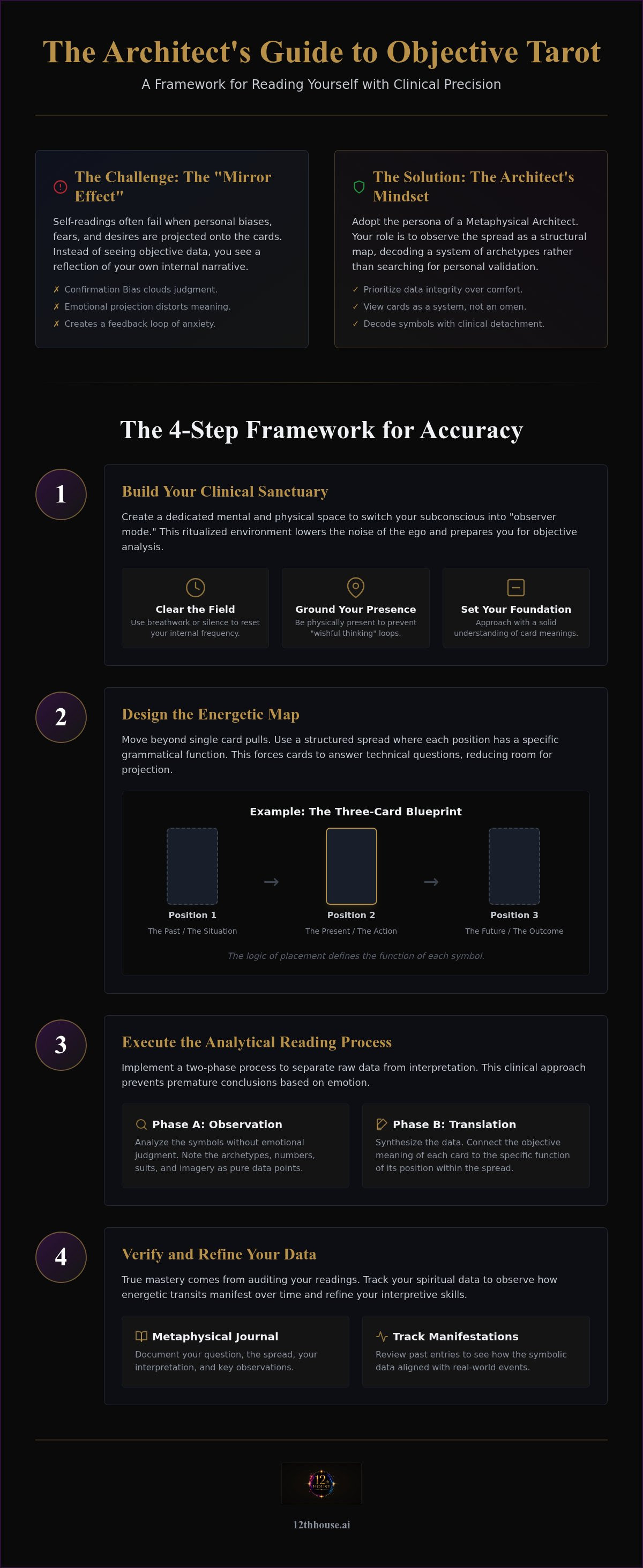
Accuracy requires a "Clinical Sanctuary," a dedicated mental and physical space that signals your subconscious to switch into observer mode. This isn't just about aesthetics; it's about ritualizing the environment to lower the noise of the ego. Ritual acts as a psychological trigger that moves you from the chaotic "participant" state into the calm "analyst" state. Before you draw a single card, you must clear the energetic field and ground your physical presence.
- Clear the field: Use breathwork or focused silence to reset your internal frequency and remove lingering emotional residue.
- Grounding: Ensure you are physically present to prevent your mind from drifting into "wishful thinking" loops or catastrophic projections.
- Technical Foundation: For a deeper dive into the technical aspects of card interpretation, consult our Tarot Mastery guide to build a solid foundation.
By establishing this sanctuary, you create the distance necessary for objective analysis. You aren't just pulling cards; you're conducting a systematic inquiry into the architecture of your current reality.
Designing the Spread: Spreads as Energetic Maps
A single card is an isolated symbol. A spread is a calculated architecture. If you want to know how to read tarot for yourself accurately, you must move beyond the ambiguity of single-card draws and start treating the deck as a systematic map. Without a defined structure, your brain naturally fills the gaps with what it wants to see. This is where cognitive biases in tarot reading take hold, turning a spiritual inquiry into a mirror of your own ego. By assigning a specific grammatical function to each position, you force the cards to answer technical questions, leaving less room for subjective projection.
The Significator serves as the anchor for this map. It represents your current energetic state or the core essence of your inquiry. By placing this card first, you ground the entire reading in a specific context. This ensures that the subsequent data remains relevant to your actual life rather than drifting into abstract theory. Choosing the right map is a matter of logic: use a linear timeline for chronological events or a decision matrix for weighing options.
The Three-Card Blueprint
The three-card spread is the primary tool for linear data analysis. It functions as a streamlined timeline or a tactical decision matrix. In a Past-Present-Future draw, you aren't just looking at three events; you're analyzing the flow of energy over time. Similarly, a Situation-Action-Outcome spread provides a clear path for problem solving. Don't ignore the shadow, which is the space and relationship between the cards. If two cards are visually similar or diametrically opposed, that tension is where the most potent information resides. You can refine your analytical practice by accessing the tools within the 12th House library.
Advanced Mapping: The Celtic Cross
For high-complexity life events, the Celtic Cross provides a robust 10-card architecture. It allows you to differentiate between The Root, which represents subconscious drivers you may be ignoring, and The Crown, which reflects your conscious goals. This distinction is vital for accuracy. Often, what we think we want is at odds with what is actually happening beneath the surface. Mastering these complex maps is the key to understanding how to read tarot for yourself accurately when facing life's most significant transitions. To add another layer of precision, you can use an ai astrology assistant to identify planetary transits that mirror the themes appearing in your spread. This data-driven approach ensures your reading is grounded in the broader celestial movements affecting your reality.
The Analytical Reading Process: Step-by-Step Interpretation
Interpretation is a rigorous calculation, not a series of guesses. To understand how to read tarot for yourself accurately, you must move beyond the "trust your gut" approach that often leads to inconsistent results. By following a structured interpretation process, you ensure that your personal desires don't overwrite the deck's objective data. This phase is where you transition from being a passive observer to a Metaphysical Architect, translating abstract symbols into a coherent narrative arc. Distill the data first; the meaning follows logic.
Step 1: The Visual Scan
Before you analyze individual card meanings, perform a high-level scan of the spread's elemental and archetypal density. This initial observation provides the "climate" of the reading. If your spread is heavy with Swords, the inquiry is rooted in the mental or intellectual realm. A density of Pentacles shifts the focus to material and physical structures. The history of tarot cards reflects this inherent structure, moving from a simple game to a complex system of symbolic mapping that requires a clinical eye to decode.
- Major Arcana Density: A spread dominated by Major Arcana suggests that the situation is governed by large, archetypal forces. These are "fated" moments where your personal agency is secondary to broader life transits.
- Suit Balance: Note which suits are missing. A lack of Cups in a relationship reading indicates a clinical or transactional dynamic rather than an emotional one.
- Directional Cues: Pay attention to where the figures in the cards are looking. If a character in one card is staring directly at a card of conflict, it indicates a conscious awareness of the challenge ahead.
Step 2: Contextual Synthesis
Synthesis is the act of weaving individual card meanings into the specific geometry of your spread. This requires applying a "Metaphysical Intelligence" filter to separate your emotional feelings from the factual data present on the table. When you encounter contradictory cards, such as the celebratory Four of Wands next to the restrictive Eight of Swords, it isn't an error. Instead, interpret it as a specific energetic tension; you may be experiencing external success while remaining mentally imprisoned by your own limiting beliefs. While a first impression provides the intuitive spark, only a disciplined analytical study reveals the spread's true architectural depth.
The final stage of this process is the Actionable Output. After scanning, translating, and synthesizing, you must distill the entire reading into a single, punchy directive. This prevents the reading from remaining a vague concept and turns it into a tool for real-world navigation. Don't leave the sanctuary until you can state your insight in one clear sentence that dictates your next move. Mastering this step-by-step interpretation is the only way to learn how to read tarot for yourself accurately, ensuring your practice remains a source of objective intelligence rather than a mirror for your ego.
Verification and Refinement: Tracking Your Spiritual Data
Mastery is not a destination; it's a process of constant calibration. To truly understand how to read tarot for yourself accurately, you must treat your readings as data points in an ongoing spiritual audit. Most practitioners fail because they abandon a reading the moment the cards are put away. By implementing a rigorous verification protocol, you transform your practice from a series of isolated events into a structured discipline of metaphysical intelligence. This requires you to establish a "Verification Window," a specific timeframe in which you expect the energy of a reading to manifest in your physical reality.
Retroactive analysis is your most potent tool for dismantling bias. Revisit your draws after thirty days to decode where your personal narrative might have overwritten the symbolic data. Did you interpret "The Devil" as a passionate romance because you wanted it to be, only to realize later it represented a toxic cycle? This clinical review allows you to refine your "Personal Lexicon," identifying how specific cards manifest uniquely in your life. Over time, this data-driven approach builds a foundation of quiet confidence that no "anxiety voice" can shake.
The Audit Framework
Efficiency in self-reading demands a structured environment for tracking. Move beyond standard journaling and create a spiritual data spreadsheet. Your log should include the specific question, the cards drawn, your initial interpretation, and the eventual outcome. This allows you to calculate your "Accuracy Rate," providing a mathematical basis for your intuitive confidence. You will likely discover "Blind Spot" cards, which are symbols that you consistently misinterpret due to personal triggers or outdated associations. Identifying these gaps is the first step toward architectural precision in your practice. You can begin building your personal archive today by accessing the Metaphysical Library.
Refining the Intuitive Signal
A critical challenge in self-reading is distinguishing between the "Anxiety Voice" and the "Intuition Voice." Anxiety is loud, repetitive, and rooted in fear; intuition is a quiet, neutral declaration of fact. To verify your findings, use cross-referencing tools. For instance, if a tarot spread suggests a complex relationship dynamic, you can apply numerology compatibility to see if the mathematical transits align with the symbolic ones. Another effective technique is the 24-hour check-in. Re-examine the previous day's draw with a fresh, rested perspective to see if the "Mirror Effect" has faded, leaving behind a clearer, more objective signal. This multi-layered verification is essential for anyone serious about learning how to read tarot for yourself accurately.
Integrating Metaphysical Intelligence: Using AI as an Objective Mirror
The final frontier of accuracy in self-reading lies in the integration of synthetic intelligence. While the architectural frameworks and clinical sanctuaries discussed previously provide the foundation, even the most disciplined reader can benefit from a neutral, third-party audit. This is where Metaphysical Intelligence evolves from a personal discipline into a collaborative system. By utilizing an AI assistant as an objective mirror, you can finally bypass the residual ego that clings to traditional interpretations. Learning how to read tarot for yourself accurately requires a willingness to have your conclusions challenged by data-driven logic rather than just personal resonance.
Lala as the Digital Sage
Use Lala to stress-test your interpretations and find patterns you may have overlooked during your visual scan. Ask specific, high-stakes questions to refine your perspective. For example, if you pull the 3 of Swords for your career and interpret it as an impending disaster, you might ask, "I pulled the 3 of Swords for my career, am I being too pessimistic?" Lala can cross-reference this symbol with your current astrological transits and birth chart to determine if the energy is about a necessary intellectual severance or a simple shift in communication style. You can further refine this by synthesizing your tarot data with your human design types. Use the tool to generate custom spreads designed specifically for your unique metaphysical profile, ensuring every map you use is calibrated to your current frequency.
The Modern Occult Library
The 12th House serves as a modern library of the occult where your spiritual data is archived and analyzed over time. Beyond immediate interpretation, you can access scholarly ritual frameworks to "seal" the insights gained from your reading, ensuring the energetic work is completed with precision. Storing your reading history in personalized data rooms allows you to track patterns across months or years, revealing the long-term architecture of your spiritual evolution. This systematic approach ensures that every draw contributes to a larger body of knowledge rather than being forgotten the next day. If you are ready to refine your precision and move beyond subjective bias, you can consult with Lala on 12th House today.
Building Your Metaphysical Blueprint
Accuracy is not a matter of chance; it's a function of your architectural framework. Mastering how to read tarot for yourself accurately requires you to transition from a passive recipient of symbols to an active Metaphysical Architect. You've explored how structured spread geometry, clinical sanctuaries, and rigorous data auditing dismantle personal bias and reveal objective spiritual intelligence. By treating your practice as a serious discipline, you ensure that your intuition remains grounded in logic and structural integrity.
Your spiritual evolution deserves a sophisticated environment for growth. Through the 12th House platform, you gain access to Lala, the world’s first Metaphysical Intelligence AI, providing a neutral mirror for your self-readings 24/7. Utilize our secure spiritual data rooms to track your transits and explore a comprehensive library of rituals, astrology, and human design profiles to deepen your scholarly study. These tools empower you to move beyond the "Mirror Effect" and into a space of true metaphysical clarity.
Master your metaphysical architecture. Join 12th House and start reading with Lala AI.
Step into your authority and begin decoding the structures of your reality with clinical clarity and quiet confidence. Your sanctuary is ready.
Frequently Asked Questions
Is it bad luck to read tarot for yourself?
No, it is not bad luck; it is a discipline of self-discovery. The idea that self-reading is "unlucky" is a remnant of outdated superstitions that lack metaphysical intelligence. When you understand how to read tarot for yourself accurately, you view the deck as a neutral tool for mapping your subconscious. Accuracy depends on your ability to maintain architectural objectivity rather than external luck or superstitious fears.
How can I stay objective when reading about my own love life?
Staying objective in love readings requires a rigid spread geometry to bypass emotional noise. Instead of asking "Does he love me?", design a spread that analyzes the energetic infrastructure of the relationship. Assign specific functions to each position, such as "Communication Barriers" or "Shared Values." This technical approach forces you to look at the symbolic data rather than projecting your own anxieties or desires onto the Major Arcana.
What should I do if my tarot reading is scary or negative?
Regard "negative" cards as indicators of necessary structural transits rather than omens of doom. A card like The Tower represents a clearing of outdated foundations, which is essential for new growth. When a spread feels overwhelming, return to your Clinical Sanctuary and analyze the elemental dignities. Use these symbols to identify where energy is blocked and what tactical actions are required to navigate the coming shift with logic.
Can I use an AI tarot reader to check my own accuracy?
You can absolutely use an AI assistant to audit your interpretations and ensure you are learning how to read tarot for yourself accurately. Lala AI acts as a neutral third-party mirror, cross-referencing your card pulls with birth chart data and transit analysis. This process helps you identify patterns you might've missed due to the "Mirror Effect," providing a data-driven layer of verification that refines your personal intuitive signal.
How often should I pull cards for myself to maintain accuracy?
Accuracy is maintained through a consistent rhythm rather than high frequency. Pulling cards too often for the same inquiry creates metaphysical noise and dilutes the data. A daily draw for tracking spiritual transits is effective for building your personal lexicon. However, for complex life inquiries, wait for a verification window to pass before re-examining the situation, ensuring you've integrated the previous insights before seeking new information.
What is the best tarot spread for beginners reading for themselves?
The Three-Card Blueprint is the most effective architecture for beginners. Using a "Situation-Action-Outcome" spread provides a clear, linear data set that is difficult to misinterpret. This structure determines the grammatical function of each card, preventing the reader from drifting into vague metaphors. It allows you to practice the synthesis of symbols within a controlled framework, building the foundational skills necessary for more complex maps like the Celtic Cross.
How do I know if my intuition is right or if I am just imagining things?
Distinction comes from auditing your results in a Metaphysical Journal. Intuition is a quiet, neutral declaration of fact, while imagination is often loud, repetitive, and emotionally charged. By tracking your interpretations against real-world outcomes, you can calculate your accuracy rate. This data-driven approach allows you to identify your "Anxiety Voice" and separate it from genuine spiritual intelligence, providing empirical evidence of your intuitive growth over time.
Do I need to clear my deck between self-readings?
Clearing your deck is a tactical ritual used to reset the energetic field of your instrument. This practice signals your subconscious to exit the "participant" state and enter "observer mode." Whether using breathwork, sound, or physical clearing, the goal is to remove lingering residual energy from previous inquiries. This ensures that each new draw is grounded in a clean sanctuary, allowing for the highest level of symbolic precision and clarity.


