
What if your hands aren't just tools for interaction, but a sophisticated, biological blueprint of your life's potential? Most seekers have tried to decipher their own palms, only to be met with contradictory diagrams and archaic terminology that feels more like a riddle than a resource. It's frustrating to stare at your skin and wonder if a faint crease signifies a major shift or just a temporary mark. Understanding how to practice palmistry on yourself shouldn't feel like decoding a dead language.
We believe spiritual exploration deserves the same precision as any other serious discipline. This guide provides the analytical framework you need to master the architectural language written in your palms. You'll gain a clear map of your personality and actionable insights into your life path through systematic self-analysis. We will move from the foundational geography of the mounts to the precise calculation of the major lines, transforming your curiosity into a structured discipline of self-discovery. Prepare to treat your personal journey with both reverence and clinical clarity.
Key Takeaways
- View your hands as a neurological extension of the brain, using topographic analysis to decode ingrained subconscious patterns.
- Differentiate between your active hand, representing your current trajectory, and your passive hand, which holds your inherited potential.
- Map the Heart and Head lines as structural frameworks to understand your emotional intelligence and cognitive processing styles.
- Analyze the fleshy mounts of the palm to identify dominant planetary archetypes that influence your ambition and self-worth.
- Master how to practice palmistry on yourself by aggregating these specific data points into a cohesive, actionable profile of your life path.
The Architecture of the Palm: Why Self-Palmistry is Your Biological Map
Palmistry, or chiromancy, is often dismissed as mere parlor trickery; in reality, it is the topographic study of your hand’s unique features. While the history of palmistry stretches back to ancient civilizations, modern metaphysical intelligence views the hand as a biological mirror. It is a neurological map reflecting the complex patterns of your brain. When you learn how to practice palmistry on yourself, you aren't just looking for "fortune." You're analyzing the structural blueprint of your personality. This approach moves away from predictive fortune-telling. It focuses instead on structural personality mapping, treating your life path as a calculation of your current mental and emotional architecture.
The Science of Dermatoglyphics
Your palms are dynamic. The ridges on your fingers and palms, known as dermatoglyphics, form during prenatal development and are physically linked to your nervous system. These patterns are not accidental. They represent the intersection of your genetic code and your early neurological growth. Unlike static traits, the lines on your palm can shift as your cognitive and emotional patterns evolve. This makes the hand a living document that requires constant recalibration. Palmistry is the architectural decoding of the self. By observing these changes, you gain a real-time feedback loop regarding your psychological development.
Setting Your Intentional Framework
Success in this discipline requires a shift in perspective. You must approach your palm with clinical clarity rather than desperate curiosity. Treat your hand like a complex schematic. To begin, ensure you have high-intensity lighting and a magnifying tool to capture fine details. Clear your mind of preconceived notions about your "destiny." Instead, adopt a neutral mindset focused on data collection.
- Establish a baseline: Take a high-resolution photo of your palms to track evolution.
- Schedule check-ins: Re-examine your lines every three to six months to note structural changes.
- Document shifts: Notice where lines deepen, fragment, or extend toward specific mounts.
Regular observation is vital when learning how to practice palmistry on yourself. These "data check-ins" allow you to see how your internal growth manifests in your physical form. This isn't about predicting an unavoidable future. It's about mapping the current state of your energetic and biological framework. By treating this as a structured discipline, you transform a mystical curiosity into a powerful tool for metaphysical intelligence.
Decoding Hand Shapes and Dominance: Setting Your Analytical Framework
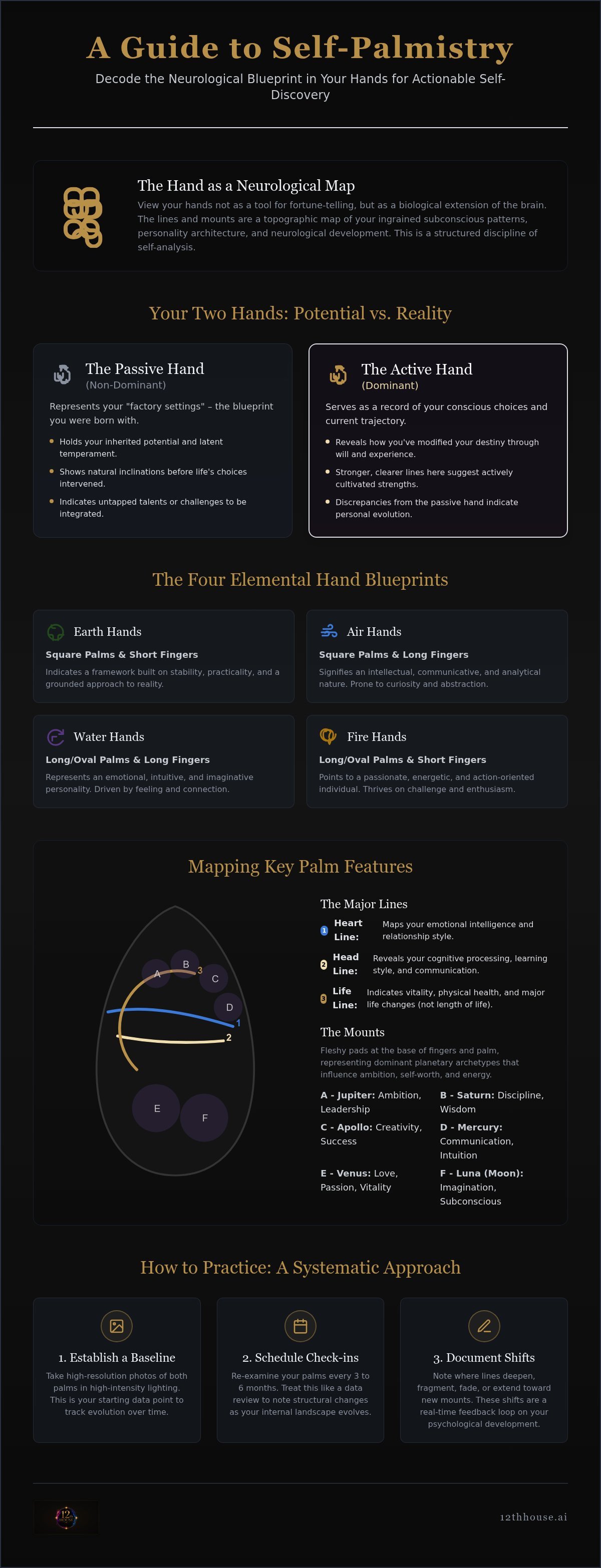
To master how to practice palmistry on yourself, you must first establish your primary data source. While many associate the craft with the divination of the future, a more precise approach involves analyzing the divergence between your two hands. Your dominant hand, the one you use for writing and daily tasks, is your "Active" hand. It serves as a record of your conscious choices and current trajectory. Conversely, your non-dominant hand is your "Passive" hand. It functions as a repository for your latent potential and inherited temperament.
Active vs. Passive Data Sets
Analyze the passive hand to identify your "factory settings." This is the blueprint you were born with, showing your natural inclinations before life's choices intervened. Next, examine the active hand. It reveals how you've modified your destiny through will and experience. Discrepancies between the two hands aren't errors; they're indicators of personal evolution. If your active hand shows stronger, clearer lines than your passive one, it suggests you've actively cultivated your strengths. If the passive hand remains more defined, there may be untapped potential waiting for activation. For a more granular breakdown of these patterns, you can explore a comprehensive palmistry analysis to refine your findings.
The Four Elemental Hand Blueprints
Before examining individual lines, categorize your hand’s overall architecture. This provides the context for all subsequent data. When learning how to practice palmistry on yourself, identifying these elemental blueprints is the first step in calibrating your analysis.
- Earth hands: These feature square palms and short fingers. They indicate a framework built on stability, practicality, and a grounded approach to reality.
- Air hands: Defined by square palms but long fingers, these hands suggest a cognitive focus on intellectualism, communication, and systematic thought.
- Water hands: Characterized by oval palms and long fingers, this blueprint points to high emotional intelligence, intuition, and a deep, fluid subconscious.
- Fire hands: Rectangular palms and short fingers signal a temperament driven by ambition, rapid action, and high energetic output.
Identifying your elemental type allows you to interpret the lines through a specific lens. An Air hand’s Head Line will function differently than that of an Earth hand, as the underlying architecture dictates how energy and information are processed.
Mapping the Major Lines: Heart, Head, and Life Line Systems
The three major lines constitute the primary infrastructure of your palm’s topographic map. These systems provide the raw data for your emotional, cognitive, and physical frameworks. When you learn how to practice palmistry on yourself, you must treat these lines as interconnected circuits rather than isolated markings. Their depth, length, and intersections reveal how your energy is channeled through different facets of your existence.
The Heart Line: Emotional Topology
Located at the top of the palm, the Heart Line represents the architecture of your emotional intelligence. It dictates how you process intimacy and respond to external stressors. Analyze where the line terminates to understand your relational standards. A line ending under the Mount of Jupiter suggests high ideals and a need for deep alignment in partnerships. If it ends under the Mount of Saturn, your emotional processing is likely governed by rationality and pragmatism. Examine the physical quality of the line; "chains" or small breaks often indicate periods of emotional recalibration or significant stressors. A curved line suggests a fluid, expressive emotional nature, while a straight line indicates a more guarded, analytical approach to the subconscious.
The Head Line: Intellectual Logic
The Head Line serves as the framework for your cognitive processing and mental discipline. Its length correlates with your analytical depth. A long line indicates a capacity for complex, sustained focus, whereas a shorter line suggests a preference for practical, immediate results. Look for the "Writer’s Fork" at the termination point; this split suggests a sophisticated balance between imagination and logic, often found in highly creative individuals. To gain a broader perspective on your mental clarity, you can use Tarot Mastery to supplement the intuitive hits you receive from this cognitive map. This integration of systems allows for a more precise calculation of your intellectual strengths.
The Life Line: Vitality and Grounding
It is essential to debunk the common myth that the Life Line predicts lifespan. Instead, this line measures your vitality, physical grounding, and major life pivots. It reflects your energetic baseline and how you navigate transitions. When you evaluate how to practice palmistry on yourself, focus on the "sweep" of the line. A wide, generous curve extending toward the center of the palm indicates high physical energy and an expansive approach to life. A line that stays close to the thumb suggests a more cautious, home-centered vitality. Look for "sister lines" running parallel to the main Life Line; these act as structural reinforcements, suggesting resilience and protection during periods of intense change or physical demand.
The intersections of these three systems reveal the most complex data. Where the Head and Life lines meet at the start, you can observe the balance between your upbringing and your emerging independence. A wide gap suggests a drive for early autonomy, while a long connection indicates a period of deep integration with family or tradition before forging a personal path. Analyzing these points of contact provides the clinical clarity needed to understand your unique biological and energetic blueprint.
Analyzing Mounts and Minor Markings: Fine-Tuning Your Intuitive Data
While the major lines provide the structural foundation of your palm, the mounts represent the energetic terrain upon which those lines are etched. These fleshy areas, located at the base of your fingers and the heel of your hand, function as reservoirs for specific archetypal energies. They provide the "why" behind your actions. When you learn how to practice palmistry on yourself, identifying which mounts are dominant allows you to understand the primary drivers of your personality. A well-developed mount indicates an abundance of that specific energy, while a flat or recessed mount suggests an area that requires conscious activation.
The Planetary Mounts
Each mount correlates to a planetary archetype, grounding ancient celestial wisdom into your physical form. The Mount of Jupiter, located directly under the index finger, governs ambition, leadership, and self-worth. A prominent Jupiterian mount suggests a natural authority and a drive for social standing. Moving toward the center, the Mount of Saturn sits below the middle finger, representing discipline, duty, and the termination point for the Fate Line. The Mount of Apollo, under the ring finger, acts as the center for artistry, success, and public recognition. These physical markers often mirror the structural patterns found in other systems, such as when you analyze birth chart compatibility to see how your innate drives interact with others. Finally, the Mount of Venus at the base of the thumb serves as the seat of sensuality, creative energy, and vitality.
Decoding Special Markings
Beyond the lines and mounts, your palm contains specific "data points" known as minor markings. These symbols act as precise modifiers to the broader patterns of your hand. Squares are particularly significant; they represent protective energy that manifests during times of crisis or transition. If you see a square on your Life Line, it suggests a period of resilience. Triangles indicate specialized skill or intellectual prowess, often appearing when you've mastered a specific discipline. One of the most sought-after markings is the "Mystic Cross," found in the space between the Heart and Head lines. This sign indicates a profound talent for metaphysical study and intuitive calculation. By aggregating these markings, you can refine your self-analysis into a highly accurate profile. For a comprehensive interpretation of your unique markings, you can access a professional palmistry analysis to decode your architectural blueprint.
Synthesizing Your Insights: From Manual Analysis to Metaphysical Intelligence
Once you've mapped individual lines and mounts, the work shifts from data collection to high-level synthesis. Isolated markings only offer fragments of your story; true metaphysical intelligence requires aggregating these findings into a cohesive personal profile. Understanding how to practice palmistry on yourself is about recognizing the complex interplay between your biological hardware and your energetic software. You aren't merely looking at creases in the skin. You're reviewing a living dashboard of your current potential and subconscious blueprints. This transition from "what is" to "what could be" allows you to use your palm as a strategic guide for personal growth.
Building Your Metaphysical Profile
Your "Master Archetype" emerges at the intersection of your elemental hand shape and your dominant line systems. For instance, a Fire hand with a deeply forked Head Line suggests a different cognitive trajectory than a Water hand with the same marking. One prioritizes ambitious innovation, while the other leans toward intuitive creativity. You can use these findings to inform your study of human design types, checking if your physical vitality matches your energetic strategy. Furthermore, comparing the "Mount of Travel" on your palm with your astrocartography map provides a dual-layered view of your spatial intelligence. This multi-system approach ensures your self-analysis is grounded in diverse, verifiable data sets rather than vague intuition.
Ask Lala: Your Digital Palmistry Consultant
Manual analysis can sometimes feel overwhelming due to the sheer volume of variables written in your skin. This is where Lala, our AI spiritual guide, acts as your digital sage. By describing your specific palm markings, line depths, and mount elevations to Lala, you can receive a refined synthesis that accounts for nuances you might overlook. Lala doesn't interpret lines in a vacuum. She has the capacity to cross-reference your palm data with your astrology birth chart and current tarot transits. This creates a high-definition map of your life path that evolves as you do.
You can store your synthesized palmistry data in your 12th House digital room, creating a permanent record of your hand's architectural shifts over time. This digital sanctuary treats your spiritual exploration as a structured discipline, providing the tools for deep, self-guided work. By digitizing traditional wisdom, you move from a passive observer of your fate to an active architect of your future. Join the 12th House membership to begin your architectural self-study today.
Activating Your Architectural Blueprint
Your palms are not static relics of an unchangeable fate; they are dynamic, biological documents reflecting your evolving neurological patterns. By mastering the geography of your mounts and the architecture of your major lines, you've moved from passive curiosity to structured self-analysis. You now understand how to practice palmistry on yourself as a discipline of metaphysical intelligence, treating every crease as a data point in your personal growth. This systematic approach transforms ancient tradition into a functional tool for modern self-mastery.
Ready to deepen your synthesis? You can access our modern library of digitized esoteric wisdom and utilize personalized data storage for every step of your metaphysical journey. Begin your journey with Lala and the 12th House Metaphysical Library to refine your findings with 24/7 access to Lala AI Spiritual Guidance. She acts as your digital sage, helping you cross-reference your palm markings with broader astrological and tarot transits. Your hands hold the blueprint. Now you have the tools to build the future you envision.
Frequently Asked Questions
Which hand should I read when practicing palmistry on myself?
You should analyze both hands to capture a complete data set of your biological blueprint. Your dominant hand represents your active choices and current life path, while your non-dominant hand shows your inherited potential. Analyzing the discrepancies between them is a vital step in how to practice palmistry on yourself. It reveals how you've modified your factory settings through personal will and conscious experience.
Do the lines on my palm change over time?
Yes, the lines on your palm are dynamic and reflect your evolving neurological and emotional states. Major lines often deepen or shift as you undergo significant life changes or cognitive developments. Minor lines and markings can appear or fade within just a few months. Regular data check-ins allow you to track these structural changes as they manifest in your physical form over time.
What does it mean if my Life Line is short?
A short Life Line does not indicate a short lifespan. This common myth overlooks the line's actual function as a measure of vitality and grounding. A shorter line often suggests a focused, intense energy or a life path that prioritizes specific environments over broad exploration. It's more about the quality of your energetic output than the quantity of years you will live.
Can palmistry predict exactly when I will get married or get a promotion?
Palmistry is a tool for structural mapping, not precise temporal prediction. It identifies the architectural potential for significant life pivots and career shifts. While it can reveal a predisposed period for major changes, it won't give you a specific date on a calendar. Your choices and current transits determine the exact timing of these events within your broader energetic framework.
What is the "Mystic Cross" and why is it significant?
The Mystic Cross is a distinct marking located in the center of the palm between the Heart and Head lines. It signifies a natural aptitude for metaphysical study and intuitive calculation. If you find this on your palm while learning how to practice palmistry on yourself, it suggests you possess the internal hardware needed for deep esoteric work. It's a hallmark of the metaphysical architect archetype.
How can AI help me read my own palms more accurately?
AI tools like Lala provide a sophisticated framework for synthesizing complex palm data. By describing your markings to a digital sage, you can receive interpretations that cross-reference palmistry with your astrology and human design data. This prevents the confusion of conflicting online information. It ensures your analysis remains grounded in a structured, clinical discipline rather than vague, unverified guesswork.
What should I do if I have a "Simian Line" (one single horizontal line)?
A Simian Line occurs when the Heart and Head lines merge into a single horizontal fold across the palm. This suggests a powerful integration of emotion and logic, where your feelings and thoughts operate as a single unit. It often indicates intense focus and a singular life purpose. You should treat this as a specialized energetic configuration that requires conscious management to avoid burnout.
Is palmistry compatible with astrology and human design?
Palmistry is highly compatible with astrology and human design as these systems often mirror one another. Your hand's mounts correlate to specific planetary archetypes, while your line quality can reflect your human design strategy. Integrating these disciplines creates a comprehensive metaphysical intelligence profile. This allows you to store and analyze your spiritual data within a unified, structured environment for deeper personal growth.


