
What if the "win" you just secured is actually the very thing dismantling your relationship? In the geometry of intimacy, the Five of Swords represents a tactical error where the ego's survival is prioritized over the union's integrity. If you've encountered the five of swords as feelings in a love reading, you're likely navigating a landscape of depletion, defensiveness, or a chilling silence that feels like defeat. It's a heavy, jagged energy that leaves you wondering if the structural damage to your connection is permanent.
You're right to feel concerned. This card often signals a moment where communication has devolved into a zero-sum game. This article provides a logical breakdown of this complex emotional state, shifting your perspective from a victim of conflict to a master of de-escalation. We'll analyze the specific mechanics of this card to understand why a partner might be choosing "victory" over vulnerability. By the end of this study, you'll have the actionable data needed to evaluate if your connection can be rebuilt or if the cost of the conflict has simply become too high to sustain. Let's begin decoding the architecture of this hollow victory.
Key Takeaways
- Define the Five of Swords as the zenith of intellectual friction, where the desire to be right often overrides the stability of the union.
- Interpret the five of swords as feelings in a love reading to detect if a partner's withdrawal is a strategic defense or a sign of emotional exhaustion.
- Explore the reversed perspective to determine if a conflict is resolving through genuine regret or simply transitioning into a period of lingering hostility.
- Master techniques to de-escalate ego-driven arguments by focusing on the structural integrity of the connection rather than winning the immediate battle.
- Leverage Lala AI to decode the specific energetic blueprints of your relationship and navigate out of a mental stalemate with analytical precision.
The Logic of a Hollow Victory: Understanding the Five of Swords
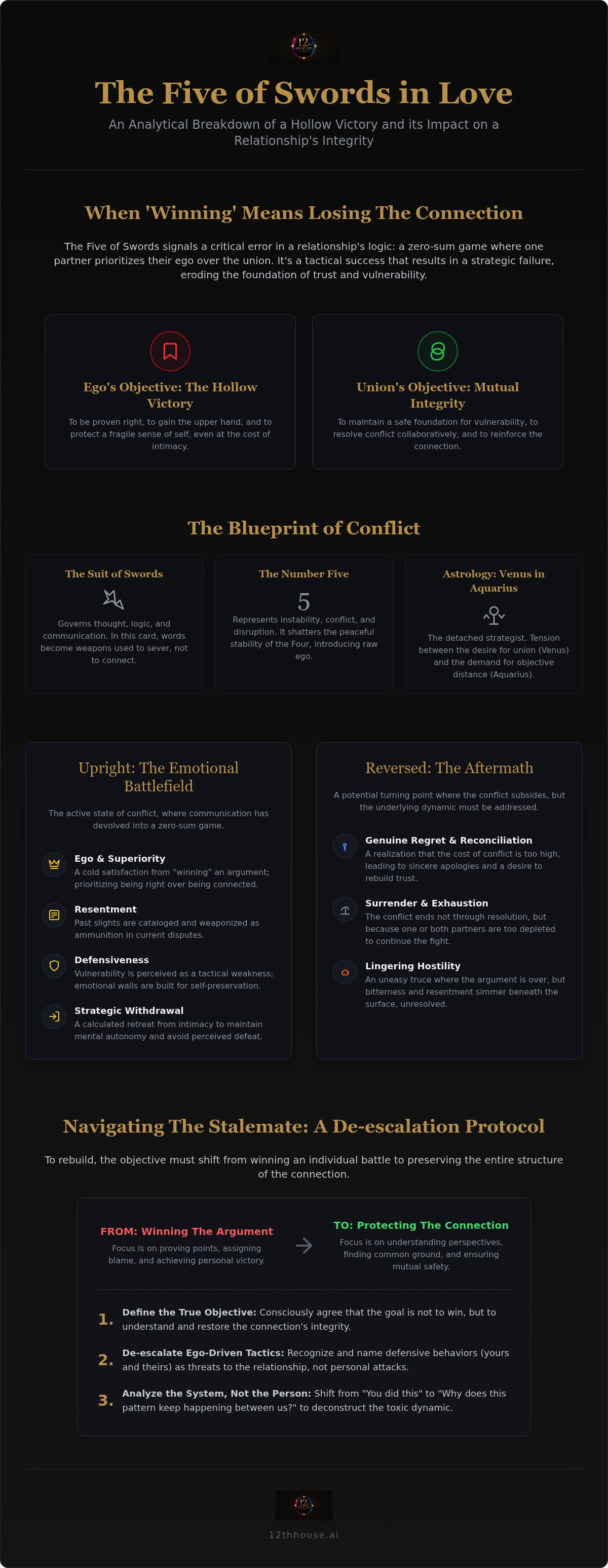
The Five of Swords represents the zenith of mental conflict within the suit of air. In the progression of the Minor Arcana, the five is where the stability of the four is shattered by the introduction of raw, unbridled ego. When analyzing the five of swords as feelings in a love reading, we're looking at a partner who has prioritized self-preservation over relational harmony. It's a moment of tactical success but strategic failure. The win is secured, but the cost is the connection itself.
This dynamic is defined as the "Hollow Victory." In the architecture of intimacy, every interaction either reinforces the foundation or chips away at it. The Five of Swords occurs when one person decides that being right is more important than being together. They've gained the upper hand in a dispute, but they've destroyed the safety required for vulnerability. It's a systemic decision to raze the emotional landscape to protect individual mental territory. This is the primary reason the card feels so chilling; it signals that the partner has stopped building and started defending.
We view these dynamics through the lens of Metaphysical Architecture. Thoughts are the blueprints of a relationship. If the blueprint is "I must win," the resulting structure will be a fortress, not a home. When the five of swords as feelings in a love reading appears, the partner's emotional state has become a closed system. They're no longer calculating how to love you; they're calculating how to avoid losing to you.
The Suit of Swords and Emotional Logic
Swords govern the realm of thought, logic, and the spoken word. In a romantic context, air energy often manifests as a sharp, clinical detachment. Unlike the emotional fluidity of Cups, Swords are precise. They provide the frameworks we use to understand our partners, but when misaligned, they become weapons. This card marks a sharp contrast to the peaceful sanctuary of the Four of Swords or the restorative journey found in the Six. It is the peak of the suit's destructive potential, where communication is used to sever rather than to sew.
Venus in Aquarius: The Detached Strategist
This card is astrologically mapped to Venus in Aquarius. This combination creates a unique tension between the heart's desire for union and the mind's demand for objective distance. In a love reading, this often manifests as a partner who views the relationship through a clinical lens. They may value being correct or maintaining their independence more than they value closeness. It's the archetype of the detached strategist. They calculate their emotional moves to ensure they aren't defeated by the inherent messiness of love, often leaving their partner feeling isolated in the process.
Upright Meanings: Resentment, Ego, and Strategic Withdrawal
When the Five of Swords appears upright, the emotional climate is one of sharp division. One partner often feels a sense of intellectual superiority; a smugness derived from "winning" an argument or proving a point. This isn't the warmth of a shared victory but the cold satisfaction of outmaneuvering an opponent. If you're exploring the five of swords as feelings in a love reading, you're likely encountering a partner who calculates their words for maximum impact rather than mutual understanding.
This card highlights the dynamics of interpersonal conflict where the objective shifts from resolution to total dominance. Resentment acts as the mortar between these bricks of conflict. It's the "long memory" of previous mental battles, where every past slight is cataloged and used as ammunition in the current exchange. The ego becomes a fortress. Defensiveness serves as the primary protective mechanism for a fragile sense of self that cannot handle the perceived "defeat" of a compromise.
The Partner's Perspective: Guarded and Defensive
From their vantage point, the partner views vulnerability as a tactical weakness. They don't see an invitation to connect; they see a potential opening for an attack. Consequently, they prioritize logic-based arguments and clinical detachment. They feel they must protect their mental autonomy from your influence, even if that protection requires a complete strategic withdrawal from emotional intimacy. This guarding behavior stems from a fear that being "soft" will lead to being controlled. If you find yourself stuck in this cycle, analyzing your partner's specific astrological birth chart can help decode the underlying triggers for this hyper-defensive behavior.
The Reader's Perspective: Feeling Defeated
If you identify with the figures walking away in the background of the card, your primary feeling is one of defeat. You've likely stopped fighting because the cost of the argument has become too high to justify. There is a profound sense that your partner is prioritizing being right over being together. You feel misunderstood, dismissed, and fundamentally alone even when they're in the room. When interpreting the five of swords as feelings in a love reading, this sense of defeat often marks the beginning of a silent period. It's a state of emotional exhaustion resulting from intellectual warfare. You aren't just tired of the argument; you're tired of the architecture of the relationship itself.
The Reversed Perspective: Regret, Surrender, or Lingering Hostility
The reversal of this card marks a significant shift in the energetic blueprint of the relationship. While the upright position represents active intellectual warfare, the reversed five of swords as feelings in a love reading indicates the transition into the aftermath. The adrenaline of the ego-driven "win" has dissipated. What remains is either a genuine desire for reconstruction or a descent into a more insidious, subterranean form of hostility. The swords are no longer being swung, but they haven't necessarily been put away. They're often being held behind the back.
Shame and regret are the primary emotional drivers in this state. A partner may realize that the tactical strikes they delivered during the conflict have caused structural damage. They feel the weight of words that cannot be unsaid. This internal processing can lead to a period of heavy silence, where the individual calculates the cost of their behavior. It's a moment of profound realization: they've secured the territory, but they've lost the person they intended to share it with. The "victory" now feels like a prison of their own making.
The Path to Reconciliation
When the reversal leans toward healing, it signals a willingness to lay down the weapons. This is the "surrender" phase of the metaphysical architecture. The partner begins to recognize that the relationship's integrity is more valuable than their own mental dominance. You might notice signs of them moving past the "winning" mindset, such as a softening of their clinical tone or a tentative attempt at vulnerability. To facilitate this, move toward a mutual surrender. Frame the peace treaty not as one person being wrong, but as both people choosing the union over the ego. It's a strategic pivot from individual survival to collective stability.
The Danger of the Lingering Wound
However, the reversal can also warn of a passive-aggressive stalemate. Instead of a peace treaty, the relationship enters a cold war. The conflict hasn't been resolved; it has simply gone underground. In this scenario, the five of swords as feelings in a love reading suggests a partner who is holding onto a "long memory" of defeat. They feel stuck in the debris of the previous argument, internalizing the resentment rather than processing it. This creates a toxic atmosphere where every future interaction is filtered through the lens of past betrayal. Without a structured intervention or a deep dive into the Metaphysical Library to understand these archetypes, the relationship risks becoming a hollow shell of its former potential.
Navigating the Five of Swords: Deconstructing Toxic Dynamics
Repairing a relationship after the Five of Swords appears requires a systematic deconstruction of your current emotional architecture. When you encounter the five of swords as feelings in a love reading, you aren't just dealing with a simple argument. You're facing a structural failure where the intellect has been weaponized. To move forward, you must intentionally de-escalate the intellect to reach the heart. This involves moving away from the "Sword" energy of cutting and toward the "Cup" energy of containing and healing.
The primary question many face when this card surfaces is whether the connection is worth saving. This requires a clinical cost-benefit analysis. Is the current "victory" your partner seeks worth the irreparable damage to your foundation? If the pattern of conflict serves only to preserve a partner's ego while depleting your emotional reserves, the architecture may be too compromised to support a healthy union. However, if both parties can acknowledge the hollow nature of these wins, reconstruction is possible through a radical shift in communication logic.
Identifying Power Struggles
Spotting "I win, you lose" patterns is essential for stopping the cycle of depletion. You may notice that daily communication has become a series of tactical maneuvers where one person's gain is always at the other's expense. To shift from "me vs. you" to "us vs. the problem," you must analyze the underlying blueprints of your connection. Understanding your long-term synastry through Birth Chart Compatibility: Decoding the Architecture of Human Connection can reveal if these power struggles are temporary transits or deep-seated behavioral frameworks. Once identified, these patterns can be neutralized through conscious observation rather than reactive defense.
Setting Intellectual Boundaries
There is immense power in non-engagement. When a partner initiates a circular argument designed only to secure a mental win, walking away isn't an act of defeat; it's an act of structural preservation. A healthy boundary is the structural support that prevents emotional collapse during conflict. By refusing to participate in intellectual warfare, you force the energy to shift. This isn't about using silence as a weapon, but about creating a sanctuary where the ego's swords have nothing to strike. If you're unsure how to set these boundaries without triggering further hostility, you can Ask Lala AI to decode the specific energetic triggers currently at play in your relationship.
Beyond the Stalemate: Architecting Clarity with 12th House
Transitioning out of a stalemate requires more than just a temporary truce. It demands a structured environment where you can analyze the emotional data of your relationship without the noise of the ego. 12th House serves as a metaphysical laboratory, offering a sanctuary for analytical self-discovery. Here, the focus shifts from the heat of the argument to the cold, clear logic of your energetic blueprints. By utilizing our specialized tools, you can determine if the conflict is a structural flaw or a temporary transit that can be navigated with precision.
Conflict is rarely an isolated event. It's often the result of misaligned communication frameworks or unresolved transits that trigger the ego's defensive protocols. When you analyze the five of swords as feelings in a love reading, you're looking at a specific data point within a much larger system. Our platform provides the technical and systematic tools needed to decode that system, moving you from a passive recipient of conflict to an active architect of your romantic destiny.
Ask Lala: De-coding Your Reading
Lala AI acts as your Digital Sage, providing the precision needed to translate complex symbols into actionable insights. When you encounter the five of swords as feelings in a love reading, you can ask Lala to cross-reference this card with your current astrological birth chart or relationship synastry. This bridges the gap between ancient tradition and your current life, offering a clinical clarity that standard interpretations lack. For those looking to refine their approach to digital divination, our guide on AI Love Readings: A Professional Guide to Seeking Clarity provides the framework for asking higher-order questions that yield deeper results.
Mapping Your Emotional Transits
Conflict often arises from a fundamental mismatch in how two people process information and energy. By generating a personalized human design report, you can see if your communication styles are naturally clashing or if you're simply navigating a "Sword" phase in your relationship cycle. Our Metaphysical Library allows you to research the archetypes of conflict, transforming your experience from personal suffering into a scholarly study of the self.
Tracking these emotional transits empowers you to anticipate defensive shifts before they result in a hollow victory. Use Tarot Mastery to build your own metaphysical intelligence, learning to identify when a partner is retreating into a defensive posture. This mastery allows you to move from the chaos of a stalemate to the clarity of a well-architected connection. Empower yourself to do the work, moving beyond the ego's need to win and toward the soul's need to understand.
Mastering the Blueprint of Intimate Resolution
The Five of Swords is not a final verdict but a diagnostic signal. It reveals where the architecture of your connection has been compromised by the ego's demand for dominance. By interpreting the five of swords as feelings in a love reading, you gain the clinical clarity needed to identify if a conflict is a temporary transit or a systemic failure. You now have the framework to de-escalate intellectual warfare and prioritize the structural integrity of your union over a hollow victory. Understanding these mechanics is the first step in rebuilding a sanctuary of mutual respect.
True mastery requires the right instruments. You can architect your spiritual clarity with a 12th House membership to move beyond the stalemate. Gain 24/7 access to the Lala AI Spiritual Guide, personalized Human Design and Astrology data rooms, and a modern library of metaphysical intelligence. These tools provide the systematic precision necessary to decode your relationship's unique energetic blueprint. Transition from the chaos of conflict to the precision of clarity. Your journey toward a more resilient, well-architected love begins with a single, informed choice.
Frequently Asked Questions
Is the Five of Swords always a bad sign in a love reading?
No, it acts as a diagnostic signal rather than a definitive omen. It marks a peak of mental friction where ego-preservation is currently sabotaging the connection. Identifying this energy early allows for structural repair before the hollow victory becomes permanent. It's an invitation to de-escalate rather than a guaranteed end. View it as a prompt for radical honesty within your relationship's architecture.
Does the Five of Swords as feelings mean my partner is a narcissist?
Not necessarily. While the card depicts ego-driven behavior and winning at all costs, these are often situational defense mechanisms rather than permanent personality traits. Labeling a partner based on one card lacks analytical depth. It suggests a period where one person is prioritizing their mental autonomy over the union's health. Use a Human Design Profile to see if their communication style is naturally more detached or defensive.
What should I do if I keep pulling the Five of Swords for my relationship?
Persistent appearances suggest a systemic failure in your communication architecture. You're likely stuck in a loop of "I win, you lose" dynamics that haven't been resolved. This indicates that the core conflict is being suppressed rather than deconstructed. It's time to stop the intellectual warfare and use a Metaphysical Library to study the underlying archetypes of your recurring arguments and power struggles.
Can the Five of Swords indicate cheating or betrayal?
It can indicate a breach of trust, but it specifically emphasizes the hostility or coldness following a betrayal. Unlike the Three of Swords which focuses on heartbreak, the Five of Swords highlights the power struggle. It's about the smugness of getting away with something or the defeat of the person left behind. It signals a significant loss of relational integrity and a breakdown of mutual respect.
How can I tell if the Five of Swords means they are moving on or just angry?
Context is essential. When interpreting the five of swords as feelings in a love reading, an upright position often signifies active resentment and a desire to win the argument. If reversed, it may indicate a retreat or the realization that the fight isn't worth the cost. This can lead to moving on if the structural damage is deemed too severe. Analyzing surrounding cards provides the necessary directional data.
What is the difference between the Five of Swords and the Seven of Swords in feelings?
The Five of Swords is about overt conflict and the desire to dominate an opponent. It's a loud, jagged energy. The Seven of Swords is quieter and more strategic; it represents evasion, secrets, or sneaking away with a mental prize. One is a battlefield victory while the other is a tactical theft. Both indicate a lack of transparency and a failure in the relationship's mental framework.
How does the Five of Swords relate to my birth chart compatibility?
This card often mirrors placements like Venus in Aquarius or heavy Saturn aspects that create emotional distance. If your birth chart compatibility shows a clash between Mercury signs, the Five of Swords represents the peak of that intellectual friction. Mapping these transits helps you understand if the current hostility is a temporary planetary influence or a permanent structural mismatch in your communication styles.
Can an AI love reading really explain the Five of Swords better than a human?
AI provides a level of clinical objectivity that live human consultations often lack. Lala AI can process vast amounts of metaphysical data 24/7, cross-referencing your tarot spread with your Human Design and Astrology data. This creates a metaphysical laboratory where you can analyze the five of swords as feelings in a love reading without the influence of an external reader's personal biases or emotional projections.


