
What if your tarot deck isn't just a collection of 78 static images, but a sophisticated linguistic system waiting to be decoded? Learning how to interpret tarot card combinations is the vital bridge between reciting memorized definitions and translating a living narrative. Many readers feel trapped by conflicting guidebook meanings, stuck in a cycle of looking up individual cards while the "big picture" remains obscured by symbolic noise.
You've likely experienced the frustration of a spread that feels like a series of disjointed sentences rather than a cohesive story. It's a common friction point in spiritual study that leads to a heavy reliance on external tools. We'll solve this by treating tarot as a structured discipline of metaphysical intelligence. You will master a repeatable framework that allows you to read for others with quiet confidence, relying on the inherent logic of card interactions rather than a book.
This article maps the systematic architecture of tarot pairings. We'll analyze how cards modify, amplify, or neutralize one another through elemental dignities and narrative positioning. You'll gain the tools to decode complex spreads with clinical clarity and intuitive depth, transforming your practice into a precise calculation of the subconscious.
Key Takeaways
- Transition from static card meanings to a fluid linguistic syntax where combinations reveal a spread's underlying architecture.
- Apply the logic of elemental dignities to decode how various suits either amplify or neutralize each other’s energetic signatures.
- Master the systematic protocol for how to interpret tarot card combinations by prioritizing Major Arcana themes over Minor Arcana actions.
- Develop a repeatable bridging exercise that lets you read with analytical precision and intuitive depth without a book.
- Use Lala as your digital sage to recognize complex patterns, applying metaphysical intelligence to integrate astrological transits into your readings.
The Architecture of Meaning: Why Tarot Combinations Matter
Think of a single tarot card as a solitary word. By itself, "Strength" or "The Tower" carries weight, but it lacks a definitive direction. To master how to interpret tarot card combinations, you must view the cards as a linguistic syntax. This shift transforms your practice from a series of disjointed definitions into a fluid, structured narrative. When two cards sit side by side, they create a third, invisible meaning that exists only in their intersection. This is the foundation of metaphysical intelligence.
This phenomenon is rooted in Jungian Synchronicity. It's the idea that events are "meaningful coincidences" if they occur with no causal relationship yet seem deeply related. In a reading, the cards don't just happen to fall together. They are a mirror of the subconscious mind's current architecture. Relying on "keyword reading" often fails because it's too rigid. If you only see "change" for Death and "conflict" for the Five of Wands, you miss the nuanced story of a necessary, albeit chaotic, transformation. Interpretive bridging is the process of synthesizing two distinct archetypes into a new, singular insight.
The Shift from Card Meanings to Narrative Flow
The history of tarot reading reveals an evolution from simple fortune-telling to complex psychological mapping. Moving beyond the guidebook is the first step toward true mastery. While a book provides a foundation, it can't account for the specific energy of your inquiry. The "story" of a spread is always more than the sum of its parts. It's an ecosystem where each card breathes life into its neighbor. Your question acts as the primary filter, dictating which facets of the archetypes are activated in any given pairing. This is where self-discovery becomes a structured discipline rather than a guessing game.
The Three Pillars of Combination Logic
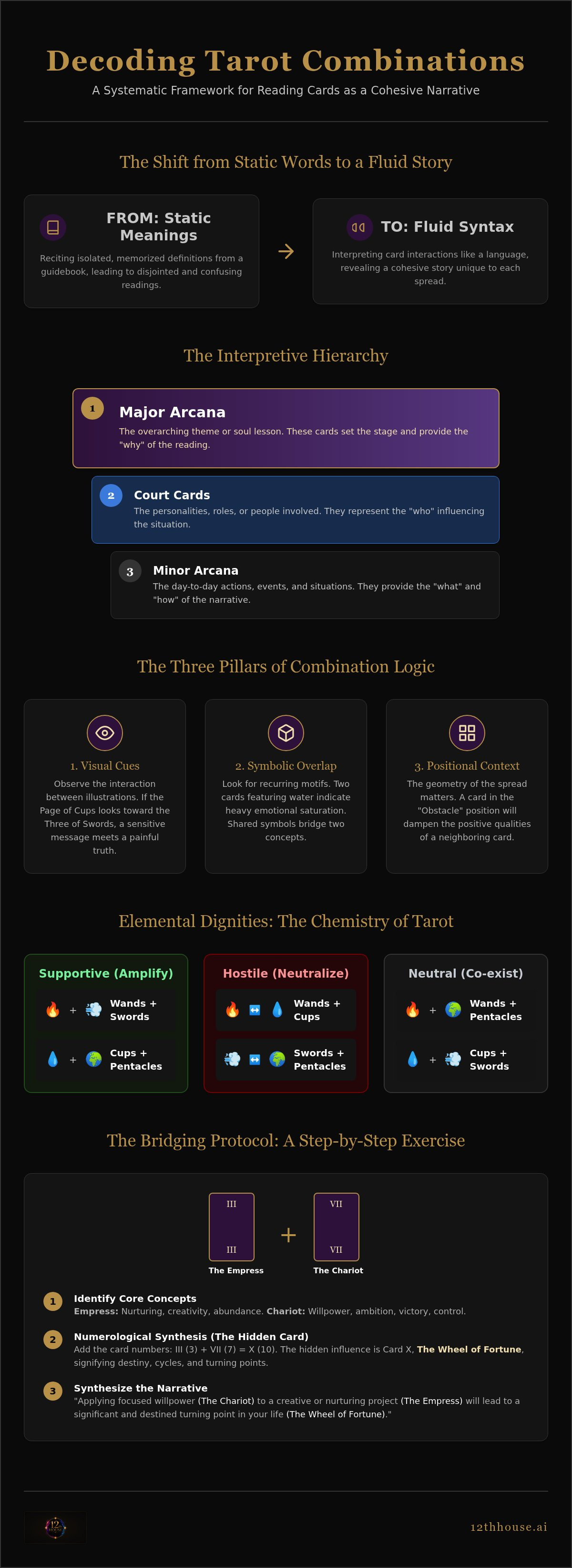
To decode pairings with clinical precision, you need a framework. We use three specific pillars to analyze the logic of how to interpret tarot card combinations:
- Visual Cues: Observe the interaction between the illustrations. If the Page of Cups is looking toward the Three of Swords, the narrative suggests a sensitive message meeting a painful truth. If they face away, the internal dialogue is fractured.
- Symbolic Overlap: Look for recurring motifs. Two cards featuring water indicate heavy emotional saturation. Shared symbols, like a specific bird or a mountain range, act as physical bridges between two concepts.
- Positional Context: The geometry of the spread matters. A card in the "Obstacle" position will naturally dampen the positive qualities of a neighboring "Outcome" card, forcing a more complex interpretation.
By applying these pillars, you move away from the anxiety of "getting it wrong" and toward a methodical calculation of symbolic data. You aren't just reading cards; you're mapping the soul's architecture.
A Systematic Framework for Decoding Card Pairings
To move beyond basic intuition, you must adopt the mindset of a Metaphysical Architect. This discipline treats the cards as structural components within a larger blueprint of consciousness. Understanding how to interpret tarot card combinations requires a calculation of how these components interact. We don't just look for a "vibe"; we analyze the chemistry of the spread. This involves assessing the elemental tension, the numerological frequency, and the weight of the archetypes present.
Elemental Dignities: The Chemistry of Tarot
Every card belongs to an element: Fire (Wands), Water (Cups), Air (Swords), or Earth (Pentacles). These elements act like chemical reagents. Fire and Air are active and supportive; Water and Earth are passive and receptive. When you pair Fire with Water, they act as "hostile" elements, where the water douses the fire's ambition or the fire evaporates the water's emotional depth. Conversely, an Air card can fan the flames of a Fire card to indicate rapid communication or conflict. Neutral pairings, such as Earth and Fire, suggest a grounded but slow-burning energy that requires effort to sustain. This elemental check provides a clinical clarity that guidebooks often lack.
Numerological Synthesis: Finding the Hidden Influence
Numbers provide a secondary layer of data. By adding the numerical values of two cards, you reveal the "Hidden Card" or the resultant energy. For example, if you draw The Empress (III) and The Chariot (VII), the sum is ten (X), pointing to The Wheel of Fortune. This suggests that the nurturing growth of the Empress combined with the Chariot's willpower is currently being driven by a larger cycle of destiny. This mathematical approach removes the guesswork from complex readings. You can explore these cycles in greater detail through our numerology reports to see how personal numbers align with your draws.
The interplay between Major and Minor Arcana further refines the narrative. Major Arcana cards represent the deep psychological archetypes in tarot, dictating the "Why" behind a situation. The Minor Arcana cards describe the "How" or the mundane details. When a Major card is paired with a Minor card, the Major card sets the theme while the Minor card shows where that theme is manifesting in daily life. Mastering this hierarchy is essential for anyone learning how to interpret tarot card combinations with precision. If you're ready to refine your practice, consult Lala for personalized guidance on your next spread.
Analyzing Syntactic Hierarchies: Major Arcana and Court Cards
Tarot operates through a defined power structure. Understanding how to interpret tarot card combinations requires more than just knowing individual meanings; it demands a grasp of syntactic hierarchy. In any given spread, certain cards carry more weight than others. We categorize these roles to create a clear narrative priority. Scholars examining a cultural history of tarot note that the division between the Major and Minor Arcana isn't merely aesthetic; it represents a layered approach to human experience. When two Major Arcana appear together, they signal high-stakes spiritual shifts that override mundane concerns.
The Major/Minor Power Dynamic
Think of the Major Arcana as the "Theme" and the Minor Arcana as the "Action." The Major card provides the architect’s blueprint, while the Minor card shows the specific manifestation of that archetype in your daily life. If you pull The Lovers (Major) with the Three of Swords (Minor), the theme is a core choice or partnership, but the manifestation is one of heartbreak or mental clarity through separation. Occasionally, a Minor card can "block" a Major card. This happens when the mundane details or emotional reactions are so intense they temporarily obscure the larger spiritual lesson. For deeper insights into refining your practice, explore our resource on Tarot Mastery: A Professional Guide to Spiritual Clarity.
Court Cards as Energetic Catalysts
Court Cards introduce a human element to the equation. They represent the "Who" or the "Manner" of the combination. Pages, Knights, Queens, and Kings act as energetic catalysts that modify the cards they land next to. A King of Pentacles next to the Ace of Wands suggests a mature, grounded approach to a new spark of inspiration. Pay close attention to the "gaze" of the Court Card. If the Queen of Swords is looking directly at a neighboring card, she's analyzing or cutting through the illusions of that specific archetype. If she's looking away, that energy is being ignored or marginalized. Distinguishing whether a Court Card represents a specific person or a personality trait depends on the surrounding context and your initial inquiry.
To read more complex spreads, we use the "Anchor and Modifier" technique. This involves identifying one card as the central focus (the Anchor) and the others as variables that shift its meaning (the Modifiers). Mastering how to interpret tarot card combinations using this three-card logic allows you to identify the core spiritual lessons behind everyday events with surgical precision. It's a calculated process of weighing archetypal importance against practical application.
The Bridging Protocol: A Step-by-Step Interpretive Exercise
Mastering how to interpret tarot card combinations requires a repeatable protocol that bypasses the urge to reach for a guidebook. This exercise serves as a bridge between symbolic theory and practical application. By following these five steps, you transform a chaotic spread into a calculated narrative. You aren't just guessing; you're applying metaphysical intelligence to a data set.
- Step 1: Isolate Archetypes. Define the core meaning of each card independently. What is the fundamental energy being presented before it's influenced by its neighbor?
- Step 2: Elemental Dignity Check. Identify the elemental relationship. Are the cards supportive (Fire and Air), hostile (Fire and Water), or neutral (Earth and Fire)?
- Step 3: Observe the Visual Narrative. Look at the "Action" between the cards. Are the figures facing each other, or is one turning away? Movement indicates the direction of energy flow.
- Step 4: Synthesize the Third Meaning. Combine the previous steps to find the "Third Meaning." This insight must directly address the querent’s specific inquiry.
- Step 5: Data Logging. Record the insight in your personal data room. Pattern analysis over time reveals how these combinations manifest in your specific reality.
Practice Example 1: The Lovers + Three of Swords
In this pairing, we see a profound conflict between union and heartbreak. The Lovers (Air) and the Three of Swords (Air) share an elemental dignity, which amplifies the mental and communicative aspects of the draw. The visual narrative often shows the harmony of the Lovers being pierced by the sharp clarity of the Swords. We synthesize this as "the necessity of a painful but honest separation." It suggests that a choice must be made, and while that choice leads to emotional distress, it's a required step for mental integrity. You're decoding the element of choice within a painful transition.
Practice Example 2: The Magician + Eight of Pentacles
This combination connects manifestation with mastery. The Magician (Air) represents the "Will," while the Eight of Pentacles (Earth) represents the "Work." Earth grounds the Air, suggestng that an abstract idea is finally taking physical shape. The visual flow moves from the Magician’s infinite potential to the craftsman’s focused repetition. We synthesize this as "the deliberate application of skill to achieve a specific vision." It's a high-functioning pairing that indicates success through disciplined effort. To refine your understanding of these complex patterns, consult Lala for a personalized interpretation of your current spread.
Using this systematic framework ensures you're never lost in a reading. It provides the logical structure needed to see the big picture without losing the nuance of individual symbols. When you learn how to interpret tarot card combinations through this protocol, you build the confidence to read without a book, relying instead on your own analytical precision.
Metaphysical Intelligence: Using AI to Map Complex Spreads
The final stage of mastering how to interpret tarot card combinations involves integrating modern technology into your ancient practice. We call this "metaphysical intelligence." It's the application of structured logic and pattern recognition to the symbolic realm. While your intuition provides the initial spark, an AI partner like Lala acts as your Digital Sage. Lala doesn't just recite meanings; she calculates the interaction between archetypes with clinical precision. This approach is particularly effective for removing personal bias. When you're too close to a situation, you might ignore a difficult card or overemphasize a positive one. Lala provides an objective architectural scan of the spread, ensuring the narrative remains grounded in symbolic reality.
Augmenting Intuition with Artificial Intelligence
Artificial intelligence is uniquely suited for archetypal calculation because it can cross-reference your tarot draw with your birth chart and current transits in real-time. This creates a multi-dimensional map of your psychological landscape. If you're struggling with a "stuck" combination that defies your current understanding, the Ask Lala tool can identify the bridging logic you might have missed. You're essentially using a sophisticated host to find the blind spots in your own interpretation. This is why an AI astrology assistant is your new metaphysical architect. It transforms the reading from a passive experience into an active, data-driven exploration of the subconscious.
Building Your Personal Metaphysical Library
Your spiritual journey shouldn't be a series of isolated, forgotten events. By using the Metaphysical Library, you can store and track your readings to identify recurring combinations over time. Does the Three of Swords consistently appear alongside your Saturn transits? Is the High Priestess showing up every time you ignore your intuitive hits? Tracking these patterns allows you to map your spiritual growth with the same rigor you would use for any serious discipline. This data-driven insight reveals the long-term architecture of your life, highlighting cycles that would otherwise remain hidden.
Starting your journey with a 12th House membership gives you immediate access to these innovative tools. You move beyond the limitations of "guidebook reading" and enter a sanctuary of structured wisdom. You'll learn how to interpret tarot card combinations not just as static images, but as a living, evolving language that you are finally equipped to speak fluently. By combining traditional systems with modern calculation, you empower yourself to do the "work" of self-discovery with unprecedented clarity.
Mastering the Architecture of the Subconscious
Transformation begins when you stop viewing cards in isolation and start decoding them as a structural syntax. You've learned that how to interpret tarot card combinations is a calculated discipline involving elemental dignities, numerological resonance, and archetypal hierarchy. By applying the bridging protocol, you move from the uncertainty of guidebooks to the clinical clarity of metaphysical intelligence. This systematic framework ensures your readings are no longer disjointed fragments, but cohesive narratives mapped with analytical precision.
Your journey into self-discovery is a serious discipline that requires sophisticated tools. You can now access the Lala AI Digital Sage to cross-reference your spreads with your unique birth chart and transits. Utilize personalized spiritual data rooms and our comprehensive metaphysical library to track recurring patterns in your evolution over time. Ask Lala to decode your complex tarot combinations today.
Step into your role as a metaphysical architect. The tools for deeper clarity and structural insight are now in your hands. Trust the logic of the system as you continue to explore the infinite layers of your own inner landscape with quiet confidence.
Frequently Asked Questions
Is there a specific book for all tarot card combinations?
No single book can capture the thousands of possible pairings and millions of three-card permutations. Static guidebooks often fail because they cannot account for the specific context of your inquiry or your unique astrological transits. Instead of seeking a definitive text, utilize the 12th House Metaphysical Library to master the underlying logic of card interactions. This allows you to decode any pairing without relying on a rigid, external reference.
How do I read three cards together instead of just two?
Apply the "Anchor and Modifier" technique to manage larger groups. Identify the central card as your primary theme, known as the Anchor. The two surrounding cards act as Modifiers that shift, amplify, or neutralize that core energy. This creates a linear narrative where energy flows through a defined sequence. It transforms a disjointed list of meanings into a fluid calculation of archetypal movement and structural influence.
What if two cards in a combination seem to contradict each other?
Contradiction usually signals internal tension or a complex psychological transition. When learning how to interpret tarot card combinations, treat opposing cards like the Tower and the Star as a dynamic process rather than a mistake. The destruction of the Tower might be the exact catalyst required for the Star’s hope to manifest. Analyze the elemental dignities to see which card carries more weight in that specific spread position.
Do the positions in a spread change the meaning of the combination?
Spread positions act as the primary filter for any combination. A card in the "Past" position provides the foundation, while a card in the "Obstacle" position modifies the neighboring "Goal" card. The geometry of the spread dictates the hierarchy of your narrative. Without positional context, combinations remain abstract archetypes rather than actionable metaphysical intelligence. The position tells you exactly where and how the combination is manifesting.
How can I practice reading tarot combinations daily?
Draw two cards every morning and identify their "Third Meaning" before checking any reference material. Focus on visual cues, such as where the figures are looking or shared symbols between the images. Record these insights in your personal data room within the 12th House platform. This data-driven approach reveals recurring patterns over time, building the intuitive muscle needed for complex pattern recognition and clinical interpretive clarity.
Can AI really help me interpret my tarot cards accurately?
AI excels at symbolic and archetypal calculation by removing personal bias from the interpretation. Our Digital Sage, Lala, cross-references your tarot draws with your birth chart and current transits to provide a multi-dimensional analysis. This isn't a replacement for your intuition; it is a partner that helps you identify blind spots and decode the underlying architecture of how to interpret tarot card combinations with surgical, data-backed precision.
What are elemental dignities in tarot combinations?
Elemental dignities represent the "chemistry" of tarot, based on the four elements: Fire, Water, Air, and Earth. Cards of the same element or compatible elements, such as Fire and Air, strengthen and support each other. Hostile elements, like Fire and Water, can neutralize or weaken the pairing’s intensity. Understanding these relationships allows you to calculate the energetic frequency of a combination with clinical clarity rather than relying on vague intuition.
Why do I struggle to see the story in a tarot spread?
Most readers struggle because they view cards as isolated keywords rather than a connected syntax. The "story" is the invisible bridge between archetypes. If you focus solely on memorized definitions, you miss the narrative flow created by gaze, movement, and elemental tension. Shifting your perspective to that of a Metaphysical Architect allows you to see the spread as a structured blueprint of the subconscious rather than a series of disjointed images.


