

Can an AI interpret your birth chart in a way that’s genuinely specific to you? A polished reading can sound personal while overlooking the placements that make your chart distinct. Useful AI astrology birth chart interpretation should show how it connects chart details to its conclusions, rather than asking you to accept confident-sounding claims at face value.
If astrological terms feel difficult to connect, or your birth time is uncertain, it’s reasonable to ask what a reading can actually tell you. Planetary placements provide the framework; interpretation gives those symbols context. When birth time is uncertain, details such as the rising sign and house placements may be less reliable, so a reading should make that limitation clear.
This guide explains how AI uses chart information to generate an interpretation, what to look for when assessing whether a reading reflects your actual placements, and how to use its insights as prompts for reflection rather than fixed predictions. You’ll also see why calculation and interpretation are different steps, and how tools such as Ask Lala can help you explore personalized chart questions while leaving the final judgment in your hands.
Key Takeaways
- Separate chart calculation from interpretation so you can see what the software is doing at each stage.
- Evaluate an AI astrology birth chart interpretation by tracing specific claims back to named placements, aspects, or other chart factors.
- Start with one life theme, then ask a focused question instead of requesting a total life forecast.
- Explore birth-chart and transit themes with 12th House, then use Ask Lala to ask personalized chart questions and consider the responses with your own discernment.
What AI Astrology Birth Chart Interpretation Actually Does
AI astrology birth chart interpretation is software-generated analysis that connects natal-chart data with symbolic meanings from an astrological tradition. It can organize chart factors and describe how astrologers might read them. It doesn’t turn symbolism into a verified account of your personality or a dependable forecast of events.
Keep two operations distinct: calculation and interpretation. Calculation identifies where planets and other chart points were positioned for the birth details entered. Interpretation assigns symbolic themes to those positions and relates them to one another. Accurate calculation can make chart data consistent with the inputs, but it doesn’t prove an interpretation is objectively true. For a concise overview of the tradition behind those symbols, see Astrology.
A chart-specific interpretation connects its statements to identifiable factors in your natal chart; a generic horoscope offers broad sign-based themes without showing that connection. Use this distinction to assess a reading: can you trace a claim to a placement or aspect, or could the same passage fit almost anyone?
What information forms a natal chart?
A natal chart is commonly calculated using a person’s birth date, place, and time. It represents planetary positions associated with those recorded details. Birth time matters for certain features, including the ascendant and house placements, so an uncertain time can make those parts of the chart less dependable.
A placement describes a planet’s position by sign and, depending on the chart system, house. An aspect describes an angular relationship between two chart factors, such as a square or trine. These are components of an astrological map, not conclusions about a person. An AI system may explain what a placement or aspect traditionally symbolizes, then combine those themes into prose.
How is a chart reading different from a horoscope?
A horoscope written for a zodiac sign usually addresses a broad audience. It may offer a theme for people sharing that sign, but it doesn’t necessarily use an individual’s full birth data. A natal-chart interpretation can refer to particular placements and relationships in one person’s chart. The specificity comes from the chart factors named, not simply from a personal tone or the use of your name.
Look for a clear trail between evidence and explanation. If a reading discusses communication, for example, it should identify the chart factor it is interpreting and explain the symbolic association. If it makes a definite claim about your future without showing how it follows from the chart, treat that certainty with care. Personalization can make a reading more relevant to explore; it doesn’t make astrological symbolism a scientifically established prediction.
How AI Turns Birth Data into an Astrological Interpretation
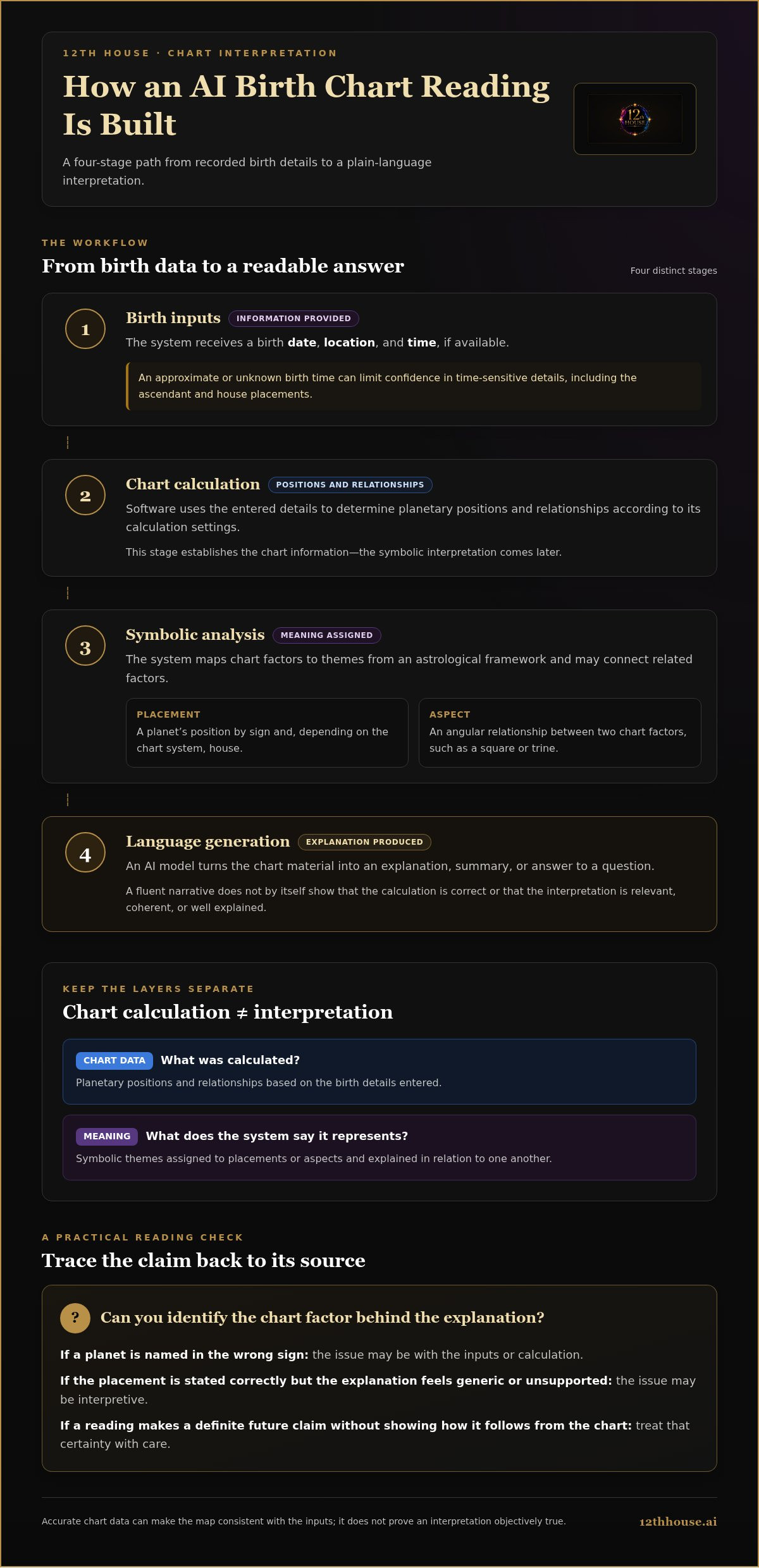
An AI reading is built in stages. First, the system receives birth details. It then calculates chart factors, applies an interpretive framework to those factors, and generates a plain-language response. Each stage has a different job. A correct calculation can provide a consistent map of the entered data, but it can’t guarantee that the symbolic reading is relevant, coherent, or well explained.
Chart calculation establishes the positions; AI interpretation assigns and explains their symbolic meaning. Keeping those layers separate helps you locate an error. If a reading names a planet in the wrong sign, the issue may be in the inputs or calculation. If the placement is stated correctly but the explanation feels generic or unsupported, the issue is interpretive.
A simplified workflow looks like this:
- Birth inputs: The system receives a date, location, and birth time, if available.
- Chart calculation: Software uses those details to determine planetary positions and relationships according to its calculation settings.
- Symbolic analysis: The system maps chart factors to meanings from an astrological framework and may connect related factors.
- Language generation: An AI model turns that material into an explanation, summary, or answer to a question.
The final response may read as one seamless narrative, but fluency isn’t proof that each step was handled well. Language generation can summarize symbolic associations and connect themes. It doesn’t independently validate astrological claims, confirm that the chosen interpretive framework is appropriate, or establish that a reading predicts real events.
Why birth time and location can change chart details
Recorded birth details shape the chart calculation. Time-sensitive features, such as the ascendant and house placements, depend on the time and location used, so an approximate or unknown time can limit confidence in those details. Tools may handle missing times differently; don’t assume there’s one universal fallback. Look for whether the reading identifies which chart factors depend on an uncertain time.
From placements and aspects to a readable answer
Interpretation begins with chart factors, then adds meaning. For example, a reading might identify a planetary placement and associate it with a symbolic theme, or describe an aspect as a tension between two themes. The placement or aspect is the chart information; the theme is the interpretation. A useful response makes that distinction visible instead of presenting an interpretation as a directly measured fact.
When reviewing an AI astrology birth chart interpretation, look for the bridge between those layers: which placement or aspect supports the statement, and how does the system explain the connection? A response that names its chart factors gives you something specific to examine. You can ask a focused follow-up about that connection rather than treating polished language as evidence.
For an interactive way to explore personal chart questions, Ask Lala AI spiritual guidance offers an ongoing space to inquire about chart themes. Treat each answer as material for reflection, not a substitute for your own discernment.
How to Judge Whether an AI Birth Chart Reading Is Specific
A reading can sound precise without being grounded in your chart. Fluent language, confident phrasing, and personal-sounding details don’t prove the system used your actual placements correctly. Test the connection between each concrete statement and the chart factor it claims to interpret.
A reader should be able to identify which chart factor supports a specific interpretation. Use this comparison to assess what the reading gives you:
| Reading pattern | What to look for | How to assess it |
|---|---|---|
| Chart-specific evidence | A named placement, aspect, house, or other chart factor, with an explanation of its relevance. | Check that the factor appears in the chart and that the interpretation is linked to it. |
| Generic language | Broad statements about being sensitive, ambitious, or ready for change, with no chart factor named. | Ask whether the same statement could apply to almost anyone. |
| Unsupported certainty | Guaranteed outcomes or absolute claims about what will happen, without clear chart-based reasoning. | Treat certainty as a warning sign, not proof of accuracy. |
Signs that a reading is grounded in your chart
Look for more than a reference to your Sun sign. A specific reading may identify a placement or aspect, then explain how the chosen astrological framework associates it with a theme. It should distinguish the chart detail from the meaning assigned to it. For example, “Mars is in this sign” is a chart claim; “this may suggest a direct approach to conflict” is an interpretation.
Trace one claim at a time. Locate the named factor in your chart, then check whether the response explains the symbolic link. If the placement is present but you disagree with the meaning, that’s an interpretive difference, not necessarily a chart error. If the reading names a placement that isn’t there, first consider whether the chart inputs or settings differ. The issue may be a calculation mismatch rather than a disagreement about symbolism.
How to recognize uncertainty and overreach
Be cautious of language that turns symbolism into a guarantee: “You will meet your future partner this month” is a much stronger claim than “this factor is sometimes interpreted as emphasizing partnership.” A reading that names a placement absent from your chart also needs scrutiny. Recheck the chart details and the specific factor before deciding what went wrong.
For a broader perspective on AI-guided astrology, explore this guide to the AI astrology assistant. The central test is practical: does the answer show its chart basis, explain its symbolic reasoning, and leave room for your judgment? A useful AI astrology birth chart interpretation makes those steps visible. It doesn’t ask polished prose to stand in for evidence.
A Practical Method for Exploring Your AI Chart Reading
A useful reading begins with a clear process, not a request for a complete account of your life. Choose one theme, such as communication, work habits, or relationships, and use the AI to explore how your chart might frame it. This keeps the inquiry focused and makes it easier to separate chart information from interpretation.
Move through these steps in order:
- Enter your best available birth details. Use the most accurate date, location, and time you have. If the time is uncertain, state that clearly rather than treating an estimate as exact.
- Review the chart factors. Note the placements and aspects the reading uses. Check that its claims refer to factors shown in your chart, and flag time-sensitive details if your birth time is approximate.
- Ask one focused question. Instead of requesting a total life forecast, ask how a particular chart factor is interpreted in relation to one theme. Invite the AI to name the placements or aspects behind its answer.
- Reflect on the response. Record the ideas that feel useful, the ones you want to question, and the chart factors the AI cited. Treat conclusions as prompts for observation, not instructions or fixed outcomes.
This sequence makes an AI astrology birth chart interpretation easier to examine. You can return to a specific claim, ask what supports it, and decide whether the explanation offers a worthwhile perspective. The goal isn’t to make every symbolic statement fit. It’s to use the chart as a structured lens for inquiry while keeping your own experience in view.
Ask focused questions that invite explanation
Shape questions to invite reasoning, not certainty. For example, ask, “Which placements or aspects might relate to how I handle conflict, and how are they interpreted?” rather than “Will my relationship last?” Follow up by asking for a plain-language definition of an unfamiliar term or how another symbolic interpretation might differ. Specific questions make answers easier to assess.
Connect chart symbolism with lived experience
Compare an interpretation with your own observations, but don’t treat resonance as proof. You might note whether a suggested communication pattern matches experiences you’ve noticed, then consider where it doesn’t. Astrology can provide a reflective framework; claims about another person’s intentions or future events need evidence beyond symbolism. For relationship themes, explore birth chart compatibility as another interpretive lens, not a verdict on a relationship.
Want to explore a chart question through personalized AI interaction? Ask Lala about your birth chart, then use the response as a starting point for your own reflection.
Explore Your Birth Chart with 12th House and Lala
Once you know how to assess a chart reading, explore your own chart with a clear question in mind. 12th House offers astrology birth-chart and transit analysis to help you examine personal chart themes. Rather than treating interpretation as a verdict, use it as a framework for noticing patterns, considering symbolic connections, and deciding what feels relevant to your experience.
Ask Lala is an AI spiritual guidance assistant for personalized questions about charts. A question-led approach lets you investigate a theme in stages. Start with a placement you’ve noticed, ask what it can symbolize, then request context about how it relates to another chart factor. You can continue exploring while keeping your own discernment at the centre.
Use Lala to deepen a chart question
Try a simple sequence: identify a placement or aspect, ask Lala for its symbolic context, then reflect on what the interpretation brings up for you. If a term is unfamiliar, ask for a plain-language explanation. If a response feels too broad, ask which chart factors support it. This keeps the exchange focused on inquiry rather than certainty, and leaves you free to decide what meaning to carry forward.
For example, instead of asking for a complete forecast, ask how a particular chart factor is traditionally interpreted in relation to a theme you’re considering. Then separate the stated chart detail from the meaning offered. Note what resonates, what doesn’t, and what you’d like to explore further. AI guidance can support reflection, but it shouldn’t replace your judgment or be treated as a guarantee about what will happen.
Continue your study at your own pace
Membership includes ongoing platform access, unlimited interactions with Lala, personalized data rooms, and access to the metaphysical library. This supports a continuing practice: return to a chart question, build on what you’ve learned, and use the library to broaden your understanding of symbolic frameworks. Explore this AI astrology assistant guide for a wider look at using AI as a tool for guided exploration.
A thoughtful AI astrology birth chart interpretation doesn’t need to decide your path. It can help you frame better questions, examine chart themes, and reflect with more structure. Keep what proves useful to your own inquiry, and leave the rest open. Explore 12th House to continue exploring your birth chart with Lala.
Let Your Next Question Open the Chart
Make your next step small and intentional. Choose one chart theme that’s on your mind, then ask what you’d like to understand about it. A thoughtful AI astrology birth chart interpretation can help you approach that question from a new angle, but you remain the authority on your lived experience. Stay curious, and let insight develop through reflection rather than urgency.
Ask Lala offers AI-driven personalized spiritual guidance for chart questions. With membership access to unlimited Lala interactions and a metaphysical library, you can continue exploring ideas and deepen your study over time. Use that space to follow a question, clarify a symbol, or consider another perspective, without handing over your judgment.
Explore your chart questions with 12th House, and take the next step with an open mind. Your chart can be a map for inquiry, while the meaning you make of it remains yours.
Frequently Asked Questions
Can AI accurately interpret my birth chart?
AI can report chart details accurately when it receives correct birth information and uses a consistent calculation method, but the meaning it assigns to those details is interpretive. Check a reading by comparing its named placements with your chart, then assess whether its explanation follows from the factors it cites. Accurate calculation doesn’t establish that an astrological interpretation is objectively true or predicts your experience.
What information do I need for an AI astrology birth chart interpretation?
You’ll generally need your birth date and birthplace, plus your birth time if you know it. The place helps identify the location used in the chart calculation, while the time can affect certain chart details. Enter information as accurately as you can, and don’t present guesses as facts. If you’re unsure about a detail, make that uncertainty clear when you ask your question.
Can AI astrology interpret a birth chart if I do not know my birth time?
Yes, you may still be able to explore some chart themes, but missing time can limit confidence in time-sensitive features. For example, the ascendant and house placements may be uncertain. Tools may handle an unknown time in different ways, so look for an explanation of what the reading can and can’t assess. Avoid treating time-dependent claims as firm if the birth time is only an estimate.
How can I tell whether an AI birth chart reading is using my actual placements?
Choose one specific statement and look for the chart factor behind it. If the reading says a planet’s placement shapes a theme, compare that placement with the chart you entered. Then ask the tool to identify the factor supporting its explanation. A response that stays at the level of broad personality traits without naming chart details may sound personal, but gives you little to verify.
Why might two AI astrology tools interpret the same birth chart differently?
Tools may use different astrological traditions, interpretive rules, or ways of weighing chart factors. One might emphasize a particular placement, while another gives more attention to an aspect or house. Their wording can also vary because AI generates language in different ways. Compare the chart details each tool uses and the reasoning it gives. A difference in symbolic interpretation isn’t automatically a calculation error.
Is AI birth chart interpretation the same as a horoscope?
No. A horoscope often offers general content for a zodiac sign, while an AI chart interpretation can refer to factors drawn from an individual birth chart. To see whether an answer is individualized, check whether it names details specific to your chart rather than relying only on your Sun sign. Personalization makes a reading more tailored, but it doesn’t make its claims objectively predictive.
Can I ask an AI astrology tool follow-up questions about my chart?
Yes, if the tool supports continued questions. Follow-ups can help you clarify an unfamiliar term, ask why a chart factor matters, or request a different explanation of the same symbolism. Ask one thing at a time. For example, ask what a named aspect refers to before asking how an astrologer might interpret it. Ask Lala provides AI-driven spiritual guidance and answers personalized chart questions.
Should I treat an AI astrology birth chart interpretation as a prediction?
No. Treat it as a symbolic perspective or prompt for reflection, not a guaranteed account of what will happen. If a reading makes a definite claim about a relationship, career, or other decision, consider what evidence you have outside astrology before acting. Note which ideas help you think more clearly, and leave uncertain claims open rather than allowing a confident-sounding answer to decide for you.


